
August 23, 2026
East Africa's Gold Sector Reaches an Inflection Point
Across sub-Saharan Africa, the gap between geological endowment and actual production capacity has long frustrated investors and policymakers alike. Vast mineral belts stretch across the continent's eastern flank, yet the infrastructure, capital structures, and operational frameworks needed to convert resources into ounces have historically lagged behind those of more established mining jurisdictions. That dynamic is beginning to shift, and the KEFI BCM Tulu Kapi mining contract offers one of the clearest illustrations yet of how East Africa is closing that gap.
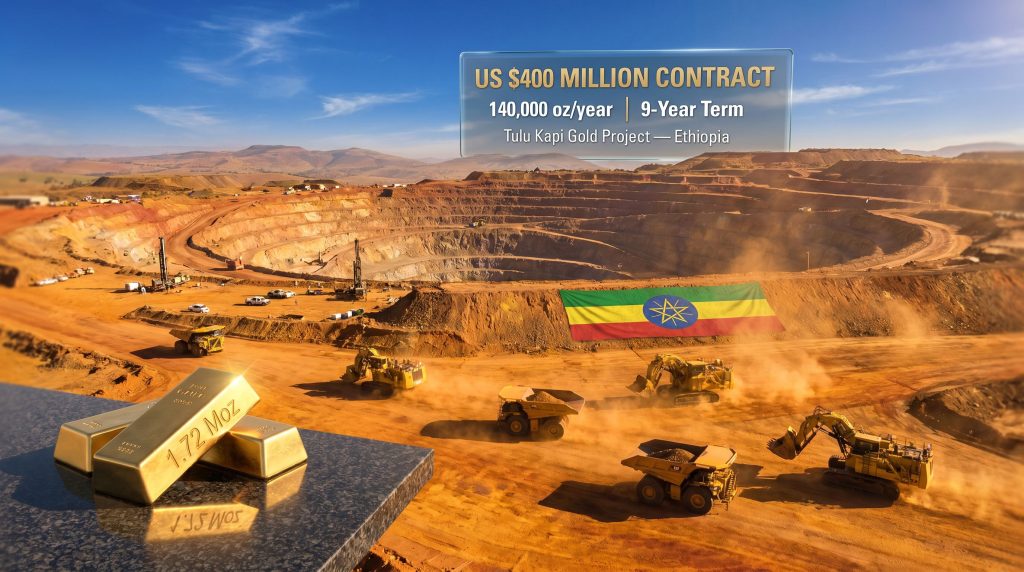
The execution of a US$400 million, nine-year mining services agreement between KEFI Gold and Copper and BCM Group at Ethiopia's Tulu Kapi Gold Project is not merely a bilateral commercial transaction. It represents a structural maturation of how frontier-market gold development is being financed, contracted, and governed in 2026, and it carries implications that extend well beyond the project boundaries. Furthermore, understanding the broader gold M&A activity reshaping the global sector provides useful context for assessing this deal's significance.
When big ASX news breaks, our subscribers know first
From Artisanal Workings to Industrial-Scale Operations: A Multi-Generational Resource Story
The Tulu Kapi deposit sits within Ethiopia's western Oromia region, in a geological corridor that has attracted mineral interest for nearly a century. Italian prospectors conducted small-scale gold extraction at the site during the 1930s, establishing the earliest recorded production history at Tulu Kapi. This historical footprint is more than a footnote; it signals that the orebody's surface expressions were visible and economically attractive even to early-twentieth-century operators using rudimentary methods.
What modern exploration has revealed is a resource of considerably greater scale. The project currently hosts:
- A probable ore reserve of 1.05 million ounces (Moz) of gold
- A total mineral resource inventory of 1.72 Moz of gold
- An estimated open-pit production rate of approximately 140,000 ounces per year
- A 20-year mining licence, providing long-duration operational security
KEFI formalised its partnership with the Ethiopian Government through a mining agreement ratified in April 2015, establishing the joint-development framework that underpins today's commercial activity. The Ethiopian Government participates as an equity partner in the project through its stake in Tulu Kapi Gold Mines Share Company (TKGM), KEFI's Ethiopian subsidiary. This co-ownership model distinguishes the project from a pure concession arrangement and creates a shared interest in successful operational outcomes.
The combination of a defined multi-million-ounce resource base, a sovereign equity partner, and a licensed 20-year operational window positions Tulu Kapi firmly in mid-tier territory rather than the speculative junior category that characterises most frontier-market gold stories.
What the KEFI BCM Mining Contract Actually Covers
Contract Scope, Commercial Scale, and Signing Context
The mining services agreement between KEFI and BCM Group was executed in London during the inaugural Ethio-British Investment Forum, with Ethiopia's Minister of Foreign Affairs, Gedion Timothewos Hessebon, in attendance. The choice of venue and attendees is deliberate and worth examining: signing a commercial mining contract at a diplomatic investment forum signals that both parties understand the reputational and geopolitical dimensions of the deal, not just its operational mechanics.
The contract covers a nine-year operational period, broadly aligned with the project's initial open-pit mine life. Its total value exceeds US$400 million (approximately €349.55 million at the time of signing), making it one of the largest mining services agreements executed in East Africa in recent memory. For additional detail on the syndicate membership announcement, KEFI's official filing provides a comprehensive breakdown of the agreement terms.
BCM's Responsibilities Under the Agreement
| Service Category | BCM Responsibility |
|---|---|
| Mining Fleet Provision | Procurement and deployment of a Caterpillar mining fleet for open-pit operations |
| Workforce Development | Training and ongoing management of locally recruited operators |
| Operational Oversight | Full mining activity management under TKGM supervision |
| Pre-Production Contribution | US$23 million committed toward pre-production project costs |
| Earthworks and Drilling | Already mobilised on-site prior to contract finalisation |
BCM's pre-contract presence at Tulu Kapi is operationally significant. The company had already delivered bulk earthworks and drilling services at the site before the formal agreement was signed, which means procurement pipelines for the Caterpillar fleet were effectively pre-positioned. In frontier-market projects, commissioning delays driven by procurement logistics are among the most common destroyers of value. BCM's on-site mobilisation compresses that risk meaningfully.
Governance Structure: Why TKGM Supervision Matters
All mining activities conducted by BCM will operate under the direct supervision of TKGM. This dual-layer governance architecture serves multiple functions. It ensures Ethiopian regulatory compliance, maintains local institutional accountability, and creates a mechanism for knowledge transfer from the international contractor to the domestic entity. For investors evaluating sovereign risk, the presence of a locally incorporated supervisory entity adds a layer of legal and operational anchoring that pure foreign-contracted operations typically lack.
BCM Group's Operational Pedigree and Why It Matters for Frontier Projects
From Western Australia to Emerging Markets
BCM Group's origins lie in Western Australia, one of the world's most technically demanding open-pit mining environments. The company expanded into West Africa more than three decades ago, accumulating direct operational experience across jurisdictions where infrastructure is constrained, logistics are complex, and workforce development is an operational necessity rather than an optional commitment.
BCM's chief executive noted that the company's experience in establishing mining projects across the Middle East was directly relevant to the Ethiopian context. This parallel is instructive. The Middle East and East Africa share certain operational challenges: extreme climate variability, limited in-country mining services infrastructure, and the need to build local operator capability from a relatively low baseline.
Why the Caterpillar Fleet Specification Is Strategically Important
The specification of a Caterpillar mining fleet for Tulu Kapi is not incidental. Caterpillar maintains one of the most extensive global dealer and parts-support networks in the mining equipment industry. In a landlocked country with limited mining services infrastructure, specifying OEM equipment with robust global support reduces the risk of extended equipment downtime caused by parts unavailability — a factor that has compromised project economics at multiple African mining operations in recent decades.
For a project targeting 140,000 ounces per year, fleet availability is a direct driver of revenue. Every percentage point of additional downtime translates to thousands of lost production ounces at current gold prices above US$2,300 per ounce. Consequently, the gold miners' outlook for high-margin, well-contracted operations like Tulu Kapi remains compelling at these price levels.
The Ethio-British Investment Forum as a Commercial and Diplomatic Catalyst
Reading the Diplomatic Signals in a Commercial Transaction
The decision to execute the KEFI BCM Tulu Kapi mining contract at the first Ethio-British Investment Forum was not logistical convenience. It was a deliberate act of positioning. When the Foreign Affairs Minister of a sovereign nation attends a mining services contract signing, the message to the international investor community is unambiguous: this project carries state-level visibility and the host government is actively engaged in marketing it as a flagship investment vehicle.
KEFI's executive chairman, Harry Anagnostaras-Adams, characterised the forum as a meaningful milestone in Ethiopia's private sector development and international investment credibility. The underlying message aligns with a broader observation about the country's extractive sector: mining has already become Ethiopia's leading export-generating industry, yet the sector's output remains well below what its geological endowment would theoretically support.
Ethiopia's Resource Nationalism Model With Foreign Participation
Ethiopia's approach to Tulu Kapi reflects a governance philosophy that is gaining traction across Africa: resource nationalism structured around equity participation rather than outright exclusion of foreign capital. Rather than rejecting international operators, the Ethiopian model invites them in while retaining a sovereign ownership stake through the joint-venture structure. This approach has precedent in Senegal's oil and gas sector, in Côte d'Ivoire's cocoa-linked mineral revenue frameworks, and in various West African gold jurisdictions where state mining companies hold carried interests.
The distinction matters for investors assessing repatriation risk and long-term project stability. A government that holds equity in a project has an aligned financial incentive to support its operational success, which modestly but meaningfully reduces certain categories of political interference risk compared with pure concession models. In addition, the broader mining industry consolidation trend reinforces why sovereign co-investment structures are becoming increasingly common in frontier jurisdictions.
Benchmarking the Deal: How the Contract Compares to Peer Mining Services Agreements
| Metric | Tulu Kapi / BCM Agreement |
|---|---|
| Contract Value | US$400 million+ |
| Contract Duration | 9 years |
| Fleet Specification | Caterpillar (OEM) |
| Contractor Origin | Western Australia |
| Host Country | Ethiopia (East Africa) |
| Governance Layer | TKGM (KEFI Ethiopian subsidiary) |
| Pre-Production Commitment | US$23 million from BCM |
| Annual Production Target | ~140,000 oz gold (open pit) |
| Mining Licence Duration | 20 years |
| Total Resource | 1.72 Moz gold |
Nine-year mining services contracts exceeding US$400 million are genuinely uncommon in sub-Saharan Africa outside of established Tier 1 jurisdictions such as Ghana, South Africa, and Tanzania. The BCM arrangement's most unusual feature is the contractor's US$23 million pre-production equity contribution. This converts BCM from a fee-for-service provider into a project syndicate participant with skin in the game, aligning its financial interests with production timelines and output targets rather than simply billing hours.
That structural alignment is a material differentiator. Mining services contracts that incentivise contractors based purely on activity metrics rather than project outcomes have a documented history of contributing to cost overruns and commissioning delays in frontier markets. BCM's capital commitment introduces a countervailing incentive.
The next major ASX story will hit our subscribers first
Risk Framework: What Investors Need to Understand Before Drawing Conclusions
Frontier-Market Risk Factors Specific to Ethiopia
Tulu Kapi's investment thesis is compelling, but it operates within a risk environment that demands clear-eyed assessment. Understanding the mining geopolitical risk landscape is, however, essential before drawing firm conclusions about frontier-market gold projects of this nature.
-
Security risk: Ethiopia experienced significant internal conflict in its northern regions between 2020 and 2022. While the Oromia region where Tulu Kapi is located has distinct dynamics, country-level security perceptions affect capital cost and insurance premiums across the board.
-
Infrastructure constraints: Operating an open-pit gold mine at industrial scale requires reliable grid power or on-site generation, water access, and road connectivity capable of supporting heavy equipment logistics. These are capital-intensive requirements in any frontier environment.
-
Workforce localisation curve: BCM's mandate to train and manage locally recruited operators introduces a productivity ramp-up period. Building a skilled equipment operator base from a low industrial mining baseline typically takes 12 to 24 months before optimal bench productivity is achieved.
-
Currency and repatriation dynamics: Gold export revenues priced in USD provide a natural hedge against Ethiopian birr depreciation, but capital control frameworks and repatriation mechanisms require ongoing monitoring.
-
Fleet logistics: Deploying a Caterpillar open-pit mining fleet to a landlocked country involves import documentation, customs clearance timelines, and port-to-site transportation planning. BCM's early mobilisation reduces but does not eliminate this risk.
Risk Mitigation Factors Already Embedded in the Structure
- BCM's pre-contract earthworks presence reduces site preparation timelines.
- TKGM's supervisory governance layer creates domestic accountability.
- BCM's US$23 million capital contribution aligns contractor incentives with project delivery.
- The 20-year mining licence duration extends well beyond the 9-year contract term, preserving optionality for subsequent contract phases.
- The Caterpillar fleet specification reduces equipment downtime risk through global parts networks.
Disclaimer: The above represents a structural risk analysis only and does not constitute financial advice. Investors should conduct independent due diligence. Forward-looking statements regarding production, timelines, and financial outcomes involve assumptions that may not be realised.
Catalytic Effects on Ethiopia's Mining Sector Development
Why This Contract Is More Than a Single Project Transaction
The KEFI BCM Tulu Kapi mining contract's significance extends beyond the project fence line. A successfully executed US$400 million internationally contracted mining agreement in Ethiopia creates a commercial precedent that materially changes the risk narrative for subsequent foreign investors evaluating the country's resource sector. Furthermore, the gold sector challenges facing frontier markets make this kind of structured, well-governed development increasingly important as a benchmark.
Several catalytic effects are worth tracking:
-
Skills pipeline development: BCM's operator training mandate creates a domestic workforce with internationally transferable mining skills, reducing the human capital deficit that constrains sector growth across East Africa.
-
Regulatory pressure for modernisation: Successfully delivering a flagship project of this scale typically accelerates regulatory reform as governments seek to replicate the outcome. Ethiopia's mining code has historically been less developed than those of West African peer jurisdictions; Tulu Kapi's operational success would strengthen the case for streamlining.
-
Foreign exchange contribution: At 140,000 ounces per year and gold prices above US$2,300 per ounce, the project's annual gold sales value would approach or exceed US$320 million, representing a meaningful contribution to Ethiopia's foreign exchange reserves.
-
West-to-East contractor migration: BCM's expansion from West Africa into Ethiopia signals a broader geographic shift in where experienced mining services companies are looking for growth. East Africa's comparatively underdeveloped mining services ecosystem creates significant first-mover advantages for contractors willing to navigate frontier-market complexity.
The Tulu Kapi project and the KEFI BCM mining contract together represent something that frontier-market gold development rarely produces cleanly: a convergence of defined resource economics, sovereign partnership structure, experienced international contracting, and diplomatic visibility. Whether that convergence translates into the project's stated production outcomes will depend on execution discipline over the nine-year contract horizon, but the structural foundations in place are materially stronger than most comparable East African gold developments at equivalent stages.
For further industry coverage of the Tulu Kapi project and the BCM contract announcement, The Assay has published related reporting on the syndicate completion, and Mining Weekly has also covered the project's progress against schedule in detail.
Want to Capitalise on the Next Major Mineral Discovery Before the Broader Market?
Discovery Alert's proprietary Discovery IQ model delivers real-time alerts on significant ASX mineral discoveries, transforming complex geological and market data into actionable investment insights for traders and long-term investors alike. Explore how historic discoveries have generated substantial returns and begin your 14-day free trial today to position yourself ahead of the market.