July 15, 2026
The Hidden Legal Trap Inside Mining's Vendor Loan Playbook
When commodity giants divest non-core assets, the financial engineering behind the transaction rarely attracts scrutiny until something goes wrong. Vendor loan arrangements, in which the seller effectively finances the buyer's acquisition, have become a common feature of resource sector deal-making. They allow sellers to offload assets quickly, extract headline enterprise values that might otherwise be unachievable, and maintain a residual financial relationship with the divested business. However, when borrowers default and creditors attempt to recover assets through related-party structures, the legal architecture of those arrangements can unravel in unexpected ways.
The Amsterdam District Court ruling on July 2, 2026, involving the Glencore Access World buyback rejected by a Dutch court, illustrates precisely what happens when that unravelling occurs in a civil law jurisdiction with rigorous standards around private transfer authorisations. The outcome carries implications that extend well beyond this single transaction, touching on questions of valuation integrity, process transparency, and the mining geopolitical landscape of cross-border asset recovery.
When big ASX news breaks, our subscribers know first
What Is Access World Group and Why Did Glencore Want It Back?
Access World Group operates as a commodities logistics and warehousing business, providing storage and handling services for physical commodity markets. Businesses of this type sit at the intersection of trade finance, physical commodity flows, and infrastructure, making them strategically valuable to large trading houses that benefit from controlling logistics networks adjacent to their core commodity positions.
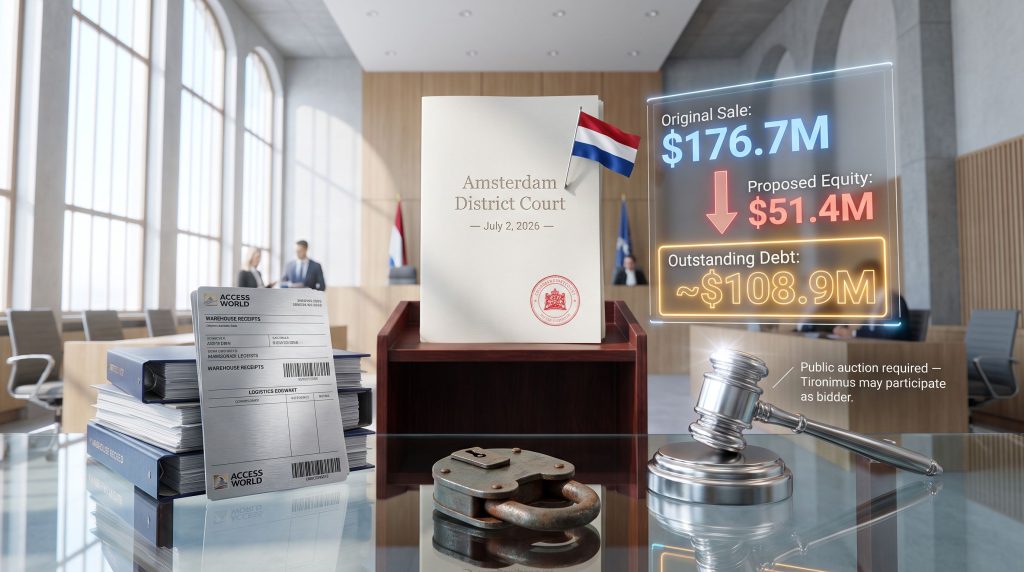
Glencore originally divested Access World in 2022 to Global Capital Merchants Limited, a British Virgin Islands-registered entity, for an enterprise value of $176.7 million. Crucially, Glencore did not simply take cash for the asset. Instead, it provided GCM with a $100 million vendor loan to finance the acquisition, which was later increased to $140 million. This arrangement meant Glencore retained substantial financial exposure to Access World even after the formal divestiture was complete.
The structure created a situation that is common in resource sector divestitures: the seller becomes the primary lender, the buyer controls the asset, and the seller's financial recovery depends entirely on the new owner's ability to generate sufficient cash flow to service the debt. Furthermore, this kind of arrangement is increasingly scrutinised as part of broader mining consolidation and asset sales activity across the sector.
The Default That Set the Dispute in Motion
GCM failed to make a scheduled loan repayment in January 2023. Rather than representing an isolated missed payment, this default marked the beginning of a prolonged period during which the debt compounded with accruing interest. By March 31, 2026, the total outstanding obligation had grown to approximately $108.9 million, of which roughly $20.3 million represented accumulated interest.
Glencore's response was to pursue recovery of the asset through its subsidiary Tironimus, seeking court authorisation under Dutch law for a private share transfer. The proposed transaction was underpinned by a valuation from Glencore's appointed firm, Vantage Valuation, which assessed Access World's equity at $51.4 million.
The financial architecture of the dispute becomes stark when these numbers are placed side by side:
| Financial Metric | Value |
|---|---|
| Original 2022 Enterprise Value | $176.7 million |
| Initial Vendor Loan | $100 million |
| Vendor Loan (Increased) | $140 million |
| Outstanding Balance (March 31, 2026) | ~$108.9 million |
| Accrued Interest Component | ~$20.3 million |
| Proposed Equity Value (Vantage Valuation) | $51.4 million |
The gap between the outstanding debt of $108.9 million and the proposed equity value of $51.4 million is not merely a negotiating difference. It represents a fundamental question about whether the private transfer would have allowed Glencore to reacquire an asset that was originally sold for $176.7 million at a price reflecting less than a third of that figure, without competitive market testing to validate the number.
Three Legal Grounds the Amsterdam Court Used to Reject the Application
The Amsterdam District Court's July 2 ruling was grounded in three distinct concerns, each of which independently created sufficient basis for refusal. As reported by Reuters, the background to this dispute had been building for some time before the court ultimately intervened:
-
Conflict of interest: Routing a distressed asset back to its original owner through a wholly owned subsidiary created structural governance concerns that the court found constituted a genuine risk of a conflict of interest.
-
Failure to justify bypassing public auction: Under Dutch law, private transfer authorisations require the applicant to demonstrate that a competitive bidding process would cause material harm. Glencore did not satisfy this threshold.
-
Valuation credibility: The court questioned whether the $51.4 million equity assessment reflected true market value, particularly given that the asset had previously traded at a substantially higher enterprise value and no competitive process had been conducted to test current market appetite.
Dutch civil law imposes a distinct standard on private transfer authorisations that differs meaningfully from common law jurisdictions. Courts assess not only whether a transaction is legally permissible but whether the process by which it is structured adequately protects the interests of all relevant stakeholders, not just the applicant.
The Problem With the Original 2022 Sale Process
One of the more significant dimensions of the ruling relates not to 2026 events but to what the court found about the 2022 divestiture itself. The Amsterdam court concluded that the original sale process was insufficient to demonstrate that the market would not have paid more for Access World. Specifically, the court noted that the pool of bidders appeared restricted, and that insufficient public disclosure of the process meant no definitive conclusion could be drawn about whether higher offers existed.
This finding has a compounding effect. When Glencore subsequently sought to reacquire the asset at $51.4 million through a private transfer, it was attempting to rely on a valuation in the absence of any genuine price discovery mechanism, whether in 2022 or in 2026. The court's assessment effectively treated both the original sale and the proposed repurchase as processes that lacked competitive integrity.
For mining and commodity companies, this creates an important lesson: the quality of a divestiture process is not simply a compliance exercise at the time of sale. It can become a material factor in legal proceedings years later, particularly when vendor financing is involved. In addition, these concerns align with broader management red flags that experienced investors watch for when evaluating resource sector transactions.
Why Civil Law Jurisdictions Apply Heightened Scrutiny to Creditor-Buyer Transactions
Does Related-Party Involvement Always Trigger Judicial Concern?
A dimension of this case that receives less attention in general financial commentary is the specific legal mechanism Glencore was attempting to use. Under Dutch law, a private transfer authorisation is a court-supervised process that allows secured creditors to transfer pledged assets to a designated party without going through a public auction. The mechanism exists to provide efficiency in straightforward creditor recovery scenarios.
However, courts in civil law systems apply significantly more rigorous scrutiny when the creditor and the proposed buyer are related entities. The concern is structural: when the lender is also the entity attempting to acquire the asset at a self-determined valuation, through a subsidiary it controls, the interests that a competitive auction would normally protect become entirely internalised.
In many jurisdictions, when a creditor seeks to acquire a distressed asset from a defaulting borrower at a self-determined valuation, particularly through a related entity, courts apply heightened scrutiny to ensure the process does not systematically disadvantage other creditors or stakeholders.
The Tironimus subsidiary structure placed Glencore precisely in this position. The court's refusal was not a finding that Glencore acted improperly, but rather that the proposed mechanism did not provide sufficient procedural safeguards to satisfy judicial standards.
The next major ASX story will hit our subscribers first
What the South African Competition Approval Actually Means
Is Regulatory Clearance in One Jurisdiction Sufficient?
A jurisdictional complexity worth examining is the South African Competition Tribunal's involvement. Competition regulatory clearance was obtained in South Africa as part of the transaction process, which might appear to suggest official endorsement of the proposed acquisition structure.
This interpretation would be incorrect. Competition regulatory review addresses whether a proposed transaction creates anti-competitive market conditions, typically focusing on market concentration, pricing power, and barriers to entry. It does not evaluate the fairness of the transaction process, the validity of the valuation methodology, or the presence of conflicts of interest between related parties.
The Amsterdam court's ruling operates on an entirely separate legal plane from competition regulatory approval. Receiving clearance from a competition authority in one jurisdiction provides no immunity from judicial scrutiny of transaction mechanics in another. This distinction matters for mining companies that operate across multiple legal frameworks and may mistakenly assume that regulatory clearance in one domain provides broader transactional protection.
The Path Forward: Public Auction and What It Could Reveal
The court's decision does not prevent Glencore or Tironimus from ultimately acquiring Access World. What it does is change the process through which any acquisition must occur. The ruling directs that a public auction be conducted, with Tironimus permitted to participate as a bidder alongside any third parties that emerge.
This has several practical implications:
-
An independent auction process must be established with transparent pricing parameters and adequate market disclosure.
-
The auction creates genuine price discovery, meaning the eventual sale price will reflect competitive market assessment rather than a single appointed valuer's conclusion.
-
If third-party bidders emerge and bid above $51.4 million, the auction outcome will validate the court's concern that the private transfer undervalued the asset.
-
If Tironimus wins the auction through competitive bidding, the resulting transaction carries substantially stronger legal defensibility than the rejected private transfer would have provided.
-
The outcome will also clarify how much Glencore can ultimately recover relative to the approximately $108.9 million still outstanding on the vendor loan.
What the Glencore Access World Case Reveals About Vendor Loan Risk in Mining Divestitures
The broader significance of this dispute lies in what it exposes about a financing structure that has become increasingly common in resource sector asset recycling. Vendor loan arrangements allow mining companies to transact at attractive headline valuations while retaining financial exposure, but they carry a category of risk that is rarely modelled in standard deal analysis. Consequently, the capital raising methods used to structure these deals deserve far closer scrutiny from investors and boards alike.
Furthermore, the role of the mining private equity role in funding entities like GCM is worth examining, as private capital backing can mask the true financial resilience of an acquiring party until a default event makes the underlying weakness visible.
Key risks embedded in vendor loan structures include:
-
Vendor loans can create perceived conflicts of interest if the lender later seeks to repossess the asset.
-
Valuation transparency requirements vary significantly across jurisdictions, and what is acceptable in one legal system may be insufficient in another.
-
Restricted historical sale processes create compounding vulnerabilities in future asset recovery attempts, as this case directly demonstrates.
-
Courts in civil law jurisdictions apply distinct standards to private transfer authorisations that differ meaningfully from common law assumptions.
-
Regulatory clearance from competition authorities does not substitute for judicial approval of transaction mechanics or process integrity.
Comparative Framework: How Similar Distressed Asset Recovery Cases Resolve
| Scenario Type | Typical Court Outcome | Key Determining Factor |
|---|---|---|
| Creditor-as-buyer with related entity | High scrutiny, often redirected to auction | Conflict of interest risk |
| Private transfer with independent valuation | Moderate approval rate | Valuation credibility |
| Public auction with creditor participation | Generally approved | Transparent price discovery |
| Cross-jurisdictional regulatory clearance only | Insufficient without judicial approval | Process integrity |
The Glencore case falls squarely into the first row of this framework. The combination of a related-entity buyer, a valuation unsupported by competitive testing, and a prior sale process the court found inadequate meant the application faced the most difficult set of conditions for approval under Dutch law. Indeed, coverage from Kitco highlights how the mechanics of this reacquisition attempt were closely watched across global commodity markets.
Frequently Asked Questions: The Glencore Access World Court Ruling
What Did the Dutch Court Rule Regarding Glencore and Access World?
The Amsterdam District Court rejected Glencore's application to transfer Access World shares to its subsidiary Tironimus through a private sale, finding that the process lacked sufficient justification for bypassing a public auction and created a conflict of interest risk. The ruling was issued on July 2, 2026, following a hearing held on May 21.
What Is Access World Group?
Access World Group is a commodities logistics and warehousing business that Glencore divested in 2022 for an enterprise value of $176.7 million to Global Capital Merchants Limited, a British Virgin Islands-based entity.
Why Did Glencore Seek to Reacquire Access World?
Following GCM's default on vendor loan repayments from January 2023 onward, the outstanding debt grew to approximately $108.9 million by March 2026. Glencore pursued recovery through its subsidiary Tironimus using a Dutch law private transfer authorisation mechanism.
Why Was the Proposed Valuation Contested?
Vantage Valuation assessed Access World's equity at $51.4 million. The court found this figure lacked credibility in the absence of competitive market testing, particularly given the asset had previously changed hands at an enterprise value of $176.7 million.
What Must Happen Before Any Sale Can Proceed?
The court has directed that a public auction be conducted, in which Tironimus may participate alongside other potential buyers, ensuring transparent price discovery before any transfer is authorised.
Key Takeaways for Mining Sector Participants
-
The Glencore Access World buyback rejected by a Dutch court highlights that vendor loan structures in mining divestitures carry long-tail legal risk that can resurface years after the original transaction closes.
-
Dutch courts apply rigorous standards to private transfer authorisations, particularly where creditor-buyer relationships create structural conflicts of interest.
-
Restricted historical sale processes create vulnerabilities not only at the time of the original transaction but in any future asset recovery proceedings.
-
Regulatory clearance from competition authorities operates in a separate legal domain and does not substitute for judicial approval of transaction mechanics.
-
Public auction requirements, while commercially inconvenient for the creditor seeking recovery, produce the most legally defensible outcomes and may ultimately reveal materially different market valuations than internally commissioned assessments suggest.
Readers seeking broader context on mining sector regulatory and legal developments may find additional reporting at Mining.com, where related coverage on global mining governance and corporate transactions is regularly published. This article contains analysis of publicly available court outcomes and financial data. It does not constitute legal or investment advice. Financial figures are sourced from court documents as reported by Reuters (July 14, 2026) and should be treated as contemporaneous data rather than current market information.
Want to Identify the Next Major ASX Mineral Discovery Before the Market Does?
Discovery Alert's proprietary Discovery IQ model delivers real-time alerts on significant ASX mineral discoveries, transforming complex mineral data into clear, actionable insights for both short-term traders and long-term investors — visit the Discovery Alert discoveries page to explore historic examples of exceptional returns, and begin your 14-day free trial today to position yourself ahead of the broader market.