July 14, 2026
Arctic Iron, Fractured Consent: The Case Against Rushing the Baffinland Steensby Expansion
Few industrial decisions carry consequences measured in decades quite like Arctic infrastructure. When a mine road becomes a railway, and a seasonal port becomes a year-round shipping corridor, the transformation is not reversible on any human planning horizon. That permanence is precisely what makes the Baffinland Steensby expansion in Nunavut one of the most consequential industrial decisions facing Canada's North in a generation, and why the speed at which it is being revived deserves careful scrutiny.
The Mary River iron ore mine on Baffin Island has operated under the shadow of an expansion debate for nearly a decade. Now, with a southern rail route to Steensby Inlet back on the table, the project's advocates and opponents are shaping up for a confrontation that will test Canada's commitments to Indigenous rights, ecological integrity, and responsible resource development simultaneously.
When big ASX news breaks, our subscribers know first
A Mine, Two Routes, and a Decade of Strategic Misdirection
The Mary River mine has been producing iron ore since it received its original approvals, but the question of how to dramatically scale that production has defined the company's trajectory for years. Baffinland Iron Mines Corporation initially pursued a northern expansion through Milne Inlet, proposing to increase output to 12 million tonnes per year. That proposal was reviewed extensively, generated significant Inuit opposition from Mittimatalik (Pond Inlet), and was ultimately rejected by the federal government in 2022.
With the northern route closed, Baffinland has reverted to an older approval — an environmental assessment certificate granted in 2012 for the Steensby Inlet route. That certificate has been dormant for over a decade while the company chased the Milne option. It is now being treated as the legal foundation for a project that would:
- Construct a 149-kilometre railway from the mine south to Steensby Inlet
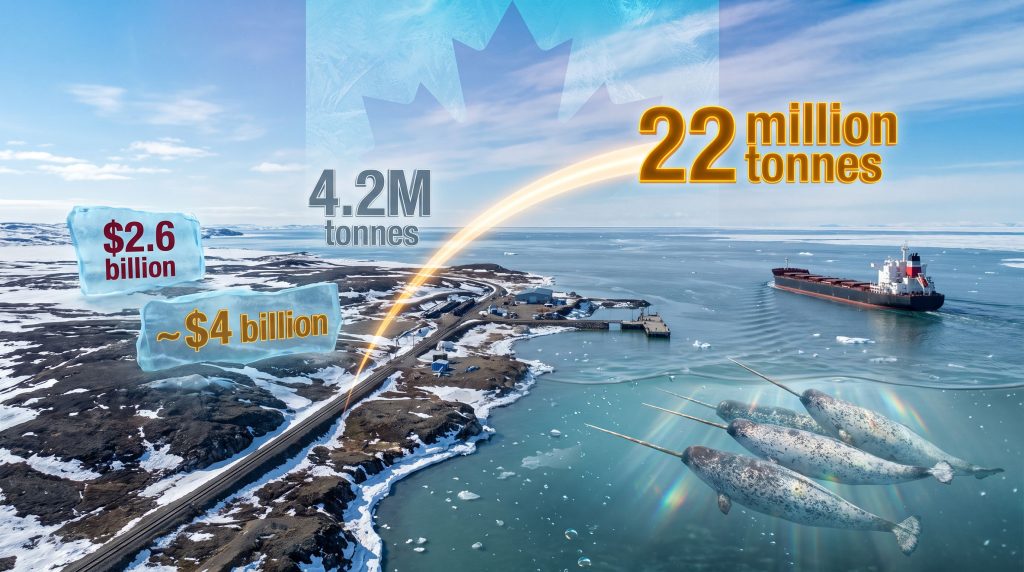
- Increase annual iron ore production from 4.2 million tonnes to 22 million tonnes, approximately a fivefold increase
- Enable year-round shipping through Foxe Basin, with 242 approved vessel transits per year
- Extend the mine's operational life to 2050 and beyond
- Require an estimated $4 billion in construction capital
| Project Component | Detail |
|---|---|
| Railway Length | 149 kilometres |
| Current Annual Production | 4.2 million tonnes |
| Proposed Annual Production | 22 million tonnes |
| Approved Annual Vessel Transits | 242 (Foxe Basin) |
| Estimated Construction Cost | ~$4 billion |
| Projected Construction Start | Later in 2026 |
| Target Completion | ~3 years post-commencement |
| Projected Mine Operating Life | Extended to 2050 and beyond |
The strategic pivot from Milne to Steensby is not simply a logistics decision. It repositions the environmental burden from communities on the eastern side of Baffin Island to communities on the western and southern coasts, particularly Naujaat, Igloolik, and Sanirajak — none of whom were meaningfully integrated into the 2012 approval process. Understanding the broader iron ore industry dynamics helps contextualise why projects of this scale attract such persistent commercial pressure despite significant community opposition.
The 2012 Certificate Problem: Outdated Approval, Modern Consequences
One of the most contested dimensions of the Baffinland Steensby expansion in Nunavut is the legal validity of relying on a 2012 environmental assessment certificate to authorise construction in 2026. The Igloolik Hunters and Trappers Association has raised a pointed legal argument in its May 2025 submission to the Canadian Transportation Agency: federal legislation contains what the association describes as sunset clauses — provisions that require reassessment when a project has not advanced within five years of its approval.
The logic behind such provisions is straightforward. Environmental conditions evolve, scientific understanding deepens, and community circumstances change. An assessment conducted in 2012 cannot account for:
- Fourteen additional years of climate-driven Arctic habitat change
- Accumulated evidence of narwhal stress responses to vessel traffic, including Fisheries and Oceans Canada data collected between 2013 and 2019
- The shift in community demographics and harvesting patterns in affected regions
- Changes in the financial standing of the proponent, including the current creditor protection status that raises questions about long-term commitment to monitoring obligations
The Igloolik Hunters and Trappers Association's position is that these sunset clauses exist precisely because approvals should not function as perpetual licences. The association argues that Baffinland's plans to build the Steensby port and railway should be subject to the same reassessment logic.
Activity-specific permits still outstanding before physical construction can begin include Canadian Transportation Agency approvals for railway construction and Fisheries and Oceans Canada authorisations. These pending approvals represent the remaining regulatory gatekeeping opportunities for concerns to be formally addressed.
Foxe Basin's Ecological Stakes: What 242 Annual Transits Actually Mean
Foxe Basin is not a generic stretch of Arctic water. It is a shallow, ice-influenced ecosystem off the west coast of Baffin Island that functions as critical habitat for an exceptional diversity of marine species. Conservation specialists at WWF-Canada have described Hudson Strait and Foxe Basin together as a marine superhighway for multiple whale species — a corridor connecting Foxe Basin to the Labrador Sea and facilitating the seasonal migrations of narwhals, bowhead whales, and beluga whales. Foxe Basin also supports the largest walrus population in Canada.
The species most directly threatened by the proposed shipping regime is the narwhal. Marine mammal scientists consistently rank narwhals among the most acoustically sensitive cetaceans on the planet. Unlike many whale species that can partially adapt to vessel noise, narwhals exhibit measurable behavioural disruption at relatively low noise thresholds, interrupting their echolocation, altering communication, and abandoning established migration routes.
The empirical record from nearby Eclipse Sound is troubling. A Fisheries and Oceans Canada study found that cortisol stress levels in narwhals near Pond Inlet increased by 200 per cent between 2013 and 2019, a period that coincided with intensifying vessel activity near the Milne Inlet port. Inuit in Mittimatalik have observed the practical consequence: narwhals redirecting their migration patterns, with population returns to familiar feeding areas declining measurably from year to year.
The proposed ore carrier routing follows the narwhal's seasonal migration corridor directly, travelling from Repulse Bay through Foxe Basin to Hudson Strait. This is not incidental overlap — it is a fundamental route conflict between industrial shipping and one of the Arctic's most ecologically sensitive migratory systems.
WWF-Canada's conservation and shipping lead has stated plainly that there is no scenario in which a project of this scale does not produce significant impacts on marine mammals and other species in the region. Beyond narwhals, the concern extends across the food web:
- Bowhead whales, already listed as a species of special concern, use Foxe Basin as key habitat
- Walruses, present in Canada's largest concentration, are sensitive to disturbance during haul-out periods
- Harp seals, ringed seals, shrimp, and cod form interconnected prey networks that vessel noise and black carbon pollution disrupt at multiple levels
- Ship-strike risk increases with year-round navigation through ice-transitional waters
- Black carbon emissions from shipping are particularly problematic in Arctic environments, where particulate deposition on sea ice accelerates melting
The compounding factor here is climate change. Arctic marine species are already navigating habitat disruption from warming temperatures and shifting ice patterns. Furthermore, adding year-round industrial shipping to that stress load creates what ecologists refer to as cumulative impact — where individually manageable pressures combine into system-level risk.
Three Communities, One Structural Grievance
The Baffinland Steensby expansion in Nunavut has generated coordinated opposition from hunter and trapper organisations representing three distinct communities:
- Arviq Hunters and Trappers Organization (Naujaat, Kivalliq region)
- Igloolik Hunters and Trappers Association (Qikiqtaaluk region)
- Sanirajak Hunters and Trappers Association (Qikiqtaaluk region)
On May 15, 2026, representatives from these three organisations held a coordinated news conference in Iqaluit, publicly calling for comprehensive review of the expansion and adequate consultation processes. Their participation in Nunavut Impact Review Board cumulative effects assessment meetings in early June 2026 marked a further escalation, and the review board subsequently announced a virtual information session for July 14, 2026.
The central grievance is structural rather than simply procedural. Naujaat was not included in the original 2012 environmental assessment process. The community was not approached, did not participate in any hearing, and has had no formal avenue to influence an approval that will govern shipping through waters central to its food systems for up to 45 years.
The contrast with Mittimatalik is instructive:
| Assessment Process | Community Involvement | Outcome |
|---|---|---|
| Milne Inlet Phase 2 (rejected 2022) | Mittimatalik consulted, participated in hearings | Community concerns contributed to project rejection |
| Steensby Inlet (approved 2012) | Naujaat not consulted, no hearing participation | Approval granted without community input |
Former Nunavut Premier Paul Okalik, who is also a lead Arctic specialist with WWF-Canada, has described the 2012 Steensby approval as deeply flawed precisely because affected communities were never given the opportunity to participate. He notes that Mittimatalik's ability to participate in the Milne Phase 2 hearings gave community members real influence over the outcome.
No equivalent process was ever offered to Naujaat for the Steensby approval, and the 14 years since have not corrected that omission. Baffinland's response is that consultation has been extensive, pointing to 48 in-person engagement sessions with Igloolik and Sanirajak communities since 2023 covering vessel routing, marine mammal protection, caribou monitoring, Inuit knowledge incorporation, and the design of nine proposed snowmobile and ATV crossings along the railway corridor.
The company also notes that Naujaat did not elect to participate in the 2012 public review process and was therefore not integrated into subsequent engagement planning. However, the Igloolik Hunters and Trappers Association's formal submission to the Canadian Transportation Agency characterises those consultations differently — describing them as piecemeal and noting that serious concerns remain unresolved, which is why the association believes permits for the expansion should not be issued at this time.
Food Security, Constitutional Rights, and the Limits of Regulatory Process
For Inuit in Naujaat, Igloolik, and Sanirajak, the Steensby expansion debate is not primarily an environmental abstraction. Narwhal is a critical food source for these communities. The disruption of narwhal migration through Foxe Basin translates directly into reduced harvesting access, and reduced harvesting access translates into food insecurity for communities with limited alternative protein sources.
The operational lifespan of the proposed Steensby shipping route — estimated at 40 to 45 years — places an entire generation of Inuit subsistence harvesting at risk. The Arviq Hunters and Trappers Organization has been explicit on this point: the opposition is not to the Mary River mine's operation, but to the specific routing of the railway and port, which the organisation argues is incompatible with the protection of Inuit harvesting rights.
Those rights are not simply policy preferences. Under the Nunavut Land Claims Agreement, Inuit communities hold constitutionally protected harvesting entitlements and consultation rights. EcoJustice is supporting the Arviq Hunters and Trappers Organization's legal position, and the possibility of court action has been described as a distinct possibility if the regulatory process does not produce meaningful outcomes.
The legal argument connects to the sunset clause issue: if federal legislation requires reassessment after five years of project inactivity, and if Naujaat was never consulted in the first place, the constitutional foundation for proceeding on the basis of the 2012 certificate is contestable.
The next major ASX story will hit our subscribers first
The Financial Paradox: A $4 Billion Expansion Under Creditor Protection
The project is being pursued by a company in serious financial distress. As of May 2026, Baffinland owes approximately $2.6 billion to creditors and is operating under creditor protection. On June 30, 2026, Export Development Canada provided a $660 million emergency loan, described as providing the company with breathing room to continue operations at Mary River.
| Financial Metric | Figure |
|---|---|
| Total Debt to Creditors | $2.6 billion |
| Emergency Loan (June 30, 2026) | $660 million |
| Estimated Expansion Capital Required | ~$4 billion |
| Current Company Status | Under creditor protection |
Shareholders have confirmed their intention to proceed with the Steensby expansion only if adequate debt and equity financing is secured. That conditionality is significant: it means the expansion's timeline and ultimate viability depend on financing markets accepting a $4 billion commitment from a company already carrying $2.6 billion in existing debt.
Creditor protection introduces further complications beyond financing access. Environmental monitoring obligations, community benefit commitments, and royalty agreements with Inuit organisations all depend on the operator's long-term financial stability. A company navigating potential recapitalisation or sale cannot offer the same certainty on those commitments as a financially sound operator.
The economic arguments for the expansion are substantial on paper. Mary River contributes approximately 25 per cent of Nunavut's territorial GDP and is the largest private-sector employer in the territory. Revenue projections from the Milne Phase 2 proposal included $2.4 billion for Inuit organisations over 17 years, $680 million annually for the Government of Nunavut, and $1.7 billion total for the federal government over the mine's life.
Those figures represent genuine economic stakes for a territory with limited revenue alternatives. Consequently, shifts in the iron ore demand outlook add another layer of uncertainty, given that the project's long-term revenue assumptions rest on sustained global demand. Whether a company under creditor protection can deliver on those commitments — or whether a potential new owner would honour them — remains an open question.
Scenarios: Four Possible Paths Forward
The resolution of this dispute will likely follow one of several trajectories, each with distinct implications for communities, ecosystems, and the broader question of how Canada manages Arctic industrial development. Furthermore, broader pressures on the steel and iron ore market may shape which of these scenarios ultimately becomes viable.
Scenario 1: Construction Proceeds With Negotiated Conditions
Financing is secured, outstanding permits are granted with enhanced conditions, and Baffinland negotiates stronger community benefit agreements with Naujaat, Igloolik, and Sanirajak. Marine mammal monitoring is strengthened and shipping routes are modified to reduce direct overlap with narwhal migration corridors.
Scenario 2: Legal Challenge Triggers Formal Reassessment
The Arviq Hunters and Trappers Organization files for judicial review of the 2012 approval on consultation and sunset clause grounds. Courts order a new environmental assessment, delaying construction by several years and potentially setting a precedent for reassessment requirements on dormant Arctic project approvals.
Scenario 3: Financial Collapse Suspends the Project
Baffinland is unable to secure $4 billion in construction financing under creditor protection conditions. The company is sold or restructured under new ownership, and the Steensby timeline is pushed beyond 2030, creating prolonged uncertainty for Nunavut's employment and GDP base.
Scenario 4: Route Redesign as Negotiated Compromise
Inuit organisations, Baffinland, and federal regulators agree to a modified shipping corridor that reduces direct conflict with narwhal migration paths. A compromise framework emerges that preserves some economic benefits while offering greater ecological protection — potentially becoming a model for future Arctic industrial development consent processes. In addition, iron ore tariff impacts and global iron ore market pressure could, however, affect which scenario emerges as most commercially feasible for Baffinland's creditors.
Frequently Asked Questions About the Baffinland Steensby Expansion
What is the Baffinland Steensby expansion?
It is a proposal to construct a 149-kilometre railway from the Mary River iron ore mine to a new deepwater port at Steensby Inlet on Baffin Island's west coast, enabling a fivefold increase in annual iron ore production and year-round shipping through Foxe Basin.
Why was the 2012 environmental approval not used until now?
Following the 2012 certificate, Baffinland shifted its expansion focus to a northern rail route through Milne Inlet. That proposal was rejected by the federal government in 2022, prompting the company to return to the Steensby route as its primary growth pathway.
What are the primary environmental concerns?
The main concerns centre on the impact of 242 annual vessel transits on narwhals, bowhead whales, walruses, and other species in Foxe Basin. Scientific evidence documents a 200 per cent increase in narwhal cortisol stress levels near Pond Inlet between 2013 and 2019 as vessel traffic increased. Year-round shipping also introduces black carbon emissions and elevated ship-strike risk into a critical Arctic marine corridor.
Why are Inuit communities demanding a new review?
Three hunter and trapper organisations argue that the 2012 assessment is outdated, that Naujaat was never consulted despite being directly affected, and that federal sunset clause provisions require formal reassessment when a project has not advanced within five years of approval. The Nunatsiaq News has reported extensively on these community concerns and the formal opposition process.
Is the expansion financially viable given Baffinland's debt position?
This remains deeply uncertain. With $2.6 billion in existing debt, $660 million in emergency financing, and a $4 billion construction requirement, the project's financial feasibility depends on financing conditions that have not yet been secured.
What legal rights do Inuit communities hold in this dispute?
Under the Nunavut Land Claims Agreement, Inuit communities hold constitutionally protected harvesting rights and consultation entitlements. Legal action in the courts has been described as a distinct possibility if regulatory processes do not produce meaningful protections for affected communities.
This article is intended for informational purposes. Projections, financial figures, and scenario analyses involve uncertainty and should not be treated as investment advice or predictions of regulatory outcomes. Readers seeking further background on the Baffinland Steensby expansion and its implications for Nunavut communities and Arctic ecosystems may find additional context at thenarwhal.ca.
Want to Stay Ahead of Significant Mineral Discoveries on the ASX?
Discovery Alert's proprietary Discovery IQ model delivers real-time alerts the moment significant ASX mineral discoveries are announced, turning complex data across more than 30 commodities into clear, actionable insights for both short-term traders and long-term investors. Explore Discovery Alert's discoveries page to understand how historic mineral discoveries have generated substantial market returns, and begin your 14-day free trial today to position yourself ahead of the broader market.