July 14, 2026
The Hidden Risk in Africa's LNG Model: When the Vessel Leaves, So Does the Revenue
Floating liquefaction technology transformed African gas economics by compressing decade-long infrastructure timelines into deployment windows measured in months. The promise was compelling: monetise offshore gas reserves rapidly, generate state revenue, and supply domestic markets, all without committing to the capital intensity of onshore LNG terminals. What the model also introduced, however, was a structural vulnerability that Cameroon is now experiencing in full. When the commercial rationale for keeping the vessel shifts, the vessel moves. And when it moves, an entire export industry moves with it.
The Hilli Episeyo exit ends LNG production in Cameroon after eight years, and the circumstances surrounding that exit reveal as much about the mechanics of FLNG economics as they do about the specific trajectory of Cameroon's gas sector.
When big ASX news breaks, our subscribers know first
Eight Years of Central Africa's LNG Experiment: What the Numbers Actually Show
How Cameroon Became a Floating LNG Pioneer
When the Hilli Episeyo commenced operations off the coast of Kribi in 2018, Cameroon secured a distinction that no other nation in Central Africa had claimed: the region's first liquefied natural gas exporter. The technology underpinning that achievement was floating LNG, a model that replaces fixed onshore infrastructure with a purpose-built vessel capable of receiving raw gas, liquefying it, and loading it onto LNG carriers directly from an offshore position.
The choice of FLNG over land-based liquefaction was not accidental. Onshore LNG terminals require multi-billion dollar capital commitments, years of construction, and extensive onshore pipeline networks. The FLNG model, by contrast, allowed Cameroon and its partners, specifically Norway-based Golar LNG operating under a charter arrangement with Cameroon FLNG, to accelerate first gas significantly. Feedstock came from the Sanaga South and Ebomé fields, operated by Perenco in partnership with the Société Nationale des Hydrocarbures (SNH), Cameroon's national hydrocarbons corporation.
Operational Metrics: The Gap Between Design and Reality
The Hilli Episeyo's operational record illustrates a pattern common to mature-field FLNG deployments: nameplate capacity rarely reflects sustained throughput.
| Metric | Specification |
|---|---|
| Nameplate LNG Capacity | 2.4 million metric tons per annum (mtpa) |
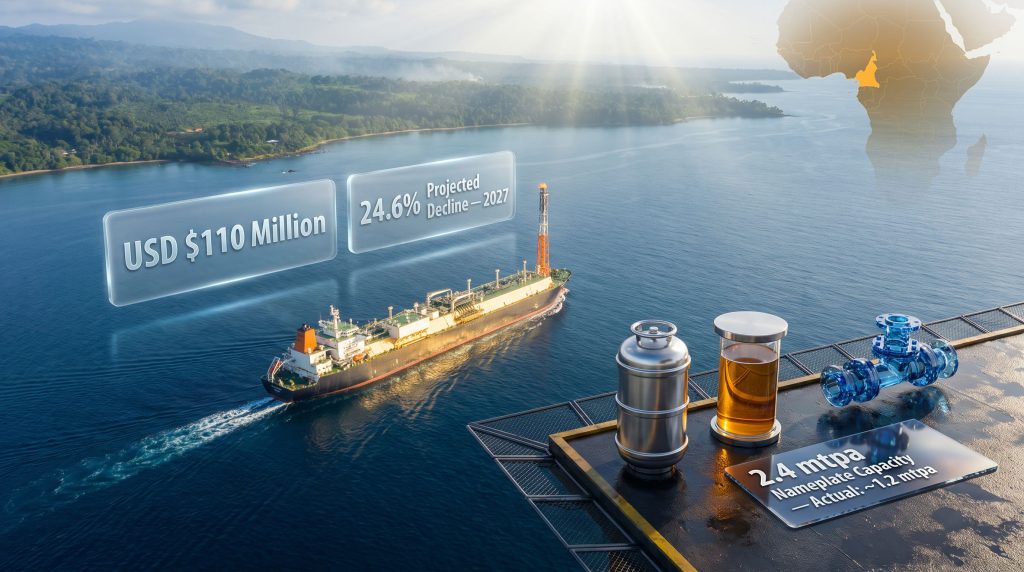
| Actual Operating Rate | ~1.2 mtpa (approximately 50% of nameplate) |
| LPG Supply to Domestic Market | ~30,000-35,000 metric tons per year |
| Condensate Production | ~5,000 barrels per day |
| State Revenue from LNG Sales (2021) | CFA 63.35 billion (~USD $110 million) |
| SNH LPG Revenue (2021) | More than CFA 4.4 billion |
| Primary LNG Off-take Partner | Gazprom (under 8-year supply arrangement) |
| Total Operating Period | 8 years (2018-2026) |
Key Insight: The persistent 50% utilisation rate was not a failure of FLNG technology itself. It reflected the natural production profile of the Sanaga South and Ebomé fields, which had passed their peak output years by the time the vessel was commissioned. This distinction matters enormously for how observers interpret the exit.
The Gazprom off-take arrangement, which underpinned a significant portion of Cameroon's LNG export volumes, was structured as an eight-year supply deal, broadly aligning with the charter duration. This temporal alignment between the supply contract and the charter agreement meant that the commercial architecture of the entire project was always designed around a defined window, not perpetual operation. Furthermore, the broader LNG supply outlook for the region has grown increasingly competitive, making vessel redeployment decisions ever more commercially sensitive.
Why the Vessel Is Moving to Argentina: The Commercial Calculus
Charter Expiry Meets a Better Opportunity
The Hilli Episeyo's departure in July 2026 followed the natural expiration of its charter agreement with Cameroon FLNG. Golar LNG had a commercially straightforward decision to make: renew under constrained feedstock conditions in Cameroon, or redeploy the upgraded vessel to a higher-value assignment.
The Argentine opportunity proved decisive. Operating against the Vaca Muerta formation, one of the world's largest unconventional gas reserves by estimated resource volume, the vessel is projected to generate approximately USD $285 million in annual revenue, with a further USD $30 million upside linked to prevailing LNG spot prices, under a 20-year charter arrangement. Before redeployment, the vessel will undergo upgrades at Seatrium's shipyard in Singapore.
The contrast with Cameroon's operating environment is stark:
- Cameroon: Mature field, approximately 50% utilisation, declining feedstock availability
- Argentina (Vaca Muerta): Large unconventional resource, high-volume long-duration feedstock environment, 20-year contract horizon
- Revenue differential: Argentina offers a structurally superior earnings profile across virtually every commercial metric
Field Maturity as the Root Cause
SNH has characterised the Hilli Episeyo's exit as the commercially natural conclusion of a mature gas field cycle. This framing is important because it separates two distinct narratives that are frequently conflated in coverage of the departure.
Cameroon has not lost its gas reserves. Extraction from the Sanaga and Ebomé fields continues, with pipeline gas supplying the Kribi Power Development Company (KPDC) for domestic power generation. What Cameroon has lost is the only industrial facility capable of converting that gas into exportable LNG. The distinction between losing liquefaction capacity and losing gas production capability carries significant implications for how the country's energy security is assessed.
Separating What Ends from What Continues
| Dimension | Status Post-July 2026 |
|---|---|
| LNG Liquefaction and Export | Ended – no replacement facility announced |
| Domestic Gas Extraction | Continues – Sanaga/Ebomé fields supply KPDC via pipeline |
| LPG Supply to Local Market | Disrupted – 30,000-35,000 mt/year cooking gas supply at risk |
| Condensate Production | Reduced – tied to FLNG operations |
| Export Revenue Stream | Eliminated – CFA 63.35 billion/year benchmark no longer generated |
| Electricity Generation Gas | Unaffected – pipeline supply to power sector intact |
The LPG supply disruption deserves particular attention. Approximately 30,000 to 35,000 metric tons of liquefied petroleum gas reached Cameroonian households annually through the Hilli Episeyo's operations. LPG is the primary cooking fuel for urban households across Cameroon, and supply disruptions have historically translated into price spikes and increased reliance on biomass fuels. The social dimension of this disruption extends well beyond the export revenue discussion.
Quantifying the Economic Damage: Fiscal Exposure and Compounding Risks
The Revenue Gap Is Real and Immediate
The 2021 Cameroon EITI (Extractive Industries Transparency Initiative) Report provides the clearest benchmark for quantifying what has been lost. In that year, the state's share of LNG sales from the Sanaga project reached CFA 63.35 billion, equivalent to approximately USD $110 million. SNH's LPG revenues added more than CFA 4.4 billion on top of that figure.
For a country whose hydrocarbon revenue base is already under pressure from declining mature field output, removing a USD $110 million annual revenue stream is a material fiscal event, not a manageable adjustment. These resource export challenges are not unique to Cameroon, as resource-dependent economies globally are grappling with similar structural revenue vulnerabilities.
The 2027 Production Cliff: A Compounding Vulnerability
The timing of the Hilli Episeyo exit could hardly be less favourable from a fiscal planning perspective. Cameroon's Ministry of Finance 2027-2029 Medium-Term Economic and Budgetary Programming Document projects hydrocarbon output to contract by 24.6% in 2027, driven primarily by declining gas volumes. The LNG export revenue loss compounds this trajectory directly.
The government anticipates production recovery beginning in 2028, contingent on multiple variables aligning:
- Completion of production-sharing contract negotiations for newly awarded blocks
- Successful mobilisation of investment capital from international operators
- Timely resource development and appraisal drilling
- Commencement of commercial production from new fields
Each of these conditions involves its own timeline risk. The overlap between the 2027 production trough and the LNG revenue loss creates a two-year fiscal pressure window that new exploration activity cannot address in time.
Scenario Modelling: Three Fiscal Trajectories
Scenario A: Delayed Recovery (Base Case)
New exploration blocks awarded in 2025 progress through production-sharing negotiations into 2027 and 2028. First commercial gas output begins in late 2028. Revenue recovery is partial and gradual, and the 2027 fiscal gap is not meaningfully offset by any new hydrocarbon income stream.
Scenario B: Accelerated Development (Optimistic Case)
International operators including Chevron and Murphy West Africa fast-track appraisal and development activity across awarded blocks (Bolongo, Etinde Exploration, Tilapia, Elombo, Ntem). A new liquefaction arrangement, potentially a second FLNG charter, is secured before 2029, restoring partial LNG export capacity before 2030. This scenario requires both exploration success and a commercially viable off-take agreement to materialise simultaneously.
Scenario C: Structural Stagnation (Downside Case)
Investment mobilisation stalls due to global LNG market dynamics, operator financing constraints, or negotiation delays on production-sharing contracts. Cameroon exits the LNG export market for a period exceeding five years. Domestic gas supply maintains baseline energy security, but export revenues remain suppressed through the early 2030s. Under this scenario, the country's broader hydrocarbon revenue trajectory does not recover meaningfully until new fields reach sustained commercial output.
Cameroon's Rebuilding Strategy: Exploration Diversification Without a Liquefaction Plan
The 2025 Licensing Round and What It Can Realistically Deliver
SNH's strategic response to the Hilli Episeyo exit centres on portfolio diversification rather than single-asset dependency. In 2025, Cameroon offered nine oil and gas exploration blocks to international investors across the Rio del Rey and Douala/Kribi-Campo basins, two of the country's most geologically prospective sedimentary provinces.
As of mid-2026, five of the nine blocks have been awarded for production-sharing contract negotiations:
| Block | Awarded Operator |
|---|---|
| Bolongo | Octavia Energy Corporation Limited |
| Etinde Exploration | Murphy West Africa |
| Tilapia | Murphy West Africa |
| Elombo | Murphy West Africa |
| Ntem | Murphy West Africa |
The concentration of four blocks within a single operator introduces its own risk dynamic. Murphy West Africa's commitment signals genuine appetite for Cameroonian upstream acreage, but it also means the diversification thesis depends heavily on one company's capital allocation decisions, financing environment, and corporate strategic priorities holding steady over a multi-year development cycle.
The Infrastructure Gap That No Exploration Programme Can Bridge
This is the central strategic blind spot in Cameroon's current positioning: exploration success creates a resource base, but not exportable LNG. Converting discovered gas into saleable product requires liquefaction infrastructure, and as of July 2026, no new FLNG charter, onshore LNG terminal, or alternative liquefaction partnership has been formally announced.
Industry Reality Check: Under optimal conditions, the timeline from exploration block award to first LNG export spans five to ten years. This means even the most successful outcome from the 2025 licensing round cannot restore Cameroon's LNG export capacity before the early 2030s at the absolute earliest. The infrastructure gap is structural, not transitional.
The FLNG model itself offers a potential path forward, as demonstrated by emerging projects in Tanzania, Mozambique, and the Senegal-Mauritania corridor. However, those projects have also illustrated that securing FLNG charter arrangements requires sustained operator commitment, credible off-take agreements, and favourable financing conditions, none of which materialise quickly. Consequently, the commodity price impacts on investor appetite further complicate the timeline for securing replacement liquefaction infrastructure.
The next major ASX story will hit our subscribers first
What Cameroon's Exit Means for the Broader Central African LNG Picture
A Thinner Regional Supply Pool
With the Hilli Episeyo departure, Equatorial Guinea and the Republic of Congo remain as the primary active LNG exporters in Central Africa. Cameroon's exit reduces the region's aggregate LNG supply diversity at a particularly awkward moment.
Global buyers, especially across Europe and Asia, have been actively pursuing African LNG as an alternative feedstock source since 2022, when Russian pipeline gas supply disruptions accelerated the search for diversified LNG origins. Cameroon's absence from the export market removes a supply source that, while modest in global terms, contributed to the optionality that buyers and portfolio managers value in tightening supply environments.
The Redeployment Risk: A Lesson for Future FLNG Deployments
The Hilli Episeyo's departure is a case study that every African nation considering FLNG as a gas monetisation pathway should analyse carefully. The technology is proven. The economics can be compelling in early-phase development. However, the mobile nature of the asset creates a structural redeployment risk that fixed infrastructure does not carry.
A hybrid development model, combining FLNG for initial monetisation with phased onshore liquefaction infrastructure investment, may offer greater long-term energy export security for gas-producing nations. Countries that commit exclusively to FLNG arrangements without a parallel infrastructure development pathway remain exposed to exactly the commercial dynamic that has reshaped Cameroon's LNG status in 2026. In addition, oil price movements and the broader US-China trade war impacts on global energy demand add further uncertainty to the investment calculus for any replacement facility.
Frequently Asked Questions
Has Cameroon stopped producing gas entirely?
No. Gas extraction from the Sanaga South and Ebomé fields continues, with pipeline supply reaching the Kribi Power Development Company for domestic electricity generation. The Hilli Episeyo exit ends LNG export production specifically, not Cameroon's gas sector as a whole.
Why did Golar LNG choose Argentina over extending in Cameroon?
The Argentine deployment against the Vaca Muerta formation offers approximately USD $285 million in projected annual revenue under a 20-year charter. Cameroon's operating environment, constrained by mature field throughput limitations that held utilisation at roughly 50% of nameplate capacity, could not match that commercial profile.
When could Cameroon realistically resume LNG exports?
Under an optimistic scenario with rapid exploration success and a replacement liquefaction arrangement, partial LNG export capacity could be restored by 2028 to 2030. A more realistic assessment, accounting for typical development timelines and the absence of any announced liquefaction infrastructure, points to a five-year or longer export gap.
What happens to domestic LPG supply?
The vessel supplied roughly 30,000 to 35,000 metric tons of LPG to Cameroon's domestic cooking gas market annually. That supply stream is disrupted by the departure, creating a meaningful gap in affordable cooking fuel availability with direct household-level consequences.
Is any replacement FLNG arrangement being considered?
No replacement FLNG charter or alternative liquefaction facility has been publicly announced as of July 2026. SNH's stated strategy emphasises exploration portfolio diversification rather than immediate liquefaction infrastructure replacement.
Key Takeaways
- The Hilli Episeyo exit ends LNG production in Cameroon, closing an eight-year chapter in which the country held the distinction of being Central Africa's first and only FLNG-based LNG exporter
- Annual state LNG revenues of approximately USD $110 million (2021 benchmark) are eliminated, alongside a domestic LPG supply disruption affecting 30,000 to 35,000 metric tons per year
- A projected 24.6% hydrocarbon output decline in 2027 compounds the fiscal exposure, creating a critical two-year pressure window before new field development can contribute meaningfully
- Five of nine 2025 licensing round blocks have been awarded, with Murphy West Africa holding four and Octavia Energy holding one, but no liquefaction infrastructure replacement has been announced
- The path back to LNG export status requires not just exploration success, but a credible, financed plan for converting discovered gas into exportable product, a challenge that no current initiative has fully addressed
For ongoing coverage of African energy sector developments and Central African gas market dynamics, Ecofin Agency at ecofinagency.com provides detailed reporting across the region's key extractive and energy industries.
Want to Track the Next Major Resource Discovery Before the Market Moves?
Discovery Alert's proprietary Discovery IQ model delivers real-time alerts on significant ASX mineral discoveries — instantly converting complex resource data into actionable investment insights for both short-term traders and long-term investors. Explore historic examples of major discoveries and their market returns, then start your 14-day free trial at Discovery Alert to position yourself ahead of the broader market.