
July 14, 2026
The Hidden Architecture of Mineral Royalty: Why Computational Rules Shape Mining Economics More Than Rates Do
Most conversations about mining taxation focus on rates. What percentage does the government take? How does that compare to neighbouring jurisdictions? These are reasonable starting points, but they miss a more consequential variable: the definition of the base to which those rates are applied. In fiscal systems built on ad valorem royalty, the construction of the taxable base is where real economic power resides. A rate held constant at 15% can produce dramatically different revenue outcomes depending on whether certain statutory payments are folded into or stripped out of the sale value used to calculate the average price benchmark.
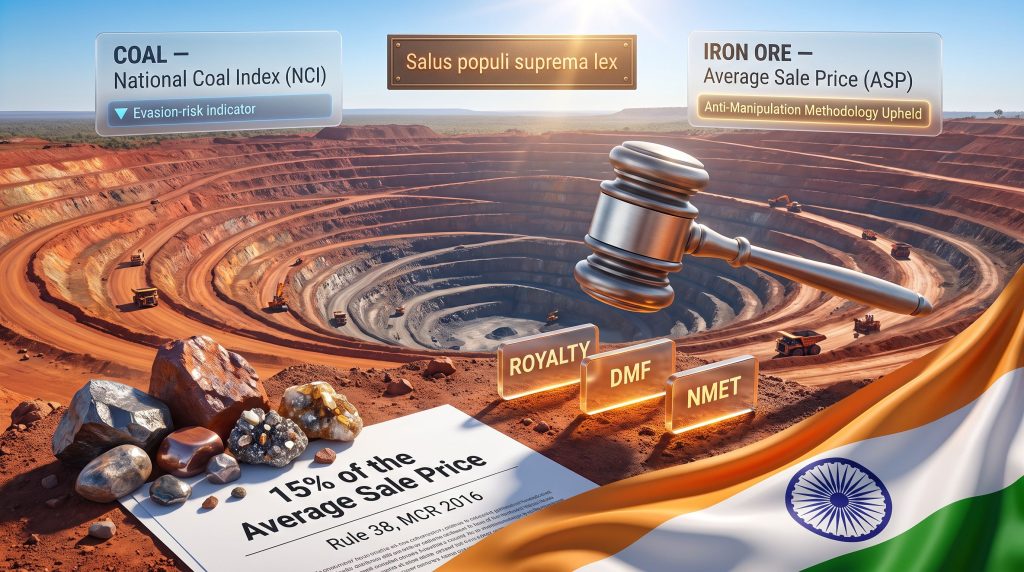
This is precisely the terrain that India's Supreme Court was asked to navigate in its landmark ruling on the Supreme Court upholds royalty DMF and NMET in mineral sale value, affirming the constitutional validity of rules requiring that royalty, District Mineral Foundation contributions, and National Mineral Exploration Trust levies be included in the sale value for computing the Average Sale Price of iron ore. The judgment, delivered by a bench comprising Justice JB Pardiwala and Justice KV Viswanathan, resolved a challenge brought by Kirloskar Ferrous Industries Ltd. and affirmed the Union Government's royalty computation framework under the Mines and Minerals (Development and Regulation) Act, 1957.
Understanding what this ruling actually changes, what it leaves open, and what it signals about India's broader mineral governance trajectory requires unpacking several layers of regulatory architecture that rarely receive sustained analysis.
When big ASX news breaks, our subscribers know first
The Statutory Framework: Three Rules, One Contested Methodology
India's mineral royalty system for non-atomic minerals operates through an interlocking set of statutory instruments. At the apex sits Section 9 of the MMDR Act, which establishes that royalty on iron ore is payable at 15% of the Average Sale Price. The ASP itself is not defined by the Act directly; instead, the methodology for arriving at it is delegated to subordinate rules. Understanding these mechanics is as important as grasping cut-off grade economics when evaluating a mining project's true fiscal burden.
Two rules were at the centre of the litigation:
- Rule 38 of the Minerals (Other than Atomic and Hydro Carbons Energy Minerals) Concession Rules, 2016 (MCR 2016): This provision governs how sale value is computed for non-atomic mineral concessions. Critically, explanations appended to this rule clarify that payments made toward royalty, DMF, and NMET are not to be deducted when calculating the sale value.
- Rule 45(8)(a) of the Mineral Conservation and Development Rules, 2017 (MCDR 2017): This establishes operational parameters for mineral pricing and conservation compliance within the same framework.
The distinction between prescribing a rate and prescribing a computation methodology sits at the heart of the Court's reasoning. The explanations appended to these rules do not touch the 15% royalty rate. They define what the sale value component contains before that rate is applied. This is not merely a semantic distinction; it is the constitutional fulcrum on which the entire case turned.
What the "Royalty on Royalty" Argument Got Right, and Where It Failed
The petitioner's cascading effect argument had intuitive logic behind it. The chain of concern ran roughly as follows:
- A miner dispatches iron ore and the transaction generates a sale price.
- From that price, the miner is obligated to pay royalty (15% of ASP), DMF contributions, and NMET levies.
- If those statutory outflows are not deducted before computing the weighted ASP, the miner effectively pays royalty on a base that already contains royalty obligations.
- This produces a compounding effect that, the petitioner argued, amounts to Parliament-unauthorised enhancement of the royalty burden.
The argument carried enough force that two government-commissioned committees, the Praveen Kumar Committee and the Dr. Aruna Sharma Committee, had previously recommended removing the alleged cascading element from the computation framework. That the government declined to act on those recommendations was itself a source of contention.
The Supreme Court's response was methodologically precise. The bench held that the government possesses the regulatory authority to define what constitutes sale value, and that doing so is categorically distinct from revising royalty rates. Prescribing a computational methodology that prevents deduction of statutory levies from the price base is a regulatory clarification, not a new imposition. Furthermore, according to the Supreme Court's full judgement, the rate of 15% was never altered.
| Argument | Petitioner's Position | Court's Finding |
|---|---|---|
| Nature of the inclusion | Impermissible double taxation | Computational clarification, not a new levy |
| Constitutional validity | Violates Articles 14 and 19(1)(g) | Neither arbitrary nor violative of fundamental rights |
| Parliamentary authority | Exceeds Section 9 MMDR Act limits | Within government's rule-making competence |
| Rate revision prohibition | Breaches Section 9(3) proviso | Rate unchanged; only methodology defined |
Iron Ore vs. Coal: Why the Differential Treatment Is Structurally Justified
One of the more technically sophisticated arguments advanced by the petitioner drew on the differential treatment afforded to coal. The Central Government had previously excluded royalty, DMF, and NMET from coal's actual price calculation, effectively eliminating the cascading concern for that sector. The petitioner argued this discrepancy was arbitrary and discriminatory under Article 14.
The Supreme Court rejected the comparison on structural grounds, describing it as akin to comparing apples and oranges. The distinction is not cosmetic.
| Parameter | Coal | Iron Ore |
|---|---|---|
| Royalty Linkage | National Coal Index (NCI), an independent index-based benchmark | Average Sale Price (ASP), computed from market data self-reported by miners |
| Price Manipulation Risk | Lower, constrained by independent index mechanism | Higher, dependent on miner-reported transaction data across dispatch volumes |
| Evasion Vulnerability | Structurally limited by index architecture | Susceptible to selective price reporting strategies |
| Regulatory Treatment of DMF/NMET | Excluded from actual price calculation | Included in sale value for ASP computation |
The coal royalty system's linkage to the National Coal Index removes the self-reporting variable that makes iron ore ASP potentially susceptible to manipulation. When royalty is anchored to an independently constructed index, the government does not rely on miner-reported transaction data to determine the royalty base. That insulation does not exist in the iron ore framework.
The Union Government placed before the Court documentary evidence, including charts and data sets, illustrating patterns where miners reportedly recorded higher ex-mine prices when dispatching negligible volumes and lower prices when dispatching substantial quantities. The mechanical effect of this pattern is to depress the weighted ASP, which in turn reduces royalty obligations, auction premiums, and other statutory dues. The Court accepted this evidentiary record as justifying the retention of the existing methodology specifically for iron ore.
"Private rights will have to cede to public interest," the bench observed, a position consistent with broader jurisprudential principles governing the relationship between commercial activity and the commodity price impact on state revenue.
This is a dimension of mineral fiscal policy that rarely surfaces in public commentary. The structure of price-reporting mechanisms, whether self-reported or index-anchored, fundamentally determines the government's vulnerability to base erosion. The choice of methodology is therefore a governance decision, not merely an administrative convenience.
The Constitutional Framework: Judicial Restraint and Public Revenue Protection
The ruling reaffirms a durable principle in Indian constitutional jurisprudence: courts should be slow to displace fiscal and economic policy choices made by the legislature or executive, provided those choices satisfy a rational nexus test.
The constitutional tests applied by the bench addressed three separate provisions:
Under Article 14 (Equality Before Law): A fiscal measure must have a rational nexus with a legitimate state objective. The anti-manipulation and revenue protection rationale satisfied this standard. The bench found no capriciousness, irrationality, or disproportionality in the government's computational approach.
Under Article 19(1)(g) (Right to Carry on Trade or Business): Regulatory fiscal conditions that are reasonable and serve the public interest do not constitute an impermissible restriction on trade. The computational methodology was characterised as a reasonable regulatory condition, not a prohibition.
Under Section 9(3) Proviso (Royalty Rate Revision Restriction): Parliament's prohibition on enhancing royalty rates more than once in any three-year period does not apply to changes in computational methodology. The Court drew a clear line between defining the base and revising the rate.
The bench also invoked the Latin maxim Salus populi suprema lex, meaning the welfare of the people is the supreme law, to underscore that individual commercial interests may legitimately yield to broader public revenue protection objectives where the measures in question are rationally designed and proportionate.
The Status of Committee Recommendations: Advisory Weight vs. Legal Authority
The Court's treatment of the Praveen Kumar Committee and Dr. Aruna Sharma Committee recommendations offers a clarifying lesson for how expert advisory processes interact with constitutional review.
Both committees had examined the royalty computation framework and recommended removal of the cascading effect. The petitioner argued these recommendations constituted an acknowledgment, even by the government's own experts, that the existing framework was problematic.
The Court drew a sharp distinction: committee reports are advisory inputs to policy deliberation, not determinative legal instruments. The constitutional validity of a statutory provision cannot be measured against the content of a recommendatory report. The bench conducted its own independent constitutional examination and found the government's reasons for retaining the existing framework, particularly the anti-evasion and revenue protection rationale, to be legally sufficient.
What makes this aspect of the ruling particularly significant for industry observers is the Court's accompanying direction. While dismissing the constitutional challenge, the bench directed the government to expedite public consultations and arrive at a final, decisive policy position on the cascading effect question. This direction does not reopen the legal question; rather, it acknowledges that the policy question remains legitimately open for administrative resolution through a structured consultation process.
The next major ASX story will hit our subscribers first
Operational and Fiscal Implications for India's Mining Sector
For iron ore mining operations, the ruling resolves a period of significant regulatory uncertainty. The computational framework that had been contested is now constitutionally validated, providing clarity across several dimensions. In addition, the ruling has implications that extend beyond royalty computation, touching on broader questions of resource export challenges and the way mineral-producing jurisdictions balance revenue collection against industry competitiveness.
| Operational Dimension | Pre-Ruling Uncertainty | Post-Ruling Clarity |
|---|---|---|
| Royalty computation basis | Contested, potential exclusion of DMF and NMET under challenge | Confirmed: DMF and NMET included in sale value |
| ASP calculation methodology | Subject to active legal challenge | Constitutionally validated |
| Anti-manipulation compliance | Uncertain enforcement landscape | Government methodology upheld as lawful |
| Future rule amendments | Possible via committee recommendations | Requires formal policy process; current rules valid |
For the District Mineral Foundation and National Mineral Exploration Trust, the ruling has downstream significance. The DMF was established under the MMDR Act to channel funds toward communities in mining-affected districts. Its inclusion in the royalty base ensures that the effective quantum of statutory obligations reflects the full cost imposed by mineral extraction, rather than being narrowed through deduction strategies.
The NMET, which finances geological exploration activities across India, benefits from the same protection. From a revenue integrity perspective, the ruling reinforces the government's capacity to close royalty leakage channels through computational rule-making without the political and legislative burden of formally amending royalty rate schedules.
What Remains Unresolved: The Cascading Effect as a Policy Question
The Court's direction to expedite consultations is worth reading carefully. It signals that while the legal challenge has been definitively resolved, the underlying policy tension between revenue protection and industry competitiveness has not been adjudicated away.
Mining sector participants who believe the cascading methodology imposes genuine additional cost burden on operations retain a legitimate avenue through formal consultation processes. Any future amendment to the rules would require the government to weigh several competing considerations:
- Revenue protection objectives: The anti-evasion rationale that the Court found compelling does not disappear simply because a policy review is initiated.
- Industry competitiveness concerns: The effective cost of compliance under the existing framework may affect investment decisions at the project level, particularly for marginal iron ore operations. This is especially relevant when considered alongside mining permitting basics and the cumulative regulatory burden facing new entrants.
- Constitutional constraints: Any revised methodology would still need to satisfy the rational nexus standard and avoid constituting an implicit rate revision under Section 9(3). Furthermore, definitive feasibility studies for iron ore projects will now need to model the validated computational framework as a fixed input.
The broader lesson from this ruling is that in ad valorem royalty systems, the definition of value is as consequential as the rate applied to it. Investors, operators, and policy analysts who focus exclusively on royalty rate levels risk missing the fiscal architecture that determines actual effective royalty burdens across different mineral categories.
The Supreme Court upholds royalty DMF and NMET in mineral sale value as a landmark principle, confirming that computational rule-making within the royalty framework is constitutionally insulated from challenge where a rational nexus with a legitimate objective — such as anti-evasion — can be demonstrated. For India's mining sector, the ruling clarifies the fiscal ground underfoot while leaving the policy conversation about cascading effects open for resolution through a process that is administrative rather than judicial. Detailed analysis of the Kirloskar Ferrous ruling provides further context for those seeking a deeper understanding of how increased royalty recovery intersects with the MMDR amendment framework.
Want to Stay Ahead of Significant ASX Mineral Discoveries in Real Time?
Discovery Alert's proprietary Discovery IQ model instantly scans ASX announcements across more than 30 commodities, delivering actionable alerts the moment a significant mineral discovery is made — removing the complexity from mineral data so investors can act with confidence. Explore historic discovery returns on Discovery Alert's dedicated discoveries page and begin a 14-day free trial to secure a market-leading edge before the broader market catches on.