
August 6, 2026
The Capital Architecture Behind Glencore's Australian Listing Plans
Global mining capital markets are undergoing a quiet structural shift. The largest commodity producers in the world are no longer satisfied with single-exchange access to institutional investors. Instead, they are engineering multi-jurisdictional shareholder bases with the precision of a hedging strategy, targeting specific pools of long-duration capital that remain structurally underexposed to diversified resource giants. Glencore Australian listing plans represent the most significant expression of this trend in years, and understanding the mechanics, the motivation, and the potential consequences requires looking well beyond the headline numbers.
When big ASX news breaks, our subscribers know first
The Strategic Logic Behind a Secondary ASX Listing
Primary Versus Secondary: Understanding What This Listing Actually Is
The distinction between a primary and secondary listing carries more weight than most investors appreciate. A secondary listing does not replicate the full governance, continuous disclosure, and capital obligation framework of a primary venue. For Glencore, London remains its primary listing home, and that choice is deliberate.
Glencore's governance preferences have long reflected a European institutional sensibility, and its earlier decision to reject a switch to a New York primary listing confirmed that the company has no intention of restructuring its core regulatory relationship with the London Stock Exchange. The ASX secondary listing via Chess Depositary Interests (CDIs) achieves something different: it creates a presence in the Asia-Pacific investor ecosystem without the complexity and cost of a full primary migration.
CDIs are a well-established mechanism in Australian capital markets. They represent a beneficial interest in an underlying foreign-listed share, settled through Australia's CHESS settlement system. From a practical standpoint, Australian investors can buy and sell CDIs through their standard brokerage accounts in Australian dollars, while the underlying shares remain listed and governed on the LSE. The structure is low-friction by design, and it is precisely why Glencore has chosen it over a more elaborate dual-primary arrangement.
The October 2026 target timeline is not arbitrary. Index inclusion cycles on the ASX operate on a defined schedule, and entering the market in the final quarter of 2026 positions Glencore for potential ASX 200 index inclusion review within the following 12-month window. CEO Gary Nagle has publicly indicated this expectation, with ASX 100 inclusion identified as a longer-term ambition contingent on CDI trading volumes reaching sufficient thresholds.
Critically, no capital raising is attached to this listing. That single fact reframes the entire strategic intent. This is not about raising funds. It is about repositioning Glencore within a new institutional capital ecosystem and creating the financial architecture for future flexibility.
How Glencore's Financial Performance Justifies This Capital Market Expansion
Decoding an 86% EBITDA Surge
The earnings context behind Glencore Australian listing plans matters enormously. A company approaching a new listing venue from a position of financial strength sends a fundamentally different signal than one seeking fresh capital out of necessity.
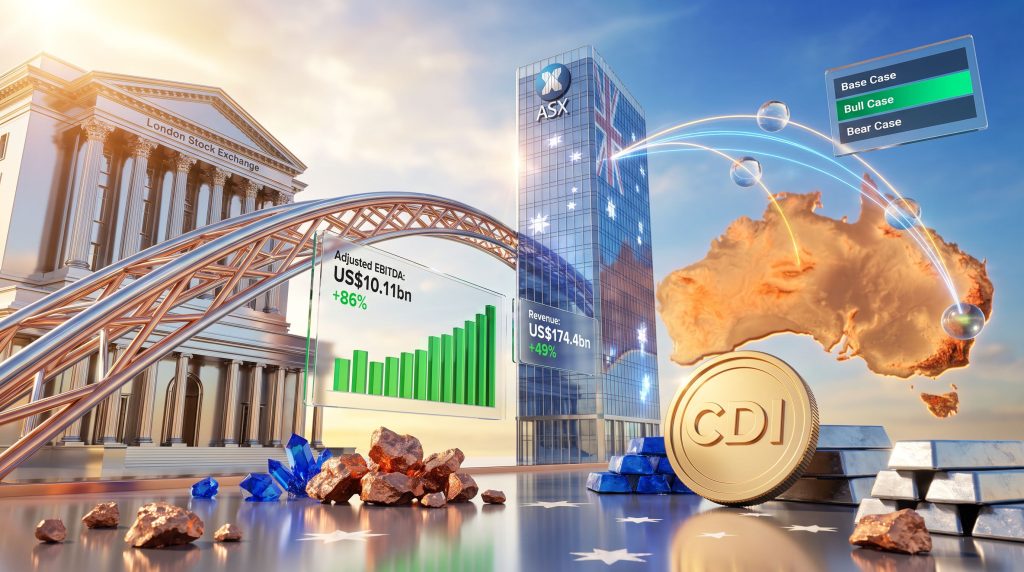
Glencore's first-half 2026 results were exceptional by almost any measure. Adjusted EBITDA reached US$10.11 billion, nearly double the US$5.43 billion recorded in the prior corresponding period. Revenue expanded 49% to US$174.4 billion, a figure that contextualises just how large Glencore's commodity trading footprint has become relative to its industrial mining operations.
| Financial Metric | H1 2025 | H1 2026 | Change |
|---|---|---|---|
| Adjusted EBITDA | US$5.43bn | US$10.11bn | +86% |
| Revenue | ~US$117bn | US$174.4bn | +49% |
| Marketing Operating Profit | ~US$1.36bn | US$3.3bn | +142% |
| Industrial Adjusted Earnings | ~US$3.78bn | US$6.5bn | +72% |
| Net Debt | ~US$11.2bn | US$10.2bn | -US$1bn |
| Total 2026 Shareholder Returns | N/A | ~US$3.5bn | N/A |
Industrial segment adjusted earnings rose 72% to US$6.5 billion, driven by a combination of favourable commodity price performance and solid operational execution across Glencore's diversified asset base. A weaker US dollar and elevated supply-chain costs partially offset these gains, a dynamic that underscores the complexity of managing a globally distributed industrial portfolio.
The Trading Division as a Structural Differentiator
One of the most important and least understood aspects of Glencore's business model is its marketing division, the commodity trading arm that distinguishes Glencore from every other large-cap miner likely to appear in Australian investor portfolios.
The marketing division generated US$3.3 billion in adjusted operating profit for H1 2026, representing a 142% year-on-year increase and a near-record first-half result. The Middle East conflict served as a structural amplifier for energy, freight, and related commodity trading margins during the period.
Unlike conventional miners that are passive price-takers in commodity markets, Glencore's trading division actively monetises price volatility, supply disruptions, and freight market dislocations. When geopolitical stress fractures normal supply chains, Glencore's marketing arm is structurally positioned to benefit. This is a dynamic that neither BHP nor Rio Tinto can replicate.
This asymmetric earnings capacity has significant implications for how Australian investors should evaluate Glencore's CDIs relative to familiar ASX-listed mining peers. Furthermore, the trading division introduces a source of earnings that is largely decorrelated from production volumes and capital expenditure cycles.
Shareholder Returns and Balance Sheet Discipline
The capital return programme accompanying the H1 2026 results signals strong management confidence. A special cash distribution of 8.5 cents per share, worth approximately US$1 billion, was announced alongside a new US$500 million buyback programme. Combined with earlier commitments, total shareholder returns for 2026 reach approximately US$3.5 billion.
Net debt fell by US$1 billion to US$10.2 billion despite US$4 billion in net capital expenditure over the period. That balance sheet trajectory, combined with full-year EBITDA guidance of approximately US$19.7 billion at current commodity prices, positions Glencore with meaningful capacity to pursue copper-focused mergers and acquisitions without stretching its credit metrics.
What Makes the ASX the Right Market for This Strategy
The Superannuation Capital Prize
Australia's superannuation system represents one of the world's most concentrated pools of long-duration institutional capital. The system manages trillions in assets under management, and its funds have a well-documented historical appetite for large-cap resource stocks, a consequence of Australia's deep cultural and economic familiarity with the mining sector.
AustralianSuper, the country's largest superannuation fund, has publicly expressed the view that an ASX listing by Glencore would be a net positive for both the company and the domestic market. That kind of institutional endorsement before a listing even occurs is a meaningful signal of latent demand.
Glencore's commodity diversification profile is particularly well-suited to superannuation fund mandates. Its exposure spans:
- Copper, the central metal of the global energy transition and EV supply chain build-out
- Cobalt, a critical battery metal in which Glencore holds one of the world's largest production positions
- Zinc, providing industrial cyclical exposure
- Coal, a significant cash-flow contributor despite ongoing ESG scrutiny
- Oil, through its marketing and trading operations
This breadth means Glencore can simultaneously appeal to funds seeking energy transition commodity exposure and those seeking traditional resources diversification, a dual appeal that few individual miners can offer.
Index Inclusion Mechanics and Passive Fund Flows
The pathway to ASX 200 inclusion is arguably the most consequential near-term outcome of Glencore Australian listing plans. Index inclusion is not merely a prestige milestone. It is, however, a structural demand catalyst.
If Glencore achieves ASX 200 inclusion within the projected 12-month window following its October 2026 listing, passive index-tracking funds managing hundreds of billions in Australian equities would be structurally obligated to hold Glencore CDIs. This creates a sustained demand floor that operates independently of active investor sentiment or commodity cycle positioning.
The mechanics work as follows:
- Glencore lists CDIs on the ASX in October 2026, subject to regulatory approvals
- CDI trading volumes accumulate over the following months, establishing a market capitalisation reference for index compilers
- ASX index eligibility reviews assess liquidity, market capitalisation, and trading turnover thresholds
- Inclusion triggers mandatory buying by passive funds tracking the ASX 200 and, eventually, the ASX 100
- Sustained institutional ownership improves bid-ask spreads, reducing Glencore's effective cost of equity capital over time
The time-zone dimension of the ASX listing adds a further structural benefit that is rarely discussed in the context of dual listings. CDI trading on the ASX creates a price discovery window between the London market close and the Asian market open, providing Asia-Pacific investors with real-time pricing access rather than relying on stale overnight LSE prices.
Scenario Modelling: Three Outcomes of the ASX Listing
| Scenario | Trigger Conditions | Likely Outcome |
|---|---|---|
| Base Case | ASX 200 inclusion within 12 months; steady CDI volumes | Institutional demand, improved liquidity, modest valuation re-rating |
| Bull Case | ASX 100 inclusion; superannuation accumulation; copper price rally | Significant passive inflows, stronger M&A optionality |
| Bear Case | Low CDI trading volumes; index inclusion delayed; commodity correction | Listing remains largely symbolic; limited strategic benefit |
What Australian Investors Need to Understand Before Glencore Lists
How CDIs Work in Practice
For Australian investors unfamiliar with CDIs, several structural points deserve attention before Glencore's October 2026 target date:
- CDIs represent beneficial ownership of underlying LSE-listed shares, not a separate share class with different rights
- Pricing will be denominated in Australian dollars, introducing a currency translation layer relative to the GBP-priced underlying shares
- Distributions, including the context of the recently announced 8.5 cents per share special distribution, flow through the CDI structure to Australian holders
- Voting rights and corporate action participation are accessible to CDI holders, though the mechanics may differ slightly from direct share ownership on the LSE
Key Risk Factors Specific to the ASX Listing Context
Investors should weigh several risks that are specific to or amplified by Glencore's CDI structure and business profile:
- Currency translation risk: CDI returns are affected by movements across AUD, GBP, and USD, since Glencore's earnings are predominantly USD-denominated but its primary shares trade in GBP
- Dual-jurisdiction disclosure obligations: Regulatory requirements across ASX and LSE may create timing differences in material information dissemination
- Commodity price cyclicality: H1 2026's exceptional results were partly a function of price and volatility tailwinds. Mean reversion in commodity cycles remains a material risk
- Coal exposure: A meaningful proportion of Glencore's earnings derive from thermal and metallurgical coal. Australian superannuation funds with explicit sustainability mandates may face internal constraints on accumulating Glencore CDIs
How Glencore Compares to ASX-Listed Mining Peers
| Attribute | Glencore (Post-ASX Listing) | BHP | Rio Tinto |
|---|---|---|---|
| Primary Listing Venue | London (LSE) | ASX / LSE (dual primary) | ASX / LSE (dual primary) |
| ASX Instrument Type | CDIs | Ordinary Shares | Ordinary Shares |
| Commodity Mix | Copper, Coal, Cobalt, Zinc, Oil | Iron Ore, Copper, Coal | Iron Ore, Copper, Aluminium |
| Marketing/Trading Division | Yes (major earnings contributor) | No | No |
| H1 2026 Adjusted EBITDA | US$10.11bn | N/A | N/A |
The absence of a trading division at BHP and Rio Tinto is perhaps the most practically significant differentiator for investors constructing a resources portfolio on the ASX. Consequently, Glencore's CDIs would introduce a genuinely different earnings dynamic into an index currently populated by production-volume-driven miners. For context, the Rio Tinto delisting impact on the ASX illustrates how sensitive Australian index composition can be to the movements of major global miners.
The next major ASX story will hit our subscribers first
The Broader Implication for ASX as a Global Mining Capital Hub
What Glencore's Move Signals for the Mining Capital Markets Landscape
Glencore's approach to its Australian listing plans carries implications that extend well beyond the company itself. The structure being employed, a CDI-based secondary listing without capital raising, executed from a position of strong earnings momentum, represents a replicable template.
Several dynamics make this strategically significant for the broader market:
- The CDI mechanism demonstrates that a Tier 1 global miner can access Australian institutional capital without restructuring primary governance or diluting existing shareholders
- If Glencore's index inclusion trajectory plays out as projected, it validates the ASX's attractiveness as a destination for large-cap international resource companies alongside Toronto, London, and New York
- The move may encourage other London or New York-primary miners with significant Asia-Pacific operational footprints to evaluate similar secondary listing strategies
- Australia's combination of mining-literate investors, deep superannuation capital, and geographic positioning as a bridge between Asian and Western financial markets is increasingly difficult for global resource majors to ignore
Furthermore, analysts covering the ASX listing have noted that Glencore's copper-focused growth ambitions make Australia's mining-friendly capital environment a particularly strategic destination. Indeed, investors evaluating copper investment strategies will find Glencore's CDI structure an increasingly relevant vehicle as the energy transition accelerates demand for the metal.
The broader speculative scenario worth monitoring: if Glencore's CDI listing generates meaningful superannuation fund inflows and achieves sustained index inclusion, it could catalyse a structural re-evaluation of how global miners approach capital market geography. The ASX may evolve from a regional resource exchange into a genuinely competitive global mining capital venue, with consequences for how international mining companies price equity and structure balance sheets.
Disclaimer: This article is for informational purposes only and does not constitute financial advice. Past financial performance is not indicative of future results. Forecasts, scenario modelling, and index inclusion expectations referenced in this article are speculative in nature and subject to regulatory approvals, market conditions, and commodity price movements. Investors should seek independent financial advice before making investment decisions.
Frequently Asked Questions: Glencore Australian Listing Plans
When Is Glencore Planning to List on the ASX?
Glencore has indicated it is targeting an ASX secondary listing in October 2026, subject to regulatory approvals and prevailing market conditions.
Will Glencore Raise Capital Through Its ASX Listing?
No capital raising is associated with the planned listing. The primary objectives are to broaden Glencore's shareholder base and improve trading liquidity through access to Australian institutional investors, particularly the superannuation sector.
What Are CDIs and How Will Glencore Use Them?
Chess Depositary Interests (CDIs) are instruments that allow Australian investors to hold beneficial interests in foreign-listed shares through the ASX's CHESS settlement system. Glencore plans to use CDIs as a cost-effective mechanism to establish its ASX presence without duplicating its full listing infrastructure or restructuring its primary London governance arrangements.
Could Glencore Enter the ASX 200?
CEO Gary Nagle has publicly stated the expectation that Glencore could achieve ASX 200 inclusion within 12 months of listing, with ASX 100 inclusion a longer-term possibility depending on CDI trading volumes meeting the required thresholds.
Why Is Glencore Interested in Australian Superannuation Funds?
Australia's superannuation system manages one of the world's largest concentrations of long-term institutional capital. Superannuation funds have a strong historical appetite for large-cap resource stocks, and Glencore's diversified commodity portfolio, spanning copper, cobalt, zinc, coal, and oil, aligns with the investment mandates of major funds seeking broad resources sector exposure.
How Does the ASX Listing Connect to Glencore's Copper Strategy?
While no capital raise is planned, a broader and more liquid shareholder base on the ASX provides Glencore with enhanced financial flexibility, including potential equity-linked financing optionality, to support copper growth ambitions as demand from the global energy transition and EV supply chain build-out accelerates over the coming decade.
Want to Track the Next Major ASX Mineral Discovery Before the Market Moves?
Discovery Alert's proprietary Discovery IQ model delivers real-time alerts on significant ASX mineral discoveries, instantly transforming complex geological data into actionable investment insights — explore the historic returns major discoveries have generated to understand the opportunity, then begin your 14-day free trial at Discovery Alert to position yourself ahead of the broader market.