May 23, 2026
The Hidden Complexity Behind Measuring What Mining Takes From Nature
Quantifying ecological damage has always been one of the extractive industries' most uncomfortable blind spots. For decades, rehabilitation was treated as an end-of-life obligation, a checkbox exercise completed after the ore ran out and the equipment was packed away. The assumption embedded in that model was that ecosystems, once disturbed, could simply be replanted and left to recover. What scientific research has increasingly revealed is that ecological restoration is nowhere near that straightforward, and that the timing, methodology, and cultural context of restoration efforts determine whether recovery is genuine or superficial.
This complexity sits at the heart of what makes Glencore biodiversity restoration methods in mining worth examining in depth. The Swiss-headquartered mining and commodity trading group, currently ranked as the world's largest coal producer and sixth largest copper producer globally, has published detailed sustainability data for 2025 that offers one of the more granular windows available into how a major diversified miner is operationalising ecological responsibility at scale.
When big ASX news breaks, our subscribers know first
Why Biodiversity Has Become a Strategic Imperative for Global Mining Companies
The Ecological Cost of Extraction: Understanding the Scale of Disturbance
Mining's relationship with land is intrinsically consumptive. Open-cut operations remove overburden, alter drainage patterns, expose acid-generating rock, and create disturbance zones that extend well beyond the visible pit edge. Underground operations, while typically lower in surface footprint, create subsidence risks, dewater aquifers, and generate processing tailings that occupy substantial land areas. At a global industry level, the cumulative disturbance represents millions of hectares annually, with the ecological cost varying enormously depending on the biome affected.
What makes disturbance in biodiverse ecosystems particularly costly is the non-linearity of ecological loss. A 10-hectare clearing in a tropical forest does not simply remove 10 hectares of species habitat. It fragments larger ecosystems, disrupts wildlife movement corridors, alters microclimates at forest edges, and may eliminate locally endemic species that exist nowhere else on Earth. This ecological multiplier effect means that the raw disturbance figures published by mining companies tend to significantly understate the full biodiversity impact of extraction operations.
Glencore's 2025 Sustainability Report data illustrates this dynamic at operational scale. The company owned or leased approximately 20,000 square kilometres of land by December 2025, with 8.4% of that area classified as disturbed. While 30% of disturbed land has been restored to date, approximately 1,680 square kilometres remain in a disturbed state, representing an ecological liability spread across operations on multiple continents.
From Compliance to Competitive Advantage: Why Leading Miners Are Investing in Ecosystem Restoration
The shift from viewing biodiversity purely as a regulatory compliance matter to treating it as a strategic asset reflects changes in both the regulatory environment and the financial landscape. Institutional investors applying environmental, social, and governance criteria to portfolio construction are increasingly scrutinising biodiversity risk alongside carbon risk. Access to project finance, joint venture partnerships, and government mining licences in ecologically sensitive jurisdictions has become partially contingent on demonstrated biodiversity management capability.
For mining companies competing for capital and operating permits in contested landscapes, the ability to demonstrate measurable, independently verifiable biodiversity outcomes has moved from a reputational nicety to an operational prerequisite. Furthermore, companies that have developed robust, scalable frameworks for ecological restoration are increasingly positioned as preferred development partners in environmentally sensitive regions, giving them access to deposits that less credentialled operators cannot obtain permission to mine. Broader mining sustainability transformation efforts are accelerating this competitive dynamic across the sector.
How the Kunming-Montreal Global Biodiversity Framework Is Reshaping Corporate Nature Commitments
The Kunming-Montreal Global Biodiversity Framework, adopted in December 2022, establishes binding national targets that downstream into corporate obligations through supply chain due diligence requirements. The framework's 30×30 target, calling for the protection of 30% of global land and ocean areas by 2030, directly affects mining companies operating in or adjacent to areas nominated for conservation status. Its requirement that large companies assess and disclose biodiversity risks creates reporting obligations comparable in scope to those established for climate risk by the Task Force on Climate-related Financial Disclosures.
Mining companies that develop measurable, transparent restoration frameworks are positioning themselves ahead of disclosure requirements that are expected to tighten considerably before 2030. Those without verifiable biodiversity data face increasing risk of regulatory non-compliance and capital market exclusion.
What Is the Mitigation Hierarchy and How Does Glencore Apply It Across Its Operations?
Defining the Four-Step Framework: Avoid, Minimise, Restore, Offset
The mitigation hierarchy is the conceptual backbone of contemporary mining biodiversity management. Rather than treating ecological damage as inevitable and simply managing its aftermath, the framework establishes a sequential decision structure that constrains operational choices at each stage of mine development. Its power derives from its hierarchy: each step is attempted before the next is considered, ensuring that avoidance of disturbance is always prioritised over its compensation.
| Stage | Objective | Glencore Application |
|---|---|---|
| Avoid | Prevent disturbance before it occurs | Siting decisions informed by pre-operational ecological surveys |
| Minimise | Reduce disturbance footprint during operations | Progressive rehabilitation concurrent with active extraction |
| Restore | Return disturbed land to functional ecosystem condition | Miombo reforestation (DRC), grassland reclamation (Canada) |
| Offset | Compensate residual impacts outside the operational footprint | Wetland restoration (South Africa), reforestation (Indonesia) |
How Sequential Application Reduces Net Ecological Impact Over the Mine Life Cycle
When applied rigorously, the sequential structure of the mitigation hierarchy compresses the ecological debt that accumulates during operations. Avoidance decisions made at feasibility stage eliminate disturbance that would otherwise require decades of restoration to remedy. Minimisation during operations reduces the footprint requiring rehabilitation. Restoration returns land to productive ecological condition before closure liabilities crystallise.
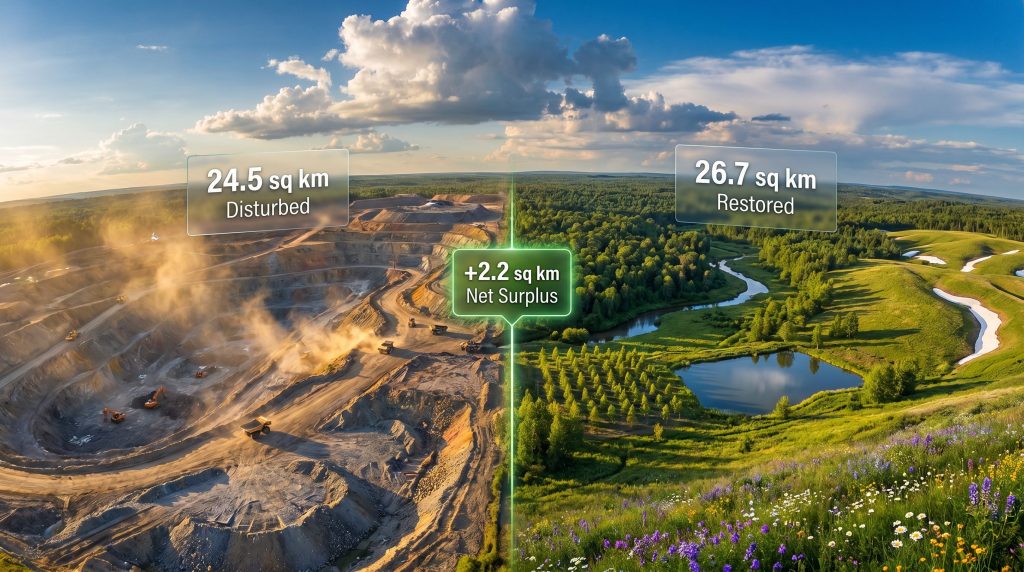
Offset investments address whatever residual impact the preceding three stages cannot fully resolve. The result, when implemented effectively, is that a mine's net ecological impact at closure is substantially lower than the gross disturbance figures recorded during peak operations. Glencore's 2025 data showing restoration of 26.7 square kilometres against 24.5 square kilometres of new disturbance reflects this principle in practice, with rehabilitation programmes outpacing new land consumption within a single reporting year.
Where the Mitigation Hierarchy Falls Short
The framework has well-documented limitations. In high-biodiversity, low-disturbance ecosystems, even the best-designed offset programmes struggle to replace what is lost when unique habitats are disturbed. Ecological equivalence, the principle that offset gains genuinely compensate for operational losses, becomes increasingly difficult to demonstrate when the disturbed ecosystem contains endemic species, ancient soil biomes, or hydrological features that cannot be replicated at offset sites.
Supplementary tools that address these gaps include enhanced pre-operational baseline studies, Independent Biodiversity Management Plans developed with conservation scientists, and closure plans that specify post-operational monitoring obligations extending beyond the formal mine life. Considering natural capital in mining frameworks alongside the mitigation hierarchy provides a more comprehensive accounting of ecological value at risk.
How Does Glencore's No Net Loss Methodology Work in Practice?
What No Net Loss Actually Means and Why the Timing of the Target Matters
No Net Loss is a commitment that the cumulative biodiversity impact of an operation, measured at the time of final site closure, will be neutral or net positive. The timing is critical to understanding what the commitment actually requires. By applying the target at closure rather than at the peak of operations, the framework acknowledges that active mining inevitably creates disturbance that rehabilitation programmes cannot fully counteract in real time.
The commitment is that, by the time the site is handed back to communities or returned to nature, the accounts will balance. This temporal structure also creates financial incentive for early rehabilitation. Mining companies that begin progressive restoration during operations accumulate ecological credit that reduces the closure-stage rehabilitation liability. Glencore's 2025 net restoration surplus of 2.2 square kilometres represents exactly this dynamic: restoration outpacing disturbance during an active operational year contributes to the ecological balance that will be assessed at closure.
The Role of Machine Learning and Satellite Imagery in Standardising Biodiversity Measurement
Glencore completed development of its No Net Loss methodology in 2025 in collaboration with international consultants. The system applies machine learning algorithms to satellite imagery to produce standardised ecosystem condition assessments across geographically diverse operating sites. This capability addresses one of the sector's most persistent technical challenges: producing comparable biodiversity measurements across tropical forests, alpine grasslands, dryland savannas, and wetland systems using consistent analytical parameters.
Traditional biodiversity assessment relies on ground-based ecological surveys, which are expensive, time-consuming, and difficult to standardise across different surveying teams and environmental contexts. Machine learning applied to multi-temporal satellite imagery can detect vegetation structure changes, phenological shifts, and land cover transitions at landscape scale with a frequency and geographic consistency that ground surveys cannot match. For a company operating across dozens of countries, this representational consistency is operationally significant.
Key 2025 Land Use and Restoration Performance Data
| Metric | Figure |
|---|---|
| Total land owned or leased (December 2025) | 20,000 sq km |
| Percentage of land classified as disturbed | 8.4% |
| Proportion of disturbed land restored to date | 30% |
| Land restored during 2025 | 26.7 sq km |
| New land disturbed during 2025 | 24.5 sq km |
| Net restoration surplus (2025) | +2.2 sq km |
The 2025 restoration surplus, while modest in absolute terms, represents a directional indicator that rehabilitation programmes have reached sufficient scale to outpace new disturbance creation within a single reporting cycle. For a company of Glencore's operational scope, this is a meaningful milestone rather than a trivial accounting exercise.
How Consistent Parameters Enable Cross-Site Ecological Comparisons
One underappreciated technical challenge in mining biodiversity management is the difficulty of comparing restoration outcomes across different ecosystem types. A hectare of restored tropical forest and a hectare of restored alpine grassland represent fundamentally different ecological systems, with different species diversity benchmarks, different vegetation structure metrics, and different functional indicators of ecosystem health. Producing a single consolidated restoration figure that is ecologically meaningful requires analytical frameworks capable of normalising these differences.
Glencore's machine learning approach attempts to address this by generating standardised ecosystem condition scores that can be summed and compared across sites, enabling the consolidated reporting visible in the 26.7 square kilometre restoration figure. Whether these standardised scores accurately capture the full ecological value of different ecosystem types remains an area where independent validation would strengthen the methodology's credibility.
What Are Glencore's Core Biodiversity Restoration Methods?
Progressive Rehabilitation: Restoring Land During Active Operations, Not After
The conceptual foundation of Glencore biodiversity restoration methods in mining involves treating rehabilitation as a concurrent operational activity rather than a post-closure obligation. This progressive approach is operationally complex: it requires coordinating rehabilitation crews with active extraction sequences, ensuring that land released from mining use is immediately prepared for ecological recovery rather than left as temporary waste. Mine reclamation innovation is driving significant improvements in how these concurrent programmes are designed and executed.
Key features of this approach include:
- Rehabilitation timelines aligned with extraction sequences, enabling phased land return as individual pit sections are completed
- Soil salvage and storage programmes that preserve topsoil biodiversity during disturbance for reapplication during rehabilitation
- Revegetation using locally endemic species rather than generalist commercial species, improving ecological functionality of restored areas
- Monitoring protocols tracking vegetation establishment success and triggering remedial intervention where natural recruitment fails
The Miombo Reforestation Initiative: Restoring Tropical Forest Ecosystems
One of the more technically demanding of Glencore's active restoration programmes involves reforestation within the miombo woodland ecosystem adjacent to the Kamoto copper mine in the Democratic Republic of Congo. Miombo woodlands represent one of Africa's most extensive tropical dry forest ecosystems, covering approximately 2.7 million square kilometres across central and southern Africa and supporting exceptional species diversity, including numerous endemic plant and animal species.
The programme targets 100,000 seedlings planted annually across a five-year period, incorporating more than a dozen plant varieties. Critically, the species selection includes culturally significant medicinal plants, reflecting a design philosophy that treats community value and ecological restoration as complementary rather than competing objectives. Medicinal species planting enhances community acceptance of restoration programmes and creates tangible material benefits for neighbouring populations during the extended timeframe required for forest ecosystem recovery.
Ecosystem-Based Reclamation: Reconnecting Disturbed Land to Surrounding Landscapes
Beyond simple revegetation, Glencore's reclamation design philosophy emphasises landscape-scale ecological connectivity. Rather than creating isolated revegetated patches within a matrix of disturbed land, reclamation designs aim to re-establish functional connections between restored areas and surrounding intact ecosystems. This connectivity orientation reflects ecological science showing that isolated habitat patches, however well-revegetated, struggle to sustain viable wildlife populations without connectivity to larger landscape systems.
Effective landscape-integrated reclamation requires:
- Detailed mapping of wildlife movement corridors in surrounding landscapes before reclamation design begins
- Hydrological restoration that re-establishes natural drainage patterns rather than imposing engineered drainage solutions
- Native soil seed bank preservation and restoration to enable natural vegetation recruitment supplementing direct planting programmes
- Long-term ecological monitoring extending beyond formal project completion to verify that restored systems achieve self-sustaining function
How Does Indigenous Knowledge Shape Glencore's Restoration Design?
The Fording River Operations Collaboration: A Model for Co-Designed Reclamation
At the Fording River Operations in British Columbia, Canada, Glencore partnered with the Ktunaxa Indigenous nation on a 40-hectare grassland and brushland reclamation project that demonstrates how traditional ecological knowledge can substantially improve restoration outcomes. The collaboration saw Indigenous knowledge holders inform three specific reclamation design elements: wildlife movement corridor placement, snow retention feature design, and escape terrain configuration for local fauna.
Each of these contributions reflects knowledge accumulated over generations of observing how specific wildlife species use landscape features across seasonal cycles. Conventional ecological baseline studies, conducted over one to three years, cannot replicate the depth of landscape-scale ecological observation embedded in Indigenous knowledge systems developed across centuries of continuous land relationship.
Traditional ecological knowledge often captures long-term landscape dynamics that conventional scientific baselines may miss entirely. In remote and ecologically complex environments, this knowledge gap between short-term scientific observation and multi-generational Indigenous observation can be substantial.
Why Co-Designed Restoration Produces More Durable Ecological Outcomes
The functional advantages of incorporating Indigenous ecological knowledge into mine reclamation design extend beyond cultural respect and social licence considerations. Wildlife movement corridors placed according to long-term observational knowledge of animal behaviour are more likely to align with actual movement patterns than corridors placed according to vegetation maps and theoretical habitat models. Snow retention features designed by practitioners familiar with site-specific wind and precipitation patterns are more likely to function effectively than engineered equivalents.
These functional improvements translate into measurably better restoration outcomes: higher wildlife utilisation rates, faster vegetation establishment through improved moisture retention, and lower rates of reclamation failure requiring costly remedial intervention. The business case for co-designed reclamation therefore extends beyond social licence into demonstrable technical performance improvement.
Building Social Licence Through Community-Centred Biodiversity Planning
Mining companies operating without meaningful community buy-in face project disruption risks that can dwarf the cost of comprehensive community engagement. Co-designed restoration programmes that reflect community values, incorporate community knowledge, and deliver tangible community benefits during the restoration process build the social relationships that underpin durable operational stability. In regions where Indigenous land rights are legally recognised, this engagement is also a legal requirement that cannot be substituted by unilateral restoration planning.
The next major ASX story will hit our subscribers first
What Habitat Enhancement Programmes Does Glencore Run Beyond Reforestation?
Aquatic Habitat Restoration: Fish Passage and Culvert Removal Programmes
One of the less visible but ecologically significant dimensions of Glencore's habitat enhancement portfolio involves the removal of road culverts that fragment aquatic ecosystems. Over 180 culverts have been removed across operations during the past five years, directly restoring natural watercourse connectivity and improving fish passage through previously fragmented stream networks.
Culvert removal is ecologically significant because road crossings that interrupt natural stream flow create barriers to fish migration, reduce genetic connectivity between fish populations in upstream and downstream reaches, and alter the sediment transport dynamics that shape stream habitat quality. A single culvert at a critical stream location can effectively isolate entire upstream fish populations from their migration routes and downstream genetic connections.
High-Elevation Grassland Restoration: Research Partnerships Advancing Native Plant Sourcing
Restoration at high-altitude mine sites presents particular technical challenges because the harsh environmental conditions that characterise alpine and sub-alpine ecosystems constrain the range of plant species capable of establishing and persisting after planting. Commercial revegetation mixes typically lack species adapted to extreme temperature variation, high UV exposure, thin soils, and short growing seasons characteristic of high-elevation sites.
Glencore is addressing this challenge through research partnerships with academic institutions, including the University of Alberta, focused on developing reliable native plant sourcing pipelines for high-elevation species. Research outcomes directly inform operational rehabilitation planning, creating a feedback loop between restoration science and operational practice that improves revegetation success rates at the most technically challenging sites.
Forest Encroachment Removal: Active Vegetation Management for Wildlife Habitat
In some restoration contexts, vegetation management involves removal rather than planting. Encroachment of woody species into grassland systems can progressively degrade forage quality for grassland wildlife species, reducing the ecological value of nominally restored areas over time. Glencore has implemented collaborative forest encroachment removal projects designed with Indigenous communities to improve forage production and maintain grassland ecological function in areas where natural succession would otherwise lead to habitat degradation.
How Are Research Partnerships Strengthening Glencore's Restoration Capabilities?
The Breadth of Glencore's Conservation Research Network
| Partner | Location | Focus Area | Notable Outcome |
|---|---|---|---|
| University of Lubumbashi | Democratic Republic of Congo | Artificial wetland trials | Aquatic ecosystem restoration research |
| University of Alberta | Canada | Native plant sourcing | High-elevation grassland rehabilitation |
| Ktunaxa Indigenous Nation | British Columbia, Canada | Co-designed grassland reclamation | 40-hectare wildlife habitat project |
| Kent Wildlife Trust | United Kingdom | Marshland stewardship | Protected area designation achieved in 2021 |
University of Lubumbashi: Trialling Artificial Wetlands in Central Africa
The partnership with the University of Lubumbashi focuses on researching artificial wetland construction as a tool for aquatic ecosystem restoration in the copper-rich Katanga region of the Democratic Republic of Congo. Artificial wetlands serve multiple restoration functions: they improve water quality by filtering mine-affected drainage, provide habitat for aquatic and semi-aquatic species, and can accelerate the re-establishment of wetland plant communities in areas where natural wetland systems have been degraded by mining activity.
Research conducted through this partnership feeds directly into Glencore's operational rehabilitation planning at its central African assets, creating local scientific capacity for ecosystem restoration that persists beyond the operational period of specific mine sites. Glencore's approach to nature restoration illustrates how these research investments connect to the company's broader sustainability commitments.
Britannia Refined Metals and Kent Wildlife Trust: A Decade of Marshland Stewardship
Perhaps the most instructive example of the long-term ecological outcomes achievable through consistent industrial site restoration involves a partnership established in 2013 between Britannia Refined Metals, a Glencore asset in the United Kingdom, and the Kent Wildlife Trust. The collaboration manages 18.5 hectares of marshland on the operational site, with ecological management sustained continuously for over a decade.
The conservation trajectory of this site demonstrates what long-term commitment to ecological management can achieve at industrial locations:
- 2013: Partnership established, ecological management of 18.5 hectares commences
- 2017: Site achieves Local Wildlife Site designation, recognising its ecological value relative to surrounding landscapes
- 2021: Site receives formal protected area status, placing it in the same conservation category as purpose-designated nature reserves
The achievement of formal protected area status at an active industrial site is a remarkable ecological outcome that challenges the assumption that mining operations and high-value conservation are inherently incompatible. It also illustrates the timeframes involved in genuine ecological restoration: the site required eight years of consistent management to reach protected area standard.
How Do Biodiversity Offsets Complement On-Site Restoration Efforts?
What Constitutes a Credible Biodiversity Offset in a Mining Context
Biodiversity offsets compensate for residual ecological impact that cannot be fully addressed through on-site avoidance, minimisation, and restoration. A credible offset must satisfy several technical criteria that distinguish genuine conservation gain from accounting fiction. The offset investment must be additional, meaning it produces conservation outcomes that would not have occurred without the offset funding. It must be ecologically equivalent, delivering habitat value comparable to what was lost at the operational site. And it must be permanent, with conservation outcomes secured for a timeframe comparable to the operational disturbance period.
These criteria are considerably more demanding than they appear. Identifying genuinely additional offset opportunities requires detailed assessment of the conservation baseline at offset sites. Establishing ecological equivalence between disturbed operational ecosystems and offset habitats requires sophisticated biodiversity assessment frameworks. Securing permanence requires legal instruments, management endowments, and institutional arrangements capable of sustaining conservation management indefinitely.
Glencore's External Conservation Investments
Glencore's offset portfolio includes wetland restoration programmes in South Africa and reforestation investments in Indonesia, both targeting ecosystems outside the direct operational footprint. These investments are designed to deliver measurable conservation gains that compensate for residual disturbance at operational sites that cannot be fully addressed through on-site rehabilitation alone.
The geographic diversity of these offset investments reflects the scale and distribution of Glencore's operational footprint. Offsets in South Africa and Indonesia address disturbance from operations in those regions, consistent with biodiversity offset principles that favour geographic proximity between operational disturbance and compensation investment.
How Does Glencore's Emissions Reduction Strategy Connect to Its Biodiversity Commitments?
Scope 1, 2 and 3 Emissions Performance: 2024 Versus 2025
| Year | Total Scope 1, 2 & 3 Emissions (CO₂e) | Notes |
|---|---|---|
| 2024 | 416.2 million tonnes | Excluding Elk Valley Resources |
| 2025 | 399.9 million tonnes | Excluding Elk Valley Resources |
| Reduction | ~16.3 million tonnes | Approximately 3.9% year-on-year decrease |
Thermal Coal Production Wind-Down: The Emissions Reduction Mechanism
Glencore's emissions reduction in 2025 corresponds directly with reduced output at thermal coal assets. The company has established a structured thermal coal production wind-down timeline measured against 2019 baseline production levels. The mining decarbonisation benefits of this approach extend well beyond simple emissions accounting, creating compounding ecological and financial advantages over time:
- 15% reduction target by 2026
- 25% reduction target by 2030
- 50% reduction target by 2035
- Net zero emissions target by 2050, subject to supportive policy frameworks being in place
Simultaneously, Glencore has confirmed plans to position itself as one of the world's largest copper producers over the next decade, pursuing copper expansion independently following the collapse of a potential Rio Tinto merger. This strategic pivot reflects the company's assessment that copper's role in electrification infrastructure and energy transition technology positions it as the priority commodity for long-term portfolio value creation.
Why Transitioning Away From Coal Creates Biodiversity Co-Benefits
The ecological consequences of thermal coal mining extend considerably beyond the operational footprint metrics captured in rehabilitation reports. Coal mining operations typically occur in regions with significant groundwater resources, as coal seams frequently sit within or adjacent to aquifers. The dewatering requirements of active coal mines create groundwater drawdown impacts that can extend kilometres beyond the operational boundary, affecting wetland systems, stream baseflows, and vegetation communities that depend on stable groundwater levels.
As thermal coal assets transition toward closure within Glencore's portfolio, the groundwater recovery process that follows dewatering cessation can progressively restore hydrological conditions supporting biodiversity in surrounding landscapes. This hydrological recovery represents a biodiversity co-benefit of coal wind-down that is rarely captured in restoration accounting but may, over decades, deliver ecological benefits substantially larger than the direct rehabilitation programmes conducted within operational boundaries. Investing in renewable mining solutions alongside coal wind-down accelerates these co-benefits further.
What Role Does Mine Closure Planning Play in Glencore's Long-Term Biodiversity Strategy?
Integrating Closure Concepts Across All Phases of the Asset Life Cycle
Helen Harper, Head of Legacy Assets at Glencore, articulates the company's closure philosophy by emphasising that integrating closure planning into every phase of an asset's life is essential to operational sustainability. Early and continuous review of closure concepts, according to this framework, enables economically viable and technically achievable closure plans while identifying opportunities to create lasting environmental and social value for host regions.
This philosophy has direct implications for biodiversity outcomes. Closure plans developed at late stages of mine life, with limited financial provision and incomplete ecological baseline data, routinely produce inferior rehabilitation outcomes compared to plans developed progressively from feasibility through operations to closure. Rehabilitation methods that are appropriate to local ecosystem conditions require time to research and trial. Native plant material for revegetation requires years of propagation programme development.
Why the No Net Loss Target Is Measured at Closure
The closure-stage measurement point for Glencore's No Net Loss commitment is both scientifically defensible and practically necessary. Ecologically, measuring net biodiversity impact at closure allows sufficient time for restoration outcomes to stabilise, enabling assessment of whether restored ecosystems are genuinely self-sustaining rather than still in transitional states dependent on ongoing management intervention. Practically, it creates a defined accountability endpoint against which rehabilitation investment and outcomes can be assessed.
Several Glencore sites will reach closure within five to ten years. A dedicated management team has been assigned to oversee these transitions, with the stated objective of providing host communities with advance notice and structured support during the economic transition that mine closure creates. How effectively this transition occurs will depend substantially on how well local economic, social, and environmental requirements are identified and addressed during the pre-closure planning period.
How Does Glencore's Approach Compare to Industry Best Practice?
Benchmarking Against the ICMM Biodiversity Framework
The International Council on Mining and Metals has established biodiversity management standards for its member companies that include requirements for: no-go commitments in World Heritage Sites, mitigation hierarchy application, biodiversity management plans for ecologically sensitive operations, and public reporting on biodiversity performance. Glencore's published approach aligns with these standards in several dimensions, including mitigation hierarchy application and No Net Loss commitment. Glencore's environmental commitment has been independently recognised as reflecting leadership-level practice within the sector.
Where Machine Learning-Driven Biodiversity Assessment Sits on the Industry Maturity Curve
Automated, satellite-based biodiversity monitoring represents a frontier application in mining environmental management. While remote sensing has been used in conservation monitoring for decades, its integration with machine learning for standardised ecological condition assessment across mining operations is relatively recent. Glencore's completion of its No Net Loss methodology in 2025 places the company among the earlier adopters of this capability, though the methodology's maturity and accuracy relative to ground-based ecological survey benchmarks has not yet been independently validated in published form.
Gaps and Limitations in Current Reporting
Transparency has limits in Glencore's current biodiversity reporting. However, several areas where additional disclosure would strengthen the credibility of reported outcomes include:
- Site-level breakdown of restoration activity by geography or mine type is not currently published in accessible form
- Independent third-party verification of No Net Loss outcomes has not yet been detailed publicly
- Long-term ecological monitoring data from previously restored sites, demonstrating whether restored ecosystems maintain function beyond the operational period, has not been systematically disclosed
- The specific ecological parameters used in machine learning-based condition assessment have not been published in sufficient technical detail to enable peer review
Frequently Asked Questions: Glencore Biodiversity Restoration Methods in Mining
What is Glencore's No Net Loss biodiversity commitment?
No Net Loss is a commitment that the cumulative biodiversity impact of each operation, assessed at the point of final site closure, will be neutral or net positive. The methodology was completed in 2025 using machine learning and satellite imagery to standardise ecosystem condition assessment across geographically diverse sites.
How does machine learning improve biodiversity monitoring at mine sites?
Machine learning algorithms applied to multi-temporal satellite imagery can detect vegetation structure changes, land cover transitions, and ecosystem condition shifts at landscape scale, with geographic consistency that ground-based surveys cannot match. This enables standardised biodiversity measurement across different ecosystem types using consistent analytical parameters.
What is progressive rehabilitation in mining and why does it matter?
Progressive rehabilitation integrates restoration activities into active mining operations rather than deferring all rehabilitation to site closure. This concurrent approach reduces cumulative ecological liability, allows earlier re-establishment of vegetation and soil function, and distributes rehabilitation cost across the operational period rather than concentrating it at closure.
How much land has Glencore restored compared to what it has disturbed?
In 2025, Glencore restored 26.7 square kilometres while newly disturbing 24.5 square kilometres, producing a net restoration surplus of 2.2 square kilometres. Cumulatively, 30% of total disturbed land across all operations has been restored to date.
What is the Miombo reforestation project and where is it located?
The Miombo reforestation initiative is located in the Democratic Republic of Congo, adjacent to the Kamoto copper mine. It targets 100,000 seedlings planted annually across a five-year programme, incorporating more than a dozen plant varieties including culturally significant medicinal species.
How does Glencore involve Indigenous communities in its restoration programmes?
At the Fording River Operations in British Columbia, Glencore partnered with the Ktunaxa Indigenous nation on a 40-hectare grassland and brushland reclamation project. Indigenous ecological knowledge informed wildlife movement corridor placement, snow retention feature design, and escape terrain configuration for local fauna.
What are biodiversity offsets and how does Glencore use them?
Biodiversity offsets are conservation investments made outside the operational footprint to compensate for residual ecological impacts that cannot be fully addressed through on-site restoration. Glencore's offset portfolio includes wetland restoration in South Africa and reforestation in Indonesia.
When does Glencore's No Net Loss target apply?
The No Net Loss target applies at the point of final site closure rather than during active operations. This temporal structure acknowledges that active mining creates disturbance that rehabilitation programmes cannot fully counteract in real time, while ensuring a defined accountability endpoint for cumulative ecological performance.
Key Takeaways: What Glencore's Biodiversity Restoration Framework Means for the Mining Industry
The significance of Glencore's 2025 biodiversity data extends beyond the specific metrics to what they collectively suggest about the direction of environmental performance standards in large-scale mining. Several themes emerge from the detailed examination of Glencore biodiversity restoration methods in mining that have implications for the broader sector:
- Restoration surpassing new disturbance within a single reporting year (26.7 sq km versus 24.5 sq km in 2025) signals that rehabilitation programmes have reached sufficient operational maturity to generate measurable net ecological gains during active production phases
- Machine learning-enabled biodiversity assessment addresses a persistent measurement problem that has historically made cross-site ecological comparison unreliable, with potential to become an industry-wide standard if the methodology achieves independent validation
- Co-designed reclamation with Indigenous communities at Fording River demonstrates technical and social licence advantages that extend beyond compliance obligations, with functional ecological benefits from knowledge systems that conventional scientific baselines cannot replicate
- The Kent Wildlife Trust partnership illustrates that formal protected area status is achievable at active industrial sites given sufficient time, consistency, and ecological management rigour, challenging assumptions about the incompatibility of mining operations and conservation value
- Alignment of thermal coal wind-down timelines with biodiversity and emissions commitments suggests an integrated sustainability strategy in which different environmental objectives reinforce rather than trade off against each other
- The greatest remaining credibility gap in Glencore's biodiversity reporting is independent verification: the ecological metrics are detailed and internally consistent, but external audit of machine learning methodology accuracy and site-level restoration outcomes would substantially strengthen the framework's standing with investors and conservation organisations
This article is based on publicly available information including Glencore's 2025 Sustainability Report as reported by Mining Digital. Forward-looking statements regarding emissions targets, production timelines, and ecological outcomes are subject to operational, regulatory, and environmental uncertainties. Nothing in this article constitutes financial advice.
Want to Know Which ASX Mining Companies Are Advancing Responsible Discovery?
Discovery Alert's proprietary Discovery IQ model scans ASX announcements in real time, instantly identifying significant mineral discoveries and translating complex data into actionable investment insights — so subscribers can act decisively as opportunities emerge. Explore how historic discoveries have generated substantial returns and begin your 14-day free trial today to position yourself ahead of the broader market.