June 8, 2026
Understanding Glencore's Dual Energy Strategy in South Africa
Investor sentiment around energy-intensive mining hinges on how companies adapt to shocks in power pricing and regulatory volatility. South Africa, as a global charge chrome heavyweight, commands attention due to recent operational standoffs and evolving policy frameworks. Within this complex macro environment, Glencore has advanced a dual-path solution, pursuing tailored strategies for its ferrochrome smelters and coal mining operations.
One arm of the strategy leverages direct tariff negotiations with Eskom, South Africa's main electricity provider, aiming to stabilise the economic landscape for ferrochrome production. Parallel to this, Glencore's renewable energy partnership for its coal assets underpins long-term competitiveness, decarbonisation, and cost predictability. This coordinated approach introduces a system-wide shift, responding to the country's critical need for industrial energy recalibration.
Key data contextualising this transformation:
- Energy accounts for 30-40% of South Africa's ferrochrome production costs.
- Historically, tariffs hovered at 135.82 cents/kWh by late 2025.
- Tariff transitions: 135.82 → 87.44 cents/kWh (Jan 2026, interim) → 62 cents/kWh (new proposal, April 2026, awaiting NERSA certification).
- Recent production slump: Combined Glencore-Merafe output fell approximately 63% in 2025, citing unsustainable energy costs.
This intricate energy strategy seeks not merely to reduce expenses, but to secure the technological and economic foundation for South Africa's mineral value chain. Rather than abandoning beneficiation and focusing solely on ore exports (a more profitable route in recent years), Glencore's initiatives aim to maintain processing within national borders, reinforcing local industrialisation and job security.
When big ASX news breaks, our subscribers know first
What Makes the Eskom Ferrochrome Agreement Financially Viable?
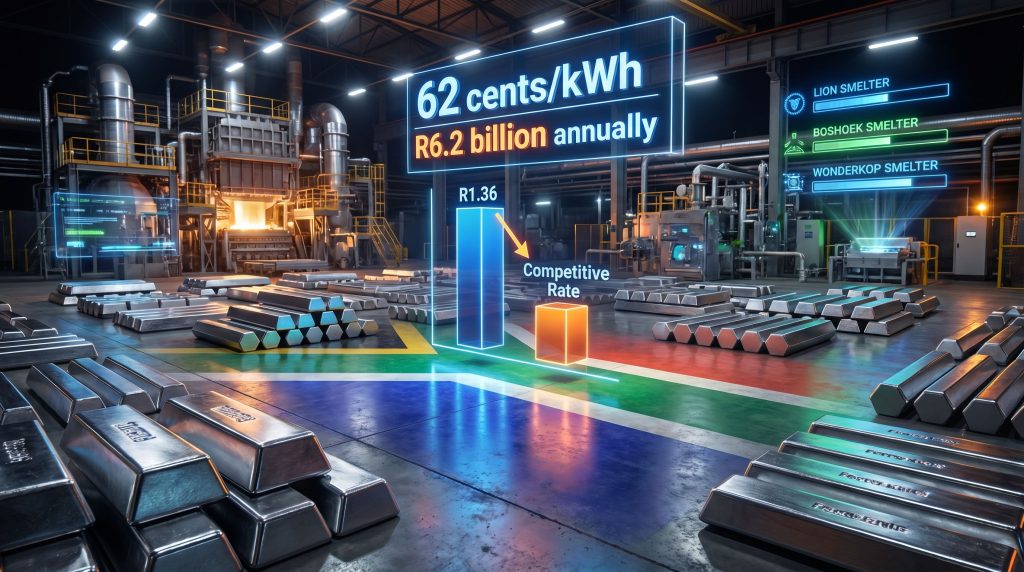
At the heart of the Glencore South Africa energy deal lies a radical tariff reset, with the new proposed electricity rate at 62 South African cents/kWh—a 54% reduction from recent levels. This is not simply a rate cut, but a structural bridge, staking out a new cost framework for the entire industry.
Essentials of the Agreement:
| Metric | Value |
|---|---|
| Proposed electricity tariff | 62 cents/kWh |
| Previous interim tariff | 87.44 cents/kWh |
| Historic end-2025 tariff | 135.82 cents/kWh |
| Reduction from interim rate | ~54% |
| Lion Smelter's break-even threshold | 87 cents/kWh |
| Industry-wide viability threshold | 62 cents/kWh |
| Annual electricity usage (2 majors) | ~10 TWh |
| Annual Eskom revenue at new rate | R6.2 billion |
| Tariff commitment duration | 5 years |
The crucial economic insight is that the 62 cents/kWh rate does not create windfall profits—it simply covers operational costs at prevailing chrome prices, keeping plants open and maintaining jobs. Furthermore, previously profitable alternatives, such as chrome ore exports, would have left South Africa with diminished beneficiation capacity.
From the utility's perspective, the deal locks in billions in annual revenue, whereas smelter closures would see Eskom holding excess grid capacity and lost income. Importantly, the agreement is structured so that the cost difference from previous prices is absorbed by Eskom, and not directly passed on to ordinary consumers.
How Does the Risk-Sharing Model Protect Both Parties?
Unlike static supply contracts, the Glencore South Africa energy deal features a sophisticated risk-sharing matrix to spread commercial uncertainty.
Key Risk-Sharing Features:
- Profit-sharing: If market conditions improve and Glencore smelters become profitable, Eskom will receive a share of the gain.
- Take-or-pay clauses: Smelters commit to a guaranteed energy purchase volume, ensuring Eskom's baseline revenue.
- Load factor commitments: Minimum consumption levels reduce the risk of grid instability and allow better operational planning for Eskom.
- Five-year fixed tariff: Supports both parties' investment and operational planning.
Risk/Reward Framework Table:
| Risk Factor | Eskom Protection | Glencore Protection |
|---|---|---|
| Revenue shortfall | Take-or-pay clauses | Low fixed rates, cost certainty |
| Market upturn | Profit-sharing | Retains some upside |
| Grid stability | Consumption commitment | Flexible load management |
This design ensures both public and private stakeholders share accountability and benefit, a model that could have wider applications in other energy-intensive sectors.
Which Smelting Operations Benefit Most from Energy Relief?
The transformative power of the tariff appears unevenly across Glencore's South African ferrochrome portfolio, reflecting plant age, efficiency, and prior investment in technology.
Facility-Level Snapshot:
| Facility | Status | Restart Date | Key Threshold | Production Potential |
|---|---|---|---|---|
| Lion Smelter | Active | 18 Feb 2026 | 87c/kWh | Immediate |
| Boshoek Smelter | Suspended | Post-NERSA approval | 62c/kWh | Rapid restart possible |
| Wonderkop Smelter | Suspended | Post-NERSA approval | 62c/kWh | Rapid restart possible |
Industry-Wide Capacity Impact:
- Current production: ~1 million tonnes/year (2025)
- Maximum restored capacity: Up to 4.5 million tonnes/year (combining all reopened major smelters)
Lion Smelter, due to its modern technology, operates viably even at the interim rate of 87.44 cents/kWh. In contrast, Boshoek and Wonderkop require the full implementation of the 62 cents/kWh tariff to achieve break-even. Glencore delayed retrenchments across these operations pending final regulatory approval, underscoring the deal's significance for at-risk jobs—estimated at 1,500 direct roles.
What Are the Broader Industry Implications?
South Africa's return to cost-competitive ferrochrome production could ripple across global supply chains, with both immediate pricing and longer-term structural shifts. However, this transformation occurs within a complex environment where tariffs impact markets and global trade dynamics.
Global Market Rebalancing:
- China: Inner Mongolian ferrochrome producers have relied on lower energy costs and fragmented competition but will face new pressure from South African smelter restarts.
- South Africa: Scale and higher efficiency among just two major companies may outcompete smaller and less-efficient Chinese rivals if energy parity is achieved.
- Supply perspectives: Restoration of up to 4.5 million tonnes per year could stabilise or moderate global price spikes, challenging previously dominant Asian suppliers.
- Long-term innovation: South African operators indicate that only continual investment in process efficiency and alternative tech (like hydrogen or renewables) will secure ongoing competitiveness, especially if Chinese power costs fall further.
These dynamics highlight how energy policy is not only a localised operational concern but a lever for international resource market shifts. Moreover, as the industry explores decarbonisation benefits, these energy transitions become increasingly strategic.
How Does the Renewable Energy Agreement Support Long-Term Strategy?
In parallel, Glencore's 20-year renewable energy deal with Discovery Green for South African coal mining operations showcases a forward-thinking commitment to sustainability and risk management. This agreement exemplifies the renewable energy transformations occurring across the mining sector.
Renewable Integration Overview:
- Coverage: Solar and wind generation for the Goedgevonden, Tweefontein, iMpunzi, and eMalahleni mining complexes
- Volume: Over 290 GWh/year clean energy supplied
- Impact: Stabilises input costs, hedges against fossil fuel price volatility, and strengthens compliance with tightening emissions frameworks
Strategic Advantages:
- Diversified sourcing blends grid and off-grid power, increasing reliability
- Demonstrates a working model for extensive private-sector procurement of renewables in an economy frequently hindered by power shortages and aging coal infrastructure
- Positions Glencore as a credible transition leader in South African mining
These advances suggest that renewables are not just a public relations move but an operational lever aligned with international competitiveness and regulatory resilience. Furthermore, this commitment aligns with South Africa's broader aspirations for green metals leadership in global markets.
The next major ASX story will hit our subscribers first
What Challenges Remain for Implementation?
Despite announcements and provisional agreements, several operational and compliance hurdles loom over the realisation of the Glencore South Africa energy deal.
Implementation Risks:
- Regulatory approval: The tariff is pending final sign-off by NERSA, with timelines subject to bureaucratic unpredictability
- Grid stability: Managing the synchronised ramp-up of smelter loads with South Africa's constrained and often unreliable power system
- Tariff sustainability: Eskom's generation costs for coal-fired electricity are estimated around 80 cents/kWh, below the new rate—raising questions on the long-term viability of offering power at a loss
- Workforce and technical upgrades: Restarting idled facilities often requires new investment in plant refurbishment, training, and supply chain realignment
Uncertainty around government capacity to continue subsidising or sustaining these rates beyond five years is notable, as is the risk of further market or technical shocks. Additionally, the energy transition in mining requires careful coordination between traditional energy sources and renewable alternatives.
Why Is Government Intervention Economically Justified?
While some have questioned the cost of subsidising energy for large industrial consumers, the broader rationale hinges on safeguarding the nation's industrial and labour base.
Key Economic Findings:
- Employment preservation: About 1,500 direct jobs (plus indirect roles in services and supply chains) protected from redundancy
- Export revenues: Sustained foreign currency inflows by avoiding a shift to raw ore exports or full closure of local processing
- Industrial ecosystem: Downstream manufacturing reliant on local ferrochrome sustains key segments of national GDP
- Grid planning: Predictable, high-volume industrial energy consumption aids system forecasting and investment planning
If smelters were shuttered, the government and Eskom would lose revenue while being forced to maintain spare grid capacity, likely leading to more frequent power curtailments affecting a much broader swath of the economy.
How Will This Affect Global Ferrochrome Markets?
With the reactivation of South African ferrochrome production, global supply chains and price discovery mechanisms are set for significant adjustment.
Projected Market Effects:
- Increased competition: Efficient South African output at low tariffs will pressure marginal or high-cost producers, especially in China
- Downward price pressure: Additional capacity could moderate recent price gains, particularly as global inventories normalise
- Technology race: Both South African and global peers will need to accelerate process improvements to remain viable at lower price bands
- Supply chain balance: Greater geographic diversity of supply reduces reliance on any single mining region and supports greater price stability
However, these projections assume stable energy pricing and continued policy support, both of which are vulnerable to future market or political developments. Consequently, investors should evaluate exposure to regulatory risk, currency fluctuations, and potential divergence in global energy transition speeds.
What Does This Mean for Future Energy Policy?
Glencore's dual energy agendas—tariff negotiations for smelting and renewable procurement for mining—demonstrate a sophisticated template for balancing immediate industrial needs against long-term transformation.
Policy Lessons:
- Competitive industrial energy pricing is essential for maintaining a globally relevant beneficiation sector
- Grid modernisation and flexibility are prerequisites for supporting large, variable industrial loads alongside intermittent renewables
- Corporate procurement of renewables can lower system risk and provide stable supply in environments dominated by legacy coal or unreliable infrastructure
- Industrial policy, energy frameworks, and employment must be aligned to prevent sectoral collapse and maximise national developmental outcomes
These insights underscore the importance of harmonising sectoral interests with national strategic goals, pointing towards a model where industrial energy policy isn't static but dynamically tailored to retain competitive advantage into the future. As the mining industry continues to evolve, the Mining Weekly report highlights how such partnerships are becoming increasingly vital for long-term sustainability.
For instance, this approach offers valuable lessons for other sectors grappling with similar challenges, demonstrating how strategic energy partnerships can support both immediate operational needs and longer-term decarbonisation goals. In addition, the Glencore South Africa energy deal serves as a blueprint for how mining companies can navigate the complex balance between cost competitiveness and environmental responsibility in emerging markets.
Disclaimer: All statistics and timelines are based on industry reports and public statements as of April 2026; regulatory outcomes, market performance, and financial viability remain subject to material uncertainties and may evolve as new data emerges.
Looking to Capitalise on Energy-Driven Mining Opportunities?
Discovery Alert's proprietary Discovery IQ model delivers real-time alerts on significant ASX mineral discoveries, including those in the energy transition metals sector that are reshaping global supply chains. With major energy deals like Glencore's transforming mining economics worldwide, subscribers gain instant insights into actionable ASX opportunities that could benefit from similar industry shifts, ensuring you're positioned ahead of the broader market when the next breakthrough discovery is announced.