
August 14, 2026
What Makes Global Energy Infrastructure So Vulnerable to Single Chokepoint Failures?
The modern world's appetite for energy has created a complex web of dependencies that few recognise until disruption strikes. Maritime trade routes, particularly narrow waterways that funnel massive volumes of crude oil between continents, represent perhaps the most fragile links in the global energy supply chain. A strait of hormuz oil disruption transforms regional conflicts into worldwide economic threats, demonstrating how physical geography continues to shape geopolitical power structures in an interconnected economy.
Understanding chokepoint vulnerabilities requires examining both the scale of energy flows and the limited alternatives available when primary routes face closure. The concentration of oil transit through specific waterways creates systemic risks that reverberate far beyond immediate shipping disruptions, affecting everything from consumer prices to monetary policy decisions across multiple continents.
Geographic Vulnerability and Strategic Importance
The Strait of Hormuz exemplifies how geographic constraints create disproportionate influence over global energy markets. This narrow passage, approximately 33 miles wide at its broadest point with shipping lanes compressed to just 2.4 nautical miles in critical sections, serves as the primary transit route for roughly 20 percent of globally traded petroleum. The waterway connects Persian Gulf producers with Asian markets, creating an essential corridor that cannot be easily bypassed.
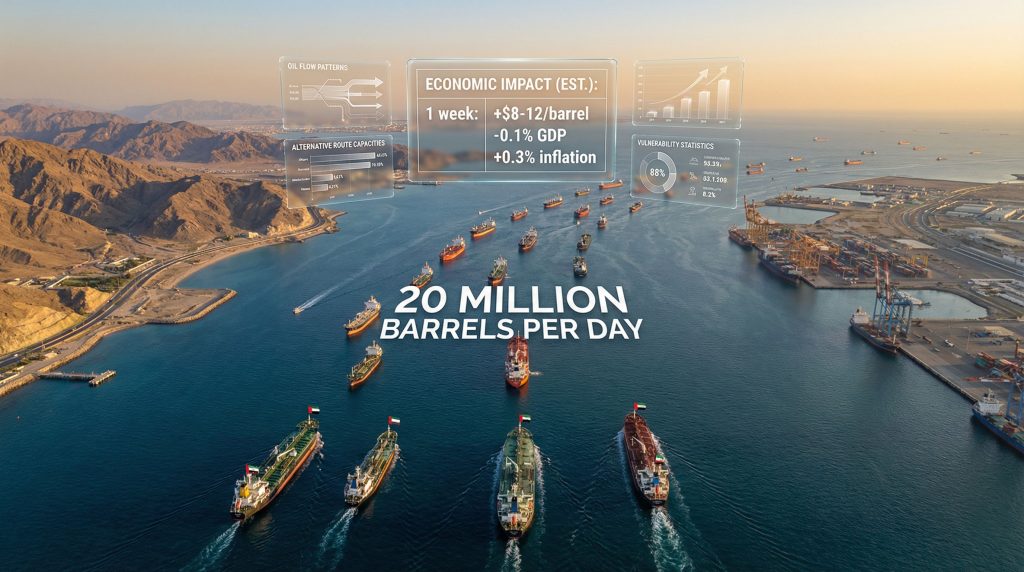
Daily transit volumes through the strait reach approximately 20 million barrels, representing flows that dwarf the strategic petroleum reserves of most importing nations. The concentration of such massive energy volumes through a single geographic point creates what strategists term a "single point of failure" in global supply chains.
Recent events have demonstrated the immediate market impact of chokepoint threats. Following military strikes on Iran in March 2026, oil tanker traffic through the strait experienced significant disruption, with one vessel bombed and traffic nearly halted according to market reports. This physical disruption triggered immediate price responses even before actual supply shortages materialised, highlighting how a strait of hormuz oil disruption can create instant global economic consequences.
The strategic positioning of the strait between Iran to the north and Oman plus the United Arab Emirates to the south creates additional complexity. Multiple nations control different sections of the waterway, meaning diplomatic resolution of transit disputes requires coordination among parties that may have conflicting interests during regional tensions.
Furthermore, analyses of Asian oil supply vulnerabilities demonstrate how chokepoint dependencies create asymmetric risks across different regions and economic sectors.
Historical Precedents of Maritime Energy Disruptions
Energy chokepoint closures have repeatedly triggered global economic crises throughout modern history. The 1973 oil embargo demonstrated how coordinated supply restrictions could reshape international relations, as major Middle East producers slashed supply to influence US foreign policy, causing prices to quadruple and economies to stall.
These historical precedents established the template for understanding how energy leverage operates in international relations. Unlike most commodities, oil's energy density and limited producer base create unique opportunities for supply manipulation that can achieve geopolitical objectives beyond simple commercial considerations.
Insurance markets provide another lens for understanding chokepoint vulnerability. War risk premiums increase substantially when tensions escalate near critical shipping lanes, effectively pricing geopolitical risk into energy costs before physical disruptions occur. Lloyd's of London and other major underwriters adjust coverage terms and pricing based on threat assessments that factor in both probability and magnitude of potential disruptions.
When big ASX news breaks, our subscribers know first
How Do Oil Supply Disruptions Trigger Global Economic Cascades?
Energy price shocks operate through multiple transmission mechanisms that amplify initial disruptions into broader economic impacts. Unlike localised supply chain interruptions, oil market disruptions affect virtually every sector of the economy through both direct energy costs and indirect effects on transportation, logistics, and manufacturing inputs.
The speed and magnitude of these cascade effects depend on several factors: the duration of supply disruption, the availability of strategic reserves, the flexibility of alternative supply sources, and the overall state of global demand relative to available production capacity.
Price Transmission Mechanisms in Global Markets
Oil markets exhibit forward-looking pricing behaviour that incorporates not only current supply and demand fundamentals but also expectations about future availability. This characteristic means markets reflect both present conditions and anticipated disruptions, creating price volatility that can exceed the scale of actual supply shortages.
Current market conditions illustrate this dynamic clearly. Brent crude prices increased from approximately US$68 per barrel to US$76 per barrel within weeks of escalating Middle East tensions in early 2026, representing an 11.7 percent increase despite limited immediate supply impacts. This pricing reflects risk premiums that traders build into contracts when geopolitical instability threatens major production or transit regions.
In addition, detailed energy security impact assessments show how strait of hormuz oil disruption scenarios affect broader asset prices beyond oil markets.
Key Price Transmission Pathways:
• Upstream effects: Crude oil cost increases raise refinery feedstock expenses
• Midstream effects: Transportation and logistics costs rise with fuel prices
• Downstream effects: Retail fuel prices increase with typical lag times of 2-4 weeks
• Secondary effects: Higher freight costs increase food prices, broadening inflation pressure
Regional price differentials also create arbitrage opportunities during disruptions. When specific supply routes face closure, price spreads between different crude oil benchmarks can widen significantly, encouraging inventory builds in some regions while depleting stocks in others.
Macroeconomic Multiplier Effects
Energy price shocks generate multiplier effects throughout economic systems that often exceed the direct cost of higher fuel prices. Transportation-intensive sectors experience immediate margin pressure, while manufacturers face increased input costs that eventually translate into consumer price increases.
The following table illustrates potential economic impact scenarios based on disruption duration and severity:
| Disruption Duration | Oil Price Impact | Global GDP Effect | Inflation Increase |
|---|---|---|---|
| 1 week | +$8-12/barrel | -0.1% | +0.3% |
| 1 month | +$20-30/barrel | -0.5% | +0.8% |
| 3+ months | +$40-60/barrel | -1.2% | +1.5% |
Central bank responses to energy-driven inflation create additional economic effects. Monetary policy adjustments intended to contain price pressures can amplify the recessionary impact of energy shocks, creating a policy dilemma between controlling inflation and maintaining economic growth.
Consumer behaviour also contributes to price amplification during supply disruptions. Anticipatory demand, such as the long queues reported in Australia as motorists rushed to fill up before possible price spikes, can create temporary shortages even when underlying supply remains adequate.
Which Nations Are Most Vulnerable to Persian Gulf Supply Disruptions?
Import dependency creates asymmetric vulnerability to supply disruptions, with some nations facing existential energy security challenges while others maintain greater resilience through diversified supply sources or domestic production capacity. Understanding these vulnerabilities requires analysing both the scale of import dependence and the availability of alternative supply routes.
The geographic concentration of oil reserves in politically unstable regions compounds these vulnerabilities. Nations that rely heavily on Persian Gulf imports face not only supply disruption risks but also price volatility driven by regional conflicts that may not directly affect their primary suppliers.
Asian Import Dependency Analysis
Asian economies demonstrate some of the world's highest vulnerability levels to Persian Gulf supply disruptions due to their combination of high import dependence and limited alternative supply routes. China imports most of its oil, with significant volumes sourced from Iran, creating both supply security concerns and sanctions compliance challenges.
China's evolving energy profile offers insights into how major importers can reduce vulnerability over time. Electric vehicles comprised 50 percent of new car sales in China during 2025, with EVs representing 12 percent of the total vehicle fleet. This rapid electrification shift has begun changing oil demand patterns, with China increasingly using oil for plastics production rather than transportation.
However, these positive trends must be balanced against ongoing challenges, as demonstrated by recent developments in Venezuela oil policy impact on global supply chains.
Key Asian Vulnerability Indicators:
• China: 84% crude import reliance on Gulf supplies, though EV adoption reducing transport demand
• Japan: Approximately 90% crude import dependence with limited domestic alternatives
• South Korea: 95% import dependence with concentrated supply source exposure
• India: 80% import dependence, strategic reserves provide 30-60 day buffer capacity
India's experience during the 2015 Nepal oil import blockade illustrates how supply disruptions can accelerate policy responses. Following the disruption that triggered chaos, authorities encouraged rapid electric vehicle growth, leading to declining oil imports in subsequent years.
Alternative Supply Route Limitations
Physical infrastructure constraints limit the ability of alternative routes to compensate for major chokepoint closures. Even operating at maximum capacity, existing bypass infrastructure cannot accommodate the full volume of strait transit during extended closures.
Current Alternative Route Capacities:
• Saudi East-West Pipeline: 7 million barrels per day maximum capacity
• UAE Fujairah bypass infrastructure: 1.8 million barrels per day capacity
• Combined alternative capacity: ~8.8 million barrels per day
• Remaining vulnerable volume: ~11.2 million barrels per day with no viable alternatives
Critical Infrastructure Gap: Even with maximum bypass capacity utilisation, approximately 18 million barrels per day remain vulnerable to Strait closures, representing an insurmountable supply gap through alternative routes.
Cape of Good Hope routing provides an additional alternative but introduces significant complications. This route adds 7-10 additional transit days compared to direct Persian Gulf routing, increasing:
• Insurance costs due to extended voyage exposure
• Fuel consumption for longer journey distances
• Working capital requirements for inventory in transit
• Overall transportation costs that ultimately affect end-user prices
Why Are Countries Accelerating Energy Independence Strategies?
The intersection of energy security and national security has created powerful incentives for countries to reduce import dependence through domestic alternatives. Recent geopolitical developments have accelerated these trends, with nations pursuing energy independence not primarily for environmental reasons but as strategic security imperatives.
This shift represents a fundamental change in how governments conceptualise energy policy. Rather than focusing solely on cost optimisation or emissions reduction, policymakers increasingly view energy independence as essential for maintaining economic sovereignty and reducing vulnerability to external coercion.
Renewable Energy as Geopolitical Shield
Renewable energy technologies offer unique advantages for energy security that distinguish them from fossil fuel alternatives. Unlike oil or natural gas, renewable energy sources cannot be weaponised through supply restrictions or subjected to transportation chokepoint vulnerabilities.
Cuba's energy transition exemplifies crisis-driven renewable adoption. Facing severe oil supply restrictions due to US pressure and reduced Venezuelan exports, Cuba has implemented emergency renewable energy deployment. Solar panel imports increased by 34 times compared to the previous year as authorities and businesses sought alternatives to imported petroleum.
According to economic analysis, Cuba may experience among the world's fastest energy transitions due to necessity rather than policy choice. This demonstrates how supply crises can accelerate renewable adoption far beyond normal market-driven timelines.
Moreover, countries are learning from oil price rally insights that show how trade policies and geopolitical tensions create additional price volatility beyond fundamental supply and demand factors.
Decentralised Generation Advantages:
• Supply chain resilience: Solar panels and wind turbines avoid maritime chokepoint vulnerabilities
• Distributed risk: Multiple generation sites prevent single-point-of-failure scenarios
• Local control: Power generation occurs within national boundaries, reducing foreign dependency
• Scalable deployment: Renewable capacity can be added incrementally without major infrastructure investments
Ukraine's wartime experience illustrates the strategic military advantages of decentralised renewable energy. Russia has systematically targeted centralised power plants and energy infrastructure during the conflict. In response, Ukraine has accelerated renewable deployment because distributed wind and solar installations require significantly more resources to destroy than centralised fossil fuel plants.
Electric Vehicle Adoption as Security Policy
Transportation electrification represents one of the most effective strategies for reducing oil import vulnerability. Electric vehicles powered by domestically-generated electricity eliminate exposure to global petroleum markets while providing additional benefits for grid stability and energy storage.
Ethiopia's comprehensive approach demonstrates how emerging economies can leapfrog traditional transportation infrastructure. The country banned new internal combustion engine vehicle sales, forcing rapid EV adoption while simultaneously developing renewable electricity capacity to power the emerging electric vehicle fleet.
China's experience provides data on the potential scale and speed of transportation electrification. With 50 percent of new vehicle sales being electric in 2025, China has demonstrated that rapid EV adoption can occur even in large markets with established automotive industries.
Furthermore, technological advances such as the battery recycling breakthrough are addressing concerns about critical mineral dependencies in clean energy systems.
EV Adoption Security Benefits:
• Import substitution: Domestic electricity replaces imported petroleum for transportation
• Price stability: Local power generation provides more predictable energy costs than volatile oil markets
• Grid integration: Vehicle batteries can provide distributed energy storage capacity
• Strategic autonomy: Reduced dependence on politically unstable oil-producing regions
What Are the Most Effective Oil Dependency Reduction Models?
Successful energy transition strategies require coordinated approaches that address both immediate vulnerability reduction and long-term structural changes. The most effective models combine multiple technologies and policy instruments while maintaining economic competitiveness during the transition period.
Different countries have achieved energy independence through varying combinations of renewable energy deployment, transportation electrification, industrial efficiency improvements, and strategic reserve management. Understanding these diverse approaches provides insights for other nations seeking to reduce import dependence.
Crisis-Driven Energy Transitions
Emergency situations often accelerate energy transitions by overcoming normal policy inertia and creating political support for rapid change. These crisis-driven transitions provide valuable data on the maximum possible speed of energy system transformation when political will and economic necessity align.
Cuba's Rapid Solar Deployment represents perhaps the most dramatic example of crisis-driven renewable adoption. Facing severe petroleum shortages, the country implemented emergency solar installation programmes that achieved 34-fold increases in panel imports within a single year. This transition occurred despite Cuba's limited financial resources, demonstrating that energy security concerns can overcome traditional investment constraints.
Ukraine's Wartime Energy Strategy offers insights into how military conflict can reshape energy priorities. Facing systematic attacks on centralised power infrastructure, Ukraine has prioritised distributed renewable energy deployment specifically for its resilience characteristics rather than cost or environmental considerations.
Ethiopia's Transportation Revolution illustrates how developing countries can implement comprehensive electrification policies. By banning internal combustion engine vehicle imports, Ethiopia has forced rapid EV adoption while simultaneously developing domestic renewable energy capacity to support electric transportation.
China's Strategic Pivot from Transport to Petrochemicals
China's energy transition demonstrates how large economies can systematically reduce oil import vulnerability while maintaining industrial competitiveness. Rather than eliminating oil use entirely, China has strategically shifted oil consumption from transportation to higher-value industrial applications.
Transportation Electrification Progress:
• 50% of new vehicle sales are electric vehicles as of 2025
• 12% of total vehicle fleet is now electric-powered
• Rapid charging infrastructure deployment supporting nationwide EV adoption
• Manufacturing scale advantages reducing EV costs below internal combustion alternatives
This transportation shift has enabled China to redirect oil consumption toward plastics and petrochemical production, maintaining import volumes while reducing strategic vulnerability. Petrochemical production provides higher economic value than transportation fuel while offering more flexibility for inventory management during supply disruptions.
Strategic stockpiling behaviour has also characterised China's approach. Recent import increases reflected stockpiling of huge volumes amid global uncertainty rather than increased consumption, providing buffer capacity against future supply disruptions.
Consequently, these developments are interconnected with broader issues including trade war market impact on global energy flows and pricing mechanisms.
How Do Energy Security Strategies Differ Across Economic Development Levels?
Economic development levels significantly influence both energy security vulnerabilities and available response options. Developed economies typically possess greater financial resources and technological capabilities for rapid energy transitions, while developing countries often face capital constraints that limit their adaptation options.
However, developing countries sometimes achieve faster relative transitions by avoiding legacy infrastructure investments and implementing more comprehensive policy changes. Understanding these development-level differences provides insights for tailoring energy security strategies to national circumstances.
Developed Economy Approaches
Advanced economies generally pursue energy independence through technology-intensive strategies that leverage their financial and technological advantages. These approaches typically involve significant upfront investments in renewable energy infrastructure, electric vehicle charging networks, and smart grid technologies.
Technology-Driven Transition Pathways in developed countries emphasise:
• Advanced manufacturing capabilities for renewable energy equipment and electric vehicles
• Sophisticated financial markets that can mobilise large-scale clean energy investments
• Research and development infrastructure supporting next-generation energy technologies
• Regulatory frameworks that can coordinate complex multi-sector transitions
Policy coordination mechanisms in developed countries often integrate climate objectives with energy security goals, creating political coalitions that support renewable energy deployment. This dual motivation can accelerate transitions beyond what either objective might achieve independently.
Emerging Market Adaptation Strategies
Developing countries face unique constraints in pursuing energy independence but also possess certain advantages that can enable rapid transitions. Limited existing fossil fuel infrastructure can actually facilitate faster renewable energy deployment by avoiding stranded asset concerns.
Resource constraint navigation requires emerging markets to prioritise investments with multiple benefits. Renewable energy projects that simultaneously address energy security, economic development, and environmental objectives receive priority in resource allocation decisions.
International financing mechanisms play crucial roles in emerging market energy transitions. Multilateral development banks, climate finance facilities, and bilateral development cooperation provide capital that domestic resources cannot support independently.
Leapfrogging opportunities allow developing countries to bypass intermediate technology stages and implement advanced energy systems from the outset. This approach can actually result in more modern and efficient energy infrastructure than gradual upgrade processes in developed countries.
These challenges are particularly relevant when considering energy export challenges facing resource-rich nations adapting to changing global demand patterns.
The next major ASX story will hit our subscribers first
What Role Does Energy Infrastructure Resilience Play in National Security?
Modern national security analysis increasingly incorporates energy infrastructure resilience as a core component of strategic planning. The vulnerability of centralised energy systems to both physical attack and cyber disruption has elevated energy security to the same priority level as traditional defence considerations.
Infrastructure resilience extends beyond simple redundancy to encompass adaptive capacity, rapid recovery capabilities, and distributed design principles that minimise single points of failure. Understanding these resilience characteristics provides insights into how energy systems can support broader national security objectives.
Centralised vs. Decentralised System Vulnerabilities
Traditional energy systems concentrated around large power plants and centralised distribution networks create inherent vulnerabilities that distributed alternatives can address. The trade-offs between centralised efficiency and distributed resilience represent fundamental design choices in energy system architecture.
Centralised System Vulnerabilities:
• Single-point-of-failure risks where individual plant closures affect large populations
• Transmission line vulnerabilities that can isolate entire regions during disruptions
• Concentrated target profiles that facilitate both physical and cyber attacks
• Extended recovery times due to complex interdependencies and specialised equipment requirements
Distributed System Advantages:
• Resilient degradation where individual unit failures minimally affect overall system performance
• Reduced attack surface requiring multiple coordinated actions to achieve system-wide disruption
• Faster recovery capability through modular replacement and repair processes
• Local control systems that can operate independently during broader network disruptions
Ukraine's wartime experience provides practical evidence for these theoretical advantages. Ukrainian energy officials report that destroying a wind farm requires approximately 40 missiles compared to single missile capability against coal power stations. This demonstrates the tactical advantages of distributed energy generation during military conflict.
Critical Mineral Dependencies in Clean Energy Systems
Renewable energy systems create new forms of strategic mineral dependencies that differ from but do not eliminate resource security concerns. Understanding these dependencies is crucial for developing comprehensive energy security strategies that address both fossil fuel vulnerabilities and clean energy supply chain risks.
Critical Mineral Concentrations:
• Lithium processing concentrated in China and Chile for battery manufacturing
• Rare earth mining dominated by China for wind turbine and solar panel production
• Cobalt supplies heavily dependent on Democratic Republic of Congo with political instability risks
• Copper demand increasing substantially for electrical infrastructure and renewable energy equipment
Supply Chain Diversification Strategies include:
• Geographic diversification of mining and processing operations to reduce single-country dependencies
• Recycling infrastructure development to create circular economy approaches for critical minerals
• Strategic stockpiling of essential materials to provide buffer capacity during supply disruptions
• Alternative technology development that reduces dependence on scarce or geopolitically sensitive materials
How Are Financial Markets Pricing Long-Term Energy Security Risks?
Capital markets increasingly incorporate energy security considerations into investment allocation decisions, creating market-based incentives for energy independence strategies. Understanding these financial market dynamics provides insights into the economic forces driving energy transitions beyond government policy initiatives.
Investment flows toward renewable energy infrastructure and away from fossil fuel projects reflect both risk assessment evolution and return expectation changes. These market-driven allocation shifts complement and sometimes exceed policy-driven incentives for energy independence.
Investment Flow Patterns in Energy Transition
Global capital allocation increasingly favours energy projects that provide security benefits alongside financial returns. This trend reflects institutional investor recognition that energy security risks affect portfolio performance across multiple sectors and geographic regions.
Renewable Energy Investment Drivers:
• Reduced regulatory risk compared to fossil fuel projects facing potential restrictions
• Predictable operating costs without fuel price volatility or supply disruption exposure
• Long-term contract availability providing stable revenue streams for infrastructure investors
• ESG mandate compliance meeting environmental, social, and governance investment criteria
Risk-adjusted return calculations increasingly factor in geopolitical stability when evaluating energy infrastructure investments. Projects in politically stable regions with diversified supply chains command premium valuations compared to investments with geopolitical exposure.
Sovereign Wealth Fund Energy Strategy Evolution
Gulf state sovereign wealth funds provide particularly interesting examples of how oil-producing countries are hedging their own energy export strategies through renewable energy investments. These funds recognise that global oil demand may peak within decades, creating incentives for economic diversification.
Strategic Hedging Mechanisms:
• Renewable energy technology investments that position funds to benefit from global energy transitions
• Battery and energy storage development supporting grid integration of renewable power
• Electric vehicle manufacturing investments capturing value in transportation electrification
• Green hydrogen production capabilities creating new export opportunities for renewable energy
Oil price volatility management through sovereign wealth funds increasingly involves investments in technologies that reduce global oil demand over time. This seemingly counterintuitive strategy reflects long-term thinking about sustainable revenue streams beyond petroleum exports.
What Are the Implications for Global Energy Trade Architecture?
The global energy trade system developed around fossil fuel movements is undergoing fundamental restructuring as renewable energy deployment reduces import dependence. This transition affects not only bilateral trade relationships but also multilateral institutions and international cooperation mechanisms.
Understanding these architectural changes provides insights into how international energy governance may evolve as countries achieve greater energy independence through domestic renewable resources.
Bilateral Energy Partnership Restructuring
Traditional energy partnerships based on long-term oil and gas contracts are giving way to technology-focused cooperation agreements that emphasise renewable energy development, equipment manufacturing, and technical expertise sharing.
Evolving Partnership Models:
• Technology transfer agreements replacing simple commodity purchase contracts
• Joint renewable energy projects enabling shared risk and expertise development
• Manufacturing cooperation for solar panels, wind turbines, and battery systems
• Grid integration collaboration supporting cross-border renewable energy trade
Long-term contract renegotiation trends reflect changing demand patterns and supply security priorities. Traditional 20-30 year fossil fuel contracts face pressure for modification as buyers seek greater flexibility and suppliers adapt to declining demand projections.
Multilateral Institution Adaptation
International energy governance institutions originally designed around oil and gas trade patterns are adapting to address renewable energy cooperation and energy security in a decarbonising world.
International Energy Agency evolution includes expanded focus on:
• Renewable energy deployment coordination among member countries
• Critical mineral supply chain security for clean energy technologies
• Grid integration standards supporting international renewable energy trade
• Energy storage coordination enabling grid stability with variable renewable sources
OPEC+ coordination mechanisms face fundamental challenges as global oil demand patterns shift toward petrochemical applications and away from transportation fuel. These changes may require new approaches to production coordination that account for changing demand characteristics.
How Should Investors Position for the Energy Security Transformation?
The intersection of energy security imperatives and technological advancement creates both opportunities and risks for investors seeking to capitalise on global energy system transformation. Understanding these dynamics requires analysing both sector-specific trends and broader geopolitical developments that influence investment returns.
Successful investment strategies must account for the varying pace of energy transitions across different regions and sectors while recognising that security-driven policy changes can accelerate transitions beyond normal market-driven timelines.
Sector Allocation Strategy Framework
Energy security investment themes span multiple sectors and require portfolio approaches that capture both direct technology benefits and indirect security value creation. The most effective strategies combine exposure to enabling technologies with geographic diversification that reduces geopolitical concentration risks.
Renewable Energy Infrastructure Opportunities:
• Utility-scale solar and wind projects in politically stable regions with strong regulatory frameworks
• Distributed generation systems that provide resilience benefits alongside cost advantages
• Energy storage deployment supporting grid stability and renewable energy integration
• Transmission infrastructure enabling renewable energy trade across regions
Energy Storage Technology Development represents a critical enabling sector for renewable energy deployment and grid resilience. Investment opportunities include:
• Battery manufacturing for both grid-scale and transportation applications
• Advanced storage technologies including compressed air, pumped hydro, and hydrogen systems
• Smart grid infrastructure managing distributed energy resources and storage coordination
• Vehicle-to-grid integration utilising electric vehicle batteries for grid services
Traditional Energy Sector Transition Assessment requires careful analysis of stranded asset risks and transformation opportunities:
• Oil and gas companies investing in renewable energy and carbon capture technologies
• Utilities transitioning from fossil fuel generation to renewable energy portfolios
• Transportation fuel distributors adapting to electric vehicle charging infrastructure requirements
• Petrochemical producers benefiting from oil demand shifts away from transportation
Geographic Diversification Considerations
Energy security investments require geographic allocation strategies that balance return potential with political stability and regulatory predictability. The most attractive investment destinations combine renewable resource advantages with governance structures that support long-term infrastructure investments.
Resource-rich regions with stable governance provide opportunities for:
• Large-scale renewable energy development in countries with excellent solar and wind resources
• Critical mineral mining projects in politically stable jurisdictions with established regulatory frameworks
• Manufacturing hub development for renewable energy equipment in locations with competitive advantages
• Technology research and development in regions with strong intellectual property protection
Emerging market energy transition financing offers higher return potential but requires careful risk assessment:
• Development finance institution partnerships providing risk mitigation for infrastructure investments
• Blended finance structures combining commercial capital with concessional funding
• Local currency financing reducing exchange rate risks for domestic energy projects
• Policy risk insurance protecting against regulatory changes that affect project returns
The strait of hormuz oil disruption crisis has demonstrated why diversified energy security strategies require reducing petroleum dependence through renewable energy adoption, electric vehicle deployment, and decentralised power generation systems that eliminate single-point vulnerabilities in global supply chains. Investors who position for this transformation while maintaining geographic diversification and sector balance will benefit from both security-driven policy support and fundamental technological advancement.
Disclaimer: This analysis contains forward-looking statements and investment considerations based on current market conditions and policy trends. Investment decisions should be made in consultation with qualified financial advisors who can assess individual risk tolerance and investment objectives. Geopolitical developments and policy changes may significantly affect the performance of energy sector investments.
Seeking Exposure to Critical Mineral Discoveries Fuelling the Energy Transition?
Discovery Alert's proprietary Discovery IQ model delivers real-time alerts on significant ASX mineral discoveries, instantly empowering subscribers to identify actionable opportunities as energy security drives unprecedented demand for lithium, copper, and other critical minerals. Begin your 14-day free trial today and position yourself ahead of the market as the global energy transformation accelerates.