July 30, 2026
The Supply Chain Reckoning Reshaping How Resource States Compete
Something fundamental shifted in global industrial strategy when export restrictions on critical minerals began disrupting manufacturing pipelines across the United States, Europe, and East Asia. Advanced economies that had spent decades optimising for cost efficiency suddenly discovered the fragility embedded in geographically concentrated supply chains. The response has not been incremental. It has been structural, urgent, and increasingly focused on identifying stable, sovereign-governed jurisdictions with the geological endowment and industrial capacity to supply refined and processed materials at scale.
Queensland finds itself at precisely that intersection. The state's combination of multi-commodity mineral deposits, existing metallurgical infrastructure, and a skilled industrial workforce positions it as one of the few jurisdictions globally capable of meeting allied-nation demand across multiple critical mineral categories simultaneously. The Queensland critical minerals plan formalises this positioning into a funded, multi-year industrial strategy with a defined pathway from extraction to export-ready product.
When big ASX news breaks, our subscribers know first
Understanding What Makes a Mineral "Critical" and Why Queensland's Geology Matters
The term "critical mineral" carries specific technical and policy weight. These are materials identified by governments as essential to advanced manufacturing, clean energy infrastructure, and national defence systems, where supply concentration creates unacceptable geopolitical risk. The critical minerals demand driving this urgency includes cobalt, vanadium, rare earth elements, nickel, copper, phosphate, and various battery-grade materials.
What distinguishes Queensland from many competing jurisdictions is the geological breadth of its endowment. Rather than holding large deposits of a single commodity, the state hosts meaningful concentrations of multiple critical mineral categories across geologically diverse terrains.
- The North West Queensland Mineral Province, centred on Mount Isa, is one of the most significant polymetallic districts in the Southern Hemisphere, with established copper, cobalt, and phosphate mineralisation
- The Julia Creek and Richmond region hosts one of the world's largest known vanadium deposits, with grades and deposit scale that have attracted international processing interest
- Queensland's rare earth element occurrences span several prospective zones, adding a strategically important dimension to the state's mineral portfolio
A less commonly understood aspect of Queensland's competitive position is that geological diversity creates compounding investment advantages. A processing precinct that can handle multiple mineral streams achieves higher infrastructure utilisation rates than single-commodity facilities, improving project economics and attracting a broader range of downstream industrial partners.
The $146 Million Commitment: What the Queensland Critical Minerals Plan Actually Does
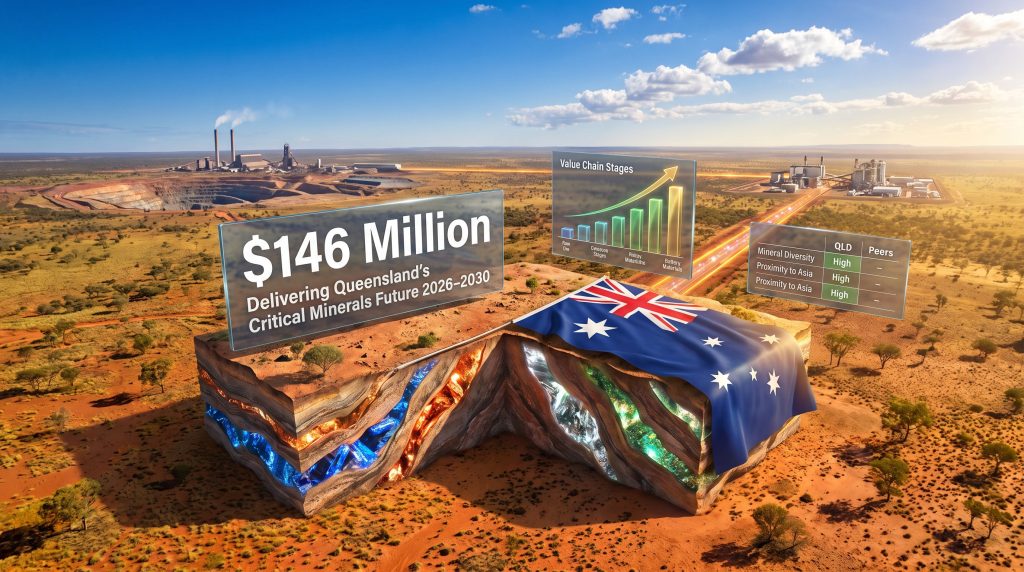
The Delivering Queensland's Critical Minerals Future 2026-2030 strategy represents a $146 million Budget commitment structured to support projects across the full mineral development lifecycle. This is not a single grant program or exploration incentive scheme. It is a coordinated policy architecture with distinct mechanisms targeting different points in the value chain.
The strategy is designed to accelerate Queensland's transformation from a raw material exporter into an integrated critical minerals supplier, with downstream processing and manufacturing investment at its core.
The 2026 plan builds directly on the $245 million Queensland Critical Minerals Strategy introduced in 2023, which established the foundational institutional and financial infrastructure still active today. Furthermore, the Queensland Critical Minerals Strategy outlines the broader policy framework underpinning this multi-year commitment.
Key Components of the 2026-2030 Plan
| Mechanism | Function |
|---|---|
| Critical Minerals Queensland Office | Industry facilitation, investor matchmaking, international engagement |
| Critical Minerals Zones (Julia Creek/Richmond; Mount Isa) | Clustered infrastructure precincts to reduce per-project development costs |
| Queensland Critical Minerals and Battery Technology Fund | $100 million targeted at mining, processing, refining, and battery technology |
| Research and ESG Programs | Mine-waste reprocessing, circular economy, and ESG capability investment |
| Exploration Rent Reduction | $0 exploration rents for five years, representing approximately $55 million in direct support |
The exploration rent reduction is a particularly significant structural lever. Junior explorers operating in Queensland's remote mineral provinces face substantial carrying costs before a project reaches feasibility study stage. Reducing exploration tenure costs to zero for five years meaningfully extends the runway for early-stage companies, increasing the probability that marginal but potentially significant deposits progress toward development.
The Zone Model: Why Co-Location Is a Critical Enabler
One of the more technically sophisticated elements of the Queensland critical minerals plan is its deliberate use of designated industrial zones as a development accelerant. The Julia Creek/Richmond and Mount Isa critical minerals zones are not simply geographic designations. They are designed as purpose-built economic precincts where shared infrastructure reduces the per-project capital burden that has historically prevented remote Queensland deposits from reaching commercial development.
The logic of industrial clustering in critical minerals development deserves closer examination:
- Infrastructure sharing: Water, power, transport, and processing facilities built to serve multiple projects simultaneously reduce the capital expenditure each project must raise independently
- Agglomeration effects: Clustering attracts downstream manufacturers and technology partners who require reliable, co-located feedstock supply
- Regulatory pathway efficiency: Zone-level environmental and planning frameworks can reduce the duplication of project-specific approval processes
- Workforce pooling: Shared regional labour markets reduce recruitment costs and support sustainable employment in communities that would otherwise lack the population base to support single-project operations
The Mount Isa zone is particularly notable because it already hosts established smelting and refining infrastructure that has operated continuously for decades. Repurposing existing metallurgical assets for critical mineral processing streams represents a capital-efficient alternative to greenfield facility construction, a consideration that significantly improves the economics of early-stage processing investment in the region.
Moving Beyond Ore Export: The Downstream Processing Imperative
The central strategic thesis of the Queensland critical minerals plan is that exporting unprocessed or minimally processed ore captures only a fraction of the economic value embedded in Queensland's mineral endowment. This is not merely a policy preference. It reflects a fundamental truth about where value accretes in modern mineral supply chains.
The progression from raw extraction to manufactured product follows a hierarchy that compounds in value at each stage:
- Raw ore extraction captures the lowest unit value but the highest extraction volume
- Beneficiation and concentration produces a mineral-rich product suitable for refining, achieving moderate value uplift
- Hydrometallurgical or pyrometallurgical refining converts concentrates into high-purity metals or compounds, generating significant margin
- Precursor chemical manufacturing produces battery-grade intermediate materials at substantially higher prices per tonne than refined metals
- Battery materials and advanced component manufacturing achieves maximum value capture, with pricing structures tied to performance specifications rather than commodity benchmarks
Australia's critical challenge in this hierarchy is well-documented: despite being the world's largest producer of lithium and a top-five producer of cobalt and rare earths, Australia's share of global processing and refining capacity remains disproportionately small relative to its in-ground resource base. China currently dominates rare earth refining at approximately 85-90% of global separation capacity, and controls a substantial share of lithium hydroxide and cobalt sulphate production used in battery manufacturing.
Queensland's plan directly targets this gap by prioritising investment in processing steps 3 through 5, leveraging the state's existing industrial base to avoid the greenfield infrastructure costs that make downstream investment prohibitive for most emerging mineral jurisdictions. In addition, the green metals innovation fund complements this approach by channelling national capital toward exactly these higher-order processing capabilities.
Vanadium and the Underappreciated Strategic Asset at Julia Creek
Among Queensland's critical mineral assets, the vanadium deposits in the Julia Creek region warrant particular attention because they remain less understood outside specialist circles than the state's copper or cobalt endowment.
Vanadium is increasingly recognised not only as a steel-hardening additive but as the active material in vanadium redox flow batteries (VRFBs), a grid-scale energy storage technology that offers advantages over lithium-ion systems for stationary applications, including longer cycle life, negligible capacity degradation over time, and the ability to decouple power and energy capacity in facility design.
Vanadium redox flow batteries can theoretically operate for 20,000 or more charge-discharge cycles without significant performance degradation, compared to approximately 1,000-2,000 cycles for conventional lithium-ion installations. This characteristic makes them particularly suited to daily cycling in utility-scale renewable energy storage applications.
The Julia Creek vanadium deposit is hosted in a Cretaceous marine shale formation known as the Toolebuc Formation. This geological context is significant because the vanadium occurs as a dispersed fine-grained mineralisation throughout the shale matrix rather than in discrete high-grade veins, which has historically made extraction economics challenging. However, advances in heap leach and hydrometallurgical processing specifically adapted to vanadium shale deposits have substantially improved the project economics of similar deposits globally.
If grid-scale energy storage deployment accelerates in line with renewable energy integration targets, vanadium demand forecasts suggest Queensland's Julia Creek deposits could transition from regionally significant to globally strategic within the plan's 2026-2030 timeframe.
The next major ASX story will hit our subscribers first
How Queensland Stacks Up Against Competing Critical Minerals Jurisdictions
| Competitive Factor | Queensland | Western Australia | Canada | Chile |
|---|---|---|---|---|
| Mineral diversity | High (multi-commodity) | High (lithium, iron ore dominant) | Moderate | Concentrated (copper, lithium) |
| Existing processing infrastructure | Strong | Moderate to Strong | Moderate | Limited downstream |
| Workforce and skills base | Established | Established | Established | Developing |
| Sovereign stability | AAA-equivalent | AAA-equivalent | AAA-equivalent | Moderate |
| Battery technology investment | Growing | Growing | Strong | Limited |
| Proximity to Asian markets | High | High | Low | Low |
Queensland's geographic proximity to Asian manufacturing centres is a structural advantage that deserves more emphasis than it typically receives. The state's east-coast port infrastructure at Townsville and the capacity of the Mount Isa to Townsville rail corridor mean that processed critical mineral products can reach major consuming markets in Japan, South Korea, and China significantly faster than equivalent products shipped from Atlantic Basin suppliers.
This proximity matters not just for freight economics but for supply chain reliability. Manufacturers operating just-in-time production systems for battery cells and electronic components assign a measurable premium to suppliers capable of consistent delivery windows, which geographically advantaged, politically stable jurisdictions like Queensland are well-positioned to capture.
The Federal-State Policy Architecture: How the Two-Tier System Functions
A less visible but critically important dimension of the Queensland critical minerals plan is how it fits within Australia's broader national policy framework. Understanding the interaction between state and federal instruments matters significantly for investors assessing project risk profiles.
The architecture functions as a funding escalator:
- State-level support (Queensland's $146 million plan) de-risks early-stage project development through exploration incentives, zone infrastructure, investor facilitation, and pre-feasibility co-investment
- Federal instruments including the Critical Minerals Facility administered through Export Finance Australia provide concessional project financing once projects reach bankable feasibility study stage
- Allied-nation procurement frameworks including the US Inflation Reduction Act and the EU critical raw materials facility create binding downstream demand signals that make Australian-sourced, processed materials commercially attractive to international battery manufacturers and technology companies
This layered structure reduces the capital and regulatory risk at each development stage, improving the probability of projects reaching financial close. For institutional investors, the policy architecture effectively compresses the risk curve across the project lifecycle, which is particularly relevant for the infrastructure and sovereign wealth funds that Queensland's Critical Minerals Prospectus is targeting. Furthermore, the Australia strategic minerals reserve adds another layer of sovereign security to this architecture, reinforcing the national commitment to supply chain resilience.
Regional Communities and the Economic Multiplier Effect
The Queensland critical minerals plan's explicit emphasis on regional employment is not simply political messaging. It reflects the economic mathematics of resource investment in remote communities.
Research on mining investment multiplier effects consistently shows that each direct mining job supports between 3 and 5 indirect positions in regional service, logistics, and community support sectors. For communities in the Mount Isa corridor and North West Queensland mineral province, where economic diversification options are limited, processing and manufacturing investment generates proportionally larger economic impacts than equivalent investment in metropolitan settings.
The plan's workforce development programs embedded within its ESG and research funding streams are designed to address a specific skills gap: while Queensland has deep expertise in extraction and primary processing, the higher-order chemical processing and battery materials manufacturing steps require different technical competencies. Building this capability domestically within regional Queensland is a long-term investment in sovereign industrial capacity that extends well beyond the plan's 2030 horizon. The broader critical minerals outlook for Australia consistently reinforces that this skills transition is as important as the capital investment itself.
Key Metrics: Queensland Critical Minerals Plan at a Glance
| Metric | Detail |
|---|---|
| 2026-2030 Budget commitment | $146 million |
| Foundational strategy investment (2023) | $245 million |
| Battery Technology Fund | $100 million |
| Exploration rent reduction | $0 for five years (~$55 million support) |
| Plan duration | 2026-2030 |
| Critical minerals zones | Julia Creek/Richmond; Mount Isa |
| Dedicated government office | Critical Minerals Queensland |
Frequently Asked Questions: Queensland Critical Minerals Plan
What is the Queensland critical minerals plan?
The Queensland critical minerals plan, formally titled Delivering Queensland's Critical Minerals Future 2026-2030, is a four-year state government strategy backed by $146 million in Budget funding. It is designed to grow Queensland's critical minerals sector across the complete value chain, from exploration and extraction through to processing, refining, and international export. The Critical Minerals Queensland office plays a central coordination role in delivering the strategy's objectives.
How does the 2026 plan relate to Queensland's earlier critical minerals strategy?
The 2026 plan builds directly on the $245 million Queensland Critical Minerals Strategy announced in 2023, which established the Critical Minerals Queensland office, the $100 million Queensland Critical Minerals and Battery Technology Fund, and the five-year exploration rent reduction program. The 2026 plan extends and deepens these foundations with additional investment and a sharper downstream processing focus.
Which minerals does Queensland's strategy cover?
The strategy encompasses cobalt, vanadium, rare earth elements, copper, nickel, phosphate, lithium compounds, and other materials classified as critical or strategic by major consuming nations. Queensland's multi-commodity geological endowment makes it one of the few jurisdictions capable of supplying several critical mineral categories from a single investment destination.
What are Queensland's critical minerals zones?
The designated critical minerals zones at Julia Creek/Richmond and Mount Isa function as purpose-built industrial precincts designed to cluster infrastructure, streamline regulatory processes, and attract downstream processing and manufacturing investment. Zone-based co-location reduces per-project capital requirements and creates the agglomeration effects that draw technology partners and industrial offtake agreements.
How does the plan benefit investors?
Queensland has published a Critical Minerals Prospectus presenting investment-ready projects to domestic and international private capital. The combination of state-level exploration incentives, zone infrastructure, and the federal policy escalator creates a risk-reduced pathway for sovereign wealth funds, strategic industrial investors, battery manufacturers, automotive OEMs, and junior and mid-tier mining companies seeking co-investment to advance projects toward bankable feasibility.
Disclaimer: This article is informational in nature and does not constitute financial or investment advice. All financial data, policy figures, and market projections referenced are based on publicly available information and should be independently verified before making investment decisions. Forecasts and speculative scenarios involve inherent uncertainty and actual outcomes may differ materially from those described.
Want to Catch the Next Major ASX Critical Minerals Discovery Before the Market Does?
Discovery Alert's proprietary Discovery IQ model delivers real-time alerts on significant ASX mineral discoveries — instantly cutting through complex data across 30+ commodities to surface actionable opportunities in sectors like vanadium, cobalt, and rare earths the moment they are announced. Explore historic examples of major mineral discoveries and their returns, then start your 14-day free trial at Discovery Alert to position yourself ahead of the market.