July 30, 2026
When Guidance Upgrades Speak Louder Than Headlines
In commodity markets, the numbers that move institutional models are rarely the splashy ones. They tend to be the incremental revisions, the quietly upgraded mid-points, and the half-year production reports that tell experienced analysts whether a major producer's operational thesis is holding together or quietly unravelling. For a miner of Glencore's scale, a seemingly modest upward revision to full-year energy coal guidance carries outsized informational weight.
It signals that the underlying asset base is performing with consistency, that management's operational assumptions were conservative rather than optimistic, and that the second half of the year opens from a position of strength rather than recovery.
Glencore lifts coal outlook on strong Australian output — and that headline tells part of the story. However, the deeper narrative running through the result spans longwall mining mechanics, copper cost curves, embedded guidance upgrades hidden inside divestment announcements, and the complex tension between volume growth ambitions and energy transition commitments.
When big ASX news breaks, our subscribers know first
Australian Coal: The Engine Behind the Guidance Upgrade
Energy Coal Outperforms by a Meaningful Margin
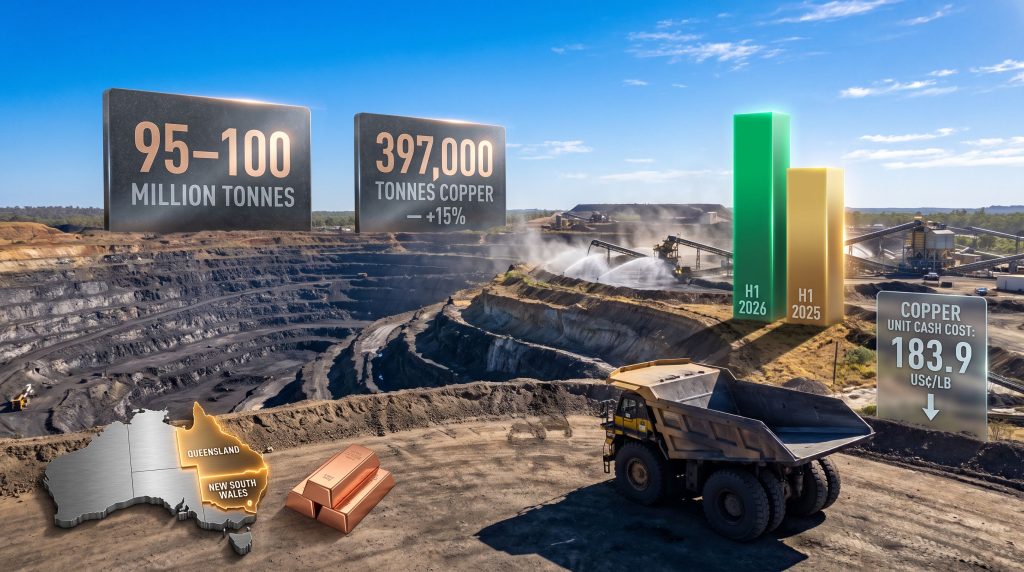
Glencore's Australian energy coal operations produced roughly three million tonnes above prior guidance in the first half of 2026, a performance strong enough to push the full-year energy coal guidance range to 95-100 million tonnes, with the mid-point lifted by one million tonnes. On its face, one million tonnes at the mid-point sounds modest.
In practice, for a commodity traded globally at scale, that revision recalibrates supply-side models used by purchasing teams across Japan, South Korea, India, and other major seaborne thermal coal importers who treat Glencore's guidance as a reference variable when planning procurement positions. Furthermore, Glencore's Queensland mining commitment remains a cornerstone of the company's broader production strategy.
First-quarter energy coal output came in at 22.9 million tonnes, broadly flat against the same period in 2025. The strength that drove the H1 beat emerged from the cumulative performance across Australian operations, which offset softer production at Cerrejón, Glencore's Colombian thermal coal joint venture.
This is a critical portfolio dynamic that is often underappreciated: the Australian asset base functions as a counterweight within Glencore's global coal network, absorbing operational variability elsewhere in the portfolio and maintaining aggregate output stability.
Steelmaking Coal: Reading the Temporary Disruptions Correctly
The steelmaking coal picture for Q1 2026 requires careful interpretation. Output of 6.5 million tonnes in the quarter was down on the prior corresponding period, and three factors explain the shortfall:
- Pit sequencing constraints at Elk Valley Resources (EVR), Glencore's Canadian steelmaking coal operation
- Wet weather disruptions across central Queensland's coal mining regions
- A planned longwall relocation at the Oaky Creek underground mine in central Queensland
The third factor deserves technical context that is rarely explained in mainstream reporting. A longwall move is one of the most operationally intensive events in underground coal mining. The longwall system, which uses a hydraulically-supported cutting shearer to extract coal across a face that can span 300 metres or more, must be physically dismantled, relocated to a new panel, and recommissioned.
The important insight for forward-looking analysis is that longwall moves are non-recurring disruptions. Once the equipment is commissioned in the new panel, yield rates typically return to or exceed pre-move levels as the shearer works into fresh, undisturbed coal. The completion of the Oaky Creek longwall move therefore functions as an operational inflection point, not a lingering problem. Full-year steelmaking coal guidance of 30-34 million tonnes remains intact, and with the disruption resolved, H2 2026 volumes are positioned to recover.
Longwall mining typically achieves extraction rates of 80-90% of in-situ coal resources within a panel, compared to 50-60% for conventional bord-and-pillar methods. This recovery efficiency advantage is why major underground coking coal operations overwhelmingly favour longwall systems despite their high capital relocation costs.
Queensland's Geological and Logistical Advantages Explained
Central Queensland's Bowen Basin is not simply a convenient geography for Glencore's steelmaking coal operations. It is one of the world's premier hard coking coal provinces, producing coal with coking properties that command premium pricing from integrated steelmakers in Asia. The Bowen Basin's coal seams, particularly those hosting operations like Oaky Creek, are characterised by low-sulphur, low-ash metallurgical coal with high coke strength after reaction (CSR) values.
CSR is the key quality metric steel producers use when evaluating whether coal will maintain structural integrity inside a blast furnace, and Bowen Basin hard coking coal consistently achieves CSR values that benchmark at the top of global supply.
Beyond geology, Queensland's coal export infrastructure provides a competitive advantage over comparable producing regions. The combination of the Dalrymple Bay Coal Terminal and Hay Point facilities near Mackay, along with dedicated rail corridors managed by Aurizon, enables high-volume, low-delay export logistics that many competing jurisdictions cannot match. According to Australian coal export data, Glencore has consistently boosted its Australian coal shipments in recent periods, reinforcing this infrastructure advantage.
2025 vs. 2026 Australian Coal Output: Trajectory at a Glance
| Metric | 2025 Full Year | 2026 Guidance (Mid-Point) |
|---|---|---|
| Energy Coal (Total, Global) | ~98.0 million tonnes | ~97.5 million tonnes |
| Steelmaking Coal (Total, Global) | ~30+ million tonnes | 30-34 million tonnes |
| Australian Saleable Coal (Total) | ~97 million tonnes | Tracking above prior H1 guidance |
| Q1 Steelmaking Coal | N/A | 6.5 million tonnes |
| Q1 Energy Coal | ~22.9 million tonnes (comparable) | 22.9 million tonnes |
Copper's Surge: The Number Inside the Number
A 15% Volume Increase with an 18% Cost Reduction
While Glencore lifts coal outlook on strong Australian output, the copper result running alongside it deserves equally close attention. The company extracted 397,000 tonnes of copper in the first half of 2026, representing a 15% increase on H1 2025. The primary contributors were higher mining rates and improved ore grades across African operations, with additional grade-driven tonnage from Antamina in Peru.
In copper mining, ore grade refers to the concentration of copper within the host rock, typically expressed as a percentage. Improvements in ore grade mean that more copper is recovered from each tonne of material mined and processed, which simultaneously lifts output volumes and reduces the cost per unit of metal produced. In addition, copper market trends heading into the latter half of the decade suggest structural demand will continue supporting elevated price floors. This is why Glencore's unit cost movement is so significant:
| Period | Net Unit Cash Cost (Copper) |
|---|---|
| H1 2025 | 225.1 US cents per pound |
| H1 2026 | 183.9 US cents per pound |
| Year-on-Year Change | -41.2 US¢/lb (-18.3%) |
An 18.3% reduction in unit cash costs is not merely an operational efficiency story. At current copper price levels, which have been supported by structural demand from electrification, grid infrastructure investment, and electric vehicle production globally, margin expansion of this magnitude is directly earnings-accretive. Higher throughput spreads fixed operating costs across more pounds of copper, and better grades reduce processing costs per unit — both forces operated simultaneously in H1 2026.
The Kidd Mine Divestment: An Embedded Upgrade Most Analysts Missed
On June 1, 2026, Glencore completed the sale of its Kidd mine in Ontario, Canada. Kidd is a historic copper-zinc mine that has operated since the late 1960s and represents a finite, mature asset that was approaching the end of its economic life. The divestment itself was not a surprise.
What is analytically significant is what Glencore did not do following the sale. Rather than reducing its full-year copper and zinc guidance to account for the production volumes lost by removing Kidd from the portfolio, the company left both guidance ranges unchanged. This constitutes a like-for-like upgrade at the mid-point for both metals.
Consequently, the remaining portfolio is implicitly performing well enough to absorb Kidd's lost contribution without trimming the full-year target — a nuance that rarely surfaces in headline-level reporting. Such strategic mining asset sales are increasingly common among diversified miners seeking to concentrate capital in higher-returning operations.
The Marketing Division: Earnings Architecture That Changes Risk Profiles
Glencore's business model is structurally distinct from virtually every other major mining company because of the scale and integration of its commodity trading operations. The marketing division is projected to generate approximately US$3.3 billion in adjusted EBIT for the first half of 2026.
To contextualise that figure, it represents trading earnings derived from Glencore's ability to arbitrage price differentials across geographies, time periods, and product specifications in coal, copper, zinc, oil, and other commodities. Indeed, commodity trading giants of Glencore's stature operate with a structural advantage that pure-play miners simply cannot replicate.
For investors interpreting the coal production upgrade, this marketing earnings base matters in a specific way. It means that even if Australian coal output or copper volumes were to experience temporary disruptions in H2 2026, the trading arm provides an earnings cushion that operates somewhat independently of physical production performance.
Commodity price volatility, which typically damages pure-play mining companies, can actually generate additional marketing earnings for Glencore by widening the arbitrage spreads that the trading desk exploits. Understanding commodity prices and miner performance is therefore essential context when evaluating Glencore's dual-engine earnings model.
This dual-engine structure, industrial production combined with commodity trading, reduces the binary risk profile that characterises most mining investments. It does not eliminate operational risk, but it changes the earnings sensitivity profile in ways that standard mining valuation frameworks do not fully capture.
The HVO Continuation Project: Long-Term Volume Growth and Its Constraints
Looking beyond the 2026 production cycle, the most consequential long-term variable for Glencore's Australian coal output trajectory is the Hunter Valley Operations (HVO) Continuation project in New South Wales. This proposed extension would extend the life of one of Australia's largest open-cut thermal coal operations, with the potential to materially increase Glencore's seaborne thermal coal volumes later in the decade.
However, the HVO Continuation project faces a regulatory and community approval pathway that introduces genuine uncertainty into long-run volume projections. Open-cut coal expansion proposals in New South Wales have historically faced extended assessment timelines, and the current policy environment means that approval outcomes are difficult to forecast with confidence.
It is also worth noting the tension this creates at the corporate level. Glencore has publicly committed to a responsible stewardship approach to its coal assets, which involves managing production through the energy transition rather than aggressively expanding capacity. Pursuing expansion approvals for HVO sits in inherent tension with that public positioning, and institutional investors with net-zero portfolio commitments are watching how this tension is resolved. Further context on Glencore's coal operations in Australia highlights just how central the domestic asset base is to the company's global strategy.
Scenario Analysis: Risks to the H2 2026 Outlook
| Risk Factor | Probability | Potential Output Impact |
|---|---|---|
| Wet weather (Queensland) | Medium | Steelmaking coal -5% to -10% |
| Thermal coal price softening | Low-Medium | Guidance maintained; margin compression |
| Regulatory delays (HVO Continuation) | Medium | Long-term volume growth deferred |
| Further asset divestments | Low | Like-for-like guidance adjustments |
| African copper operational disruptions | Low | Indirect; marketing earnings buffer |
The next major ASX story will hit our subscribers first
Peer Context: Where Glencore Stands in Australian Coal
The competitive landscape for Australian seaborne coal has been reshaped significantly over the past decade by the strategic exits of BHP and Rio Tinto from thermal coal. Rio Tinto divested its entire coal portfolio by 2018. BHP's exit from thermal coal was formalised through the South32 demerger, and its subsequent focus has been on metallurgical coal through the BHP Mitsubishi Alliance (BMA) joint venture in Queensland's Bowen Basin.
This consolidation of thermal coal ownership has, perhaps counterintuitively, increased Glencore's influence over seaborne thermal coal supply. With fewer major diversified miners holding material thermal coal positions, Glencore's production guidance revisions carry proportionally greater weight as a supply-side signal to Asian utility buyers and industrial consumers.
For steelmaking coal, the competitive dynamic is different. Glencore competes in the premium hard coking coal segment against BMA, Anglo American's Moranbah North operation, and a range of smaller Queensland producers. Quality differentiation at the seam level, particularly CSR values and ash content, drives pricing outcomes in this segment more than volume alone.
Key Takeaways from the H1 2026 Production Result
The following points summarise the most important analytical conclusions from Glencore lifts coal outlook on strong Australian output:
- Australian operations delivered roughly three million tonnes above prior energy coal guidance in H1 2026, supporting a full-year mid-point upgrade
- The Oaky Creek longwall move is complete, removing a structural constraint and positioning steelmaking coal for stronger H2 volumes
- Copper's 15% volume surge and ~18.3% unit cost reduction demonstrate portfolio-wide operational momentum beyond coal
- Maintaining copper and zinc guidance following the Kidd divestment constitutes an embedded, like-for-like upgrade that headline figures do not reflect
- The marketing division's projected ~US$3.3 billion in H1 adjusted EBIT provides an earnings architecture that partially insulates the group from single-commodity production variability
- The HVO Continuation project represents the most significant long-term volume variable, but remains subject to regulatory processes with uncertain timelines
This article contains forward-looking statements and guidance ranges sourced from Glencore's publicly available half-year production report. Production guidance, cost metrics, and project timelines are subject to change. Nothing in this article constitutes financial advice. Readers should conduct their own research and seek professional advice before making investment decisions.
Want to Stay Ahead of the Next Major ASX Mineral Discovery?
Discovery Alert's proprietary Discovery IQ model delivers real-time alerts on significant ASX mineral discoveries, cutting through complex data to surface actionable opportunities the moment they're announced — explore historic discoveries and the returns they generated, then start your 14-day free trial at Discovery Alert to position yourself ahead of the broader market.