

May 11, 2026
Understanding Global Energy Investment Through Libya's Petroleum Licensing Challenges
Strategic energy diversification has become increasingly complex as traditional oil-producing regions navigate post-conflict reconstruction while competing for international capital allocation. North African petroleum markets present unique analytical frameworks that reveal how geopolitical uncertainty intersects with resource economics to shape investment decision-making across emerging energy provinces.
Libya's oil licensing round in 2025 offers a compelling case study in frontier market dynamics, where geological potential must compete against regulatory ambiguity and operational risk assessment. Furthermore, the mathematical reality of energy investment suggests that even Africa's largest proven reserve base cannot guarantee commercial success when institutional frameworks remain fragmented across competing authorities.
When big ASX news breaks, our subscribers know first
How Dual Authority Structures Transform Energy Investment Risk Calculations
Political Fragmentation Creates Novel Operational Dependencies
Energy investment in politically fragmented territories requires sophisticated risk compartmentalisation strategies that extend beyond traditional frontier market exposure. Libya's current governance structure demonstrates how legal contracting authority can become separated from operational control, creating investment dependencies that span multiple institutional relationships.
The Government of National Unity maintains formal licensing authority through its National Oil Corporation, providing international legal validity for upstream contracts and access to global financial systems. However, actual field operations frequently depend on coordination with eastern military forces controlling key production infrastructure, particularly within the prolific Sirte Basin region.
Key Risk Factors:
• Dual contracting requirements: Legal agreements with Tripoli authorities plus operational arrangements with eastern forces
• Force majeure complexity: Disputed triggering events between competing political entities
• Infrastructure security: Production continuity dependent on military cooperation rather than civilian governance
• Regulatory uncertainty: Conflicting interpretations of contractual obligations across territorial boundaries
This operational reality has persisted despite the October 2020 ceasefire agreement, with localised security incidents continuing to affect production planning and capital deployment decisions throughout 2025. Consequently, US‑China trade impacts have further complicated international investment flows into the region.
Security Premium Integration in Frontier Energy Economics
Quantifying risk-adjusted returns in post-conflict energy markets requires incorporating security premiums that extend beyond traditional political risk insurance mechanisms. Moreover, Libya's licensing framework reveals how elevated uncertainty translates into specific contractual modifications designed to compensate operators for operational friction.
The evolution from pre-2011 EPSA IV terms to the 2025 licensing structure demonstrates explicit risk premium incorporation:
| Metric | Pre-2011 EPSA IV | 2025 Framework | Premium Differential |
|---|---|---|---|
| Contractor Share | 5-15% | 34% | +127-580% increase |
| Internal Rate of Return | 2.5% | 35.8% | +1,332% increase |
| State Take | 85-95% | 66% | 19-29 percentage points lower |
Regional Comparative Analysis:
Libya's oil licensing round achieved only a 23% block award success rate, contrasting sharply with established African producers, where Nigeria achieves 75% licensing success and Angola maintains 60% award rates. This differential reflects market assessment of Libya's unique risk profile relative to operational complexity in other frontier regions.
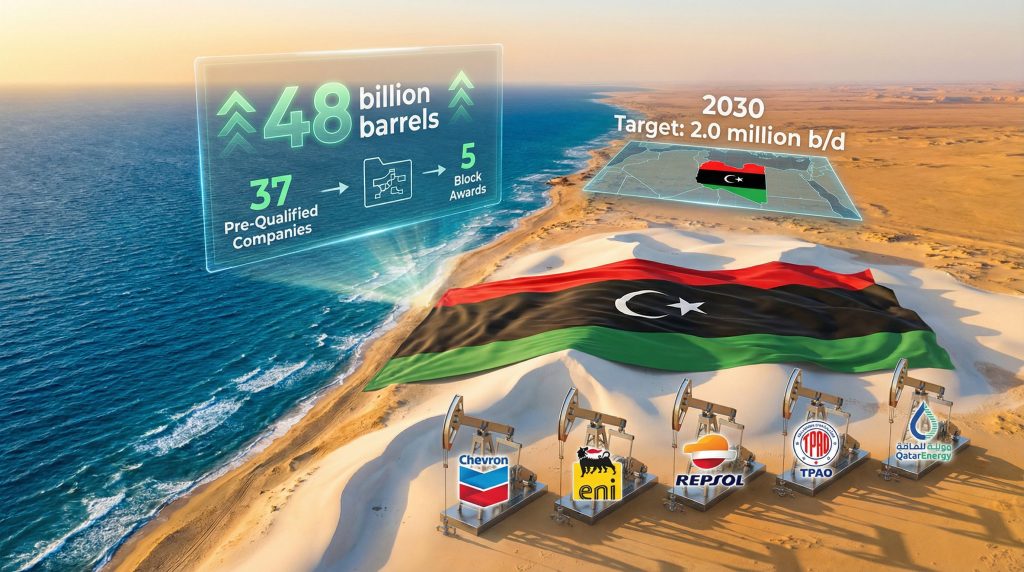
Despite holding Africa's largest proven reserves at 48 billion barrels, Libya's licensing attracted only 9 final bidders from 37 pre-qualified companies, demonstrating that resource scale alone cannot overcome institutional uncertainty in capital allocation decisions.
Additionally, global factors including oil price rally factors have influenced investor sentiment towards frontier markets, while tariffs impact investments continue to reshape capital allocation strategies.
Strategic Portfolio Positioning in Libya's Revised Contractual Framework
Production Sharing Agreement Transformation Analysis
Libya's contractual evolution from EPSA IV to the 2025 framework represents fundamental recognition that pre-conflict terms became economically unviable once political stability collapsed. In addition, the magnitude of contractual adjustment reveals sophisticated understanding of risk-return relationships in frontier energy markets.
EPSA IV Economic Profile:
Under the restrictive pre-2011 framework, operators retained minimal profit participation while bearing full exploration and development risk. A hypothetical $100 million profit oil scenario would yield only $5-15 million to contractors, with state take capturing $85-95 million.
2025 Framework Improvements:
The revised structure increases contractor retention to approximately $34 million from the same profit pool, representing a 127-567% improvement in cash flow allocation. However, this enhanced return profile incorporates substantial risk premiums reflecting political and operational uncertainty.
Critical Contractual Gaps:
• Cost recovery mechanisms: Ambiguous categorisation of allowable expenses
• Force majeure definitions: Unclear triggering conditions in dual-authority environment
• Stabilisation clauses: Limited protection against unilateral contract modification
• Dispute resolution: Uncertain arbitration jurisdiction in fragmented political structure
Asset Portfolio Optimisation for Mature Discovery Development
Libya's oil licensing round offered predominantly mature discoveries rather than frontier exploration prospects, creating a fundamental mismatch between asset characteristics and qualification requirements. This structural disconnect limited participation from specialised redevelopment operators while favouring large international oil companies.
Discovery Profile Analysis:
Of 22 offered blocks, 19 contained undeveloped discoveries requiring redevelopment rather than exploration. These assets typically demand:
• Rapid capital recovery through accelerated development
• Operational expertise in aging infrastructure management
• Specialised techniques for pressure maintenance and water management
• Cost-efficient development strategies for known geological structures
Qualification Criteria Misalignment:
The National Oil Corporation required participants to demonstrate substantial existing reserve portfolios and production capacity, effectively excluding smaller independents specialising in late-life asset optimisation.
Winner Analysis: Strategic Positioning Over Pure Economic Returns
Major Company Re-entry Strategies
Chevron's Calculated Return:
Chevron's successful bid for Block S4 represents the first major U.S. company re-entry since 2011, defeating a TotalEnergies-ConocoPhillips consortium for strategic Sirte Basin positioning. Furthermore, this decision reflects risk tolerance for selective geographic exposure where infrastructure access and geological understanding provide competitive advantages.
European Operator Advantages:
Eni's consortium victory (with QatarEnergy) for offshore Block 01 leverages existing Libyan operational experience and government relationships developed over decades of in-country presence. This institutional knowledge provides significant advantages in navigating regulatory complexity.
Regional Alignment Strategies:
TPAO's successful participation reflects Turkey's diplomatic coordination with Libya's Tripoli government, demonstrating how geopolitical alignment can translate into commercial opportunities in frontier markets.
Mid-Tier Independent Positioning
MOL's Strategic Logic:
Hungary's MOL represents mid-tier independents targeting remaining conventional opportunities where competition from major oil companies may be limited by risk appetite. Libya offers large-scale conventional prospects increasingly rare in established producing regions.
Nigerian Expansion Model:
Aiteo's Block M1 award marks its first international expansion beyond Nigerian operations, targeting similar geological structures and operational environments in North African conventional plays. However, the broader context of OPEC oil market influence continues to shape regional investment strategies.
Production Target Reality Assessment
Mathematical Analysis of 2030 Output Goals
Libya's National Oil Corporation has established ambitious production targets requiring substantial capacity expansion beyond current operational levels:
| Production Category | Current Status | 2030 Target | Required Growth |
|---|---|---|---|
| Crude Oil Output | 1.3 million b/d | 2.0 million b/d | 700,000 b/d increase |
| Natural Gas Production | Current baseline | 57 Mcm/d | Substantial expansion |
| New Block Contribution | 5 awarded blocks | Target support | Insufficient capacity |
Development Timeline Constraints
Exploration-to-Production Reality:
Even successful 2025 licensing participants face 7-10 year minimum development cycles, meaning production contributions will emerge in the early-to-mid 2030s rather than supporting 2030 targets.
Near-term Growth Dependencies:
Meeting 2030 production goals requires optimising existing producing assets rather than relying on new exploration success. Current infrastructure capacity and reservoir management will determine short-term output expansion possibilities.
Infrastructure Development Requirements:
Sustaining production growth beyond current levels demands significant pipeline, processing, and export facility investment across politically fragmented territories, creating additional operational complexity.
Future Licensing Success Optimisation Strategies
Second Round Framework Improvements
Libya's National Oil Corporation must address structural issues revealed by the limited success of its inaugural licensing round:
Contractual Clarity Requirements:
• Explicit force majeure definitions covering dual-authority scenarios
• Detailed cost recovery categories and approval mechanisms
• Stabilisation clause incorporation protecting against regulatory changes
• Clear arbitration jurisdiction and dispute resolution procedures
Asset-Investor Matching:
• Qualification criteria aligned with specific block development requirements
• Separate tracks for redevelopment specialists versus exploration companies
• Risk-appropriate return structures for different asset categories
• Geographic clustering of blocks to optimise infrastructure development
Regional Competitive Positioning Context
North African Licensing Comparison:
Algeria's recent rounds achieved 65% block award success, while Egypt consistently awards 70-80% of offered acreage. Libya's oil licensing round success rate of 23% reflects unique challenges requiring targeted solutions.
Mediterranean Supply Diversification:
Libya's geographic proximity to European markets provides strategic supply diversification advantages, but operational uncertainty limits commercial realisation of this positioning benefit. Saudi exploration licenses have also demonstrated how regional dynamics influence global investment patterns.
Libya's Mediterranean location offers European energy security benefits, yet licensing participation rates lag established African producers due to institutional uncertainty rather than geological limitations.
The next major ASX story will hit our subscribers first
Investment Climate Indicators and Market Psychology
Risk Tolerance Differentiation Across Investor Categories
The gap between initial licensing interest (44 applicants) and final participation (9 bidders) reveals sophisticated risk assessment processes rather than simple resource attraction dynamics. Companies conducted detailed evaluation of multiple risk factors:
Political Stability Metrics:
Investment decisions incorporated assessment of governance fragmentation impact on contract enforceability and operational continuity.
Regulatory Framework Analysis:
Contractual ambiguity in key provisions deterred risk-averse operators despite attractive headline returns, demonstrating hierarchy of concerns where legal clarity supersedes economic potential.
Operational Security Evaluation:
Security cost integration extended beyond quantifiable insurance premiums to include operational friction, personnel safety, and infrastructure protection requirements.
Long-term Investment Climate Development
Libya's upstream revival depends on demonstrating sustained institutional stability and regulatory predictability rather than further contractual concessions. Future licensing success requires:
Political Consolidation Indicators:
Unified governance structures providing single-source contracting authority and operational oversight across all producing regions.
Legal Framework Standardisation:
International arbitration mechanisms and contractual protection aligned with global petroleum industry standards and practices.
Infrastructure Security Assurance:
Civilian security provision for energy infrastructure independent of military cooperation agreements between competing authorities.
Frequently Asked Questions About Libya's Oil Licensing Framework
Why did major oil companies avoid bidding despite pre-qualification?
Companies conducted comprehensive risk assessments evaluating Libya's geological potential against operational uncertainties, contractual ambiguities, and security considerations. Many chose to monitor initial round outcomes before committing capital to projects with unclear regulatory and operational frameworks.
How does Libya's licensing success compare to other North African producers?
Algeria's recent licensing rounds achieved 65% block award rates, while Egypt consistently awards 70-80% of offered acreage. Libya's 23% success rate (5 of 22 blocks) reflects unique political and security challenges rather than geological limitations or economic terms. As noted in this Reuters analysis of Libya's licensing results, the limited success highlights persistent institutional challenges.
What role do existing operators play in future licensing rounds?
Companies like Eni and Repsol, maintaining established Libyan operations, possess operational knowledge and government relationships providing competitive advantages in uncertain regulatory environments. This institutional experience translates into risk mitigation capabilities unavailable to new entrants.
Can Libya achieve its 2030 production targets with limited new acreage?
The five awarded blocks will contribute minimally to 2030 targets due to exploration-to-production timelines of 7-10 years. Near-term growth must depend on optimising existing producing assets rather than new exploration success, making the 2 million b/d target increasingly challenging.
What improvements could increase future licensing participation?
Success depends on addressing structural issues: clarifying contractual terms including force majeure and cost recovery provisions, aligning qualification criteria with asset development requirements, and demonstrating sustained political stability across all producing regions. According to Libya Herald's detailed analysis, institutional improvements remain critical for future success.
This analysis is provided for informational purposes and does not constitute investment advice. Energy market investments involve substantial risk, including potential total loss of capital. Readers should conduct independent research and consult qualified professionals before making investment decisions.
Looking for Strategic Energy Investment Opportunities?
Libya's frontier market dynamics reveal how political fragmentation creates unique risk-return profiles that sophisticated investors can navigate for substantial upside potential. Discovery Alert's proprietary Discovery IQ model provides real-time insights into emerging resource opportunities across global markets, helping investors identify actionable positions before broader market recognition. Begin your 14-day free trial today and gain the analytical edge needed to capitalise on complex energy sector developments ahead of the competition.

