
August 3, 2026
Understanding Global Energy Market Vulnerabilities Through Continental Infrastructure Dependencies
Energy infrastructure bottlenecks represent one of the most critical vulnerabilities facing modern economies, particularly when entire regions become dependent on single transportation routes or buyer relationships. The strategic challenge of diversifying energy export pathways has emerged as a defining issue for resource-rich nations seeking to maximise their geopolitical leverage and economic returns. This dependency dynamic creates what economists term "monopsony vulnerability," where sellers face limited bargaining power due to concentration of buyer markets.
Contemporary energy geopolitics increasingly revolve around infrastructure capacity rather than just resource availability. Nations with abundant energy reserves but limited export diversity often find themselves accepting discounted pricing and unfavourable terms. The solution typically requires massive capital investments in alternative transportation networks, regulatory navigation across multiple jurisdictions, and careful stakeholder management including Indigenous communities and environmental groups.
Furthermore, the economic modelling behind major pipeline projects reveals multiplicative effects that extend far beyond simple transportation capacity. Enhanced market access enables premium pricing opportunities, particularly when connecting to supply-constrained regions where crude oil trades at significant premiums above continental benchmarks. However, these theoretical advantages must be weighed against substantial execution risks and regulatory uncertainties that have historically plagued large-scale energy infrastructure development.
When big ASX news breaks, our subscribers know first
Strategic Market Access Economics and Asian Demand Dynamics
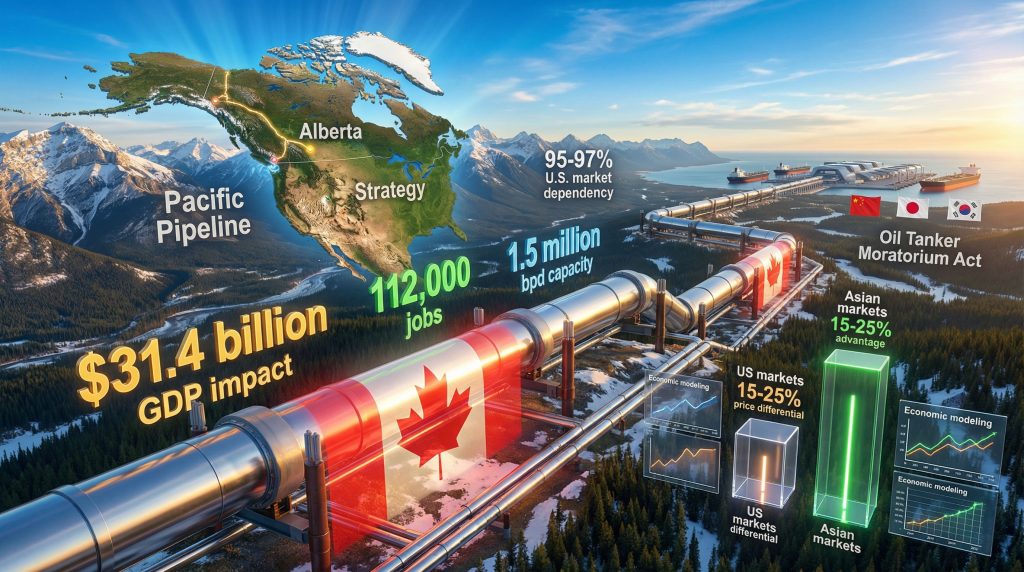
The economic rationale for Alberta pipeline to break U.S. dependence centres on accessing higher-value Asian markets where supply constraints create substantial pricing premiums. Current market analysis suggests Canadian crude could capture significant value through Pacific export terminals, with Asian refineries typically paying premiums of $15-25 per barrel above North American benchmarks due to transportation costs and limited supply alternatives.
In addition, this market diversification strategy addresses Canada's energy transition challenges by providing enhanced revenue streams that could fund renewable energy investments. The timing proves particularly strategic given ongoing concerns about US tariffs impact on Canadian industries affecting traditional trade relationships.
Asian-Pacific Market Premium Analysis:
| Market Destination | Typical Premium vs WTI | Transportation Costs | Net Economic Advantage |
|---|---|---|---|
| Chinese Refineries | $18-22/barrel | $8-12/barrel | $6-14/barrel |
| Japanese Markets | $15-20/barrel | $10-14/barrel | $1-10/barrel |
| South Korean Buyers | $16-21/barrel | $9-13/barrel | $3-12/barrel |
| Indian Processors | $12-18/barrel | $11-15/barrel | $(-3)-7/barrel |
The sustainability of these premiums depends heavily on continued Asian demand growth and the absence of alternative supply sources. Pipeline transportation typically costs $3-5 per barrel compared to $8-15 for rail alternatives, creating structural cost advantages for high-volume export scenarios. However, the economics become more complex when factoring in terminal construction costs, marine transportation, and competitive pressures from other global suppliers.
Moreover, ATB Financial economic modelling projects that expanding Canadian pipeline capacity could generate substantial GDP benefits. Their estimates suggest an additional 1.5 million barrels per day export capacity could add $31.4 billion annually to Canada's real GDP between 2027 and 2035. This represents approximately 1.1% of GDP annually while supporting an estimated 112,000 additional jobs across direct and indirect employment categories.
Indigenous Consultation Frameworks and Community Partnership Models
The success of major pipeline projects increasingly depends on meaningful Indigenous participation rather than mere consultation. Historical analysis of Canadian energy projects reveals that Indigenous opposition represents one of the most significant project risks, often resulting in costly delays, legal challenges, and potential cancellation.
Critical Indigenous Engagement Variables:
- Revenue-sharing mechanisms: Percentage-based participation in project cash flows
- Equity ownership opportunities: Direct ownership stakes in pipeline infrastructure
- Environmental protection protocols: Enhanced spill prevention and response systems
- Traditional territory recognition: Formal acknowledgment of land use rights
- Community benefit agreements: Local employment and training programs
The Trans Mountain precedent illustrates both the challenges and potential solutions for Indigenous engagement. Initial opposition from several First Nations groups led to extensive legal challenges and delays, ultimately requiring federal government acquisition of the project for $4.5 billion. Cost escalation from initial estimates of $5.4 billion to nearly $35 billion demonstrates the financial impact of inadequate early engagement.
Consequently, recent policy changes have expanded the Indigenous Loan Guarantee Program to $10 billion, recognising that Indigenous ownership participation often determines project viability. This approach shifts from traditional consultation models toward genuine partnership structures that align Indigenous economic interests with project success.
Regulatory Pathway Complexity and Federal-Provincial Coordination
The regulatory approval process for Alberta pipeline to break U.S. dependence involves multiple overlapping jurisdictions and policy frameworks that create substantial execution uncertainty. The 2019 Oil Tanker Moratorium Act represents perhaps the most significant regulatory barrier, prohibiting vessels carrying over 12,500 metric tons of crude from accessing British Columbia's northern coast.
Furthermore, the intersection of carbon policy and pipeline approvals creates additional complexity. Negotiations between Alberta and federal authorities regarding industrial carbon taxation and the Pathways Alliance carbon capture initiatives could significantly impact project timelines. These discussions missed their April 1, 2026 deadline, creating ongoing uncertainty about the regulatory framework.
Key Regulatory Milestones and Risk Factors:
| Approval Stage | Estimated Timeline | Primary Risk Elements |
|---|---|---|
| Industrial Carbon Pricing Agreement | 6-12 months | Federal-provincial negotiations |
| Major Projects Office Application | 12-18 months | Technical documentation requirements |
| Indigenous Consultation Process | 18-24 months | Community consent protocols |
| Environmental Assessment | 24-36 months | Marine ecosystem protection standards |
| Tanker Ban Legislative Review | Uncertain | Parliamentary and federal-provincial dynamics |
Environmental assessment requirements have become increasingly stringent, particularly for projects affecting marine ecosystems. The proposed Prince Rupert terminal location involves sensitive coastal areas and the Great Bear Rainforest, requiring comprehensive impact studies and mitigation strategies that exceed current industry standards.
Geopolitical Risk Assessment and Supply Chain Resilience
Current Middle Eastern conflicts have highlighted Canada's potential strategic value as a stable energy supplier to allied nations. Unlike suppliers in politically volatile regions, Canadian energy resources offer several distinct advantages that appeal to security-conscious buyers, particularly sovereign wealth funds and national energy companies. These factors become increasingly relevant when considering oil price movements amid trade wars and global supply chain disruptions.
According to Alberta's official energy infrastructure development plans, the province is actively courting international investment to diversify its export markets beyond traditional U.S. dependence.
Canada's Strategic Supplier Advantages:
- Political stability: Democratic governance with consistent regulatory frameworks
- Geographic isolation: Minimal exposure to regional conflicts or shipping disruptions
- Resource longevity: Oil sands provide 70+ years of extraction potential at current production levels
- Allied nation status: Preferential access during supply emergencies and crisis situations
- Technical expertise: Advanced extraction and processing capabilities for heavy oil resources
The Iran conflict scenario demonstrates how rapidly geopolitical events can shift global energy investment flows. When traditional supply sources face disruption risks, buyers increasingly value reliability premiums that stable suppliers like Canada can command. However, limited infrastructure capacity prevents Canada from fully capitalising on these strategic advantages.
Eric Nuttall from Ninepoint Partners has identified the Middle East conflict as creating significant opportunities for Canadian energy exports. His analysis suggests that Canada's combination of massive reserves, political stability, and technical capabilities positions the country advantageously during periods of global supply uncertainty.
International Capital Structure and Investment Models
The proposed financing structure for Alberta pipeline to break U.S. dependence reflects sophisticated understanding of global capital markets and investor motivations. Premier Danielle Smith's announcement regarding 15-30% minority stakes targets specific categories of international investors seeking different risk-return profiles and strategic objectives. This approach aligns with broader key investment strategies that emphasise infrastructure diversification.
Investor Category Analysis:
| Investor Type | Target Stake Range | Primary Motivation | Risk Tolerance |
|---|---|---|---|
| Asian Sovereign Funds | 15-20% | Energy security diversification | Long-term stability focus |
| Middle Eastern Capital | 10-15% | Geographic portfolio diversification | Moderate geopolitical risk |
| Canadian Pension Funds | 20-25% | Domestic infrastructure mandate | Regulatory familiarity advantage |
| Private Energy Companies | 30-40% | Operational expertise and market access | Higher return expectations |
This structure provides international legitimacy whilst maintaining Canadian operational control. Foreign investment brings essential capital efficiency and global market connections, whilst domestic participation ensures regulatory alignment and community acceptance. The approach learned from previous pipeline financing failures where inadequate capital backing led to project abandonment.
Consequently, sovereign wealth funds particularly value infrastructure investments that provide stable, long-term returns with inflation protection. The pipeline's strategic importance to global energy supply chains makes it attractive to funds seeking both financial returns and energy security benefits for their home countries.
Why Are Asian Investors Particularly Interested?
Asian investors demonstrate heightened interest in Canadian energy infrastructure for several strategic reasons. First, energy security remains paramount for Asian economies heavily dependent on Middle Eastern imports. Second, Chinese state-owned enterprises and Japanese trading houses view Canadian partnerships as hedges against regional supply disruptions.
For instance, Japanese trading giants like Mitsubishi and Mitsui have historically invested in Canadian resource projects to secure long-term supply arrangements. Similarly, South Korean conglomerates including POSCO and Samsung seek energy infrastructure stakes to support their industrial operations.
The next major ASX story will hit our subscribers first
Environmental Compliance Evolution and Carbon Policy Integration
The environmental assessment framework for major pipeline projects has evolved significantly beyond traditional impact mitigation toward comprehensive sustainability leadership. Modern projects must demonstrate environmental advantages rather than mere regulatory compliance to achieve social licence and regulatory approval. This becomes particularly challenging given existing energy exports challenges faced globally.
Environmental Assessment Framework Components:
- Marine ecosystem baseline studies: 18-month research requirements for coastal impact areas
- Carbon footprint optimisation: Integration with federal and provincial carbon pricing systems
- Spill prevention technology: Advanced leak detection and emergency response infrastructure
- Biodiversity protection: Enhanced protocols for sensitive habitat areas including the Great Bear Rainforest
- Climate adaptation measures: Infrastructure resilience planning for changing environmental conditions
The pipeline project's intersection with Canada's evolving carbon policy creates both challenges and opportunities. Integration with the Pathways Alliance carbon capture initiative could provide environmental credibility whilst the federal industrial carbon tax negotiations affect project economics. Successfully navigating these policy frameworks requires demonstrating alignment with Canada's climate commitments rather than opposition to them.
Furthermore, marine transportation represents a particularly complex environmental challenge. Increased tanker traffic through British Columbia coastal waters raises concerns about marine mammal populations, fishing communities, and ecosystem disruption. Advanced vessel routing systems, enhanced pilot requirements, and emergency response capabilities become essential components of project approval.
Market Psychology and Investment Timing Considerations
The current geopolitical environment has created unique market psychology dynamics that favour stable energy infrastructure investments. Rising global energy security concerns, Middle Eastern supply disruptions, and increasing recognition of supply chain vulnerabilities have shifted investor preferences toward predictable, long-term energy assets.
Investment Climate Factors:
- Supply security premiums: Increased willingness to pay for reliable energy sources
- Geopolitical risk aversion: Flight to quality toward stable jurisdictions
- Infrastructure asset appetite: Strong institutional demand for inflation-protected returns
- Energy transition hedging: Diversification strategies during renewable energy growth
- Sovereign wealth fund liquidity: Substantial capital seeking strategic deployment opportunities
The timing convergence of these factors creates potentially favourable conditions for major pipeline financing. However, investors remain cautious about execution risks, particularly given the historical track record of Canadian pipeline projects facing delays, cost overruns, and cancellations.
In addition, market psychology also reflects growing recognition that energy infrastructure must precede demand rather than respond to it. The proposed 1-million-barrel-per-day capacity exceeds current production requirements but matches the scale of major global pipeline systems like the Baku-Tbilisi-Ceyhan corridor.
Clearwater Formation Development and Production Scaling
The Clearwater Formation in Alberta represents a significant unconventional resource that could support sustained pipeline capacity utilisation. With estimated in-place volumes exceeding 70 billion barrels in the Cold Lake area alone, this heavy oil resource provides the production base necessary to justify large-scale pipeline infrastructure investment.
Clearwater Formation Production Projections:
- Current production levels: Approximately 150,000 barrels per day across multiple operators
- 2031 production targets: Estimates suggest potential growth to nearly 400,000 barrels per day
- Technical advancement impact: Enhanced recovery techniques improving extraction efficiency
- Infrastructure requirements: Specialised handling for high-viscosity crude oil transport
- Market integration potential: Blending opportunities with conventional oil sands production
The formation's high-viscosity crude requires specialised transportation and processing infrastructure, making pipeline access particularly valuable compared to rail alternatives. The technical challenges of moving heavy oil through pipeline systems favour larger-scale, dedicated infrastructure rather than shared-capacity arrangements.
Moreover, production scaling timelines align well with proposed pipeline construction schedules, providing confidence that sufficient throughput volumes will be available to justify the infrastructure investment. However, the development depends on continued technological advancement and favourable commodity pricing to maintain economic viability.
Alternative Route Analysis and Risk Mitigation Strategies
Whilst Prince Rupert has emerged as the preferred terminal location, alternative routing options provide important risk mitigation for the overall project strategy. Southern British Columbia terminals, despite higher transportation costs, might face fewer regulatory barriers and Indigenous opposition concerns.
Route Comparison Framework:
| Terminal Location | Regulatory Risk | Community Opposition | Transportation Cost | Capacity Potential |
|---|---|---|---|---|
| Prince Rupert | High (tanker ban) | Moderate-High | Lower | Full (1M bpd) |
| Kitimat | Moderate | Moderate | Moderate | Reduced capacity |
| Southern BC Ports | Lower | Lower | Higher | Limited expansion |
| Alternative Coast Access | Variable | Variable | Highest | Project-specific |
The route selection decision involves balancing multiple competing factors rather than optimising any single variable. Prince Rupert offers the most direct access to Asian markets with lowest transportation costs, but faces the highest regulatory and political risks. Southern alternatives reduce approval risks but increase ongoing operational costs and potentially limit market access advantages.
Consequently, flexible routing strategies might involve phased development approaches, beginning with lower-risk alternatives whilst pursuing long-term optimisation through preferred northern routes. This approach requires additional capital but provides execution certainty and revenue generation during regulatory resolution periods.
What Makes Prince Rupert the Preferred Choice?
Prince Rupert offers several strategic advantages that make it the preferred terminal location despite regulatory challenges. The port provides the shortest shipping distance to Asian markets, reducing transportation costs by $2-4 per barrel compared to southern alternatives. Additionally, the harbour features deep-water access suitable for Very Large Crude Carriers (VLCCs), enabling economies of scale in marine transportation.
The port's existing infrastructure includes rail connections, storage facilities, and marine terminals that could be adapted for crude oil exports. Furthermore, Prince Rupert's location provides weather advantages with fewer operational disruptions compared to more exposed coastal areas.
Long-term Strategic Scenarios and Probability Assessment
The ultimate success of Alberta pipeline to break U.S. dependence depends on the convergence of multiple complex variables over extended timeframes. Scenario analysis reveals several potential outcomes with significantly different implications for investors and stakeholders.
Strategic Outcome Scenarios:
- Full Implementation Success (35% probability): Federal tanker ban lifted, comprehensive Indigenous partnerships achieved, sustained Asian demand growth
- Modified Implementation (40% probability): Reduced capacity, alternative routing, extended regulatory timeline but eventual project completion
- Delayed Alternative Approach (20% probability): Southern BC routing, higher costs, limited capacity but operational pipeline within decade
- Project Suspension (5% probability): Insurmountable regulatory barriers, economic downturn, or fundamental policy shifts prevent implementation
The probability assessment reflects both the strategic importance of the infrastructure and the substantial barriers to execution. Some form of enhanced Pacific pipeline access appears likely given Canada's long-term energy export objectives, but capacity, timing, and route remain highly variable.
However, success scenarios depend heavily on sustained political will across multiple government levels, continued Asian energy demand growth, and resolution of Indigenous rights and environmental protection concerns. The most likely outcomes involve compromise solutions rather than optimal configurations for any single stakeholder group.
Furthermore, investment strategies must account for extended development timelines, substantial regulatory uncertainty, and the possibility of modified project scope. The strategic value of enhanced market access and the scale of potential economic benefits continue to attract significant capital interest despite execution risks.
"Alberta's message is clear: we want to build new pipelines east, west, north and south to diversify our markets and reduce our dependence on any single buyer," stated Premier Danielle Smith during recent energy sector discussions, emphasising the province's commitment to infrastructure diversification.
Disclaimer: This article contains forward-looking statements and projections based on current market conditions and available information. Pipeline development involves substantial regulatory, environmental, and political risks that could materially affect project outcomes. Economic projections are based on assumptions about future market conditions that may not materialise. Readers should conduct independent research and consider professional advice before making investment decisions related to energy infrastructure projects.
Want to capitalise on ASX energy discoveries before the market does?
Discovery Alert delivers instant notifications on significant ASX mineral discoveries using its proprietary Discovery IQ model, helping investors identify actionable opportunities in energy and resource sectors ahead of the broader market. Explore how major mineral discoveries can generate substantial returns by visiting Discovery Alert's discoveries page and begin your 14-day free trial today to secure your competitive advantage.