August 3, 2026
The Operating Leverage Equation: Why Commodity Upcycles Reward Vertically Integrated Producers
When global commodity prices shift decisively in favour of a particular metal, the companies that feel the benefit most acutely are rarely the traders or downstream fabricators. It is the vertically integrated primary producers, those controlling the full chain from ore in the ground to refined metal, that capture the most amplified earnings response. The mechanics are well understood in theory but often underappreciated in practice: fixed costs remain largely static while per-unit realisations surge, expanding margins at a rate that can make revenue growth figures look modest by comparison.
This dynamic sits at the heart of National Aluminium Company Limited's (NALCO) Q1 FY27 financial performance. With NALCO Q1 revenue climbs 39% as higher aluminium prices lift profit to levels that nearly doubled year-on-year, the results offer a textbook illustration of how commodity price momentum interacts with vertically integrated production structures to generate outsized earnings leverage.
When big ASX news breaks, our subscribers know first
Understanding the Macro Price Environment Behind Q1 FY27
Global Aluminium Pricing and Its Transmission Into Indian Producer Margins
Aluminium pricing on the London Metal Exchange (LME) had been on a broadly constructive trajectory heading into the quarter ended June 30, 2026. It was supported by tightening global supply, elevated energy costs constraining smelting capacity in energy-intensive regions of Europe and China, and growing structural demand from electric vehicle manufacturers and infrastructure programmes across multiple geographies.
For Indian primary aluminium producers, LME price movements translate with relatively high fidelity into top-line realisations, particularly for export-oriented output. The key amplification mechanism is that input costs, especially bauxite mining and captive power, are largely denominated in domestic currency and subject to slower-moving cost curves. Furthermore, when aluminium prices rise sharply, the gap between cost per tonne and realisation per tonne widens, producing what analysts describe as margin expansion at the gross level, which then flows through operating leverage to deliver disproportionate growth at the profit line. The commodity price impact on vertically integrated producers is particularly pronounced during these upcycle periods.
NALCO's Vertical Integration: Why It Matters More in an Upcycle
NALCO operates across the full aluminium value chain, spanning bauxite mining at Panchpatmali in Odisha, alumina refining at Damanjodi, and primary aluminium smelting at Angul. This integration means that during periods of elevated aluminium prices, the company is not paying third-party alumina prices inflated by the same commodity tailwind. Its upstream cost structure is largely self-contained, giving it a structurally lower cost base than non-integrated smelters buying alumina on the spot market.
It is worth noting that alumina itself has been a volatile commodity. Alumina prices surged significantly through parts of 2024 and into 2025, driven by disruptions to bauxite supply from Guinea and refinery curtailments in Australia. Producers without captive alumina supply faced materially higher input costs during those periods. NALCO's self-sufficiency in alumina refining capacity provided an important cost shield that would have widened its competitive margin advantage relative to pure-play smelters.
NALCO Q1 FY27 Financial Results: A Detailed Breakdown
Revenue Growth and Profit Expansion: The Core Numbers
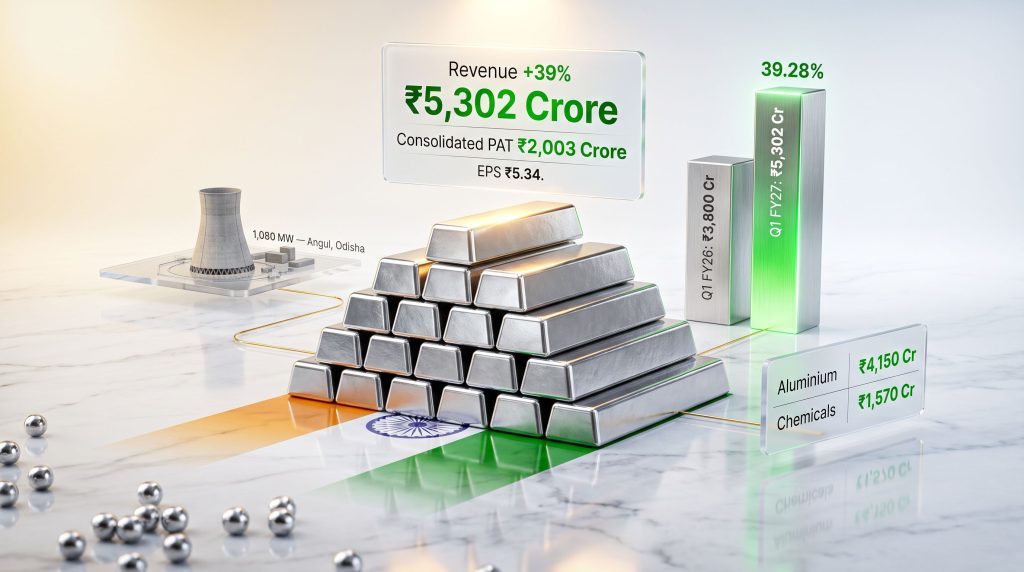
NALCO's Q1 FY27 results show standalone revenue from operations reaching approximately ₹5,302 crore (USD 557 million), up from roughly ₹3,800 crore (USD 400 million) in the prior corresponding period. This represents a 39.28% year-on-year increase, a figure substantial in isolation but arguably less important than what happened at the profit line.
| Financial Metric | Q1 FY27 | Q1 FY26 | YoY Change |
|---|---|---|---|
| Standalone Revenue from Operations | ₹5,302 crore (~USD 557M) | ₹3,800 crore (~USD 400M) | +39.28% |
| Total Income (Standalone) | ₹5,480 crore (~USD 575M) | ~₹3,936 crore | +39.30% |
| Profit Before Tax | ₹2,645 crore (~USD 278M) | ₹1,430 crore (~USD 150M) | +85.0% |
| Profit After Tax (Consolidated) | ₹2,003 crore (~USD 210M) | ~+89% | |
| Earnings Per Share | ₹5.34 (USD 0.056) | ₹3.60 (USD 0.038) | +48.3% |
Profit before tax expanded by approximately 85% against that 39% revenue increase, and consolidated profit after tax reached ₹2,003 crore (approximately USD 210 million), representing close to a doubling on a year-on-year basis. This divergence between revenue growth and profit growth is the clearest evidence of operating leverage working in NALCO's favour.
The Operating Leverage Effect: How Fixed Costs Amplify Profit Growth
Operating leverage in aluminium smelting is substantial because the capital and energy infrastructure required to produce primary aluminium carries significant fixed cost components. Whether a smelter is running at 80% or 100% of capacity, depreciation charges, maintenance overheads, and much of the energy cost structure remain relatively fixed within a given period.
When per-unit realisations increase by a meaningful margin, as they did across Q1 FY27, the incremental revenue above the fixed cost threshold flows almost entirely to the profit line. This is why a 39% revenue expansion translated into an ~85% expansion in profit before tax. The operational efficiency improvements NALCO has implemented in recent years also contributed to a lower unit cost base, meaning the fixed-cost absorption benefit was compounded by genuine efficiency gains rather than being purely price-driven.
Investors interpreting NALCO's earnings growth should distinguish carefully between price-driven gains, which are cyclical and subject to reversal, and efficiency-driven improvements, which represent structural enhancements to the company's long-term cost competitiveness. Both factors were present in Q1 FY27, but their relative durability differs significantly.
Standalone vs. Consolidated Results: Reading Between the Lines
The gap between standalone and consolidated profit figures in NALCO's reporting reflects the contribution of its subsidiaries and joint venture entities. The consolidated profit after tax of ₹2,003 crore sits above standalone equivalents, indicating that the broader corporate structure, inclusive of its various joint ventures, contributed positively to the quarter's overall outcome. Investors focused purely on standalone results may understate the total earnings power of the consolidated entity.
Segment Performance: Aluminium Dominates, Chemicals Supports
The Aluminium Segment: Exceptional Margin Profile at Current Prices
NALCO's aluminium business was the undisputed driver of Q1 FY27 performance. According to recent earnings analysis, the segment generated revenue of approximately ₹4,150 crore (USD 436 million) and delivered a segment result of ₹2,600 crore (USD 273 million).
| Segment | Revenue (Q1 FY27) | Segment Result | Implied Margin |
|---|---|---|---|
| Aluminium | ₹4,150 crore (~USD 436M) | ₹2,600 crore (~USD 273M) | ~62.7% |
| Chemicals | ₹1,570 crore (~USD 165M) | ₹270 crore | ~17.2% |
The implied segment margin for the aluminium division of approximately 62.7% is extraordinarily high and reflects the confluence of elevated realisation prices, low-cost captive bauxite supply, and operational leverage at the smelting stage. This level of margin is not typical across commodity cycles and should be understood as a cyclical peak phenomenon rather than a normalised baseline.
Three operational levers were central to this quarterly outperformance:
- Elevated global aluminium pricing driving per-unit revenue well above historical averages.
- Higher production and sales volumes compounding the price benefit through greater fixed-cost absorption.
- Increased domestic alumina sales adding a volume-driven revenue stream at the upstream refining stage.
The Chemicals Segment: Structural Diversification at a Lower Margin
NALCO's chemicals business, which largely encompasses caustic soda and related products from its alumina refining operations, reported revenue of ₹1,570 crore (USD 165 million) against a segment result of ₹270 crore. While the margin profile is considerably thinner than the aluminium segment, this business line provides a degree of revenue diversification and serves as a natural hedge when aluminium prices are under pressure.
The caustic soda market in India has been expanding in line with growth in textiles, paper, and water treatment sectors, providing a moderately constructive demand backdrop for NALCO's chemicals output. However, the chemicals division's strategic importance lies less in its margin contribution and more in its role as a by-product value-capture mechanism within the integrated alumina refining process.
Dividend Policy: Reading the Capital Return Signal
FY26 Total Payout of ₹11.50 Per Share: What It Communicates
NALCO's board recommended a final dividend of ₹1 per equity share (representing 20% of the ₹5 face value) for FY26, subject to shareholder approval at the company's 45th Annual General Meeting scheduled for August 31, 2026. The record date for the final dividend has been fixed at August 24, 2026.
This final tranche brings the total FY26 dividend to ₹11.50 per share, equivalent to 230% of face value, comprising three interim dividends totalling ₹10.50 per share paid across the financial year plus the recommended ₹1 final payment.
A 230% face value payout is not a routine event for a public sector undertaking. It communicates several things simultaneously:
- The balance sheet is generating sufficient free cash flow to fund capital expenditure commitments while returning substantial capital to shareholders.
- Management and the board have confidence in the earnings sustainability of the business at current or near-current price levels.
- The government, as the dominant shareholder in NALCO, receives a meaningful direct financial return from the company's commodity upcycle performance.
For income-focused investors evaluating PSU equities, a total payout of ₹11.50 per share should be assessed in the context of the prevailing share price to determine actual dividend yield. High absolute payout values can be misleading if the share price has appreciated significantly during the same period, compressing the forward yield.
Strategic Portfolio: Infrastructure Investment and Joint Venture Rationalisation
The 1,080 MW Captive Power Plant: Addressing the Most Critical Cost Variable
Aluminium smelting is among the most energy-intensive industrial processes in existence. Producing one tonne of primary aluminium through the Hall-Heroult electrolytic process requires approximately 13,000 to 15,000 kilowatt-hours of electricity, meaning energy costs can represent 30% to 40% of total production costs depending on the prevailing power price environment.
NALCO's decision to enter a 50:50 joint venture with NLC India Limited to develop a 1,080 MW captive thermal power plant at Angul, Odisha is therefore one of the most strategically significant capital allocation decisions the company has made in recent years. Angul is the location of NALCO's existing primary aluminium smelter, making the geographic logic of the project straightforward. Furthermore, renewable power in mining operations is increasingly reshaping how producers approach their long-term energy strategies alongside such captive thermal investments.
NLC India Limited, formerly Neyveli Lignite Corporation, brings substantial experience in thermal power generation to the joint venture, while NALCO contributes the assured demand and site proximity. The arrangement is expected to structurally reduce NALCO's energy cost per tonne of aluminium produced once operational, enhancing the company's position on the global aluminium cost curve.
Joint Venture Portfolio: Rationalisation Alongside Expansion
| Joint Venture | Status | Strategic Purpose |
|---|---|---|
| Angul Aluminium Park | Active | Downstream industrial ecosystem development |
| GACL-NALCO Alkalies & Chemicals | Active | Chemicals segment diversification |
| Khanij Bidesh India | Active | Overseas critical mineral asset acquisition |
| Utkarsha Aluminium Dhatu Nigam Limited | Winding up | Commercial unviability confirmed |
| NLC India JV (1,080 MW Power Plant) | Under development | Captive energy security at Angul |
The Ministry of Mines' approval to wind up Utkarsha Aluminium Dhatu Nigam Limited reflects a disciplined capital allocation stance. The entity was established to pursue specialty aluminium alloy production opportunities, a strategically appealing concept given India's growing defence and aerospace manufacturing ambitions. However, confirmed commercial unviability suggests that either market pricing, feedstock economics, or competitive dynamics did not support a viable business case at the required capital investment level.
Khanij Bidesh India deserves particular attention from a strategic perspective. This joint venture, formed between NALCO, Hindustan Copper, and MSTC, is focused on acquiring and developing critical mineral assets overseas. As India seeks to reduce dependence on imported minerals essential for the energy transition minerals agenda, entities like Khanij Bidesh operate at the intersection of commercial mining strategy and national resource security policy.
The Rajasthan Wind Power Regulatory Overhang
An often-overlooked element of NALCO's financial picture involves its two wind power plants in Rajasthan. Revenue from these assets has not been recognised in NALCO's accounts since April 1, 2019, due to the absence of a renewed power purchase agreement (PPA) with the relevant Rajasthan electricity distribution company. The matter is currently before the Rajasthan High Court.
The financial materiality of this unresolved situation warrants attention. Depending on the quantum of power generated and the applicable tariff, years of unrecognised revenue represent a potentially significant contingent income item. A favourable court resolution could result in a notable one-time income recognition event in a future reporting period. This regulatory overhang is a non-market risk that is specific to the company's PSU operational context and illustrates the broader complexity of operating renewable energy assets within India's state-level electricity market framework.
The next major ASX story will hit our subscribers first
India's Aluminium Sector: The Structural Demand Story Beyond the Cycle
Why Indian Aluminium Consumption Is on a Structural Growth Trajectory
While Q1 FY27 results were meaningfully boosted by cyclical price tailwinds, the underlying demand story for Indian aluminium has structural legs that extend well beyond any single commodity cycle. Consequently, China industrial demand dynamics also play an important role in shaping global aluminium supply balances that ultimately affect Indian producers. Several converging demand vectors are worth understanding:
- Electric vehicles require significantly more aluminium per unit than internal combustion engine vehicles, with body structures, battery enclosures, and thermal management components all favouring aluminium's strength-to-weight ratio.
- Transmission infrastructure for grid expansion, essential to India's renewable energy capacity build-out, is a major consumer of aluminium conductor cable.
- Packaging and consumer goods sectors continue to substitute towards aluminium as single-use plastic regulations tighten.
- Defence and aerospace manufacturing, where India has significant indigenisation ambitions, requires specialty aluminium alloys at scale.
India currently imports a meaningful proportion of its aluminium requirements, creating a demand opportunity for domestic producers as national industrial policy increasingly favours import substitution across strategic materials.
Bauxite Quality and India's Geological Advantage
A less commonly discussed factor in NALCO's competitive positioning is the quality of India's bauxite deposits. The Panchpatmali bauxite deposit in Odisha, which NALCO mines for its refinery feedstock, is considered a high-quality gibbsitic bauxite with relatively low silica content. This is technically significant because high reactive silica in bauxite increases caustic soda consumption in the Bayer refining process, directly raising the cost of alumina production.
India's eastern seaboard bauxite belt, which includes Odisha and Andhra Pradesh, contains deposits that compare favourably with many global benchmarks on silica reactivity metrics. This geological advantage, when combined with vertically integrated operations, contributes to a structurally lower alumina production cost. It is not purely a function of labour or energy price differentials, and positions NALCO favourably amongst top aluminium producers on a global cost-curve basis.
Frequently Asked Questions: NALCO Q1 FY27 Results
What drove NALCO Q1 revenue climbing 39% as higher aluminium prices lifted profit?
The primary driver was a sustained elevation in global aluminium prices, which directly improved per-unit realisations. This price benefit was amplified by operating leverage from higher production volumes and NALCO's vertically integrated cost structure, which insulated the company from upstream alumina price inflation experienced by non-integrated smelters.
Why did profit grow at nearly double the rate of revenue?
Operating leverage explains the divergence. Fixed costs across mining, refining, and smelting operations remain largely stable within a quarter, so incremental revenue generated at higher aluminium prices flows disproportionately to the profit line. Enhanced operational efficiency added further margin expansion beyond what price alone would have delivered.
What is the significance of the ₹11.50 per share total FY26 dividend?
At 230% of the ₹5 face value, the total FY26 payout indicates strong free cash flow generation and board confidence in earnings sustainability. It also reflects the government's interest in receiving dividend income from its majority shareholding in profitable PSU enterprises.
How material is the Rajasthan wind power PPA dispute?
The financial impact depends on the volume of power generated since April 2019 and the applicable tariff rate. While the company has not disclosed a specific contingent figure, the extended duration of non-recognition since 2019 means the cumulative amount is likely meaningful. Resolution through the Rajasthan High Court could have a notable impact on future income statements.
What makes the NLC India captive power JV strategically important?
Energy is the single largest cost component in primary aluminium production. Securing long-term captive power at predictable costs insulates NALCO from electricity market volatility and structurally improves its position on the global cost curve, supporting margin resilience even if aluminium prices moderate from current elevated levels.
Disclaimer: This article contains forward-looking statements, financial projections, and analytical commentary based on publicly available information. It does not constitute financial advice or a recommendation to buy or sell securities. Commodity price environments are inherently volatile and past performance of any company's financial results does not guarantee future outcomes. Readers should conduct their own due diligence before making any investment decisions.
Want To Identify The Next Major Commodity Discovery Before The Market Moves?
Discovery Alert's proprietary Discovery IQ model delivers real-time alerts on significant ASX mineral discoveries, instantly translating complex mineral data into actionable opportunities — explore historic discoveries and their exceptional returns to understand what early-mover positioning can mean for your portfolio, then begin your 14-day free trial at Discovery Alert to gain a market-leading edge on the next major find.