August 22, 2026
When Industrial Anchors Disappear: What the Liberty Bell Bay Liquidation Reveals About Regional Manufacturing Risk
Regional industrial economies are structurally different from diversified urban economies. When a single large employer collapses in a city of millions, the economic shock is absorbed gradually across a broad base. When it happens in a place like George Town or Bell Bay in northern Tasmania, the reverberations travel much further and last much longer. The Liberty Bell Bay smelter liquidation is not simply a corporate insolvency story. It is a case study in how concentrated industrial dependency, compounded by parent company instability and deferred governance failures, can unravel decades of economic infrastructure in a matter of months.
When big ASX news breaks, our subscribers know first
The Industrial Weight of a 66-Year Legacy
Liberty Bell Bay was not just a manufacturing facility. As Australia's only manganese alloy smelter, it occupied a unique position in the domestic industrial supply chain. Manganese alloys are a critical input in steelmaking, used to improve hardness, stiffness, and wear resistance. The Bell Bay site, situated in northern Tasmania with access to deep water port infrastructure and historically competitive hydroelectric power, was an economically rational location for energy-intensive smelting operations.
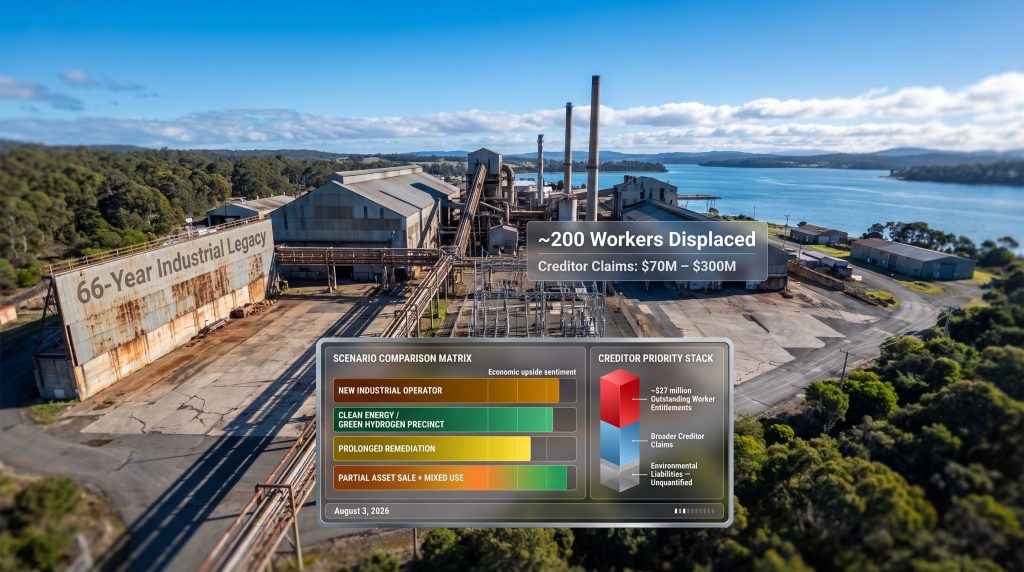
For 66 years, the facility represented the kind of long-duration industrial investment that regional economies depend on for employment stability, supply chain integration, and tax base continuity. Its closure in 2026 removed not only approximately 200 direct jobs but also the broader economic multiplier those jobs supported across accommodation, retail, transport, and services in the surrounding communities.
The Bell Bay Industrial Precinct: More Than One Smelter
Bell Bay has historically functioned as one of Tasmania's most strategically important industrial precincts, partly because of its proximity to Hydro Tasmania's generation assets and its deep water port access. The precinct hosts multiple large industrial users, most notably Bell Bay Aluminium, operated by Rio Tinto. The aluminium smelter is similarly energy-intensive and similarly dependent on competitive power pricing to remain viable. The loss of Liberty Bell Bay from the industrial energy consumption base creates a structural problem for how fixed grid costs are distributed across remaining users, a dynamic examined further below.
How the Liberty Bell Bay Smelter Reached Liquidation
Understanding the trajectory from operational smelter to liquidated asset requires tracing a sequence of compounding failures rather than a single event.
Key Timeline of Decline
| Milestone | Date |
|---|---|
| Smelter enters voluntary administration | March 2026 |
| Potential sale process initiated | March to June 2026 |
| Consortium withdraws from purchase process | July 2026 |
| Immediate closure announced; approximately 200 workers displaced | July 2026 |
| Creditors vote to liquidate; EY Parthenon appointed liquidators | August 3, 2026 |
The GFG Alliance Connection
The smelter's parent company, GFG Alliance, controlled by British industrialist Sanjeev Gupta, has faced sustained financial and regulatory pressure across multiple jurisdictions. GFG Alliance's financial difficulties were not a sudden shock but a prolonged structural deterioration that affected its Australian operations significantly. Voluntary administration in March 2026 was a downstream consequence of ownership instability rather than a standalone operational failure at the Tasmanian site.
This distinction matters for creditor recovery analysis. Where insolvency is driven by parent company financial engineering rather than local operational underperformance, the asset pool available to creditors may be more limited and more contested. Indeed, the Mount Isa smelter bailout debate illustrates how these pressures are playing out across multiple Australian industrial sites.
Why the Sale Process Failed
Administrators initiated a sale process that ran from March through June 2026. A consortium emerged as a potential buyer but ultimately withdrew from the process in July 2026. The structural barriers to a viable transaction in energy-intensive smelting are well documented: high fixed operating costs, exposure to volatile commodity prices, significant workforce obligations, and the capital expenditure required to maintain ageing industrial infrastructure. For prospective buyers, the risk-adjusted economics of acquiring a distressed manganese smelter in an era of uncertain steel demand were difficult to make work.
Insolvent Trading: What the Administrators Found
A report to creditors indicated Liberty Bell Bay may have been trading while insolvent for close to 12 months prior to the formal administration appointment in March 2026. This finding carries significant legal weight in Australian corporate law, as directors of a company that continues operating while unable to meet its financial obligations as they fall due may face personal liability assessments under the Corporations Act 2001 (Cth).
For creditors, insolvent trading findings can also influence the sequencing and quantum of recoveries, particularly if liquidators pursue recovery actions against related parties or former directors.
Understanding the Liquidation Process
The distinction between voluntary administration and liquidation is consequential and worth explaining clearly.
Voluntary administration is a process designed to give a company in financial distress the opportunity to restructure or find a buyer, with creditor interests protected by a moratorium on enforcement actions. It is a rescue-oriented mechanism.
Liquidation, by contrast, is a terminal process. The company ceases to trade, and an appointed liquidator realises whatever assets remain to distribute to creditors in a legally defined priority order.
EY Parthenon, having served as voluntary administrators, was appointed liquidator at the August 3 creditor meeting. This continuity of appointment is common in Australian insolvency practice and allows the liquidator to draw on institutional knowledge accumulated during the administration phase.
How Creditor Claims Are Structured
The reported creditor exposure for Liberty Bell Bay spans a wide range, reflecting uncertainty about the final quantum of claims and the realisable value of remaining assets.
| Creditor Category | Estimated Exposure |
|---|---|
| Total creditor claims (reported range) | $70 million to $300 million |
| Outstanding worker entitlements | approximately $27 million |
| Unpaid superannuation | Amount unconfirmed |
| Remaining asset pool for recovery | Subject to liquidation outcome |
The breadth of the $70 million to $300 million range reflects genuine uncertainty about intercompany loans, disputed claims, and contingent liabilities including environmental remediation obligations.
What Assets Can Actually Be Realised?
Realising value from a decommissioned industrial smelter is materially different from liquidating a retail business or a professional services firm. Smelting equipment is highly specialised, often site-specific, and subject to significant decommissioning costs before it can be moved or scrapped. Potential asset categories include:
- Raw materials and work-in-progress inventory
- Recoverable plant and machinery with secondary market value
- Real property and land (subject to environmental encumbrances)
- Intellectual property and process documentation
- Debtors and receivables
Against these recoverable assets, environmental remediation obligations function as a competing claim on the asset pool, potentially absorbing a significant portion of any realisable value before unsecured creditors receive distributions.
What Happens to the 200 Displaced Workers
The human dimension of the Liberty Bell Bay smelter liquidation centres on approximately 200 workers who lost their jobs when the site closed immediately in July 2026. The formal liquidation now enables those workers to access the federal government's Fair Entitlements Guarantee scheme.
What FEG Covers and What It Does Not
| Entitlement Type | FEG Coverage |
|---|---|
| Unpaid wages | Covered |
| Redundancy pay | Covered |
| Annual leave | Covered |
| Long service leave | Covered |
| Unpaid superannuation | Not covered |
| Maximum weekly wage threshold | $3,032 per week |
The superannuation gap is a material concern. Superannuation guarantee obligations that were unpaid prior to insolvency are not recoverable through FEG. Workers who are owed unpaid superannuation must lodge claims with the Australian Taxation Office, which can pursue recovery through its own enforcement mechanisms, though outcomes in insolvent estate contexts are rarely complete.
How Workers Can Access FEG: Step-by-Step
- Visit the dedicated support webpage established by the Department of Employment and Workplace Relations (DEWR) for Liberty Bell Bay employees
- Confirm personal eligibility based on employment classification and entitlement type
- Gather supporting documentation including employment records, pay slips, and termination notices
- Submit claims through the FEG online portal
- Await assessment and processing by the Fair Entitlements Guarantee Recovery Program
The Australian Workers Union has indicated that former employees are actively moving forward with their lives and pursuing entitlement recovery through available channels. Union representatives have framed the creditor vote not as a conclusion but as a procedural gateway that formally enables the financial recovery process for workers to begin.
The Broader Transition Challenge
Northern Tasmania's employment market has limited depth for workers with specialised pyrometallurgical skills. Retraining pathways through TAFE Tasmania and federally funded transition programs exist, but the pipeline from skilled industrial employment to equivalent alternative work in regional Tasmania is neither fast nor certain. The regional economic multiplier effect of losing 200 high-wage manufacturing jobs will be felt across the George Town economy for an extended period regardless of what happens to the physical site.
Four Scenarios for the Liberty Bell Bay Site
The Tasmanian government has signalled that the liquidation does not eliminate the site's strategic potential and has referenced third-party interest in the property. What that interest translates to in practice remains to be seen. Four credible scenarios exist for the site's medium-term future.
| Scenario | Timeline | Government Exposure | Economic Upside | Likelihood |
|---|---|---|---|---|
| New industrial operator acquires and restarts | 2 to 5 years | Low to Medium | High | Moderate |
| Clean energy or green hydrogen precinct | 5 to 10 years | Medium | Very High | Speculative |
| Prolonged remediation with no near-term commercial use | Ongoing | Very High | Minimal | High in near term |
| Partial asset sale with mixed-use redevelopment | 3 to 7 years | Medium | Moderate | Moderate |
The most immediate probable outcome is the third scenario: an extended period of remediation activity with no clear commercial reuse, while the liquidator resolves asset sales and environmental obligations. The longer-term scenarios depend heavily on whether Tasmania can attract investment in energy-intensive industries through competitive power pricing and whether emerging sectors such as green hydrogen eventually generate sufficient demand for established industrial precincts.
Furthermore, the Tasmanian government's Northern Economic Plan, flagged for release in late August 2026, may provide more clarity on which of these scenarios receives active policy support.
The next major ASX story will hit our subscribers first
The Environmental Remediation Problem
Perhaps the least visible but most financially significant dimension of the Liberty Bell Bay smelter liquidation is the site remediation liability. Decades of manganese alloy smelting produce contamination profiles that are complex and expensive to address, including heavy metal soil contamination, airborne particulate deposition in surrounding areas, and potential groundwater impacts depending on site geology and drainage characteristics.
Legal and environmental analysts have consistently identified a structural gap in Australian insolvency law as it relates to industrial contamination: when an insolvent company cannot fund remediation, the financial burden frequently defaults to state governments under environmental protection legislation. Tasmania's potential exposure to Liberty Bell Bay's cleanup costs could be substantial, and that exposure grows if the liquidation yields insufficient funds to meet the environmental obligations that would otherwise sit with the operator.
The polluter pays principle, which underpins Australian environmental regulation, functions effectively when the polluter remains solvent. In insolvency, the principle can become practically unenforceable, leaving regulators with enforcement rights against an entity with no assets and a legal obligation that has nowhere to go except toward the public purse.
Precedents from other Australian industrial site closures, including former aluminium and chemical processing facilities, suggest that state governments typically inherit remediation costs through a combination of direct funding and contractual indemnities negotiated during site transfer processes. The earlier and more actively the Tasmanian government engages with the liquidator on environmental obligations, the better positioned it will be to limit its ultimate exposure. Broader efforts around mining sustainability transformation offer useful frameworks for managing these legacy industrial liabilities.
The Ripple Effect on Tasmania's Energy Economics
Large industrial energy users in Australia, particularly in states with vertically integrated power systems, play a disproportionate role in determining the economics of electricity networks. When a major industrial consumer exits the grid, the fixed costs of generation, transmission, and distribution must be redistributed across a smaller remaining consumption base. This dynamic, sometimes called the death spiral risk in energy economics, can accelerate financial pressure on remaining large users.
For Hydro Tasmania, Liberty Bell Bay represented a significant contracted load. The loss of that load affects revenue calculations and potentially the pricing offered to remaining large users, particularly Bell Bay Aluminium.
| Facility | Operator | Energy Dependency | Current Status | Risk Profile |
|---|---|---|---|---|
| Liberty Bell Bay (manganese) | GFG Alliance (former) | High | Liquidated | Closed |
| Bell Bay Aluminium | Rio Tinto | Very High | Operating | Elevated |
The Australian Workers Union has specifically called on Hydro Tasmania to offer globally competitive power pricing to Bell Bay Aluminium to prevent a repeat of the Liberty Bell Bay outcome. This is not merely advocacy rhetoric. The aluminium smelter is similarly energy-intensive, and the commercial logic of its continued operation depends on access to power at internationally competitive rates.
Tasmania's hydroelectric system provides a potential competitive advantage, but that advantage must be priced to capture and retain industrial users. This is particularly relevant given growing discussions around green steel pricing and how energy costs shape the viability of metals processing across Australia.
If Bell Bay Aluminium were to face similar pressures to Liberty Bell Bay, the consequences for northern Tasmania's industrial and employment base would be significantly more severe than the current closure event.
Frequently Asked Questions: Liberty Bell Bay Smelter Liquidation
What did the Liberty Bell Bay smelter produce?
Liberty Bell Bay produced manganese alloys, which are essential inputs in steelmaking. It was Australia's only facility of its type, making its closure a structural gap in domestic industrial capacity rather than simply a regional employment story.
Why did the smelter go into liquidation?
The smelter entered voluntary administration in March 2026 following prolonged financial instability at its parent company, GFG Alliance. After a potential sale process failed in July 2026, the facility closed immediately. Creditors voted to liquidate on August 3, 2026, after concluding that business rescue was no longer viable.
How much is owed to creditors?
Administrator reports indicate total creditor claims ranging from $70 million to $300 million, including approximately $27 million owed directly to workers in unpaid entitlements.
What does the Fair Entitlements Guarantee cover?
The FEG covers unpaid wages, redundancy pay, annual leave, and long service leave, subject to a maximum weekly wage threshold of $3,032. It does not cover unpaid superannuation, which workers must pursue separately through ATO channels.
Who pays for environmental cleanup?
Under the polluter pays principle, the operator bears remediation costs. In insolvency, however, those costs frequently become a liability for state governments if the liquidated asset pool is insufficient. Tasmanian taxpayers may ultimately bear a significant portion of the Liberty Bell Bay site remediation costs.
What is GFG Alliance?
GFG Alliance is a group of global industrial companies controlled by British industrialist Sanjeev Gupta. The group has faced significant financial and regulatory scrutiny across multiple jurisdictions, and that broader instability was a primary driver of Liberty Bell Bay's administration.
What the Liberty Bell Bay Closure Signals for Australian Industrial Policy
The Liberty Bell Bay smelter liquidation exposes several structural vulnerabilities in how Australia manages large industrial assets in regional locations. Consequently, these lessons have implications well beyond Tasmania.
- Single-operator concentration risk in regional industrial precincts creates systemic employment and economic fragility when parent companies face financial distress
- Corporate governance failures at the group level can destroy decades of operational and community value in facilities that are themselves operationally competent
- Environmental liability frameworks in Australia are inadequate for preventing public cost socialisation when insolvent industrial operators leave contaminated sites behind
- Reactive policy responses to industrial closures consistently lag the speed of employment displacement, leaving workers and communities in extended periods of uncertainty
Furthermore, these vulnerabilities intersect with the broader challenge of critical minerals demand and the energy transition, as manganese remains a strategically important material for battery and steelmaking applications. In addition, the mining decarbonisation benefits debate adds another layer of complexity to how policymakers should approach the future of energy-intensive industrial sites.
The Northern Economic Plan due from the Tasmanian government in late August 2026 will be closely scrutinised for evidence that policymakers have absorbed these lessons and developed proactive mechanisms, rather than simply responding to events as they unfold. The strategic potential of the Bell Bay precinct is real, but potential without a structured pathway to realisation is simply aspiration.
Disclaimer: This article contains references to financial estimates, creditor claims, and scenario projections that involve inherent uncertainty. The creditor exposure range of $70 million to $300 million reflects figures reported by administrators and may change as the liquidation process progresses. Readers should not rely on this article as financial or legal advice. All figures and timelines are sourced from publicly reported information current as of August 2026.
Further coverage of the Liberty Bell Bay smelter liquidation, including contemporaneous reporting on the creditor vote and government response, is available through ABC News.
Want to Stay Ahead of the Next Major ASX Mineral Discovery?
While the Liberty Bell Bay liquidation highlights the risks of concentrated industrial dependency, it also underscores the critical importance of identifying transformative mineral opportunities early — Discovery Alert's proprietary Discovery IQ model delivers real-time alerts on significant ASX mineral discoveries, turning complex commodity data into actionable insights for both short-term traders and long-term investors. Begin your 14-day free trial today and position yourself ahead of the broader market.