
August 21, 2026
When Administrative Decisions Carry Constitutional Weight: The KSM Consultation Crisis
The relationship between large-scale resource extraction and Indigenous territorial rights has always been one of the most legally intricate dynamics in Canadian public policy. But what the Seabridge KSM Indigenous consultation dispute reveals goes further than a single project's regulatory troubles. It exposes a structural vulnerability buried inside British Columbia's own environmental assessment architecture, one that has been quietly accumulating legal risk for years, and which now threatens to reshape how every mining proponent in the province approaches post-certificate administration.
Understanding what is at stake requires moving past the headlines and examining the mechanics of the legal doctrine at the centre of the dispute.
When big ASX news breaks, our subscribers know first
What "Substantially Started" Actually Means in B.C. Resource Law
Within British Columbia's Environmental Assessment Act, the concept of being "substantially started" functions as a kind of regulatory preservation mechanism. Once a project receives this designation, its Environmental Assessment Certificate (EAC) remains operative even across extended development timelines, shielding it from mandatory re-evaluation.
This is not a minor procedural footnote. For a project like KSM, which has been in development planning for over a decade, the substantially started determination is arguably the single most consequential administrative outcome outside of the original certificate itself. It closes the window through which affected parties, including First Nations with asserted rights in the project area, can meaningfully intervene.
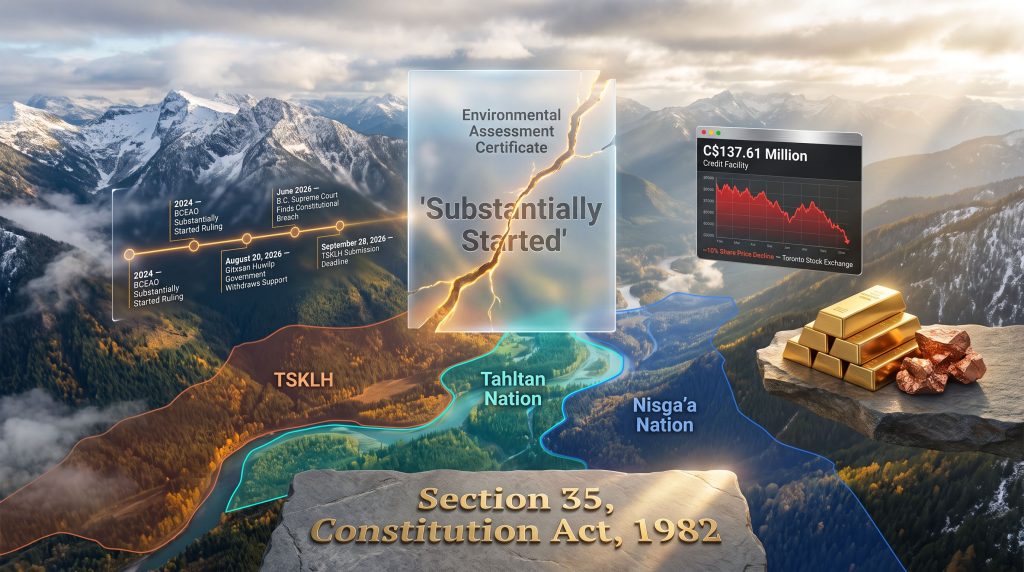
In 2024, the B.C. Environmental Assessment Office (BCEAO) issued a substantially started ruling for the KSM project. The Tsetsaut Skii km Lax Ha Nation (TSKLH) challenged that ruling, asserting they had not been properly engaged before the determination was made. In June 2026, the B.C. Supreme Court agreed, finding that the province had breached its constitutional duty to consult TSKLH before issuing the ruling.
The court's finding was precise in its scope: it did not invalidate KSM's Environmental Assessment Certificate, nor did it halt the project. It ordered the BCEAO to provide TSKLH with a 90-day window, expiring September 28, 2026, to submit written material before the office conducts a formal reconsideration of its substantially started determination.
The distinction matters enormously. A breach finding without certificate invalidation preserves the project's legal standing while creating a defined remediation pathway. However, the outcome of that pathway remains genuinely uncertain.
| Legal Outcome | Current Status |
|---|---|
| Substantially started determination | Preserved pending BCEAO reconsideration |
| Environmental Assessment Certificate | Remains in force during review period |
| TSKLH consultation order | 90-day submission window (deadline: Sept. 28, 2026) |
| SkeenaWild Conservation Trust petition | Dismissed by the court |
The Constitutional Architecture Behind the Dispute
Section 35 of the Constitution Act, 1982 affirms the existing Aboriginal and treaty rights of Indigenous peoples in Canada. Through landmark rulings including Haida Nation v. British Columbia (2004) and Taku River Tlingit First Nation v. British Columbia (2004), the Supreme Court of Canada established that the Crown carries a non-delegable duty to consult before making decisions that may adversely affect those rights.
Critically, this obligation extends to administrative determinations, not only to headline permitting decisions. A substantially started ruling, though it may appear procedurally mundane, constitutes exactly the kind of Crown decision that triggers consultation requirements. The KSM dispute is, in part, a case study in what happens when regulators treat administrative efficiency as a priority above constitutional compliance. Furthermore, the broader B.C. mining claims framework has increasingly come under scrutiny for similar structural gaps in post-certificate administration.
Where the Province's Process Failed
TSKLH's legal argument rested on a specific concern: the province proceeded with the substantially started determination without adequately engaging the Nation regarding the KSM project's tailings management facility (TMF) and its potential effects on waterways within their asserted traditional territory.
Supporting that argument, TSKLH's legal counsel Ryan Beaton referenced two pieces of documentation:
- A 2021 ethnographic report assessing TSKLH's rights and title claims in the relevant area
- A 2023 letter from B.C.'s Ministry of Indigenous Relations and Reconciliation that, according to Beaton, agreed with the study's conclusions
Beaton also directly contested Seabridge's framing of competing territorial claims, stating publicly that while it may be broadly accepted that the Tahltan Nation claims the area, it is not accepted that any evidentiary foundation for that claim has been established to the required standard. As reported by the Northern Miner, Beaton indicated that Seabridge's position was contrary to the conclusions the province itself had already reached.
Seabridge's Counter-Position
Seabridge Gold responded to the Gitxsan Huwilp Government's (GHG) withdrawal of support by releasing a statement asserting that TSKLH had been given extensive, fully funded opportunities to participate in consultation regarding the TMF during the KSM project's environmental assessment review process at a conceptual level, and that those invitations had been declined.
The company also challenged the framing of TSKLH as exclusive territorial authority over the TMF area, pointing to the Tahltan Nation and the Nisga'a Nation as holding overlapping rights. Seabridge publicly stated that TSKLH's insistence on being treated as exclusive owners of the territory had made the relationship difficult.
A critical point for investors and policy analysts to understand: Under Canadian constitutional law, the duty to consult belongs to the Crown, not to the proponent. Even if Seabridge offered and funded consultation opportunities, that does not transfer the legal obligation from the province to the company. The court's finding was directed at British Columbia's conduct, not Seabridge's.
The Three-Nation Territorial Landscape Surrounding KSM
The Seabridge KSM Indigenous consultation dispute cannot be understood without grasping the layered territorial complexity of northwest British Columbia. The KSM project sits within a region where three distinct First Nations assert rights, each with a different legal basis and treaty status.
| Nation | Basis of Claim | Treaty Status |
|---|---|---|
| Tsetsaut Skii km Lax Ha (TSKLH) | Asserted Aboriginal title, TMF area | No treaty |
| Tahltan Nation | Asserted Aboriginal rights, northwest B.C. | No treaty |
| Nisga'a Nation | Rights under Nisga'a Final Agreement | Modern treaty (2000) |
This multi-claimant environment is not simply an administrative inconvenience. It creates a structurally elevated legal risk that standard consultation frameworks struggle to accommodate. Consulting one Nation at greater depth risks being interpreted by another as implicitly validating that Nation's exclusive territorial claim, a dynamic that can undermine relationships across the entire Indigenous relations landscape simultaneously.
The Nisga'a Final Agreement, Canada's first modern treaty in British Columbia, adds another layer. Nisga'a rights are not merely asserted; they are codified under statute. The Crown's obligation to engage the Nisga'a Nation on decisions affecting their treaty area is qualitatively different from its obligations toward Nations still operating under unresolved Aboriginal title claims.
A Less-Understood Dynamic: How Overlapping Claims Affect Consultation Depth
What is not commonly appreciated among investors or lay observers is that the Crown must assess the strength of each Nation's claim and calibrate the depth of required consultation accordingly. This is sometimes called the "spectrum of consultation" principle. Where a Nation can demonstrate a strong prima facie claim to title or rights, the obligation on the Crown is not merely to notify or inform, but to engage deeply and potentially to seek accommodation.
When multiple Nations hold claims of varying strength across overlapping areas, regulators face a matrix of obligations that are extremely difficult to discharge simultaneously without inadvertently adjudicating the territorial disputes themselves. That is precisely the kind of quasi-judicial determination the Crown is not empowered to make through administrative process. Indeed, mining permitting explained in detail reveals just how complex these overlapping obligations can become for proponents navigating multi-Nation environments.
The Gitxsan Huwilp Withdrawal: Social Licence as a Risk Variable
On August 20, 2026, the Gitxsan Huwilp Government announced it was rescinding its longstanding support for the KSM project. GHG, which represents Gitxsan Nation interests in a governing capacity, had historically been among Seabridge's most significant Indigenous allies during the permitting process. Its reversal, framed publicly as an act of solidarity with TSKLH following the court ruling, introduced a new category of risk into the KSM equation.
GHG's withdrawal carries no direct legal force. It does not constitute a veto, nor does it override the existing EAC or affect the BCEAO reconsideration timeline. However, its significance in the broader investment risk context should not be underestimated.
Institutional lenders operating under modern ESG frameworks increasingly treat Indigenous community support as a substantive due diligence criterion, not merely a reputational consideration. Evidence of deteriorating social licence can affect:
- The conditions attached to existing and future credit arrangements
- The willingness of project finance institutions to underwrite construction-phase capital
- The risk premium applied to Seabridge's equity by institutional investors
- The regulatory posture of federal agencies assessing project approvals at subsequent stages
The market responded immediately. Following GHG's August 20 withdrawal announcement, Seabridge shares fell approximately 10% on the Toronto Stock Exchange by the following morning. This repricing occurred against the backdrop of a recently secured C$137.61 million (approximately US$100 million) credit arrangement, which had previously supported an upward move in the company's share price.
The speed of the correction is instructive. Markets had priced the credit facility as a signal of institutional confidence in KSM's trajectory. The GHG withdrawal reintroduced uncertainty that the credit announcement had temporarily suppressed. This pattern of social licence deterioration moving markets rapidly is consistent with broader trends in mining industry consolidation, where Indigenous relations disputes increasingly factor into asset valuations and joint venture negotiations.
Three Regulatory Scenarios for the BCEAO Reconsideration
The September 28, 2026 submission deadline for TSKLH marks the formal beginning of the BCEAO reconsideration process. Three materially different outcomes are possible.
Scenario A: The Substantially Started Determination Is Reaffirmed
The BCEAO reviews TSKLH's submissions and concludes that the remedial consultation now conducted is sufficient to satisfy the constitutional standard. The KSM EAC remains in force, and Seabridge continues development planning without material interruption. TSKLH retains the right to seek further judicial review.
Scenario B: The Determination Is Revoked or Suspended
The BCEAO finds that TSKLH's submissions reveal material deficiencies in the original process that cannot be remediated through written submissions alone. The substantially started designation is withdrawn, potentially triggering a requirement for new or extended environmental assessment. This outcome would impose significant timeline delays and could affect existing financing covenants.
Scenario C: A Negotiated Resolution Is Reached Before the Deadline
All three parties — Seabridge, the province, and TSKLH — reach a structured agreement incorporating some combination of modified TMF design parameters, impact-benefit provisions, or formal territorial acknowledgement language. This pathway, while politically demanding, would preserve the project while establishing an important precedent for resolving overlapping-claim disputes through negotiation rather than litigation.
| Scenario | Key Driver | Likely KSM Impact |
|---|---|---|
| A: Determination Reaffirmed | Strength of prior engagement record | Minimal disruption |
| B: Determination Revoked | Quality of TSKLH's evidentiary submissions | Significant timeline and cost impact |
| C: Negotiated Resolution | Political will from all parties | Managed risk, precedent-setting outcome |
The next major ASX story will hit our subscribers first
Systemic Gaps in B.C.'s Post-Certificate Consultation Framework
The KSM dispute is unlikely to remain an isolated case. It reveals a structural gap in how British Columbia's environmental assessment framework handles the administrative decisions that occur after the initial certificate is issued.
At the time of substantially started determinations, proponents have typically committed hundreds of millions of dollars to preliminary works. That sunk capital creates implicit pressure on regulators to resolve administrative questions quickly, compressing the space available for meaningful consultation.
The following reforms have emerged from the policy record as potential responses:
- Mandatory pre-determination consultation protocols requiring defined notice and engagement periods for all Nations with asserted rights in a project area before substantially started rulings are issued
- Overlapping claims mapping as a formal prerequisite for any post-certificate administrative determination affecting traditional territories
- Independent consultation monitors appointed to verify Crown engagement adequacy before determinations are finalised
- Legislative clarity on what constitutes constitutionally sufficient consultation at the post-certificate administrative stage, reducing ambiguity for both proponents and regulators
None of these reforms are currently embedded in B.C.'s Environmental Assessment Act, which creates ongoing exposure for other projects operating under certificates issued before the KSM ruling. Consequently, proponents advancing projects toward a definitive feasibility study stage must now factor post-certificate consultation risk into their project timelines and capital planning assumptions.
Frequently Asked Questions
What makes KSM significant as a mining project?
KSM, located in northwest British Columbia, is considered one of the largest undeveloped gold-copper deposits in the world by total resource size. Seabridge Gold has been advancing it through permitting and environmental assessment for over a decade. Its scale means that any material regulatory setback carries substantial implications not only for Seabridge but for the broader Canadian mining investment environment. The CBC has reported extensively on the province's consultation obligations in relation to the project.
Did the B.C. Supreme Court ruling stop the KSM project?
No. The June 2026 ruling found a constitutional breach in the province's consultation process but did not invalidate the KSM Environmental Assessment Certificate. The project's legal standing is preserved during the BCEAO reconsideration process, which runs until at least September 28, 2026.
What is TSKLH's core concern regarding the tailings management facility?
TSKLH asserts that the TMF could adversely affect waterways within their traditional territory, and that the province made a consequential administrative determination without adequately engaging them on those potential impacts. Ethnographic and ministerial documentation cited by TSKLH's legal counsel appears to support their territorial claims in the relevant area.
Does the Gitxsan Huwilp Government's withdrawal affect KSM's approvals?
Not directly. GHG's withdrawal is a political and reputational development without legal force over existing permits. However, its effect on social licence, lender confidence, and regulatory goodwill is real and has already been reflected in market pricing.
What does the duty to consult require at the administrative stage?
The Supreme Court of Canada has established that the Crown's constitutional duty to consult applies to administrative decisions, not only to initial permitting. The depth of that obligation scales with the strength of a Nation's claim and the severity of potential impacts. Substantially started determinations, which carry significant consequences for First Nations' ability to influence project trajectories, fall squarely within this framework.
Key Takeaways for Investors and Policy Observers
The Seabridge KSM Indigenous consultation dispute is a case that will likely be studied in Canadian mining policy and constitutional law courses for years. Furthermore, several implications stand out clearly for those monitoring the sector.
- Post-certificate administrative decisions are not legally insulated from constitutional consultation obligations — a reality that many project proponents and regulators have historically underappreciated
- Social licence deterioration can move markets faster than legal developments, as the 10% share price correction following GHG's withdrawal demonstrates
- Overlapping territorial claims represent structurally elevated risk that requires proactive, multi-party engagement strategies from the outset of project development, not remediation after the fact
- The September 28, 2026 TSKLH submission deadline is a genuine regulatory inflection point whose outcome will shape not only KSM's future but potentially the framework within which all substantially started determinations in British Columbia are made going forward
- The C$137.61 million credit facility signals that institutional lenders had confidence in KSM's near-term path before the GHG withdrawal, and monitoring how lender sentiment evolves through the reconsideration period will be an important signal of project trajectory
In addition, investors should remain attentive to management red flags in how companies communicate Indigenous relations risks to shareholders, particularly when social licence developments are moving faster than regulatory timelines suggest.
This article is intended for informational and analytical purposes only. It does not constitute financial, legal, or investment advice. Readers with investment exposure to companies discussed should consult qualified professionals. Regulatory outcomes described as scenarios involve inherent uncertainty and should not be interpreted as predictions.
Want to Track the Next Major ASX Mineral Discovery Before the Market Does?
Discovery Alert's proprietary Discovery IQ model scans ASX announcements in real time, delivering instant alerts on significant mineral discoveries and turning complex data into actionable investment insights — begin your 14-day free trial today, or explore Discovery Alert's dedicated discoveries page to understand why early identification of major discoveries has historically generated substantial returns.