
August 21, 2026
The Capital Concentration Imperative Reshaping Mining Services in 2026
Across the global mining services landscape, a structural realignment is quietly accelerating. The diversified, asset-heavy conglomerate model that defined many listed mining services groups through the 2010s is giving way to something leaner, more deliberate, and arguably more durable. Boards are asking harder questions about which business lines genuinely compound returns and which ones merely consume capital. The answers, furthermore, are reshaping portfolios from Perth to Toronto.
It is within this broader context that the decision by Perenti to sell BTP Group to Beetle Industries deserves to be understood — not simply as a transaction, but as a signal of where the mining services sector is heading and why private capital is increasingly positioned to absorb what listed operators are choosing to shed. This deal also reflects the broader mining industry consolidation gathering pace across the resources sector.
When big ASX news breaks, our subscribers know first
Understanding the BTP Group Divestment: Deal Architecture and Financial Terms
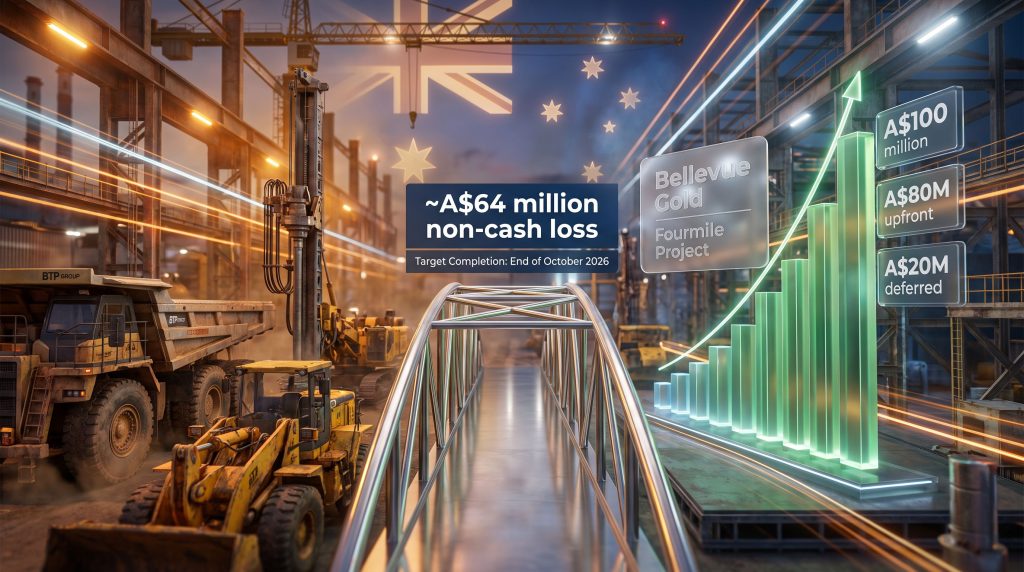
The transaction, announced in August 2026, involves the sale of BTP Group — Perenti's mining equipment rental and parts sales business — to Beetle Industries, a purpose-built acquisition vehicle established by a private consortium led by Cratus Group. The total consideration is A$100 million (approximately USD $71.1 million), structured across two tranches designed to balance seller certainty with buyer liquidity management.
Key Financial Parameters at a Glance
| Deal Parameter | Detail |
|---|---|
| Total Consideration | A$100 million (~USD $71.1 million) |
| Upfront Cash Payment | A$80 million (payable at completion) |
| Deferred Payment | A$20 million (due 12 months post-completion) |
| Performance Conditions on Deferred Payment | None |
| Expected Non-Cash Loss (FY26) | ~A$64 million |
| Target Completion Date | End of October 2026 |
The upfront A$80 million component is subject to customary working capital and net debt adjustments at completion. The deferred A$20 million tranche is notable for carrying no performance conditions whatsoever, meaning Perenti's entitlement to that second payment exists entirely independently of how BTP Group performs under new ownership. This is a structurally significant point for investors assessing Perenti's balance sheet risk.
According to Perenti's official announcement, completion remains conditional on Beetle Industries finalising its funding arrangements and obtaining required consents from relevant contract counterparties, with the transaction targeted to close by the end of October 2026.
The unconditional nature of the deferred payment removes a common source of post-divestment uncertainty. Perenti receives the full A$100 million regardless of how BTP performs under Beetle Industries, which insulates Perenti from any post-sale operational deterioration in the divested business.
Who Is Beetle Industries and What Does Cratus Group Bring to the Table?
Beetle Industries is not an existing operating entity with a long track record. It was established specifically as an acquisition vehicle for this transaction — a structure increasingly common in mid-market mining services M&A where private consortia create purpose-built vehicles to isolate transactional risk and simplify governance.
The consortium is led by Cratus Group, a private operator with established activities spanning the resources, logistics, structural capital, and infrastructure sectors across Australia and multiple Asian markets. The funding architecture for the acquisition draws on a debt facility from a major Australian bank alongside equity contributions and shareholder loans from consortium members, including a Cratus Group subsidiary.
Why Private Capital Is Attracted to Mining Equipment Rental Assets
From a private capital perspective, mining equipment rental businesses offer a set of characteristics that listed company frameworks often undervalue:
- Contracted revenue streams provide cash flow predictability that supports debt-financed acquisition structures
- Established client relationships and parts distribution networks represent embedded commercial moats that are difficult and expensive to replicate
- Operational restructuring away from a listed-company cost base can meaningfully improve margin performance without changing the underlying business model
- Private ownership removes the quarterly earnings pressure that can cause listed parents to underinvest in fleet renewal or geographic expansion within non-core subsidiaries
For Cratus Group, absorbing BTP Group into a portfolio that already spans resources and logistics creates potential cross-sector synergies that were structurally unavailable under Perenti's ownership model.
What the A$64 Million Non-Cash Loss Actually Tells Investors
Perenti has confirmed it expects to record an approximately A$64 million non-cash loss on the BTP Group sale within its FY2026 financial statements. For investors unfamiliar with how divestment accounting works in practice, this figure warrants careful interpretation.
The loss reflects the gap between BTP Group's carrying value on Perenti's balance sheet — the historical cost of the asset net of accumulated depreciation and impairments — and the A$100 million agreed sale price. A larger carrying value than the sale price generates a book loss, but this says nothing about cash generation from the transaction.
Critically, this is a non-cash item. It does not affect Perenti's operating cash flows, its liquidity position, or its capacity to fund ongoing operations. Investors should evaluate it separately from the strategic value of the capital being freed for redeployment into higher-returning business lines.
In practical terms, this kind of accounting loss is a routine feature of asset divestments where historical carrying values were established during periods of higher asset valuations or before structural headwinds compressed the market value of equipment rental businesses. It is a balance sheet adjustment, not a reflection of value destruction at the operational level. Understanding these commodity price impacts on asset valuations provides important context for this type of write-down.
Perenti's Strategic Pivot: Where the Capital Goes Next
The more consequential question for Perenti investors is not what is being sold, but what the proceeds enable. Perenti's CFO Michael Ellis confirmed that the capital freed by the BTP Group sale provides meaningful additional flexibility to pursue opportunities that clear the company's performance hurdle rates.
The immediate deployment priorities identified by management include:
- Funding operational support for the recently secured contract at Bellevue Gold in Western Australia
- Committing capital to the newly awarded Fourmile project in the United States, signalling Perenti's continued international growth ambitions
- Maintaining financial capacity across an active and competitive tender pipeline
- Preserving optionality for inorganic growth opportunities, including potential acquisitions in contract mining and technology-enabled services
This capital recycling logic is central to understanding Perenti's competitive repositioning. The company's genuine strengths lie in underground contract mining, specialist drilling, and increasingly in technology-enabled mining services. BTP Group's equipment rental model is structurally misaligned with this profile: it is asset-intensive, margin-compressed, and cyclically exposed in ways that contract mining operations are not.
Perenti's managing director and CEO Vanessa Torres has described the transaction as a continuation of the company's active portfolio management strategy, with capital being directed toward businesses that align with its core competitive capabilities and maximise total shareholder returns.
Structural Headwinds That Made BTP Group a Non-Core Asset
BTP Group did not become a divestment candidate overnight. Several structural forces have gradually compressed the attractiveness of mining equipment rental as a standalone business line within a listed mining services group. Indeed, the consolidation pressures facing the broader sector have accelerated these portfolio rationalisation decisions considerably.
- OEM-direct competition: Major equipment manufacturers have aggressively expanded their own rental and leasing programmes, reducing the captive market available to independent rental operators
- Fleet age and replacement costs: Maintaining rental fleet competitiveness requires continuous capital expenditure on equipment renewal, creating a persistent drag on free cash flow
- Client preference evolution: Mine operators increasingly favour integrated, long-term service contracts over standalone equipment hire arrangements, reducing demand for pure-play rental models
- Commodity cycle sensitivity: Equipment rental demand is closely tied to mine development activity, which itself follows commodity price cycles, creating earnings volatility that listed company investors tend to discount heavily
BTP Group's performance was acknowledged by Perenti's leadership to have been affected by market headwinds in recent years, even as its operational team demonstrated commitment to sustaining business profitability under difficult conditions.
The next major ASX story will hit our subscribers first
Comparing Exit Strategies: Why a Structured Trade Sale Made Sense
Not all divestment mechanisms are equal, and the choice of a structured trade sale to a private consortium over alternatives such as an IPO, demerger, or asset-by-asset liquidation reflects specific strategic considerations.
| Exit Mechanism | Speed | Value Certainty | Strategic Fit for Seller | Common Use Case |
|---|---|---|---|---|
| Structured Trade Sale (this deal) | Medium | High | Strong: clean exit | Non-core subsidiary disposal |
| IPO / Demerger | Slow | Variable | Moderate | High-value, standalone-capable assets |
| Asset-by-Asset Liquidation | Fast | Low | Weak | Distressed or wind-down scenarios |
| Management Buyout | Medium | Moderate | High | Operational continuity priority |
A structured trade sale to a credible private buyer delivers the combination of price certainty, execution speed, and clean separation that Perenti required. An IPO or demerger would have demanded significant management bandwidth and market readiness, neither of which suits a subsidiary facing structural headwinds. The private consortium structure, by contrast, provides BTP Group with an ownership framework genuinely motivated to invest in its future growth.
Broader M&A Patterns: What This Deal Reflects About the Mining Services Sector
The decision by Perenti to sell BTP Group to Beetle Industries is not an isolated event. However, it does reflect a convergence of trends reshaping mining industry evolution and M&A activity in 2025 and 2026:
- Listed mining services companies are increasingly treating non-core asset disposals as a standard capital management instrument rather than a last resort
- Private capital, including family offices, infrastructure funds, and consortium vehicles, is emerging as the primary absorber of mid-market mining services assets that listed operators are rationalising
- The separation of asset-heavy equipment businesses from labour and technology-intensive service operations is becoming a defining portfolio architecture preference among the sector's larger listed players
- Buyers are demonstrating strong appetite for businesses with contracted revenue bases and embedded client networks, even where recent earnings have been impacted by cyclical headwinds
This pattern suggests that the competitive landscape for contract mining, drilling, and technology services will become increasingly concentrated among listed specialists, while the equipment rental and parts distribution sub-sector transitions toward private ownership structures better suited to its capital requirements and growth dynamics.
What New Ownership Means for BTP Group's Future
For BTP Group itself, the transition to Beetle Industries and Cratus Group ownership removes a significant structural constraint: the obligation to compete for capital allocation within a listed parent's portfolio ranked against higher-margin alternatives. Under private ownership, investment decisions for BTP can be made on the basis of the business's own growth logic rather than relative return comparisons against contract mining operations.
Operational continuity is reinforced by the deal's completion conditions, which include securing required consents from relevant contract counterparties. This requirement signals that BTP's client relationships are a core component of the asset's assessed value, and the buyer is explicitly incentivised to preserve them. Furthermore, Cratus Group's existing footprint across resources, logistics, and infrastructure in Australia and Asia creates potential for BTP to access adjacent markets and cross-sector customer relationships that were not available within Perenti's organisational structure.
For a comprehensive overview of how such portfolio shifts fit within wider sector dynamics, the latest metals and mining analysis offers valuable additional context. As noted by Australian Mining, this transaction is being closely watched as a bellwether for how other listed mining services companies may approach non-core asset management in the near term.
Key Takeaways for Mining Services Investors
- Portfolio concentration is no longer optional for listed mining services companies seeking sustainable return profiles: non-core asset disposals are becoming a core capital management discipline
- The A$64 million non-cash accounting loss should be assessed separately from the strategic and cash flow benefits of the transaction, as it represents a balance sheet adjustment rather than an operational impairment
- The unconditional deferred payment structure provides Perenti with full economic certainty on the total A$100 million consideration, independent of BTP's post-sale performance
- Private consortium buyers are demonstrating a sophisticated understanding of the embedded value in established mining services client networks, even where recent earnings have been cyclically pressured
- Perenti's redeployment priorities, anchored by Bellevue Gold and Fourmile contract commitments alongside an active tender pipeline, reflect a deliberate focus on geographies and contract types where the company's competitive strengths are most defensible
This article contains forward-looking statements and analysis based on publicly available information as of August 2026. Past financial performance and strategic positioning are not necessarily indicative of future outcomes. Readers should conduct their own due diligence and seek independent financial advice before making investment decisions.
Want to Spot the Next Major ASX Mining Discovery Before the Market Does?
Discovery Alert's proprietary Discovery IQ model delivers real-time alerts on significant ASX mineral discoveries, instantly converting complex geological data into actionable investment insights for both short-term traders and long-term investors — explore the historic returns major discoveries have generated to understand the opportunity, then begin your 14-day free trial at Discovery Alert to position yourself ahead of the broader market.