August 21, 2026
The Quiet Revolution Reshaping How India Powers Itself After Dark
Most energy transitions are measured in gigawatts added to a grid. India's current transformation, however, is better understood through a different lens entirely: the growing gap between when the sun shines and when the country actually needs power. Solar irradiance peaks between 10am and 2pm. Peak electricity demand arrives in the early evening, long after panels have stopped generating at full capacity. Bridging that mismatch is not merely a technical challenge. It is the central strategic imperative behind India energy storage growth, and it is reshaping investment priorities, policy frameworks, and grid architecture at a pace few anticipated even three years ago.
When big ASX news breaks, our subscribers know first
From Gigawatts to Gigawatt-Hours: Understanding What India Has Built So Far
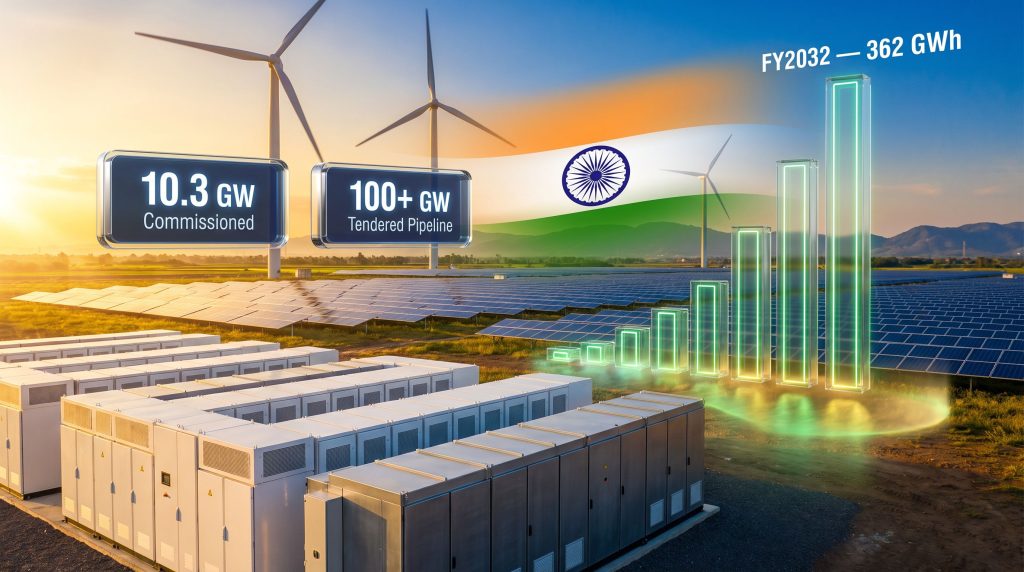
A common mistake in evaluating India's storage market is conflating installed capacity with maturity. The two are very different things. India had approximately 5.9 GWh of cumulative installed battery storage as of March 2026, while total commissioned storage across both batteries and pumped hydro reached around 10.3 GW by June 2026. These are meaningful numbers, but they exist within a much larger context of ambition.
| Metric | Value | Timeframe |
|---|---|---|
| Cumulative installed battery storage | ~5.9 GWh | March 2026 |
| Total commissioned storage (battery + pumped hydro) | ~10.3 GW | June 2026 |
| Projects awarded | ~50 GW | Mid-2026 |
| Total tendered pipeline | >100 GW | Mid-2026 |
| Projected commissioned storage | ~61 GW / 218 GWh | FY2030 |
| Projected commissioned storage | ~97 GW / 362 GWh | FY2032 |
The distinction between power capacity (measured in GW) and energy throughput (measured in GWh) matters enormously for storage planning. A gigawatt of pumped hydro running for four hours delivers four gigawatt-hours of usable energy. Battery energy storage systems (BESS) are increasingly being designed for two-hour to four-hour discharge durations, which means raw GW figures can obscure how much actual energy a storage fleet can deliver to the grid when it matters most.
What the numbers above reveal is a market that is large in intent but still early in execution. The gap between a tendered pipeline exceeding 100 GW and commissioned capacity of roughly 10.3 GW is not a sign of failure. It is the normal anatomy of a sector in the process of scaling from policy design to physical infrastructure.
The Q1 2026 Signal That Changed the Narrative
Perhaps the most striking data point in India's recent storage story is the quarterly acceleration recorded in early 2026. Battery storage additions reached 4.6 GWh in Q1 2026 alone, compared with just 442.7 MWh in the preceding quarter. That is not incremental growth. It is roughly a tenfold increase in a single quarter, driven by the commissioning of projects that had been tendered and awarded in prior periods.
Annual battery additions are forecast to climb from approximately 507 MWh in 2025 to around 5 GWh across 2026, reflecting both the maturation of earlier procurement rounds and the accelerating effect of falling battery prices. This kind of acceleration is what structural inflection points look like in energy infrastructure: slow build-up followed by a sharp commissioning surge as multiple projects reach completion simultaneously.
The Policy Architecture Driving India Energy Storage Growth
India's storage policy framework operates on two distinct but reinforcing tracks. The first creates demand. The second builds domestic supply capability. Both are necessary for the market to scale sustainably, and both are currently active. Furthermore, understanding this dual-track approach is essential for appreciating why the battery raw materials market is increasingly oriented towards India's expanding procurement pipeline.
Mandatory Storage Obligations: Creating Guaranteed Demand
The Ministry of Power has established a storage obligation framework requiring that 4% of total electricity demand be sourced through storage by 2030. This is not a target in the aspirational sense. It is a procurement mandate that translates into enforceable demand signals for developers, financiers, and equipment manufacturers. When utilities know they are legally required to procure storage, the bankability of storage projects improves markedly, which in turn reduces financing costs across the sector.
Central procurement agencies play a key aggregation role here, bundling storage tenders at scale in ways that individual distribution companies could not achieve independently. The result is larger tender packages, more competitive bidding, and lower per-unit costs — a virtuous cycle that accelerates India energy storage growth while improving project economics.
PM-KUSUM, PM Surya Ghar, and the Distributed Storage Opportunity
India's distributed energy story is often told through the lens of rooftop solar, but storage integration is now becoming central to how policymakers think about decentralised generation. The original PM-KUSUM scheme supported solar deployment across 35 million farms, creating a vast installed base of generation assets that, without storage, remain vulnerable to grid instability and curtailment.
The Ministry of New and Renewable Energy (MNRE) is actively developing a successor programme designed to embed battery storage directly into farm-level solar systems. MNRE Secretary Santosh Kumar Sarangi highlighted this direction at the Bloomberg New Energy Finance (BNEF) Summit 2026 in New Delhi, describing the integration of battery energy storage into decentralised power management as a key ministerial priority.
This matters because farm-level storage simultaneously addresses two distinct problems: it improves energy access in areas with unreliable grid supply, and it reduces the load variability that aggregated agricultural demand creates on distribution networks. In addition, battery storage-driven lithium demand is climbing sharply as India's distributed storage ambitions translate into real procurement volumes.
The PM Surya Ghar initiative adds another layer, targeting rooftop solarisation for 10 million households. As household solar penetration deepens, the downstream demand for small-scale BESS grows organically, creating a distributed storage market that complements utility-scale procurement rather than competing with it.
Financial Incentives: PLI, Green Hydrogen, and Polysilicon
On the supply side, India's financial architecture for clean energy manufacturing is substantial:
- ₹24,000 crore allocated under the Production Linked Incentive (PLI) scheme, targeting domestic solar and wind manufacturing resilience
- ₹19,700 crore committed under the National Green Hydrogen Mission, which intersects with long-duration storage requirements
- Capital expenditure support being planned for domestic polysilicon manufacturers to reduce upstream import dependency across the solar supply chain
The strategic logic is straightforward: a country that cannot manufacture the components of its own clean energy system remains permanently exposed to the supply chain disruptions and geopolitical pressures that have repeatedly destabilised global renewable deployment.
Pumped Hydro vs. BESS: A Market in Transition
Pumped hydro has historically dominated India's installed storage base. Decades of reservoir infrastructure built for irrigation and power generation created a foundation of pumped storage capability that battery systems are only now beginning to rival in cumulative terms. However, the composition of new-build additions tells a different story.
Sarangi confirmed at the BNEF Summit 2026 that existing reservoirs across India are being actively evaluated for their potential to support pumped storage operations, effectively converting legacy water infrastructure into grid-scale energy storage. This retrofit approach offers a meaningful advantage over greenfield pumped hydro: the civil infrastructure already exists, which significantly compresses both the timeline and the capital requirement for new capacity.
Battery energy storage systems, meanwhile, are benefiting from a global cost curve that has made standalone BESS commercially viable without subsidies across a growing range of use cases. The levelised cost of storage (LCOS) for lithium-ion BESS has declined sharply over the past five years. Whilst pumped hydro retains advantages for multi-hour and seasonal storage applications, BESS is increasingly competitive for the two-to-four-hour discharge durations that grid operators most frequently need. Direct lithium extraction technologies are also improving the economics of lithium supply, with broader implications for BESS cost trajectories globally.
Scenario Analysis: How Large Could India's Storage Market Become?
| Scenario | Commissioned Capacity | Energy Throughput | Key Assumption |
|---|---|---|---|
| Base Case (FY2030) | ~61 GW | ~218 GWh | Policy mandates met, moderate BESS cost decline |
| Accelerated Case (FY2032) | ~97 GW | ~362 GWh | Renewable buildout on schedule, full mandate compliance |
| High-BESS Case (FY2032) | ~42 GW BESS alone | ~411.4 GWh total | Battery costs fall faster than projected |
The range of outcomes is wide, and the differences between scenarios are not primarily technological. They are primarily execution-related. India's renewable sector has a well-documented history of commissioning below the volumes implied by tendering activity. The structural lag between project award, financial closure, equipment procurement, land acquisition, and grid connection means that even an aggressive tender pipeline does not guarantee proportionate capacity additions within a given timeframe.
The Execution Gap: Why Tenders Are Not Capacity
Of the more than 100 GW tendered as of mid-2026, approximately 50 GW had been formally awarded. Commissioned capacity stood at roughly 10.3 GW. Each step in that funnel involves real-world constraints:
- Land acquisition remains one of the most persistent bottlenecks in large-scale energy project development across India
- Grid connectivity timelines frequently extend beyond project developers' initial projections
- Equipment supply chains for battery cells remain heavily dependent on imports, particularly from China
- Financing costs in a higher-interest-rate environment compress returns and delay financial closure on marginal projects
None of these constraints are insurmountable. All of them slow the conversion of policy ambition into operational capacity.
Three Strategic Priorities Shaping India's Renewable and Storage Ecosystem
MNRE Secretary Sarangi articulated three strategic expectations for India's energy sector at the BNEF Summit 2026, each of which carries direct implications for the storage market.
Energy security through storage integration sits at the top of the priority list. Storage is increasingly being positioned not merely as a grid management tool but as a national energy security asset. Consequently, the intersection of critical minerals and energy security has become a focal point for Indian policymakers seeking to reduce dependence on fossil-fuel peaking plants during periods of high demand and low renewable generation.
Exponential growth in distributed renewable energy represents the second expectation, with rooftop solar and farm solarisation identified as the primary growth vectors. MNRE has historically supported 40 GW of deployment through its solar power scheme and an additional 20 GW through the CPSU scheme, establishing the institutional precedent for government-backed deployment at scale.
Manufacturing resilience across the value chain completes the picture. The vulnerability of import-dependent clean energy supply chains, exposed repeatedly during global disruptions, has elevated domestic manufacturing from an industrial policy preference to a strategic necessity. The PLI scheme outcomes over the next three to five years will largely determine whether India becomes a net contributor to global clean energy component supply or remains structurally dependent on imports.
The next major ASX story will hit our subscribers first
Key Risks That Could Slow the Trajectory
India's storage ambitions are credible in policy design. The primary uncertainty lies not in the existence of demand but in the speed at which the physical infrastructure required to meet that demand can be built, financed, and connected.
Three risk categories deserve particular attention from anyone evaluating India energy storage growth:
-
Technology and supply chain concentration: Heavy reliance on lithium-ion chemistry means India's BESS ambitions are exposed to lithium price volatility and the geopolitical dimensions of battery supply chains. India holds limited domestic lithium reserves, making the long-term cost competitiveness of BESS contingent on either securing reliable import channels or developing alternative storage chemistries. India's lithium investment strategy reflects this concern, with active efforts to establish upstream supply security. Flow batteries and sodium-ion systems represent emerging alternatives, though neither has yet achieved the cost-performance profile needed for widespread deployment at grid scale.
-
Transmission network readiness: Storage systems can only deliver value if the grid can absorb and redistribute the energy they discharge. Inter-state power transfer limitations and the underdevelopment of smart grid infrastructure in many regions create binding constraints on storage utilisation rates and revenue generation.
-
Financing in a higher-cost capital environment: Storage projects typically have longer payback periods than generation assets, making them more sensitive to interest rate levels. According to IEEFA's analysis of India's energy storage push, tariff viability and financing hurdles remain among the most significant structural challenges for the sector. The combination of import-dependent equipment costs, land access challenges, and elevated financing costs creates a more complex risk profile for storage developers than for solar or wind projects operating under established procurement frameworks.
Frequently Asked Questions: India Energy Storage Growth
How much battery storage capacity has India installed so far?
India had approximately 5.9 GWh of cumulative installed battery storage as of March 2026. Total commissioned storage across batteries and pumped hydro reached around 10.3 GW by June 2026.
What is India's energy storage target for 2030?
The Ministry of Power has set a mandatory storage obligation requiring 4% of total electricity demand to be met through storage by 2030, alongside projections of approximately 61 GW and 218 GWh of commissioned storage capacity by FY2030.
Why did battery storage additions surge in Q1 2026?
Battery additions reached 4.6 GWh in Q1 2026 against just 442.7 MWh in the prior quarter, reflecting the simultaneous commissioning of projects tendered in earlier cycles, combined with falling battery costs and the progressive effect of procurement mandates.
What role does pumped hydro play in India's storage strategy?
Pumped hydro constitutes the largest portion of India's existing commissioned storage infrastructure. The government is evaluating legacy reservoir assets for pumped storage retrofits, which offer faster deployment timelines than greenfield development by leveraging civil infrastructure already in place.
How does PM-KUSUM connect to battery storage?
The original PM-KUSUM scheme focused on solar deployment for agricultural use across 35 million farms. MNRE is developing a successor programme that directly integrates battery energy storage to improve decentralised power management at the farm level, addressing both energy access and grid stability simultaneously.
What is the difference between India's tendered and commissioned storage capacity?
As of mid-2026, the tendered pipeline exceeded 100 GW, approximately 50 GW had been awarded, and commissioned capacity stood at around 10.3 GW. This funnel reflects normal project development timelines rather than market failure, but it underscores why execution velocity is the critical variable in determining whether FY2032 projections are achieved on schedule.
The Investment Case in Summary
India's energy storage growth trajectory is built on a foundation that most markets lack: mandatory demand creation, a massive pre-existing renewable fleet requiring storage integration, and falling technology costs that improve project economics with each passing year. MNRE's historical role in creating markets through government-backed schemes, having supported over 60 GW of solar deployment across multiple programmes, provides institutional credibility for the storage ambitions now being articulated.
The primary uncertainty for investors and developers is not whether demand exists. Sarangi's characterisation of storage expansion as exponential reflects a genuine policy commitment backed by financial allocations and regulatory mandates. The central question is execution velocity: how quickly can the 100 GW tender pipeline be converted into operational assets given the land, grid, supply chain, and financing constraints that have historically compressed India's commissioning rates below tender volumes.
For a market moving from single-digit gigawatt-hours of installed battery capacity toward hundreds of gigawatt-hours within a decade, the scale of opportunity is clear. Furthermore, strategic pathways research from Berkeley's IECC suggests that achieving the FY2032 targets will require sustained policy consistency, coordinated financing mechanisms, and accelerated domestic manufacturing. The path to capturing this opportunity runs directly through solving the execution problem that separates India's storage ambitions from its storage reality.
Readers seeking ongoing coverage of India's renewable energy policy landscape and storage market developments can explore related reporting at ETEnergyWorld (energy.economictimes.indiatimes.com), which tracks developments across India's clean energy transition.
This article contains forward-looking projections and scenario analysis based on publicly available data and policy frameworks current as of August 2026. Projections involve assumptions that may not be realised. Nothing in this article constitutes financial or investment advice.
Want to Identify the Next Major Mineral Discovery Before the Broader Market Does?
As India's energy storage ambitions drive exponential demand for battery raw materials and critical minerals, Discovery Alert's proprietary Discovery IQ model scans ASX announcements in real time, instantly alerting subscribers to significant mineral discoveries with the potential to deliver substantial returns — explore Discovery Alert's dedicated discoveries page to see historic examples of what major finds can deliver, and begin your 14-day free trial today to position yourself ahead of the market.