
August 21, 2026
The Psychology Behind Analyst Conviction: Understanding the Press Metal Buy Recommendation
When a broad group of institutional analysts converges on a single stock without a single dissenting sell rating, the behaviour itself becomes a data point worth examining. Investor psychology research consistently shows that analyst consensus of this nature does not emerge purely from optimism. It reflects a calculated assessment of earnings visibility, competitive positioning, and structural growth drivers that, when stacked together, reduce the perceived probability of permanent capital loss. The current Press Metal buy recommendation landscape offers a textbook example of this dynamic in action.
When big ASX news breaks, our subscribers know first
What the Analyst Consensus Actually Reveals
Across more than fifteen research houses covering Press Metal Aluminium Holdings Bhd, the rating distribution tells a striking story. Not one analyst currently carries a sell or underperform rating on the stock. The overwhelming majority hold Buy or Outperform positions, with only a small contingent maintaining cautious Hold or Neutral stances. Furthermore, analyst estimates across these research houses reinforce this overwhelmingly positive outlook.
| Rating Category | Estimated Analyst Count | Implied Sentiment |
|---|---|---|
| Buy / Outperform | 12 to 13 analysts | Strong structural conviction |
| Hold / Neutral | 2 to 3 analysts | Near-term caution, positive long-run view |
| Sell / Underperform | None recorded | No active bearish thesis |
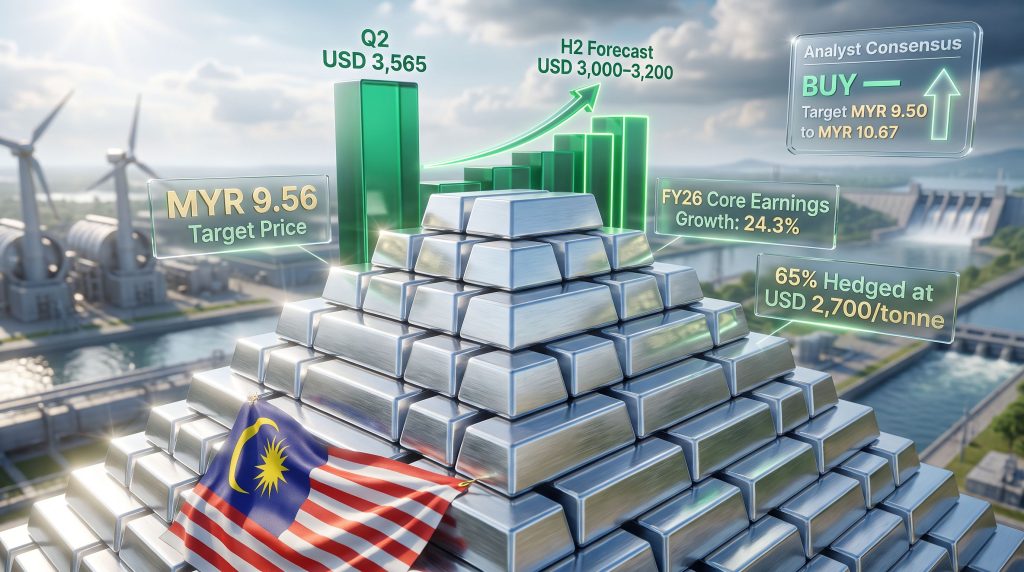
Target prices across these research houses currently range from MYR 9.50 to MYR 10.67, set against a recent trading price of approximately MYR 7.86. That implies a potential upside range of roughly 20% to 37% depending on which house's modelling assumptions are applied.
The spread in target prices is itself informative. A nearly 12% gap between the lowest and highest targets does not indicate disagreement about direction. Every analyst agrees the stock should be higher. The divergence instead reflects differing assumptions about the pace of capacity additions, aluminium price normalisation timelines, and how aggressively to value upstream integration benefits. In other words, the market is debating magnitude, not direction.
Key Insight: When no analyst holds a sell rating yet target prices diverge by nearly 12%, the market is not debating direction. It is debating magnitude. This is a hallmark of a structurally favoured stock with near-term execution risk rather than fundamental doubt.
Why the Business Model Commands a Structural Premium
Hydropower-Backed Smelting: A Cost Moat With an 18-Year Runway
The single most important competitive advantage Press Metal holds relative to regional peers is its access to low-cost, renewable hydropower for aluminium smelting. Electricity typically accounts for 30% to 40% of the total cash cost of primary aluminium production, which means energy cost is the dominant variable determining where a smelter sits on the global cost curve.
Press Metal has recently secured a 129MW hydropower allocation under an 18-year contract, a tenure that effectively locks in structural cost advantages well beyond typical capex planning horizons. This allocation is capable of supporting approximately 80,000 tonnes per annum of additional aluminium production capacity. For institutional analysts, this is not simply a capacity story. It is a margin story, because hydro-powered aluminium investment of this nature produces lower-cost, lower-carbon metal that increasingly commands physical market premiums.
The green credentials embedded in hydropower smelting are becoming commercially material. Automotive manufacturers, aerospace suppliers, and packaging companies are increasingly specifying low-carbon metals production from certified renewable sources. A smelter with an 18-year renewable energy contract is structurally positioned to capture these premiums, which adds an earnings quality dimension that does not appear explicitly in standard financial forecasts.
Vertical Integration and the Alumina Self-Sufficiency Equation
Alumina is the intermediate product refined from bauxite before it enters the smelting process, and its price behaviour is one of the most significant and often underappreciated sources of margin volatility for aluminium producers. When alumina spot prices spike, smelters that purchase alumina on the open market face immediate margin compression that can take quarters to recover from.
Press Metal is actively addressing this exposure through its PT KAN project, an upstream alumina refining venture expected to commence operations in 2027. Upon completion, PT KAN is projected to lift Press Metal's alumina self-sufficiency rate to approximately 40%, dramatically reducing the proportion of alumina purchased at spot market rates.
This matters enormously from a valuation perspective. A company that sources 40% of its key raw material internally is structurally insulated from a meaningful portion of input cost volatility. Analysts who apply premium price-to-earnings multiples to vertically integrated commodity producers are doing so precisely because integration reduces the earnings variance that forces multiple compression during commodity downturns.
Hedging Discipline as a Proxy for Management Quality
Press Metal has hedged 65% of its FY26 production at USD 2,700 per tonne, providing a defined earnings floor regardless of spot LME movements. This level of hedging coverage is not universal among aluminium producers and signals a management team that prioritises earnings predictability over speculative upside.
From an institutional investor perspective, a robust hedge book does two things simultaneously. First, it reduces the range of potential earnings outcomes, which in turn lowers the discount rate applied to future cash flows. Second, it communicates to the market that management has high enough confidence in its cost structure to lock in margins rather than gamble on price upside. Both effects support a premium valuation multiple.
Analyst Lens: A company that hedges 65% of annual output at a defined floor price is communicating earnings visibility to institutional investors. This directly compresses the risk premium embedded in the valuation, supporting higher forward multiples than unhedged peers would typically receive.
Aluminium Price Dynamics: Reading Beyond the LME Headline
Price Moderation Does Not Tell the Full Story
LME aluminium averaged USD 3,565 per tonne during the second quarter of calendar year 2026, but has since softened to a year-to-date average of approximately USD 3,196 per tonne through the third quarter. Analyst forecasts for the second half of 2026 place average prices in the USD 3,000 to USD 3,200 per tonne range, reflecting expectations that prior supply disruptions will partially resolve.
| Aluminium Price Metric | Value |
|---|---|
| Q2 CY26 LME Average | USD 3,565 per tonne |
| Q3 CY26 YTD Average | USD 3,196 per tonne |
| H2 2026 Analyst Forecast Range | USD 3,000 to USD 3,200 per tonne |
| FY26 Hedge Price (65% coverage) | USD 2,700 per tonne |
| Global Supply Deficit Forecast | 1 to 2 million tonnes |
However, focusing exclusively on the LME benchmark misses a critical nuance. Physical aluminium premiums, which represent the additional cost buyers pay above the LME price for immediate delivery of physical metal, remain elevated even as the benchmark has softened. These premiums reflect tightness in the physical supply chain that may not be immediately visible in exchange pricing.
Simultaneously, the global aluminium market is expected to record a supply deficit of one to two million tonnes in the current calendar year. Persistent supply deficits are structurally supportive of physical premiums and provide a natural buffer against LME price weakness in terms of realised pricing for producers.
The Alumina-to-LME Ratio: The Margin Signal Most Retail Investors Miss
One of the more technically sophisticated metrics that experienced aluminium sector analysts track is the alumina-to-LME price ratio. This ratio compares the cost of the primary input (alumina) to the revenue benchmark (LME aluminium price) and serves as a direct proxy for smelting spread economics.
When this ratio is below its long-run historical average, smelters are effectively capturing more margin per tonne of aluminium produced. Currently, despite expectations that alumina prices will rise modestly through the third quarter, the alumina-to-LME ratio remains below historical norms. Analysts interpret this as confirmation that smelting margins remain healthy, providing a structural tailwind to Press Metal's profitability that persists even if LME prices moderate further.
Earnings Growth Forecasts and the Valuation Framework
A 24.3% Earnings Growth Story in a Softening Price Environment
The most striking element of the current Press Metal buy recommendation thesis is that analysts forecast core earnings of MYR 2.7 billion (approximately USD 660 million) in FY26, representing year-on-year growth of 24.3%, despite an aluminium price environment that is clearly softening from its 2026 highs.
Net margin is simultaneously forecast to expand to 15.3% in FY26, up from prior-year levels. Earnings growing faster than revenue in a commodity business is a hallmark of operating leverage and input cost management working in combination. In Press Metal's case, hydropower cost advantages, favourable alumina spreads, and hedging income are all contributing to this margin expansion dynamic.
For FY27, MBSB Investment Bank revised its earnings forecast downward by just 1% following updated aluminium price assumptions. The fact that a meaningful revision to commodity price assumptions produced only a 1% reduction in earnings forecasts underscores the resilience embedded in the earnings model through hedging, integration, and cost structure advantages.
How Analysts Arrive at the MYR 9.56 Target Price
The revised target price of MYR 9.56 (approximately USD 2.36), down marginally from a prior target of MYR 9.66, is derived through a clearly structured methodology:
- Establish the FY27 base earnings estimate using revised aluminium price assumptions of USD 3,000 to USD 3,200 per tonne.
- Apply a 27x price-to-earnings multiple selected through peer group benchmarking, reflecting a premium for growth, integration, and renewable energy positioning.
- Incorporate hedge book visibility to justify the premium multiple, as earnings floor certainty reduces the risk premium embedded in the discount rate.
- Layer in capacity expansion optionality from both the 80,000 tpa hydropower allocation and the PT KAN alumina project, neither of which is fully reflected in the base case.
- Arrive at MYR 9.56, representing approximately 22% upside from the current trading price of MYR 7.86.
Bull Case, Bear Case, and Where the Conviction Breaks Down
The Bull Case: Scenario Alignment
- LME prices stabilise at the upper end of the forecast range at USD 3,200 per tonne or above
- PT KAN comes online on schedule in 2027, lifting alumina self-sufficiency toward 40%
- Physical premiums remain elevated, padding realised prices above LME benchmarks
- The 80,000 tpa hydropower capacity addition is delivered on time and on budget
- Earnings exceed FY26 forecasts, triggering upward revisions toward the MYR 10.67 target price ceiling
The Bear Case: Where Risks Concentrate
- LME aluminium falls below USD 3,000 per tonne as supply disruptions resolve faster than anticipated
- The alumina-to-LME ratio normalises upward, compressing smelting margins
- PT KAN faces construction or regulatory delays, pushing alumina self-sufficiency improvements beyond the 2027 timeline
- A broader risk-off market environment causes the 27x P/E multiple to contract
- Hold and Neutral analysts specifically cite these risks as reasons for caution following the stock's prior price appreciation
| Scenario | Key Conditions | Target Price Implication |
|---|---|---|
| Bull Case | LME at USD 3,200+, PT KAN on time, premiums hold | MYR 10.00 to MYR 10.67 |
| Base Case | LME at USD 3,000 to 3,200, hedge book provides floor | MYR 9.56 |
| Bear Case | LME below USD 3,000, margin compression, project delays | Below MYR 9.00 |
The next major ASX story will hit our subscribers first
Key Monitoring Triggers for Investors
For those evaluating whether the Press Metal buy recommendation aligns with their portfolio objectives, these industrial decarbonisation trends and commodity dynamics represent just one layer of the monitoring framework. The following catalysts and data points, furthermore, warrant ongoing attention:
- Q3 CY26 LME price trajectory and whether it stabilises above the USD 3,000 per tonne floor
- PT KAN construction progress and any announcements regarding timeline or cost revisions
- Alumina-to-LME ratio movements that could signal margin compression ahead of quarterly earnings
- Physical aluminium premium trends in major markets, particularly Europe and Southeast Asia
- FY27 hedge book renewal terms that will determine earnings floor certainty for the year ahead
Consequently, Press Metal is not a speculative commodity play. The investment case rests on a combination of earnings growth, margin resilience through vertical integration, renewable energy cost positioning, and disciplined financial risk management. Among the leading aluminium companies operating across Southeast Asia, Press Metal stands out for the structural depth of its competitive moat. For investors seeking exposure to the structural electrification and green energy megatrend, the converging analyst consensus supporting the Press Metal buy recommendation reflects a thesis grounded in operational fundamentals rather than commodity price speculation alone. In addition, those tracking broader aluminium sector joint venture activity will recognise how Press Metal's integrated strategy aligns with wider industry consolidation themes. For a broader view of the stock's market positioning, the current consensus ratings available via MarketScreener provide useful context, while independent valuation analysis from Simply Wall St offers an additional perspective on intrinsic value.
Disclaimer: This article is for informational purposes only and does not constitute financial advice or a solicitation to buy or sell any securities. All earnings forecasts, target prices, and analyst ratings referenced are subject to change and involve inherent uncertainty. Past performance and analyst consensus are not guarantees of future results. Readers should conduct their own due diligence and consult a licensed financial adviser before making any investment decisions.
Want to Stay Ahead of the Next Major Commodity Discovery Before the Market Catches On?
While analyst consensus on established producers like Press Metal reflects structural conviction built over years, the most asymmetric returns in commodities often come far earlier — at the moment of discovery. Discovery Alert's proprietary Discovery IQ model delivers real-time notifications on significant ASX mineral discoveries the moment they are announced, translating complex geological data into actionable insights for both short-term traders and long-term investors — explore historic discovery returns to see what early positioning can mean in practice, and begin your 14-day free trial today.