
August 21, 2026
Why Capital Allocation in Junior Mining Is a Marketing Problem First
The global mining sector contains thousands of listed junior companies, yet the vast majority of available capital flows to a relatively small cohort of well-positioned operators. This is not primarily a function of geological merit. Geological quality matters, but it rarely determines which companies attract sustained investor attention in junior mining company marketing and CEO pitch effectiveness — and which ones languish at low valuations despite holding genuinely prospective ground.
Understanding this dynamic is essential for anyone trying to navigate junior mining markets, whether as an investor or as a company seeking to build a loyal shareholder base. The structural imbalance in capital allocation means that communication, credibility, and narrative quality are not supplementary considerations. They are core business functions.
The rise of digital platforms has accelerated this reality. Investors now encounter hundreds of junior mining companies through conference circuits, social media channels, and online investor relations materials before any direct engagement occurs. The competition for attention is intense, and that competition is won or lost on the quality of the story being told. Understanding the broader junior mining investment landscape is therefore a prerequisite for any company seeking to stand out.
When big ASX news breaks, our subscribers know first
What a Winning Junior Mining CEO Pitch Actually Contains
The Projects, People, and Why Now Framework
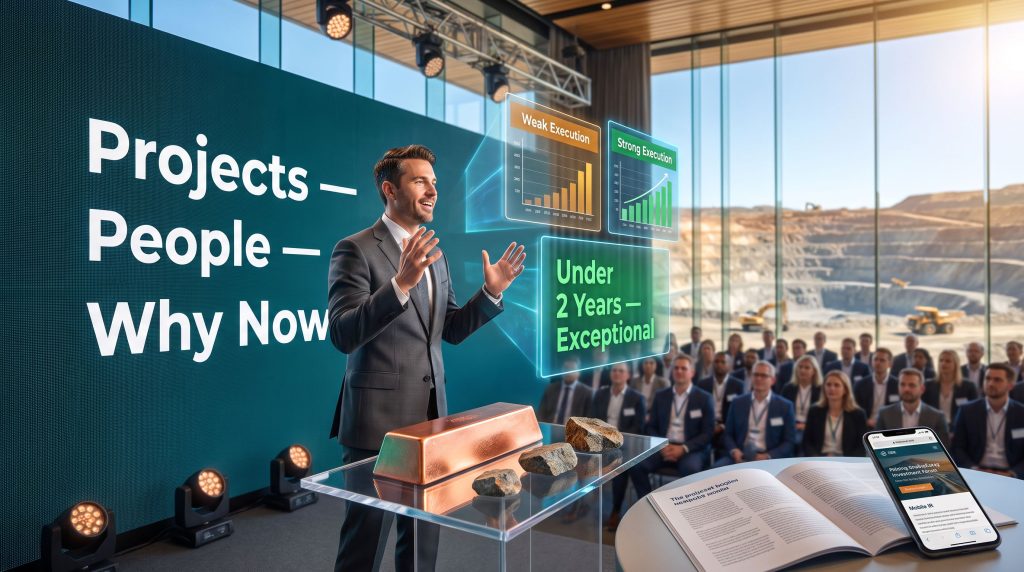
The most consistently effective investor presentations in the junior mining space share a recognisable three-part structure. First, the project must be communicated in terms that translate geological potential into investor-relevant language. Second, the management team must demonstrate a credible track record of value creation, not simply a list of credentials. Third, the timing argument must connect commodity cycles, exploration catalysts, and market conditions into a coherent signal of investment urgency.
Each of these elements carries distinct weight depending on the audience. Institutional capital tends to weight team credibility and capital efficiency heavily. Retail investors respond more strongly to accessible narrative and visible milestone tracking. The best junior mining CEOs build presentations that serve both audiences simultaneously, then adapt the emphasis depending on whether they are presenting on stage at a conference or sitting across a table in a one-on-one meeting.
The ability to translate geological data into a compelling, investor-relevant business narrative is not a soft skill. It is the primary mechanism through which junior mining companies access capital and generate share price appreciation.
Why the Story Matters as Much as the Science
There is a documented pattern among experienced buy-side geologists and resource fund managers: a second-quartile project led by an exceptional communicator often represents a more attractive investment proposition than a first-quartile project run by a CEO who cannot articulate the business case with conviction.
The logic is straightforward. When an investor purchases shares in a junior mining company, they are buying fractional ownership of a business, not fractional ownership of a mineral resource. The share price will only appreciate if other investors are persuaded to participate. That persuasion requires a CEO who can consistently attract and retain capital throughout the exploration cycle, which is a multi-year, cash-intensive process with no guaranteed outcome.
A buy-side geologist with two decades of experience across multiple resource fund mandates has observed this pattern repeatedly: sitting through a conference pitch and finding it compelling on purely narrative grounds, despite the project being technically unremarkable, produces a legitimate investment thesis if the CEO has the ability to drive a story to a meaningfully higher valuation.
| Pitch Element | Weak Execution | Strong Execution |
|---|---|---|
| Project description | Geology-heavy, jargon-dense | Clear upside narrative with visual support |
| Team introduction | CV recitation | Track record of value creation |
| Market timing | Generic commodity outlook | Specific supply and demand catalyst |
| Call to action | Passive or absent | Clear next step for the investor |
| Q&A readiness | Defensive or evasive | Confident, transparent, dialogue-driven |
How Institutional Investors Evaluate a Junior Mining Pitch
The Buy-Side Lens
Experienced resource fund managers weight CEO communication ability alongside geological quality when evaluating junior mining opportunities. This is not a concession to marketing over substance. It reflects a practical understanding that geological merit that cannot be communicated to a broad enough audience will not translate into share price appreciation, regardless of how technically sound it is.
The investor's logic runs as follows: a geologically exceptional project managed by a poor communicator is structurally inferior, from a capital markets perspective, to a solid project led by a CEO who can consistently attract and retain investment throughout the exploration cycle. One has theoretical value. The other has the commercial infrastructure to realise it. Furthermore, accessing mining private equity at the right stage can significantly amplify a company's ability to develop that commercial infrastructure.
Red Flags That Disqualify a Junior Mining Pitch
Certain presentation failures signal deeper organisational problems that sophisticated investors treat as disqualifying. Consequently, awareness of these management red flags is essential for investors conducting due diligence:
-
CEOs who cannot explain their exploration decision-making process in plain language demonstrate a failure to understand their own business from an investor's perspective.
-
Management teams unaware of their share structure, capital efficiency metrics, or unit cost of exploration suggest the company is being run as a geological exercise rather than a business.
-
Presentations that are exclusively technical, ignoring the business model, the funding runway, and the path to shareholder value creation, fail the most basic investor communication test.
-
Companies that cannot articulate how they will sustain capital inflows throughout the exploration cycle are implicitly admitting a structural vulnerability that will become critical at every subsequent financing round.
A geologically exceptional project managed by a poor communicator is, from an investor's perspective, a structurally inferior investment compared to a solid project led by a CEO who can consistently attract and retain capital.
Junior Mining Company Marketing: Building a Capital-Attracting Brand in 2025
Why Digital-First Marketing Is No Longer Optional
Investor research behaviour has shifted fundamentally toward online-first discovery. Before any conference meeting, before any one-on-one introduction, prospective investors are researching companies and their CEOs through websites, LinkedIn profiles, video content, and search results. A junior miner's digital presence is now evaluated as a credibility signal before any direct engagement occurs.
Mobile-optimised investor relations pages, current technical reports, and active executive social media presences are baseline expectations among sophisticated capital allocators, particularly those from younger cohorts of capital markets participants who conduct virtually all initial due diligence digitally. For instance, Forbes highlights how junior mining CEOs can embrace digital marketing as a strategic priority rather than an afterthought.
The Junior Mining Marketing Playbook: A Practical Framework
Effective mining communication strategies form the backbone of this playbook, and each step builds on the previous one.
Step 1: Establish a Discoverable Online Presence
-
Professional website with current technical reports and IR materials kept up to date.
-
Active LinkedIn presence for the CEO functioning as a personal credibility channel.
-
SEO-optimised content that surfaces the company in commodity-specific and project-related searches.
Step 2: Produce Consistent, Credible Content
-
CEO video updates aligned with exploration milestones and news flow.
-
Site visit content, podcast appearances, and executive commentary that demonstrate operational transparency.
-
Regular news releases that communicate genuine operational progress rather than promotional noise.
Step 3: Maintain Factual Transparency Across All Channels
-
Technical and financial claims must be verifiable and consistent across all platforms.
-
Exaggerated language erodes institutional trust and is often irreversible once established.
-
All public communications must align with applicable regulatory disclosure obligations.
Step 4: Tailor Messaging to Distinct Investor Audiences
-
Institutional messaging should emphasise capital efficiency, deal structure, and discovery probability.
-
Retail messaging should prioritise accessible narrative, milestone tracking, and CEO visibility.
-
Conference strategy should target events that reach both audiences simultaneously.
Step 5: Activate Multi-Platform Distribution
-
Mining-specific conference circuits remain the anchor marketing events for junior companies.
-
LinkedIn, X (formerly Twitter), and sector-specific investor platforms extend ongoing reach between news cycles.
-
Podcast and media appearances extend CEO visibility during quiet periods when formal news flow is limited.
Business Model Clarity: Why Investors Punish Strategic Surprises
The Prospect Generator Dilemma
Prospect generation companies attract a distinct investor base with very specific expectations. Investors who back a prospect generator do so because they understand and value that specific business model: systematic project generation, optioning to well-funded partners, and capital-efficient participation in multiple exploration programmes simultaneously.
When a prospect generator pivots unexpectedly to sole-operator exploration, particularly without prior communication with major shareholders, it creates a structural breach of the investor contract. The investors who backed the company for its prospect generation model did not consent to, or price in, the risk profile of a single-project, self-funded exploration company.
In practice, most prospect generators eventually encounter a project they are reluctant to option because they believe in it too strongly. This is not inherently a problem. The problem arises when the transition is announced without preparation. Shareholders do not penalise strategic evolution. They penalise strategic surprises.
How to Successfully Transition a Junior Mining Business Model
The communication protocol required before any material strategic shift is non-negotiable. Major shareholders need to be brought into the conversation before a public announcement is made. The Virginia Mines discovery of the Eleonore deposit provides a historical reference point for how a prospect generator can successfully drill its own project and create significant value, but the prerequisite in any such transition is aligned shareholder communication.
The use of proceeds in any associated financing must precisely match subsequent operational activity. When a CEO raises capital with a stated plan and then deploys it differently, even for ostensibly good reasons, it damages the trust relationship that is the foundation of ongoing capital access. That trust, once eroded, is extremely difficult to rebuild.
Shareholders do not penalise strategic evolution. They penalise strategic surprises. Transparent, pre-announced transitions consistently outperform abrupt pivots in terms of capital retention and shareholder support.
JV Deal Structure: What Junior Mining Investors Should Demand
Anatomy of a Strong Joint Venture Agreement
For junior companies whose strategy involves optioning projects to larger partners, deal structure is the primary mechanism through which shareholder value is either protected or destroyed. The four structural elements that define an investor-friendly joint venture agreement are:
-
Free-carry provisions: The junior should be carried as far as possible, ideally to feasibility study stage, without being exposed to dilutive cash calls from the major partner.
-
Anti-warehousing clauses: A major company should not be permitted to reach a controlling interest threshold, such as 51%, and then stall indefinitely without advancing the project. Hard expiry milestones on earn-in stages prevent this outcome.
-
Mandatory work commitments: Discretionary spending by the major partner creates no urgency to advance the project. Mandatory annual expenditure thresholds force genuine exploration activity and accelerate discovery timelines.
-
Meaningful retained equity: If the junior is diluted below an economically significant interest through the earn-in process, the discovery upside becomes largely irrelevant to its shareholders.
| Deal Structure Element | Investor-Friendly | Investor Risk |
|---|---|---|
| Carry provisions | Full free-carry to feasibility | No carry; cash calls from 51% |
| Work commitments | Mandatory annual spend thresholds | Discretionary spending by major |
| Warehousing protection | Hard expiry on earn-in milestones | Major can stall at 51% indefinitely |
| Management fees | Offset G&A costs for junior | No fee; junior fully self-funded |
| Discovery upside | Junior retains meaningful equity | Junior diluted below economic interest |
A critical and often underappreciated point: in large mining companies, any individual JV project is competing internally against potentially 50 other joint ventures for attention, capital, and technical resources. Without contractual mechanisms that force spending and progress, a junior's project can languish indefinitely at the bottom of a major's priority list.
The next major ASX story will hit our subscribers first
Upfront Capex and the Billion-Dollar Project Financing Question
Can a Junior Mining Company Realistically Finance a Large-Scale Copper Project?
The answer is yes, but the feasibility is highly company-specific and depends on the quality of the project, the credibility of the management team, and the prevailing commodity cycle. The financing architecture for a billion-dollar-plus copper project typically follows a sequential capital stack:
-
Streaming and royalty companies, including major operators in that space, are often the first capital to commit. They are highly competitive and actively seeking product, particularly on copper porphyry projects with streaming or royalty angles.
-
Once streaming and royalty financing is secured, debt providers begin engaging seriously. The presence of already-committed capital reduces their perceived risk materially.
-
Equity capital is typically the last component to arrive. If a company has already secured the equivalent of $700 to $800 million in conditional streaming and debt arrangements, raising the remaining $200 million in equity becomes structurally achievable rather than speculative.
This sequential domino effect means that the first financing milestone is the most critical. It signals to the entire capital stack that the project has passed a credibility threshold, and subsequent financing tends to follow more readily.
Payback Period as the Critical Metric
For acquiring companies and project financiers evaluating development-stage copper projects, payback period is the primary filter. Capital at risk duration determines whether a project can attract acquisition interest regardless of its absolute resource size.
| Payback Period | Market Assessment |
|---|---|
| Under 12 months | Exceptional; extremely rare |
| 12 months to 2 years | Outstanding; strong acquisition candidate |
| 2 to 5 years | Generally investable with favourable commodity assumptions |
| Over 5 years | Structurally challenged; significant risk discounts applied |
An interesting pattern in recent copper M&A is that the projects gaining the most traction are smaller, higher-grade assets rather than large-scale, low-grade porphyries. Higher copper prices mechanically improve payback metrics on previously marginal projects, and as the copper price sustains elevated levels, the financial models for even large-scale porphyry developments begin to transform materially.
Jurisdiction, Infrastructure, and the Hidden Costs Junior Miners Underestimate
Grade, Infrastructure, and the Tons Cost, Grade Pays Principle
One of the most important and least-discussed rules of thumb in project economics is the relationship between grade, infrastructure requirements, and development viability. The principle is straightforward: every tonne extracted from the ground costs money, and every unit of metal in that tonne generates revenue. Grade determines how much revenue each tonne produces. Infrastructure determines how much each tonne costs to process and deliver.
For high-grade gold deposits, particularly those running at 5 to 10 grams per tonne and above, infrastructure proximity becomes relatively less significant. The revenue per tonne of rock is high enough that the cost of remote logistics, helicopter access, or seasonal construction can be absorbed within the project economics. This is why high-grade gold mines have been successfully built in genuinely remote and logistically challenging locations.
Base metal projects, by contrast, typically operate at lower grades and therefore generate less revenue per tonne of material processed. Processing plants must be larger. Tailings storage requires more capacity. Concentrate volumes are substantial and must be transported, often over long distances, to buyers in Asia. Each of these factors amplifies the financial impact of poor infrastructure proximity.
What Useful External Infrastructure Actually Means for Project Economics
Experienced mine evaluators use the concept of useful external infrastructure as a shorthand for the suite of pre-existing facilities that reduce capital and operating costs for a new mining operation. The key components include:
-
Grid power access: The difference between connecting to an existing grid and constructing diesel-powered generation can represent hundreds of millions of dollars in capital expenditure and significantly higher ongoing operating costs per tonne.
-
Road and port access: Bulk concentrate export is impossible without reliable road access to port infrastructure. Remote base metal projects without this connectivity face a structural cost disadvantage that no amount of grade improvement can fully offset.
-
Water access: In arid jurisdictions, water sourcing and management have become increasingly strategic and expensive components of mine development.
-
Proximity to existing communities: A fly-in fly-out workforce operation for a thousand employees represents an enormous ongoing cost. A mine located 20 kilometres from an established town eliminates that cost entirely and simultaneously generates strong local economic benefits that support the social licence to operate.
Jurisdiction Selection: Nevada, the Golden Triangle, and James Bay Compared
Three Distinct Risk and Opportunity Profiles
When evaluating exploration jurisdictions, experienced buy-side geologists apply different analytical frameworks to different terrains, and those frameworks produce meaningfully different investment conclusions.
Nevada is an established, highly prospective gold province, but its very maturity creates structural challenges for junior explorers. Drilling costs in Nevada are among the highest in the world, with core holes running at $400 to $500 per metre or more in current conditions. Targets are increasingly deep, geological complexity is high, and the most significant recent discoveries have been made by major companies with the capital and technical resources to pursue deep, conceptual targets.
The Golden Triangle in British Columbia contains some of the most extraordinary mineralisation on Earth, including deposits that are genuinely without global equivalent in terms of their grade and geological character. However, the Golden Triangle is expensive, helicopter-dependent, and extremely seasonal. It is a high-risk, frontier-style jurisdiction even though it sits within Canada. Significant new discoveries will likely be made there, but they will require substantial capital commitment and geological conviction over extended timeframes.
The James Bay region of Quebec presents a different profile. Quebec is a highly regarded mining jurisdiction with competitive royalty rates, provincial capital markets infrastructure, and institutional support for the resource sector. The James Bay area is geologically prospective but relatively early in its modern exploration cycle, drawing comparisons to what West African jurisdictions looked like in the early stages of their exploration phase.
Portfolio Allocation and Conviction Management in Junior Mining Investment
Position Sizing in High-Conviction Situations
The conventional wisdom around position sizing — specifically the idea that any single holding exceeding a certain threshold should be mechanically reduced — does not always serve junior mining investors well. A high-conviction holding that has appreciated significantly and whose underlying fundamentals remain intact is not necessarily a position that should be trimmed simply because it now represents a larger percentage of the portfolio.
The behavioural trap that frequently accompanies mechanical profit-taking is the pressure it creates to immediately redeploy capital. Investors who sell a winning position often find themselves making rushed decisions to put that money back to work, frequently selecting inferior opportunities under artificial time pressure. Understanding the full spectrum of junior mining risks and rewards is consequently essential before making any such decisions.
A practical discipline for managing this dynamic: after a significant win, deliberately avoid making any new investment decisions for a defined cooling-off period. Allow the emotional satisfaction of the gain to dissipate before evaluating new opportunities. This prevents the common pattern of overconfidence immediately following a profitable exit leading to a poor subsequent entry.
The Role of Management Trust in Conviction Maintenance
Sustained investment conviction in a junior mining company is closely correlated with the degree of trust an investor has in its management team. High trust in the CEO and technical leadership reduces the cognitive burden of monitoring a position and allows investors to take a longer-term view without the constant anxiety of wondering whether the company is being managed responsibly.
The inverse signal is equally revealing. When an investor finds themselves constantly seeking reassurance about a holding, monitoring every press release with anxiety, and doubting the rationale for maintaining the position, the underlying issue is almost never the market conditions. It is almost always a trust deficit with management. That trust deficit rarely resolves itself, and the appropriate response is to exit the position and redeploy into a company where management confidence is higher.
If a position requires constant reassurance-seeking rather than periodic check-ins, the underlying issue is likely management trust, not market conditions. The rational response is to exit and redeploy into a situation where confidence in management is genuine and sustainable.
FAQ: Junior Mining Company Marketing and CEO Pitch
What Is the Single Most Important Element of a Junior Mining CEO Pitch?
The ability to translate geological potential into a compelling, investor-relevant business narrative. Technical accuracy is necessary but not sufficient. The pitch must create conviction that the CEO can drive share price appreciation by consistently attracting and retaining capital. LinkedIn discussions among mining CEOs further reinforce the importance of keeping this narrative fresh and compelling at every stage.
How Important Is Digital Marketing for a Junior Mining Company in 2025?
It is increasingly critical. Investors research companies and their CEOs online before any direct engagement occurs. A weak digital presence signals organisational immaturity to sophisticated capital allocators and can disqualify a company before a single conversation takes place.
Should a Junior Mining CEO Prioritise Conferences or One-on-One Investor Meetings?
Both serve distinct and complementary functions. Conferences build broad visibility and test the pitch under public scrutiny. One-on-one meetings convert developed interest into committed capital. The most effective junior mining CEOs excel at both formats and understand when each is appropriate.
What Makes a JV Deal Structure Investor-Friendly for a Junior Mining Company?
Free-carry provisions protecting the junior from cash calls, mandatory work commitments preventing the major from warehousing the project, anti-warehousing clauses with hard earn-in expiry milestones, and meaningful retained equity post-earn-in are the four structural elements that protect junior shareholder value.
How Should a Junior Mining Company Handle a Business Model Transition?
Through proactive communication with major shareholders before any public announcement. The rationale for the transition, the use of any associated financing proceeds, and the expected operational outcomes must all be communicated transparently. Shareholders who are brought into the process before the announcement will almost always be more supportive than those who encounter the change as a surprise.
What Payback Period Should Investors Look for in Copper Development Projects?
Under two years is considered outstanding and signals a strong acquisition candidate. Two to five years is generally investable under favourable commodity price assumptions. Beyond five years, most institutional acquirers and project financiers apply significant risk discounts, as the extended capital-at-risk duration exposes the project to too many intervening variables.
The Integrated Framework for Junior Mining Marketing Success
The most successful junior mining companies in any market cycle share a common characteristic: they treat investor relations and CEO communication as core operational functions rather than peripheral activities. Geology, business model, capitalisation structure, marketing execution, and junior mining company marketing and CEO pitch capability form an interconnected hierarchy, and weakness in any layer limits the effectiveness of all others.
The compounding advantage of consistent, trust-based CEO communication over time is substantial and genuinely underappreciated. A CEO who communicates transparently throughout the exploration cycle, who does what they said they would do with the capital raised, and who brings major shareholders along before making material strategic decisions builds loyalty and credibility that becomes a genuine competitive advantage in subsequent financing rounds.
As digital marketing maturity and CEO personal visibility become increasingly important differentiators in junior mining capital markets, the companies that invest in these capabilities early will find themselves with a structural advantage in accessing capital throughout the exploration cycle, regardless of where commodity prices sit at any given moment.
This article contains forward-looking statements and analysis based on current market conditions and publicly available information. Junior mining investment involves significant risk, including potential total loss of capital. Nothing in this article constitutes financial advice. Investors should conduct their own due diligence and consult qualified financial advisers before making investment decisions. Listeners interested in practitioner-level perspectives on junior mining strategy, deal structure, and exploration methodology can find relevant discussions through Mining Stock Education, which features conversations with experienced buy-side geologists and resource fund managers.
Want to Identify the Next Major ASX Mineral Discovery Before the Market Does?
Discovery Alert's proprietary Discovery IQ model scans ASX announcements in real time, instantly translating complex mineral data into actionable investment insights — giving subscribers a decisive edge the moment a significant discovery is announced. Explore historic discoveries and their exceptional returns, then begin your 14-day free trial at Discovery Alert to position yourself ahead of the market.