August 21, 2026
The Grid Stability Problem That Storage Alone Can Solve
Across every major energy transition, one pattern repeats itself with uncomfortable consistency: generation capacity races ahead of balancing infrastructure, and the grid pays the price. Variable renewable power, by its nature, produces electricity when the sun shines and the wind blows, not necessarily when demand peaks. As solar and wind penetration deepens, the mismatch between supply timing and demand timing becomes not just an operational inconvenience, but a structural threat to grid reliability.
India is now confronting this reality at a scale few nations have faced so rapidly. With one of the world's most ambitious renewable energy buildout programmes underway, the country is generating increasing volumes of variable power that its transmission and distribution infrastructure was never designed to absorb without substantial storage backing. The result is a growing consensus, reflected in both policy and capital flows, that India energy storage growth is no longer a future consideration. It is an immediate infrastructure imperative.
When big ASX news breaks, our subscribers know first
What India's Storage Landscape Actually Looks Like in 2026
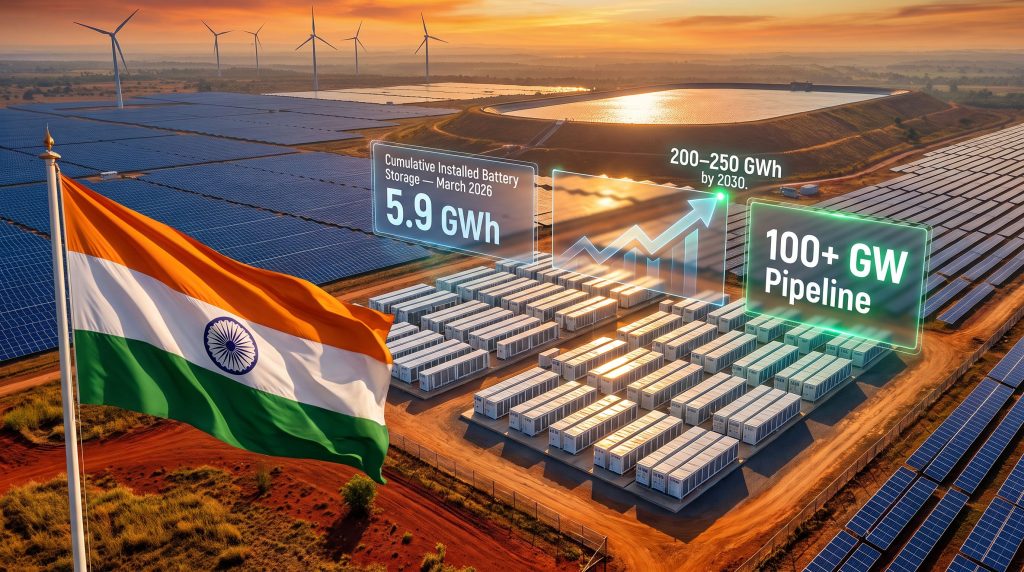
The headline numbers tell a story of extraordinary momentum layered over a formidable gap. As of March 2026, India's cumulative installed battery energy storage capacity reached 5.9 GWh, a figure that represents meaningful early progress but sits in stark contrast to a project pipeline that has now surpassed 100 GW in scale. Perhaps more telling is the Q1 2026 figure: 4.6 GWh of battery energy storage systems (BESS) were added in just three months, suggesting the deployment curve is beginning to steepen noticeably.
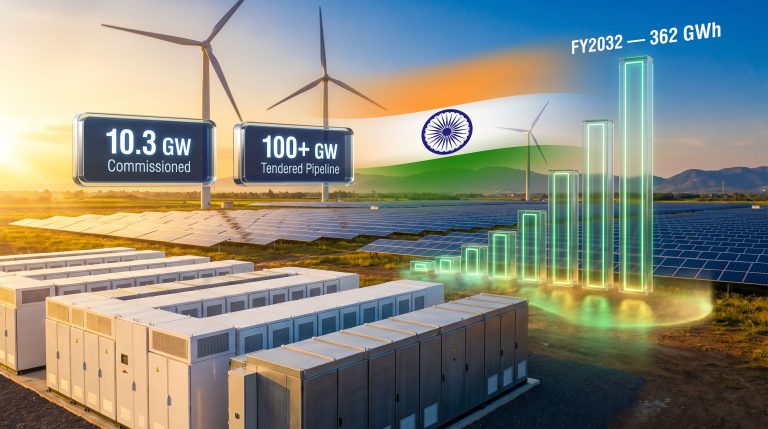
When broader storage technologies are included, the picture expands further. Total commissioned storage capacity across all technology types, including pumped hydro, sits at approximately 10.3 GW. However, the forward-looking numbers dwarf this installed base entirely. For a broader view of how this fits into the battery metals investment landscape, the downstream demand signals from India's pipeline are already influencing global commodity markets.
| Metric | Current Status (2026) |
|---|---|
| Cumulative installed battery storage | 5.9 GWh (as of March 2026) |
| Q1 2026 BESS additions | 4.6 GWh |
| Total commissioned storage (all types) | ~10.3 GW (incl. pumped hydro) |
| Total project pipeline | 100+ GW |
| BESS in pipeline | ~92 GWh |
| Pumped storage in pipeline | ~132 GWh |
| Cumulative ESS market size (tendered/awarded) | 224 GWh |
The gap between 5.9 GWh installed and 224 GWh tendered or awarded is not simply a lag in execution. It reflects a system that has moved from policy design into active procurement far faster than construction and commissioning timelines allow. This commissioning lag is one of the most important dynamics for market observers to understand.
Battery Storage vs. Pumped Hydro: A Technology Transition in Progress
Pumped hydro currently accounts for the dominant share of India's total commissioned storage capacity, given its multi-decade development history in the country. However, the forward trajectory is shifting decisively toward BESS. Battery systems offer deployment timelines measured in months rather than years, require no specific geographic preconditions, and can be sited adjacent to renewable generation assets or load centres with considerable flexibility.
Pumped hydro's 132 GWh pipeline does reflect serious government intent to monetise existing reservoir infrastructure, with feasibility assessments underway for converting legacy water management assets into grid-scale energy buffers. However, from a capital velocity and execution speed standpoint, BESS is expected to dominate new additions through the early 2030s.
The strategic question facing India's planners is not which storage technology wins in isolation, but how pumped hydro and battery systems are sequenced and co-deployed to meet both near-term grid stability requirements and long-duration storage needs further into the decade.
The Policy Architecture Driving India's Storage Ambitions
India's storage buildout is not emerging organically from market forces alone. It is being deliberately shaped by a layered set of policy obligations and programme frameworks that are creating structured demand at every level of the energy system. Furthermore, critical minerals and energy security considerations are increasingly embedded within these policy frameworks, reflecting recognition that storage ambitions cannot be separated from upstream resource access.
The 4% Storage Obligation: A Mandate With Real Teeth
The Ministry of Power has established a requirement that energy storage must represent 4% of total electricity demand by 2030. Translated into physical capacity terms, this obligation is estimated to require between 200 GWh and 250 GWh of operational storage, distributed across distribution companies, power procurers, and integrated grid operators. This is not an aspirational target but a compliance framework, meaning that entities failing to meet procurement obligations face regulatory consequences.
This distinction matters for investors and project developers. Mandated procurement creates a demand floor that is structurally different from demand generated purely by economics. Even when battery costs fluctuate or financing conditions tighten, the procurement obligation persists.
Three Programmes Reshaping Distributed Energy Storage
India's distributed energy landscape is being transformed by three interlocking government programmes, each of which creates structural demand for storage at scale:
-
PM-KUSUM Successor Programme – The Ministry of New and Renewable Energy is developing a next-generation agricultural solar initiative that will embed battery energy storage directly into its design. Unlike the original PM-KUSUM scheme, which focused primarily on generation, the successor programme is being structured to incorporate local storage management at the farm level. This represents a fundamental shift from generation-only to generation-plus-storage architecture in rural electrification.
-
PM Surya Ghar Rooftop Solar Initiative – Targeting rooftop solarisation across 10 million households, this programme is creating a distributed generation base that will increasingly require local storage buffers to prevent reverse power flow into distribution networks and to enable greater household energy independence. As household solar penetration rises, the case for residential battery systems strengthens considerably.
-
Farm Solarisation at Scale – Government schemes targeting solar deployment across 35 million farms represent one of the largest distributed generation programmes globally. The sheer geographic dispersion of this generation base creates coordination challenges that storage at the local level is uniquely positioned to solve.
At the Bloomberg New Energy Finance (BNEF) Summit 2026 in New Delhi, MNRE Secretary Santosh Kumar Sarangi communicated that India's storage trajectory was on an exponential path, characterising storage not as a supplementary layer but as a primary structural intervention in the country's energy architecture. He encouraged stakeholders to adopt an ambitious posture toward both BESS manufacturing and deployment, framing urgency as central to India's renewable integration success.
Long-Term Forecasts: Where Does India's Storage Capacity Land?
Forecasts for India's storage buildout vary meaningfully depending on the assumptions embedded in each model, but all scenarios point to multiples of current installed capacity within the next six to seven years. According to IEEFA, tariff viability and financing hurdles remain central challenges that will shape how quickly these projections are realised.
| Forecast Horizon | Projected Capacity | Basis |
|---|---|---|
| 2030 (Policy Obligation) | 200 to 250 GWh | Ministry of Power mandate |
| FY2031-32 | ~411.4 GWh | National planning estimates |
| 2033 | ~346 GWh | Base-case market scenario |
The divergence between the FY2031-32 national planning estimate of 411.4 GWh and the 2033 base-case market scenario of 346 GWh is instructive. Planning models tend to aggregate all tendered and awarded capacity as if it proceeds on schedule, while market-based scenarios discount for execution delays, financing gaps, and supply chain constraints. The realistic outcome likely sits between these figures, shaped substantially by how quickly the grid infrastructure and financing ecosystem matures.
Three Structural Forces Accelerating India's Storage Market
Renewable Capacity Overhang Creating Immediate Balancing Demand
India's renewable buildout has already created a significant overhang of variable generation that the grid must balance. MNRE has historically supported 40 GW of deployment through its solar power scheme and an additional 20 GW through the Central Public Sector Undertaking (CPSU) scheme. This installed base of variable solar generation is now generating real-time balancing requirements that thermal peaking plants alone cannot cost-effectively serve.
The economics of curtailment are also changing. As renewable penetration rises, curtailment events increase in frequency and duration. Each curtailed gigawatt-hour represents lost revenue for project developers and stranded capital in generation assets. Consequently, storage transforms curtailment risk into a revenue opportunity, creating a private-sector incentive that aligns with grid operator objectives.
Battery Cost Deflation Compressing Payback Periods
Global lithium-ion battery costs have declined dramatically over the past decade, and while the pace of cost reduction has moderated compared to the extraordinary declines seen between 2015 and 2022, further reductions continue to improve project economics. Understanding shifts in the global lithium market is therefore essential context for anyone tracking India's storage cost trajectory.
At Indian electricity tariff levels, utility-scale BESS is now approaching economic viability without requiring revenue stacking across multiple services, though the ability to capture ancillary services revenue, peak arbitrage, and transmission deferral benefits simultaneously remains important for project bankability.
Domestic Manufacturing Through PLI and Green Hydrogen Missions
India is not simply building storage capacity. It is simultaneously constructing the manufacturing ecosystem required to supply it. Key financial commitments underpinning this strategy include:
- ₹24,000 crore allocated under the Production Linked Incentive (PLI) scheme for advanced chemistry cell manufacturing and related technologies
- ₹19,700 crore committed under the National Green Hydrogen Mission, creating adjacent demand for electrolysers and large-format storage systems
- Capital expenditure support being extended to polysilicon manufacturers, reinforcing upstream solar supply chain resilience
The PLI scheme for advanced cell manufacturing deserves particular attention. India's current reliance on imported battery cells creates a strategic vulnerability, given that global battery supply chains are concentrated heavily in China. Domestic production capacity, once established, would reduce this dependency and potentially enable India to become a competitive battery exporter to regional markets.
India's Storage Position in a Global Context
Understanding India energy storage growth requires benchmarking it against markets that are further along the deployment curve. In addition, battery supply chain expansion strategies adopted by markets like South Korea offer instructive parallels for how India might accelerate its own industrial build-out.
| Country/Region | Installed BESS (Approx.) | Primary Policy Driver | Growth Stage |
|---|---|---|---|
| China | Leading globally | National five-year plans | Mature scaling |
| United States | Advanced deployment | Inflation Reduction Act incentives | Active scaling |
| European Union | Accelerating | REPowerEU targets | Mid-stage |
| India | 5.9 GWh (March 2026) | Ministry of Power obligation | Early-to-scaling transition |
India's position at the early-to-scaling transition point is actually an advantage in some respects. Later movers benefit from more mature technology, lower equipment costs, and the ability to observe and adapt from the implementation experiences of pioneer markets. The United States and European Union have both grappled with interconnection queue bottlenecks, permitting delays, and grid code uncertainty — challenges that India can proactively address in its regulatory design.
Where India faces genuine structural disadvantages is in the cost of capital. Financing BESS projects in emerging market contexts carries a sovereign risk premium that materially affects project economics compared to equivalent deployments in the US or Germany. Reducing this financing cost, through blended finance mechanisms, green bonds, and multilateral development bank co-investment, represents one of the most consequential levers available to policymakers.
The next major ASX story will hit our subscribers first
Key Barriers That Could Slow the Buildout
The exponential growth narrative is well-supported by policy intent and technology economics, but execution risk is substantial and concentrated in several areas:
- Grid infrastructure readiness: Transmission capacity in many high-renewable zones is already constrained. Storage assets commissioned without adequate evacuation infrastructure cannot deliver their intended grid services.
- Financing gaps: The sheer capital requirement of the pipeline — potentially hundreds of billions of rupees over the next six years — exceeds what domestic financial institutions can comfortably absorb without international co-financing.
- Land acquisition and permitting for pumped storage: Unlike BESS, pumped hydro projects require specific topographic conditions, access to water resources, and environmental clearances that can extend development timelines significantly.
- Critical mineral supply chains: India's battery manufacturing ambitions are constrained by limited domestic reserves of lithium, cobalt, and nickel. The country is actively pursuing mineral resource agreements internationally, but supply chain resilience for battery-grade materials remains a structural vulnerability. Furthermore, direct lithium extraction technology could meaningfully alter the global supply picture for battery-grade lithium over the coming decade, with implications for India's procurement strategies.
Frequently Asked Questions: India Energy Storage Growth
What is India's current installed battery energy storage capacity?
As of March 2026, India's cumulative installed battery energy storage capacity stood at approximately 5.9 GWh, following additions of 4.6 GWh in Q1 2026 alone.
What is India's energy storage target for 2030?
The Ministry of Power has established a storage obligation requiring capacity equivalent to 4% of total electricity demand by 2030, estimated at 200 to 250 GWh.
What is the PM-KUSUM successor scheme?
MNRE is developing a next-generation agricultural solar programme that will incorporate battery energy storage directly into its design, enabling better management of decentralised renewable power generation at the farm level, unlike the generation-only structure of the original scheme.
How large is India's energy storage project pipeline?
India's total energy storage pipeline has exceeded 100 GW, comprising approximately 92 GWh of battery storage and 132 GWh of pumped hydro projects in various stages of tendering and development.
What government funding supports India's storage and renewable manufacturing sector?
Key financial commitments include ₹24,000 crore under the PLI scheme for advanced manufacturing and ₹19,700 crore under the National Green Hydrogen Mission, alongside capital expenditure support for upstream materials producers including polysilicon manufacturers.
Will battery storage or pumped hydro dominate India's future storage mix?
While pumped hydro currently accounts for the majority of commissioned capacity, battery energy storage systems are projected to represent the largest share of future additions through 2032, driven by cost declines and deployment flexibility. Research from Berkeley's IECC outlines strategic pathways that further substantiate this outlook through detailed scenario modelling.
The Investment Outlook Through 2032
India's storage market is undergoing a structural transition from a policy-led pilot phase into a capital-intensive scaling phase. For investors and industry participants, several forward-looking dynamics are worth tracking closely:
- Tender pipeline conversion rates: The gap between 224 GWh tendered/awarded and 5.9 GWh installed signals that conversion of awarded capacity into commissioned projects is the dominant execution challenge of the next three years.
- Domestic manufacturing milestones: PLI-backed cell manufacturing capacity coming online will change India's import dependency profile and potentially alter cost structures for domestic BESS projects.
- Pumped storage evaluation outcomes: The feasibility assessments currently underway for existing reservoirs will determine how much of the 132 GWh pumped hydro pipeline is technically and economically viable.
- Regulatory evolution: Grid codes, storage compensation frameworks, and ancillary services markets are still maturing. As these frameworks solidify, the revenue certainty required for project bankability will improve.
India's storage ambitions cannot be separated from its manufacturing strategy. Domestic production of solar modules, wind components, and battery cells is being positioned as a national economic resilience priority, with implications that extend beyond the energy sector into industrial policy and trade strategy.
The convergence of government mandates, falling technology costs, and a rapidly expanding renewable generation base creates a structural demand floor for India energy storage growth that is unlikely to dissipate regardless of near-term policy changes. However, the distance between ambition and operational gigawatt-hours remains the defining challenge, and it is in the execution details — financing structures, grid readiness, and supply chain depth — where India's storage story will ultimately be written.
Disclaimer: This article contains forward-looking statements, market projections, and scenario analyses based on publicly available data and policy frameworks as of mid-2026. Actual outcomes may differ materially from forecasts cited. This content is intended for informational purposes only and does not constitute financial or investment advice. Readers should conduct independent due diligence before making investment decisions related to any sectors or projects discussed.
Want to Identify the Next Major Mineral Discovery Before the Market Does?
As India's energy storage buildout accelerates demand for battery metals including lithium, cobalt, and nickel, Discovery Alert's proprietary Discovery IQ model delivers real-time alerts on significant ASX mineral discoveries, instantly translating complex data across 30+ commodities into actionable insights — start your 14-day free trial today or explore the historic returns major discoveries have generated to understand what early positioning can mean for your portfolio.