
July 22, 2026
Global Energy Supply Networks Face Unprecedented Vulnerability Testing
Modern economies operate within intricate energy distribution systems that exhibit remarkable interdependencies across geographic regions and supply routes. When examining these networks through a macro-economic framework, critical vulnerabilities emerge that extend far beyond immediate market fluctuations. The concentration of energy flows through specific maritime passages creates systemic risks that traditional economic models struggle to adequately quantify or address, particularly concerning Strait of Hormuz supply disruption scenarios.
Supply chain resilience depends heavily on redundancy and alternative routing capabilities, yet certain geographic constraints limit these options significantly. The challenge facing global energy markets involves understanding how concentrated transit points create cascading economic effects that ripple through multiple sectors simultaneously. These effects manifest through complex transmission mechanisms that influence everything from manufacturing costs to central banking policies.
When big ASX news breaks, our subscribers know first
Understanding Strategic Energy Chokepoint Vulnerabilities
Geographic Concentration Creates Irreplaceable Transit Dependencies
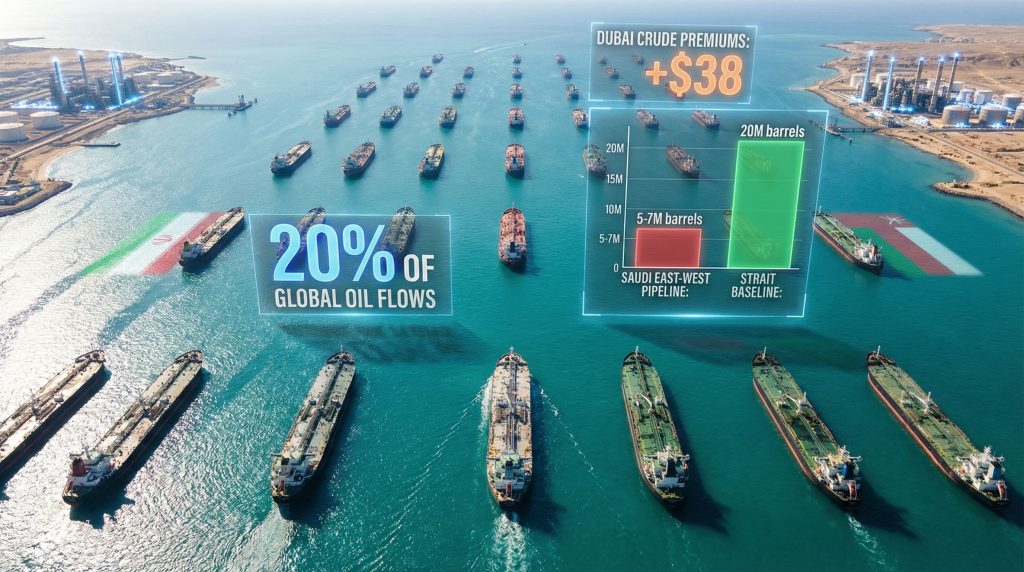
Strategic maritime passages handle disproportionate volumes of global energy flows, with the Strait of Hormuz representing the most critical example. This narrow waterway facilitates approximately 20-21% of global oil flows according to the U.S. Energy Information Administration, creating an unprecedented concentration of energy transit through a single geographic point.
The physical constraints of this passage demonstrate the vulnerability inherent in global energy infrastructure. At its narrowest navigable point, the channel accommodates only 2 nautical miles of width in each direction for tanker traffic, despite the strait spanning 54 nautical miles at its widest point. This bottleneck effect concentrates approximately 18-21 million barrels per day of crude oil movement through an extremely constrained space.
Critical Transit Statistics:
• Daily throughput: 18-21 million barrels per day under normal conditions
• Global supply share: 20-21% of worldwide oil flows
• Regional dependency: 85% of Persian Gulf proven reserves accessible only via this route
• Geographic vulnerability: 2-nautical-mile navigable channel width
The concentration extends beyond simple transit volumes to encompass the fundamental architecture of global energy supply. Furthermore, approximately 85% of proven oil reserves in the Persian Gulf region remain accessible to international markets exclusively through this maritime corridor, according to BP Statistical Review data. This dependency creates a structural vulnerability that cannot be easily mitigated through short-term policy interventions.
Infrastructure Limitations Prevent Rapid Supply Route Diversification
Alternative export infrastructure suffers from significant capacity constraints that limit its effectiveness during supply disruptions. The most substantial alternative routing system, Saudi Arabia's East-West Pipeline, operates at a maximum designed capacity of 5.0 million barrels per day. This represents only 25% coverage of the baseline Strait of Hormuz throughput volumes.
| Alternative Route | Operational Capacity | Coverage of 20M bpd Baseline | Primary Constraint |
|---|---|---|---|
| Saudi East-West Pipeline | 5.0 million bpd | 25% | Physical infrastructure limits |
| UAE Fujairah Terminal | 1.5-2.0 million bpd | 7.5-10% | Berth and loading capacity |
| Iraq-Turkey Pipeline | 0.6 million bpd | 3% | Ageing infrastructure, maintenance |
| Total Alternative Capacity | 7.1-7.6 million bpd | 35.5-38% | Multiple bottlenecks |
The infrastructure gap reveals fundamental limitations in global energy security planning. Even when operating at maximum theoretical capacity, alternative export routes can accommodate only 35.5-38% of normal Strait transit volumes. This coverage deficit creates a structural supply vulnerability that cannot be resolved through incremental capacity additions.
Technical constraints compound the capacity limitations. The Fujairah Terminal in the UAE, despite its strategic positioning, faces throughput restrictions based on berth availability and loading infrastructure rather than storage capacity. Its 14 million barrel storage capacity exceeds daily throughput capabilities, indicating that operational bottlenecks limit utilisation rather than physical storage constraints. Recent analysis from energy security experts suggests these constraints could have broader implications for global trade patterns.
The constraint is not political access but physical infrastructure inadequacy, as alternative export routes possess structural limitations that cannot be overcome through expedited construction or temporary measures during supply crises.
Market Structure Disconnects Between Financial and Physical Energy Markets
Paper Trading Systems Fail to Reflect Physical Supply Realities
Financial energy markets operate through futures contracts that often disconnect from immediate physical supply conditions. During supply disruptions, this disconnect becomes pronounced as physical crude markets consistently trade at premiums to paper futures due to fundamental differences in market participant needs and information access. The disconnect is particularly evident when considering the OPEC meeting impact on pricing mechanisms.
The phenomenon stems from information asymmetry between financial traders responding to news flows and physical market participants facing immediate procurement requirements with limited inventory buffers. This asymmetry creates pricing spreads that reflect actual supply constraints more accurately than futures markets during crisis periods.
Historical precedent demonstrates this pattern consistently. During the 2019 Aramco facility attacks at Abqaiq and Khurais, the temporary removal of 5.7 million barrels per day from global supply caused Brent crude to spike by $13 per barrel (19% increase) within a single trading day, illustrating market sensitivity to Persian Gulf supply disruptions. For instance, such events often trigger broader market responses that extend beyond immediate crude oil impacts, affecting natural gas price forecasts across regional markets.
Strategic Reserve Release Mechanisms Show Timing and Distribution Challenges
Emergency petroleum reserve systems face significant logistical constraints that limit their effectiveness during immediate supply crises. The International Energy Agency's largest documented coordinated release involved 90 million barrels in June 2022 during the Ukraine crisis, establishing precedent for emergency response capabilities.
Strategic Reserve Release Timeline Analysis:
• U.S. SPR historical drawdown rate: 1.0-1.5 million barrels per day
• Coordinated release distribution timeline: Approximately 120 days for full deployment
• Geographic distribution constraint: Asia-Pacific access limitations for non-IEA members
• Market timing mismatch: Weeks to months for physical delivery versus immediate supply needs
The timing disconnect creates a critical vulnerability during acute supply disruptions. Emergency releases require maritime transport logistics that introduce additional delays, particularly for consuming regions geographically distant from strategic reserve locations. This transportation requirement creates circular inefficiencies when reserves stored in consuming nations must be redistributed to global markets.
Non-IEA member exclusions compound distribution challenges. Neither China nor India participate in IEA coordinated releases despite representing major crude importing economies. China maintains approximately 1.2-1.3 billion barrels in domestic strategic reserves, while India's capacity reaches only approximately 5 million barrels across three storage facilities, equivalent to 1.25 days of consumption.
Regional Economic Impact Assessment and Vulnerability Distribution
Asia-Pacific Import Dependencies Create Maximum Economic Exposure
Asian economies demonstrate the highest vulnerability to Strait of Hormuz supply disruption due to their concentrated dependence on Gulf crude imports. China imports approximately 45-55% of its crude oil through this maritime corridor, representing 4.5-5.5 million barrels per day of the nation's 10-11 million barrel daily import requirement.
Regional Vulnerability Assessment:
China:
• Total crude imports: 10-11 million bpd
• Strait of Hormuz dependency: 45-55%
• Strategic buffer capacity: 1.2-1.3 billion barrels (domestic reserves)
• Economic exposure: Manufacturing sector concentration in energy-intensive industries
India:
• Import dependency: 85% of total consumption (4-5 million bpd)
• Strait transit share: 50-60% of crude imports
• Strategic reserves: 5 million barrels (1.25 days of consumption)
• Vulnerability factor: Significantly below IEA-recommended 90-day buffer
Japan:
• Daily imports: 2.5-3.0 million barrels
• Strait dependency: Approximately 75%
• Economic exposure: High manufacturing sector energy intensity
South Korea:
• Daily imports: 2.0-2.5 million barrels
• Strait dependency: Approximately 80%
• Industrial vulnerability: Petrochemical and heavy manufacturing concentration
The strategic reserve inadequacy across the region amplifies economic vulnerability. India's reserves equal only 1.25 days of consumption, representing a critical shortfall compared to the International Energy Agency's recommended 90-day strategic buffer. This deficiency limits the region's ability to maintain economic stability during extended supply disruptions.
Gulf Producer Economic Adaptation Strategies Face Capacity Constraints
Persian Gulf oil-producing nations have developed alternative export strategies, but these systems operate under significant capacity limitations. Saudi Arabia's primary alternative involves maximising East-West Pipeline utilisation, which can handle 5.0 million barrels per day compared to the kingdom's normal export capacity exceeding 7 million barrels daily. However, recent developments in Saudi exploration licences may influence these capacity planning decisions.
Gulf Producer Alternative Export Analysis:
| Producer | Primary Alternative | Maximum Capacity | Export Loss Risk | Revenue Impact |
|---|---|---|---|---|
| Saudi Arabia | East-West Pipeline | 5.0 million bpd | 65-70% | Severe revenue reduction |
| UAE | Fujairah Terminal | 2.0 million bpd | 70-80% | Critical export constraint |
| Qatar | Limited alternatives | Minimal | 90%+ for LNG | Economic crisis potential |
The UAE faces particularly acute constraints through the Fujairah Terminal system, which accommodates 1.5-2.0 million barrels daily against normal export volumes significantly exceeding this capacity. These limitations create 70-80% export loss potential during Strait closures, representing severe economic disruption for the federation's oil-dependent economy.
Qatar's position proves most vulnerable regarding liquefied natural gas exports. The nation's LNG production facilities depend almost entirely on Strait of Hormuz transit access, creating 90%+ supply risk for global markets that rely heavily on Qatari gas exports. This dependency extends the crisis impact beyond oil markets to encompass global natural gas supply chains.
Macroeconomic Transmission Mechanisms and Inflation Pressures
Energy Cost Cascades Create Multi-Sector Economic Impacts
Energy supply disruptions transmit economic effects through complex cascading mechanisms that extend far beyond immediate fuel costs. Transportation sector impacts create the most immediate transmission channel, as increased fuel expenses flow directly through supply chain logistics and freight transportation networks. These effects often coincide with broader trends in oil price rally analysis, creating compounded market pressures.
Primary Transmission Channels:
• Transportation costs: Direct fuel price increases affect logistics networks globally
• Manufacturing inputs: Energy-intensive industries face immediate cost pressures
• Food security: Agricultural and food distribution systems experience supply chain disruption
• Currency effects: Energy-importing nations face foreign exchange pressure
Manufacturing sectors with high energy intensity demonstrate particular vulnerability. Industries including aluminium smelting, steel production, and petrochemicals face immediate margin pressure as energy input costs escalate. These effects compound through intermediate goods pricing, creating inflation pressures that extend beyond direct energy consumption.
Food security implications emerge through multiple pathways. Agricultural production relies heavily on petroleum-derived fertilisers and fuel for mechanised farming operations. Simultaneously, food distribution networks face transportation cost increases that elevate consumer prices across broad geographic regions.
Central Banking Policy Responses Face Supply-Driven Inflation Constraints
Central bank monetary policy tools prove less effective during supply-driven inflation episodes compared to demand-side price pressures. Interest rate adjustments cannot directly address physical supply constraints, limiting traditional policy responses during energy crises. Research by geopolitical risk analysts suggests these constraints require alternative policy approaches.
Policy Response Limitations:
• Interest rate ineffectiveness: Monetary tightening cannot increase physical oil supply
• Foreign exchange intervention: Energy importers require currency support to maintain import capacity
• Fiscal policy pressure: Governments face fuel subsidy decisions versus budget constraint trade-offs
• Inflation targeting challenges: Supply shocks create persistent price level increases
Energy-importing economies face particular challenges in maintaining currency stability during sustained supply disruptions. Foreign exchange reserves come under pressure as energy import costs escalate, requiring central bank intervention to prevent currency collapse that would further amplify import inflation.
Fiscal policy responses involve difficult trade-offs between fuel subsidies and budgetary sustainability. Governments must balance immediate economic relief for consumers against long-term fiscal health, particularly in developing economies with limited fiscal flexibility.
The next major ASX story will hit our subscribers first
Long-Term Economic Restructuring and Investment Implications
Energy Security Infrastructure Investment Acceleration
Supply disruption experiences historically accelerate investment in energy security infrastructure, though implementation timelines span multiple years. Strategic petroleum reserve expansion programmes represent the most immediate response mechanism, requiring substantial capital commitments but offering relatively rapid deployment compared to alternative infrastructure projects. Furthermore, understanding US oil production factors becomes crucial for long-term planning.
Infrastructure Development Timeline Analysis:
• Strategic reserve expansion: 18-36 months for additional storage capacity
• Pipeline infrastructure: 3-7 years for permitting, construction, and commissioning
• Alternative energy systems: 5-10 years for significant capacity deployment
• Supply chain diversification: 2-5 years for new supplier qualification and integration
Pipeline infrastructure development faces the longest implementation timelines due to complex permitting requirements, environmental assessments, and construction challenges. New pipeline systems require 3-7 years under optimal political conditions, limiting their effectiveness for addressing immediate vulnerability concerns.
Regional energy cooperation frameworks offer medium-term solutions through enhanced coordination mechanisms. These arrangements enable more efficient emergency response protocols and improved information sharing during crisis periods, though they require sustained political commitment across multiple jurisdictions.
Geopolitical Risk Premium Integration in Energy Markets
Sustained supply disruption experiences create permanent changes in energy market risk assessment and pricing mechanisms. Insurance markets typically lead this adjustment process, with maritime energy transport insurance costs reflecting elevated geopolitical risks through premium structures.
Risk Premium Market Integration:
• Maritime insurance: Elevated premiums for Persian Gulf transit routes
• Investment flows: Capital redirection toward energy security technologies
• Trade agreements: Enhanced provisions for energy supply security
• Corporate hedging: Extended duration risk management strategies
Investment capital allocation patterns shift toward technologies and infrastructure that reduce geographic concentration risks. Renewable energy development receives accelerated funding as corporations and governments seek to reduce dependence on geographically concentrated fossil fuel supplies.
Corporate risk management strategies evolve to incorporate longer-duration hedging mechanisms and more sophisticated supply chain diversification approaches. Companies develop enhanced scenario planning capabilities that account for extended supply disruption possibilities rather than brief price volatility episodes.
The integration of persistent risk premiums fundamentally alters long-term energy market structure, creating sustained incentives for alternative energy development and infrastructure diversification investments. These changes represent permanent economic adjustments that extend beyond immediate crisis resolution periods and the broader impacts of Strait of Hormuz supply disruption scenarios.
This analysis is provided for educational purposes and should not be considered as investment advice. Market conditions and geopolitical situations remain subject to rapid change, and readers should conduct independent research before making investment decisions.
Ready to Capitalise on Energy Sector Opportunities?
Discovery Alert's proprietary Discovery IQ model provides instant notifications on significant ASX mineral discoveries, including critical energy metals and commodities that benefit from global supply chain vulnerabilities. Explore how major resource discoveries can generate substantial market returns by visiting Discovery Alert's dedicated discoveries page, and begin your 14-day free trial today to position yourself ahead of market-moving announcements.