July 22, 2026
The Mechanics Behind a Rare European Steel Pricing Inversion
Trade policy rarely delivers clean, predictable outcomes. When regulators tighten import controls on a category of goods, the textbook response is straightforward: supply contracts, prices rise, domestic producers gain. But flat steel markets operate with far greater complexity, and the Italian market in mid-2026 is demonstrating exactly why headline quota numbers can be deeply misleading. The HRC premium to plate in Italy has emerged from two closely related products, both falling under the broad flat steel umbrella, responding to the same regulatory tightening in almost entirely opposite ways, producing a pricing configuration that has not appeared in European markets for over four years.
Understanding this dynamic requires stepping back from the immediate price movements and examining the structural architecture that typically governs how hot-rolled coil and hot-rolled plate relate to one another on a cost and price basis, and then identifying precisely where that architecture has fractured.
When big ASX news breaks, our subscribers know first
The Normal Pricing Hierarchy Between HRC and Steel Plate
Why Plate Has Historically Traded Above Coil
In a well-functioning flat steel market, hot-rolled plate commands a per-tonne premium over hot-rolled coil as a matter of structural logic rather than arbitrary convention. Plate production uses a discrete rolling process applied to slab inputs, requiring capital-intensive mill configurations capable of handling thicker gauges. Each plate is rolled individually rather than continuously, which limits throughput efficiency and raises unit production costs relative to coil.
Hot-rolled coil, by contrast, is produced on continuous strip mills that process slab inputs through a sequential series of rolling stands, achieving significant economies of scale. The continuous nature of the process reduces unit costs materially, and this structural cost advantage has historically anchored HRC below plate in the pricing hierarchy.
The conventional pricing ladder across European flat steel products has generally followed this sequence:
- Hot-Rolled Coil (HRC) as the base reference product
- Cold-Rolled Coil (CRC) at a premium, reflecting additional processing
- Hot-Dipped Galvanised (HDG) above CRC, incorporating zinc coating costs
- Hot-Rolled Plate (HRP) typically occupying the premium tier among these categories
When this ladder inverts at its base, it does not simply signal a routine market fluctuation. It indicates that something structurally abnormal has occurred in supply availability, demand distribution, or the trade architecture governing how foreign material reaches domestic markets.
What an HRC Premium to Plate Actually Communicates
Price inversions between HRC and plate carry diagnostic weight for market participants. They suggest that the factors normally anchoring HRC below plate, whether cost relationships, supply availability, or demand patterns, have been disrupted in an asymmetric way. The current Italian situation is a case study in how regulatory design, feedstock pricing, and buyer psychology can simultaneously push two products in opposite directions. Furthermore, broader market forces — including the China steel market and shifting global trade flows — add additional layers of complexity to this pricing environment.
Key Insight: An HRC premium to plate is not simply a pricing anomaly. It reflects divergent regulatory exposure, asymmetric supply disruption, and misaligned demand cycles across two product categories that normally move in tandem.
How the EU's Revised Import Quota Regime Created Asymmetric Disruption
The Architecture of the New EU Steel Safeguard Framework
The European Union implemented a significantly tighter steel safeguard regime with effect from 1 July 2026, restructuring quota allocations across multiple flat steel categories in ways that have proven far more consequential than the percentage volume cuts alone suggest. The EU steel action plan has been central to reshaping how these protections are applied across member states, including Italy.
The revised framework reduced the free quota allocation for hot-rolled plate by approximately 46%, bringing the annual ceiling to around 1.2 million tonnes per year. Hot-rolled coil quotas were reduced by a smaller margin of approximately 33%, settling at around 5.2 million tonnes per year.
| Product | Previous Annual Quota (est.) | New Annual Quota | Reduction |
|---|---|---|---|
| Hot-Rolled Plate (HRP) | ~2.2mn t/yr | ~1.2mn t/yr | ~46% |
| Hot-Rolled Coil (HRC) | ~7.8mn t/yr | ~5.2mn t/yr | ~33% |
On the surface, the steeper percentage reduction falls on plate. Yet it is the coil quota structure that has proven commercially devastating for import flows. This apparent paradox sits at the centre of the current HRC premium to plate observed in the Italian market.
Why a Smaller Coil Cut Caused Greater Market Disruption
The HRC quota architecture contains a structural fragility that the raw volume numbers obscure. The total coil quota of 5.2 million tonnes is distributed across a relatively large number of supplying countries, with several receiving allocations so small that, once logistics costs, tariff exposure, and minimum viable cargo sizes are factored in, they become commercially inoperable. A supplier allocated 50,000 tonnes across a full year cannot efficiently ship product into Europe at competitive landed costs when freight economics demand a minimum cargo threshold for viability.
Compounding this fragmentation effect, additional trade measures layered on top of the quota structure further eroded the effective usable volume of HRC imports, a dynamic that does not apply equally to the plate quota framework. The Italian steel industry association Assofermet has projected that the combined effect of these measures could reduce usable steel import quotas by 60–70% across affected categories, a figure substantially more severe than the headline volume cuts imply.
Analytical Note: The distinction between nominal quota volume and usable quota volume is critical for understanding why the Italian market has reacted so sharply. A 33% cut to HRC volumes that renders an additional portion commercially inaccessible through distribution fragmentation may functionally approximate a 60%+ reduction in available supply.
The 50% Out-of-Quota Tariff and Cargo Rerouting
Volumes arriving outside quota allocations face a 50% tariff under the revised safeguard framework, a threshold that eliminates the commercial viability of most out-of-quota shipments at prevailing steel price levels. Trading firms operating in European flat steel markets have responded rationally to this arbitrage constraint: HRC cargoes that cannot land profitably within the EU are being redirected toward alternative destinations, with North Africa emerging as a primary rerouting endpoint.
This cargo diversion effect creates a secondary tightening mechanism. Supply that was previously available to European buyers is being actively redirected away from the region, reinforcing the domestic supply squeeze that the quota cuts themselves initiated. Consequently, the effects of global iron ore tariffs are compounding these regional pressures, further limiting the flexibility of European steel buyers.
The Slab Price Dimension: Feedstock Relief for Plate Producers
How Declining Slab Costs Unlocked Plate Price Flexibility
While HRC supply conditions tightened sharply under the new quota regime, plate producers in Italy were receiving a simultaneous cost relief signal from their primary input market. Italian plate re-rollers, unlike integrated steelmakers or electric arc furnace producers, source slab as their primary feedstock. Their production cost base therefore moves directly with slab price movements, giving them a degree of pricing flexibility unavailable to coil producers whose costs are structured differently.
Slab prices, which had previously elevated above $600/t cfr Italy during earlier restocking cycles, began declining through the summer period as a combination of seasonal demand softness and the unwinding of prior inventory accumulation exerted downward pressure. This cost relief gave plate re-rollers the ability to reduce their offer prices in an attempt to stimulate demand without necessarily compressing margins to unsustainable levels.
The result was a plate price index moving lower at precisely the moment the HRC index was moving higher. According to recent European price assessments, Italian plate pricing has remained broadly subdued even as coil prices pressed upward through mid-2026.
The Safeguard Regime's Unintended Effect on Slab Supply
A particularly instructive market dynamic has emerged from the interaction between the EU safeguard measures and slab supply flows. Non-EU steel producers facing quota restrictions on finished flat products retain an important alternative: exporting semi-finished slab, which remains largely exempt from EU safeguard trade measures (with the exception of Russian-origin material, which faces separate restrictions).
Market participants have drawn a direct connection between the tightening of finished product quotas and the increase in slab availability, as affected suppliers pivot their production mix toward semi-finished output to maintain access to European markets. This supply redirection has amplified the downward pressure on slab pricing, further reducing the cost base for Italian plate re-rollers.
This creates an ironic feedback loop within the regulatory architecture: a trade protection framework designed to restrict finished steel imports has inadvertently increased the availability of semi-finished inputs, lowering feedstock costs for domestic producers of one of the very products it was designed to protect.
Demand Divergence: The Behavioural Gap Between HRC and Plate Buyers
How HRC Buyers Responded to Supply Anxiety
Industrial procurement psychology plays a significant role in flat steel pricing during periods of import disruption. When HRC buyers in Italy received signals that available import volumes would tighten materially, the rational response was to accelerate purchasing activity and secure domestic supply before tighter market conditions fully materialised. This forward-booking behaviour pulled demand forward, compressed the time available for buyers to negotiate on price, and handed domestic HRC producers meaningful pricing power.
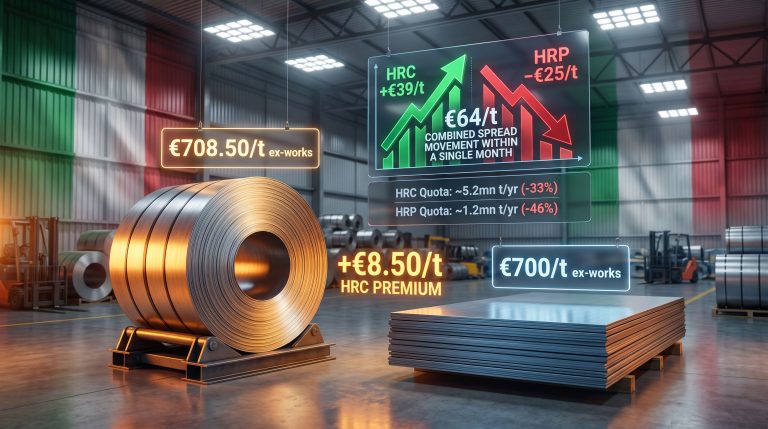
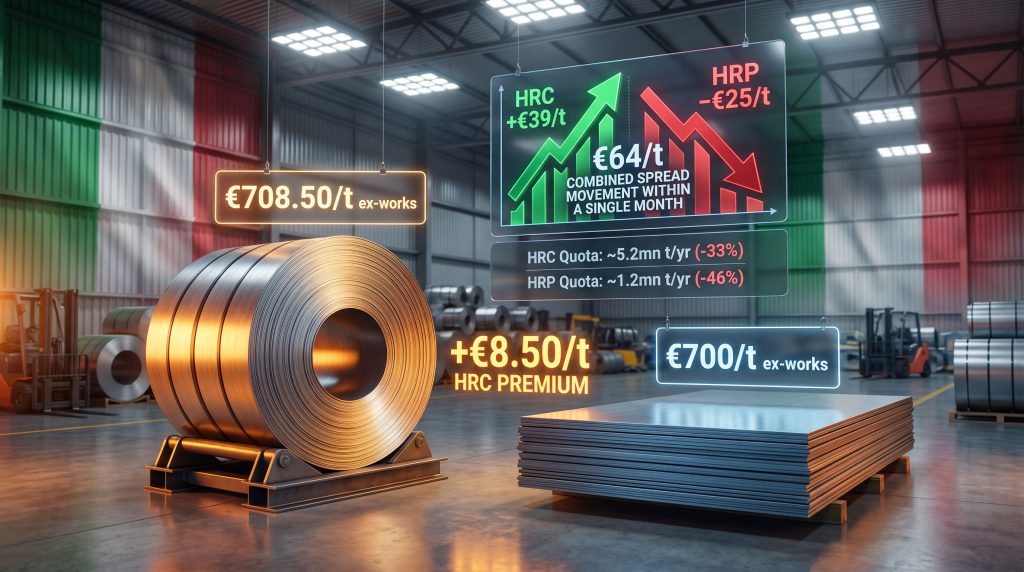
The consequence was a €39/t month-on-month price increase in the Argus daily Italian HRC index, assessed at €708.50/t ex-works as of late July 2026. This upward movement reflects not just physical supply tightness but the amplification effect of buyer urgency acting on a market with limited import flexibility. Furthermore, Italian HRC prices have continued to move higher as the new EU import safeguards take hold across the broader flat steel category.
Why Plate Buyers Remained on the Sidelines
Plate buyers entered the current period in a fundamentally different inventory position. Prior restocking activity had left many plate consumers across Italy carrying elevated stock levels, reducing their near-term urgency to source additional material. With existing inventories providing a buffer against any supply disruption, plate buyers adopted a wait-and-see posture rather than accelerating purchases.
This demand passivity removed the floor that active buying would otherwise provide. As plate re-rollers competed for orders in a soft demand environment, the Italian plate price index for S235 grades declined by approximately €25/t on a month-on-month basis, settling at around €700/t ex-works as of mid-July 2026.
| Market Variable | Hot-Rolled Coil (HRC) | Hot-Rolled Plate (HRP) |
|---|---|---|
| Buyer Behaviour | Accelerated forward booking | Sidelined; awaiting further declines |
| Inventory Position | Lean, supply-anxious | Elevated, well-stocked |
| Month-on-Month Price Change | +€39/t | -€25/t |
| Primary Driver | Import quota disruption | Cost relief and demand passivity |
| Net Price Direction | Upward | Downward |
The combined effect of these opposing price trajectories produced a total spread movement of €64/t within a single month, a compression and reversal of the conventional price hierarchy that has not appeared in this market for more than four years.
Current Price Benchmarks and the Scale of the HRC Premium to Plate
As of late July 2026, the configuration in the Italian flat steel market represents a genuine structural anomaly by historical standards:
- Italian HRC: assessed at €708.50/t ex-works (Argus daily index)
- Italian plate (S235): assessed at approximately €700/t ex-works (Argus fortnightly assessment, 17 July)
- HRC premium to plate in Italy: approximately €8.50/t, the first such premium observed in over four years
The S235 grade designation is worth contextualising for those less familiar with European plate specifications. S235 represents the lower end of European structural steel grades by yield strength, corresponding to a minimum yield strength of 235 megapascals. It is widely used in general structural fabrication, making it a broadly representative benchmark for the plate market rather than a niche specification product.
Market Snapshot: The €8.50/t HRC premium to plate in Italy as of late July 2026 may appear modest in absolute terms, but it represents a directional reversal of a deeply entrenched pricing relationship. The direction of the move matters as much as its current magnitude.
The next major ASX story will hit our subscribers first
Broader Implications for Downstream Procurement and Market Strategy
Pricing Signal Distortion Across the Supply Chain
When the conventional pricing hierarchy between flat steel products breaks down, the distortion propagates downstream in ways that procurement teams and industrial buyers may not immediately anticipate. Manufacturers operating in sectors where both coil and plate can technically serve the same application, such as certain structural fabrication and general engineering segments, now face an inverted cost incentive relative to historical norms.
Fixed-price contracts built on historical HRC-below-plate assumptions will generate unexpected margin compression for buyers who are now paying a premium for coil relative to what their procurement models predicted. This recalibration pressure will flow through supply chains at different speeds depending on contract tenure and repricing frequency. In addition, the evolving China steel outlook may introduce further volatility into European supply chains as Chinese producers seek alternative export destinations.
What Domestic Producers Stand to Gain
Italian and broader European domestic flat steel producers are the clear near-term beneficiaries of the current import restriction environment. Quota tightening has effectively created a protected pricing window, allowing domestic HRC producers to raise prices above levels that would be sustainable under more open import competition.
The durability of this advantage depends on several variables:
- Whether quota constraints remain in force and continue limiting commercially viable import flows
- Whether broader European steel demand remains sufficiently robust to absorb domestic supply at current price levels
- Whether the regulatory framework evolves in response to industry pressure or geopolitical trade negotiations
Scenario Analysis: How the HRC-Plate Spread Could Evolve
| Scenario | HRC Direction | Plate Direction | Spread Outcome |
|---|---|---|---|
| Quota constraints persist, demand holds | Stable to higher | Stable to lower | Spread widens further |
| Out-of-quota rerouting increases | Softens | Stable | Spread narrows |
| Slab prices recover | Stable | Recovers | Spread narrows |
| Plate demand recovers from inventory levels | Stable | Rises | Inversion corrects |
| Broader EU demand weakness | Falls | Falls further | Spread direction ambiguous |
The most plausible near-term path, absent a significant change in the regulatory framework, is one where the spread either holds at current levels or widens modestly as import quota constraints continue to suppress HRC availability while slab cost relief allows plate re-rollers to remain competitive on price. However, the emergence of green steel pricing dynamics adds a longer-term variable that could reshape the cost relationships between coil and plate production in years ahead.
Frequently Asked Questions: HRC Premium to Plate in Italy
What does it mean when HRC trades at a premium to plate?
It means hot-rolled coil is priced higher per tonne than hot-rolled plate, which is the reverse of the normal market hierarchy. Plate production is more capital intensive and typically serves more demanding structural applications, factors that have historically justified a per-tonne premium over coil.
Why is plate normally more expensive than HRC?
The discrete rolling process used for plate production involves higher capital investment and lower throughput efficiency compared to continuous strip mill production used for coil. These structural cost differences, combined with the demanding applications plate typically serves, have historically supported a plate premium.
How significant is the EU's revised safeguard regime for Italian steel prices?
The revised quota framework effective from 1 July 2026 has reduced usable import volumes far more severely than the headline percentage cuts suggest. Italian industry groups have projected a 60–70% reduction in effective usable import quotas, a figure reflecting fragmented quota distribution and compounding trade measures beyond the nominal volume reductions.
Why did HRC react more strongly to the quota changes than plate?
HRC import quotas, despite facing a smaller headline percentage reduction, suffered greater practical disruption because the volumes are distributed across more supplier countries, many of which received commercially unviable allocations. Plate quota distribution proved relatively more favourable, limiting the real-world supply impact despite the steeper nominal cut.
How does falling slab pricing influence Italian plate offers?
Italian plate re-rollers purchase slab as primary feedstock, meaning slab price movements flow directly into their production cost base. As slab prices declined from prior peaks above $600/t cfr Italy, plate producers gained the cost flexibility to reduce offer prices without unsustainable margin compression, even in a soft demand environment.
Are out-of-quota steel imports still entering Italy?
The 50% tariff applied to out-of-quota volumes has rendered most such shipments commercially unviable at prevailing steel price levels. Trading firms have responded by rerouting HRC cargoes toward markets including North Africa, where no equivalent tariff barrier applies, further tightening Italian domestic supply.
Key Takeaways
- The HRC premium to plate in Italy is structural rather than cyclical, reflecting asymmetric regulatory exposure under the EU's revised import safeguard framework
- Quota volume and quota usability are fundamentally different metrics, and the gap between them explains why a smaller HRC cut produced greater market disruption than a larger plate reduction
- Slab price dynamics serve as a critical secondary mechanism, with declining feedstock costs enabling plate re-rollers to defend market share through lower offers
- Buyer behaviour has amplified the spread, with forward-buying urgency in HRC contrasting sharply with inventory-driven passivity among plate consumers
- The €8.50/t premium represents a four-year first in the Italian flat steel market, and its persistence or reversal will serve as a meaningful indicator of how effectively the EU's revised safeguard architecture reshapes southern European flat steel trade flows
This article is intended for informational and analytical purposes only. Steel price assessments referenced are sourced from Argus Media's published indices. Market projections and scenario analyses represent analytical frameworks rather than investment advice. Readers seeking ongoing Italian flat steel price intelligence and EU safeguard quota analysis are encouraged to explore resources available at argusmedia.com.
Want to Stay Ahead of the Next Major Mineral Discovery on the ASX?
While European steel markets navigate complex regulatory shifts and pricing inversions, commodity-driven opportunities continue to emerge across the global resources sector. Discovery Alert's proprietary Discovery IQ model delivers real-time alerts on significant ASX mineral discoveries, instantly translating complex data across 30+ commodities into actionable insights for investors at every level — explore Discovery Alert's discoveries page to see how historic finds have generated substantial market returns, and begin your 14-day free trial today to position yourself ahead of the broader market.