June 8, 2026
When Supply Chains Break, Geology Becomes Geopolitics
Every few decades, a disruption severe enough to rewrite the rules of global energy trade forces resource-holding nations to look inward. The ongoing constraints on Persian Gulf supply flows have done exactly that, elevating domestic unconventional resource development from a long-term aspiration to an immediate strategic priority across multiple continents. Countries that once regarded shale as a speculative technology play are now treating it as critical infrastructure.
The result is something analysts are increasingly describing as the global shale race: a multi-jurisdictional push to replicate, adapt, or at least approximate the unconventional production model that transformed the United States from a major energy importer into the world's indispensable swing supplier. Whether any nation can genuinely challenge American dominance in this space is a question that combines geology, capital markets, regulatory frameworks, and industrial policy in ways that resist simple answers.
When big ASX news breaks, our subscribers know first
Why Copying the U.S. Model Is Harder Than It Looks
The American shale revolution is frequently misunderstood as a geological story. It was not. Wood Mackenzie has identified the structural foundations of U.S. shale success as including hundreds of competitive independent operators willing to absorb early-stage risk, a private land ownership system that gave surface owners mineral rights and therefore financial incentive to permit drilling, and rapidly iterating hydraulic fracturing technology.
Furthermore, deep and liquid capital markets capable of funding loss-making operators through multiple commodity cycles, and pre-existing pipeline and processing infrastructure, reduced the cost of bringing new production online. None of these conditions exist in combination anywhere else on Earth.
The consolidation wave that swept through U.S. shale following successive oil price downturns has since reduced the number of independent operators dramatically, concentrating technical expertise in a smaller group of better-capitalised companies. That concentration has preserved efficiency gains but has also removed the chaotic, competitive innovation dynamic that originally drove the technology forward so rapidly.
This matters enormously for countries attempting to develop their own unconventional programmes, because they are not starting from the same entrepreneurial ecosystem. They are, at best, borrowing technology and capital from a system that took decades to build organically. The geopolitical resource landscape adds yet another layer of complexity for nations navigating these ambitions.
"The U.S. shale advantage was never purely geological. It was an ecosystem of capital, technology, regulation, and entrepreneurial risk appetite that took decades to build and cannot be transplanted overnight."
The Five Prerequisites Any Country Must Meet
Before any nation can translate technically recoverable shale resources into commercial production, five structural conditions must align:
- Geology and resource quality — Formations must be thick, laterally continuous, and sufficiently pressured to support commercial flow rates from horizontal wells.
- Water availability — Hydraulic fracturing requires large volumes of water per well; arid or water-stressed regions face fundamental operational constraints that no amount of capital can fully overcome.
- Infrastructure density — Gathering pipelines, compression facilities, processing plants, and export terminals must sit within economic reach of the resource.
- Capital market access — Shale development requires sustained investment across price cycles; countries without deep private markets must substitute state capital, accepting a different risk-return logic.
- Regulatory and fiscal stability — Multi-year investment commitments require certainty on environmental approvals, fiscal terms, and land access that unstable political environments cannot reliably provide. In addition, permitting reform in markets like the U.S. continues to shape the broader global investment calculus.
How Global Shale Resources Actually Stack Up
Resource size and production readiness are entirely different things. A country can hold hundreds of trillions of cubic feet of technically recoverable shale gas and still be decades away from meaningful commercial output if the five prerequisites above are not met.
| Country | Shale Gas Resources (Tcf, approx.) | Shale Oil Potential | Current Production Status |
|---|---|---|---|
| United States | Largest globally | Permian, Bakken, Eagle Ford | Fully commercial, dominant |
| China | Top 3 globally | Sichuan, Tarim basins | Scaling via state direction |
| Argentina | Top 5 globally | Vaca Muerta (world-class) | Rapidly expanding |
| Algeria | Top 5 globally | Ahnet, Berkine basins | Largely undeveloped |
| Canada | Top 5 globally | Montney, Duvernay | Commercial, LNG-linked |
| Mexico | Significant | Burgos, Sabinas basins | Underdeveloped |
| Australia | Large (Beetaloo Basin) | Limited oil focus | Early-stage |
| Turkey | Promising (Diyarbakir, Thrace) | Significant oil potential | Pre-commercial |
Source: EIA global shale resource assessments; Wood Mackenzie analysis; operator disclosures
The table above illustrates a critical insight that is frequently overlooked in coverage of the global shale race: Algeria and Mexico collectively hold resource bases comparable to Argentina and Canada, yet their production trajectories diverge sharply. The difference is not geological. It is structural. For a detailed analysis of Algeria's shale gas breakthrough, the strategic implications are considerable.
Argentina's Vaca Muerta: The World's Best-Positioned Challenger
Why This Formation Stands Apart From Every Other Non-U.S. Shale Play
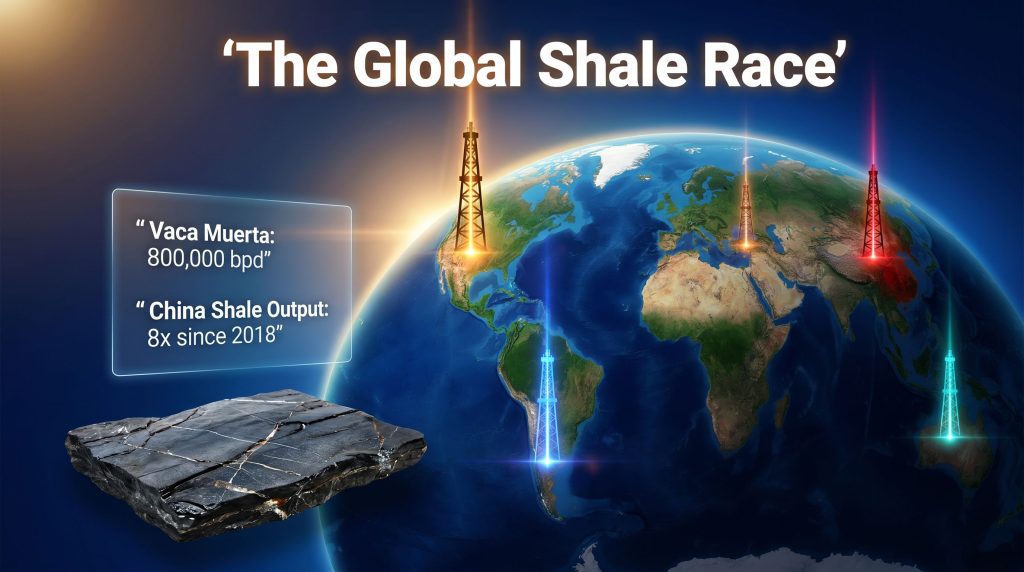
The Vaca Muerta formation in Argentina's Neuquén Basin occupies a unique position in the global shale race because it combines world-class resource quality with an accelerating operational track record. Crude oil production from the play surpassed 800,000 barrels per day in early 2026, representing approximately 16% year-on-year growth, and the formation carries a credible pathway to 1 million barrels per day before the end of the decade.
Continental Resources has publicly committed to expanding its Argentine position through an agreement with Pan American Energy, with company leadership characterising Vaca Muerta as one of the most compelling shale plays anywhere in the world. The formation offers significant natural gas upside alongside oil production, with associated volumes increasingly relevant to Argentina's emerging LNG export ambitions. This development is closely tied to the broader Chile lithium strategy reshaping South American energy resource priorities more generally.
What distinguishes Vaca Muerta from other frontier shale plays is that it has already moved beyond the theoretical phase. An established services sector, improving midstream connectivity, and a fiscal framework that has been progressively refined to attract international capital all reduce the risk premium that operators must price in.
The Risks That No Production Growth Can Eliminate
Argentina's chronic macroeconomic instability introduces risk factors that have no direct analogue in North American shale development:
- Currency controls and devaluation risk can erode the dollar-denominated returns that international operators require to justify capital allocation.
- Sovereign debt history creates financing cost premiums that disadvantage Argentine-linked projects relative to equivalent opportunities in more stable jurisdictions.
- Pipeline export bottlenecks remain a binding physical constraint on production growth, with capacity to export terminals lagging well behind formation-level output potential.
- Water management in the Neuquén Basin requires ongoing capital investment, and the semi-arid environment creates operational complexity that will intensify as hydraulic fracturing scales.
These risks have not deterred international operators, but they do explain why Vaca Muerta's development trajectory has been uneven and why investor sentiment toward Argentine shale tends to oscillate with the country's political cycle.
China's State-Directed Shale Expansion: Scale Without Market Logic
What the Numbers Actually Reveal
China's unconventional oil and gas expansion represents the most significant departure from the U.S. development model in the global shale race. In 2025, China's shale oil production reached 7.7 million tonnes, equivalent to approximately 56.4 million barrels for the year. That figure, while modest in global terms, represents an eightfold increase from 2018 output levels, a pace of growth that no privately capitalised shale programme has matched.
Unconventional gas has simultaneously transformed China's domestic supply picture, now accounting for approximately 46% of total domestic gas production. Shale gas output alone reached 27 billion cubic metres in the same period. These are not trivial numbers for a country that was effectively a shale non-participant at the start of the previous decade. The natural gas price outlook globally has consequently been shaped by China's accelerating unconventional output.
The Geological Complexity That Market Forces Would Not Overcome
Chinese shale formations present challenges that are structurally different from North American analogues:
- The primary shale-bearing zones in Sichuan and Tarim are significantly deeper than equivalent U.S. formations, increasing drilling costs per well substantially.
- Structural complexity, including folding, faulting, and high tectonic stress, reduces lateral well continuity and lowers initial production rates relative to the Permian or Bakken.
- Water scarcity in the most prospective basins creates operational constraints with no easy technical solution, since hydraulic fracturing at scale requires water volumes that simply do not exist in the required locations.
- High formation pressures and steep reservoir temperatures add engineering complexity and equipment costs to every well.
The frank reality is that if Chinese shale were evaluated purely on a return-on-capital basis by private operators, much of the current production programme would not clear investment hurdles. Beijing has accepted this trade-off consciously, treating domestic supply security as a strategic priority that justifies sub-commercial economics.
The Emerging Contenders: Turkey, Australia, and the Gulf
Continental Resources' Turkish Exploration Gamble
Perhaps the most underappreciated development in the global shale race is Continental Resources' entry into Turkey. The company has secured exploration agreements covering two separate basins: the Diyarbakir Basin in southeastern Turkey and the Thrace Basin in the northwest.
Early resource evaluations carry significant potential:
- Diyarbakir Basin: Estimated ultimate recoverable potential of up to 6 billion barrels of oil and between 12 and 20 trillion cubic feet of gas.
- Thrace Basin: Estimated gas resource potential of 20 to 45 trillion cubic feet, which, if confirmed, would rank Turkey among the more significant emerging unconventional gas jurisdictions globally.
These are exploration-stage estimates and carry substantial uncertainty. However, the scale of the numbers, if even partially confirmed by drilling results, would represent a material addition to non-OPEC supply potential over a 10 to 15 year horizon.
Australia's Beetaloo Basin: World-Scale Resources, World-Scale Barriers
The Northern Territory's Beetaloo Basin holds estimated discovered and prospective gas resources exceeding 500 trillion cubic feet, according to figures reported by the Australian Northern Territory government. By sheer resource volume, this places the Beetaloo among the most significant unconventional gas accumulations on the planet.
The obstacles to development are, however, formidable:
- Geographic remoteness from existing pipeline networks means that monetising Beetaloo gas requires multi-billion dollar greenfield infrastructure investment before a single molecule reaches market.
- Regulatory complexity at both territory and federal levels has created permitting uncertainty that has extended development timelines for all active operators.
- Community and environmental opposition from indigenous land groups and environmental advocates has added procedural layers to the approval process.
The intensifying Asian LNG demand environment, particularly given current Middle Eastern supply constraints, has renewed commercial urgency around Beetaloo. The basin's gas could theoretically serve as a long-duration feedstock for Pacific-facing LNG export terminals, making it strategically valuable to Asian buyers seeking supply diversification.
Saudi Aramco's Jafurah: Unconventional in a Conventional World
Saudi Aramco's development of the Jafurah unconventional gas field introduces a different model to the global shale race. Here, a national oil company with the world's lowest conventional production costs is deploying its own balance sheet to develop an unconventional resource, primarily to displace oil burn in domestic power generation and free up crude for export.
Jafurah demonstrates that unconventional development economics are not fixed. When the alternative use of capital is burning premium crude in domestic power plants, the hurdle rate for shale gas development falls substantially. Furthermore, an oil price rally of the kind seen in recent years only reinforces the economic logic of this strategy for Gulf producers.
The next major ASX story will hit our subscribers first
Europe's Exit From the Global Shale Race
A Trifecta of Barriers That No Operator Has Navigated
Europe's absence from the global shale race is frequently characterised as ideological. The reality is more nuanced, and in some ways more definitive. Three separate barriers operate simultaneously:
- Regulatory prohibition: France, Germany, Bulgaria, the Netherlands, and other EU member states have imposed formal moratoria on hydraulic fracturing. These are not temporary pauses but politically embedded policy positions with little near-term prospect of reversal.
- Climate policy incompatibility: EU-level decarbonisation frameworks create structural disincentives for long-duration fossil fuel development. Shale investment requires multi-decade commitment horizons that conflict directly with net-zero transition timelines embedded in EU law.
- Commercially insufficient resources: European Parliament research has assessed the commercially viable shale resource base across most of the continent as insufficient to justify large-scale development, even absent regulatory barriers. Dense population and complex surface access rights compound the challenge.
"Europe's shale exclusion is not purely ideological. The commercially recoverable resource base across most of the continent is simply too limited to generate production volumes that would justify the social and regulatory friction of development."
For a broader perspective on how these dynamics intersect with political risk across China, Argentina, and Mexico, the political risk in major shale nations analysis offers valuable comparative context.
What the Global Shale Race Means for OPEC and Long-Term Pricing Power
How Expanding Unconventional Supply Reshapes the Cartel's Influence
The geopolitical implications of the global shale race extend well beyond individual country production trajectories. If Argentina achieves 1 million barrels per day, it becomes comparable in export terms to a mid-tier OPEC member, adding a non-cartel swing supply source to a market that OPEC has historically influenced through coordinated production management.
China's shale expansion operates differently. Rather than adding to global export supply, it displaces import demand, structurally reducing the volume of crude that OPEC members can direct toward the world's largest energy consuming nation. The demand-reduction effect on OPEC pricing power is functionally similar to adding a new non-OPEC producer.
Turkey's potential, if Diyarbakir and Thrace resource estimates are confirmed by the drill bit, could reduce European and Eastern Mediterranean dependence on pipeline gas from Russia and LNG from the Gulf, creating a third-order pricing effect on traded gas markets.
The LNG Dimension: Shale Gas as Diplomatic Currency
One of the least-discussed aspects of the global shale race is its LNG dimension. Countries that develop large shale gas resources can potentially convert those resources into LNG, transforming a domestic supply asset into an export commodity with significant geopolitical value.
Canada's Montney and Duvernay formations are explicitly positioned as feedstock for Pacific-facing LNG projects targeting Asian buyers. Australia's Beetaloo, if developed, could serve a similar function. The ability to offer long-term LNG supply contracts to energy-insecure Asian importers constitutes a form of diplomatic leverage that conventional resource holders have long understood.
Frequently Asked Questions: The Global Shale Race
What exactly is the global shale race?
The global shale race describes the accelerating multi-country competition to develop unconventional oil and gas resources, specifically tight shale formations requiring horizontal drilling and hydraulic fracturing. While the United States created and still dominates the commercial model, nations including Argentina, China, Canada, Turkey, and Australia are actively pursuing their own programmes, motivated by energy security imperatives and the precedent of U.S. production success.
Which country outside the U.S. has the most promising shale development trajectory?
Argentina currently holds the strongest commercial position among non-U.S. shale jurisdictions. The Vaca Muerta formation combines world-class resource quality with an established services sector, growing production momentum, and increasing international operator interest. Canada's Montney and Duvernay plays are also highly commercial, though their growth trajectory is more closely tied to LNG export capacity than to domestic market expansion.
Why has China been able to grow shale output despite difficult geology?
China's shale expansion has been driven by state-directed investment from CNOOC, Sinopec, and PetroChina, with production targets set by central government and capital allocated accordingly. This model compensates for the absence of the competitive independent operator ecosystem that drove U.S. shale growth, effectively substituting state industrial policy for private market incentives.
Is shale development a realistic path to energy independence for most countries?
For most countries, genuine energy independence through shale is not a near-term realistic scenario. The combination of geological complexity, infrastructure requirements, capital intensity, and regulatory timelines means that even the most promising emerging shale plays require a decade or more of sustained investment before reaching production levels that materially reduce import dependence. The more achievable near-term objective is supply diversification rather than independence.
Disclaimer: This article is intended for informational purposes only and does not constitute financial or investment advice. Production forecasts, resource estimates, and market projections referenced herein involve inherent uncertainty and should not be relied upon as the basis for investment decisions. Resource estimates for exploration-stage plays such as the Diyarbakir Basin and Beetaloo Basin are preliminary and subject to revision as exploration drilling progresses.
Want to Know When ASX Discoveries With Strategic Commodity Exposure Hit the Market?
Discovery Alert's proprietary Discovery IQ model delivers real-time alerts on significant ASX mineral discoveries — including those tied to the energy transition metals and resources reshaping global supply chains — ensuring subscribers can identify actionable opportunities ahead of the broader market. Explore historic discovery returns that illustrate just how transformative early positioning can be, and begin your 14-day free trial today to secure a market-leading advantage.