August 23, 2026
The Rise of a New Industrial Asset Class: Mining Technology Reaches an Inflection Point
For most of the twentieth century, the mining industry treated technology as a cost centre rather than a value driver. Machinery was purchased, maintained, and replaced according to operational need. Software was an afterthought. Sensing systems were rudimentary. The idea that a standalone GLOBALminingTech50 mining technology companies register could command serious institutional attention would have seemed implausible to most industry veterans as recently as a decade ago.
That mental model has been dismantled. The GLOBALminingTech50 register, published by Beacon Events in 2026, documents a sector that has undergone a structural transformation since 2021, driven by automation imperatives, decarbonisation pressure, and the global scramble for critical minerals. What was once a fragmented collection of niche suppliers has consolidated into something that institutional investors are beginning to treat as a distinct and trackable asset class.
When big ASX news breaks, our subscribers know first
What Is the GLOBALminingTech50?
The GLOBALminingTech50 is a dedicated register of the world's most significant mining and metals technology companies, designed to track both established sector heavyweights and fast-growing challengers that are reshaping how the global mining industry operates. It is described by its publisher as the world's only up-to-date ranking of its kind, focused exclusively on technology revenues derived from mining and metals applications rather than broader industrial or engineering services.
This distinction matters more than it might initially appear. Most mining industry rankings measure companies by commodity output, reserves under management, or total market capitalisation. The GLOBALminingTech50 cuts across those categories to isolate technology-specific revenues, enabling a more precise view of where innovation capital is flowing and which companies are genuinely building scalable technology businesses within the mining sector.
The register spans two broad company archetypes:
- Established mining supply incumbents that have materially expanded their technology business units over the past five years, often through acquisition or organic R&D investment
- Fast-growing pure-play newcomers that have entered the mining technology space with proprietary software, sensing, or autonomous systems products
This dual structure gives the register unique diagnostic value. It captures both the evolution of legacy players and the emergence of new entrants, providing a fuller picture of competitive dynamics than any single company-type lens would allow. For a broader overview of top mining technology companies, several independent rankings highlight similar competitive themes.
A Sector Generating US$6.8 Billion in Annual Revenue
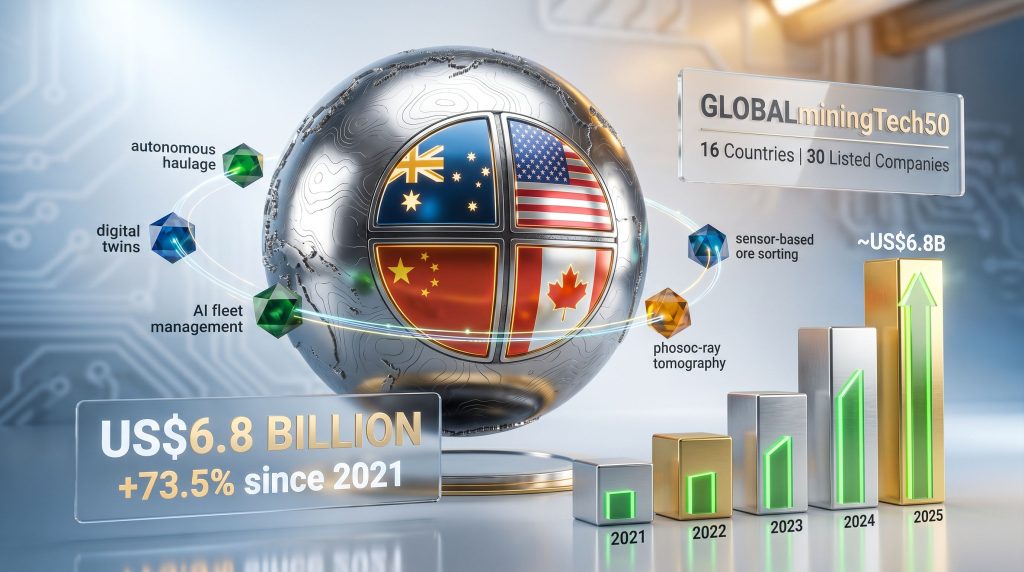
The scale of the GLOBALminingTech50 mining technology companies register is significant. The 50 companies collectively generated approximately US$6.8 billion (A$9.5 billion) in mining and metals technology revenues during 2025. That figure represents a 5% year-on-year increase from 2024 and, more strikingly, a 73.5% rise compared to 2021 levels.
To appreciate the magnitude of that four-year growth trajectory, consider the following:
| Metric | 2021 | 2025 | Change |
|---|---|---|---|
| Combined Top-Tier Mining Tech Revenue | Baseline | ~US$6.8B | +73.5% |
| Annual Revenue Growth (Year-on-Year) | Reference | ~5% | Incremental |
| Total Sector M&A and Financing (5-Year) | Baseline | US$15B+ | New Record |
| Annual M&A and Financing Milestone (2025) | Sub-US$5B | US$5B+ | First-Time Threshold |
The 73.5% revenue surge is not attributable to a single commodity cycle or macro event. Instead, it reflects compounding structural demand: miners adopting automation in mining to address labour constraints, procurement teams sourcing advanced sensors to improve ore grade precision, and executive teams responding to ESG frameworks that require measurable progress on emissions reduction.
Each of these forces independently creates sustained technology purchasing demand. Together, they have produced a growth rate that outpaces most adjacent industrial technology sectors over the same period. The M&A and financing data reinforces this picture. Crossing the US$5 billion threshold in a single calendar year for the first time in 2025, after accumulating more than US$15 billion across the prior five years, signals that strategic acquirers and capital allocators are accelerating their commitment to the space rather than moderating it.
The Companies Defining the GLOBALminingTech50 in 2026
Tier-One Incumbents
The five companies heading the 2026 register are ABB, Hexagon, Epiroc, Sandvik, and Bentley Systems. These organisations share a common characteristic: they began as industrial equipment, software, or engineering conglomerates and have systematically built or acquired mining-specific technology capabilities that now generate material standalone revenue.
ABB's presence reflects its deep penetration in mine electrification and process automation. Hexagon has become a dominant force in mine planning software, reality capture, and autonomous positioning systems. Epiroc and Sandvik represent the transformation of traditional drilling and loading equipment companies into technology platforms, integrating digital connectivity, automation software, and remote operation capabilities into their product ecosystems. Bentley Systems brings infrastructure engineering software with growing mine design and simulation applications.
Emerging Challengers Reshaping the Competitive Landscape
The more analytically interesting segment of the register comprises the challengers. Furthermore, several Chinese firms have entered the global register for the first time, reflecting the rapid scaling of autonomous and intelligent systems for mining environments in China:
- Yikong Zhijia Technology Co – Autonomous haulage technology for open-pit mining operations
- CiDi – Intelligent driving systems adapted for mining environments
- Shanghai Bolai Intelligent Technology Co – Integrated smart mining systems
Their inclusion is a notable signal. Chinese technology companies are no longer solely serving domestic mining markets. Their appearance in a global technology register reflects both the sophistication of their products and the scale at which Chinese mining operations have deployed autonomous systems, creating a commercial reference base that makes international expansion credible.
Three other challengers represent distinctive technology niches that were largely absent from mainstream mining technology discussions five years ago:
- Chrysos Corporation – Photon assay technology that uses high-energy X-rays to analyse ore samples in minutes rather than the 12 to 24 hours required by conventional fire assay methods, with implications for real-time grade control
- MineSense Technologies – Sensor-based ore sorting and grade control systems that analyse ore composition on conveyor belts and shovels, enabling dynamic ore-waste segregation decisions at the point of extraction
- Ideon Technologies – Cosmic-ray muon tomography, a subsurface imaging technique that uses naturally occurring muon particles to detect density variations underground, enabling detection of ore bodies and voids without drilling
These three companies represent a category that could be described as precision mineralogy technology — tools that make the extraction and evaluation of ore faster, more accurate, and less destructive than legacy methods. Their appearance in the register alongside autonomous haulage companies illustrates the breadth of innovation now underway.
Global Geography of Mining Technology Innovation
The GLOBALminingTech50 companies are domiciled across 16 countries, yet more than half are headquartered within just four jurisdictions: Australia, the United States, China, and Canada. This concentration reflects a consistent pattern: mining technology innovation clusters where mining demand is greatest and where capital markets infrastructure can support high-growth companies.
| Region | Distinctive Contribution to Mining Tech |
|---|---|
| Australia | High-volume technology consumer; prolific startup ecosystem; frequent acquisition target for global buyers |
| United States | AI and software leadership; deep capital markets; defence-technology crossover applications |
| China | Large-scale autonomous systems deployment; EV minerals processing technology; high domestic demand |
| Canada | Exploration technology; hard-rock and deep mining innovation; junior capital market access |
| Europe | Decarbonisation technology; OEM integration; regulatory-driven industrial R&D |
The remaining companies span 12 additional countries, a distribution that underscores the genuinely global nature of mining technology development. Nations with deep mining histories but historically limited technology export capacity are beginning to produce companies capable of competing on a global register.
One often-overlooked dimension of the register is its leadership diversity data. At the time of compilation, three of the 50 companies were led by female CEOs, a modest but symbolically significant figure in an industry sector that has historically exhibited low female representation at the executive level. Whether this reflects broader cultural shifts or isolated leadership appointments, it provides a measurable baseline against which future editions of the register can be compared.
The Investment Architecture Behind the Boom
Understanding why more than US$15 billion in M&A and financing was deployed in mining technology between 2021 and 2025 requires examining the structural forces that created simultaneous demand across multiple investment theses.
Three converging dynamics drove the capital surge:
-
Decarbonisation mandates – Miners operating under investor ESG frameworks and in some cases regulatory carbon pricing mechanisms have accelerated procurement of electrification technology, zero-emissions haulage systems, and emissions monitoring platforms. Consequently, companies offering credible mining decarbonisation solutions have commanded premium valuations as a result.
-
Automation imperatives – Labour shortages in remote mining regions, combined with safety incident frequency in conventional operations, created strong economic justification for autonomous equipment investment. The productivity delta between manually operated and fully autonomous haulage trucks in large open-pit operations runs to tens of percentage points in utilisation efficiency, making the return on investment calculation straightforward at scale.
-
Critical minerals acceleration – The energy transition's dependence on lithium, cobalt, nickel, copper, and rare earth elements has intensified pressure on mining companies to find, characterise, and extract ore bodies faster and with greater precision. The surge in critical minerals demand means that technology which compresses the timeline from exploration to production decision commands strong purchasing intent from an industry facing structural supply gaps.
A bifurcation in technology adoption priorities has emerged between Chinese and Western mining operators. Chinese miners have demonstrated a willingness to deploy automation and electrification at operational scale, often integrating domestically developed systems. Western operators have in many cases prioritised software integration, advanced sensing, and emissions measurement platforms as their initial technology investment categories, with full autonomy deployment progressing more incrementally.
This divergence has commercial implications for technology vendors. A product that achieves widespread deployment in China but limited penetration in North America or Australia faces a different commercialisation pathway than one adopted uniformly across geographies, affecting revenue concentration, reference site diversity, and acquirer interest.
The next major ASX story will hit our subscribers first
Technology Categories Attracting Capital
Automation: From Remote Control to Full Autonomy
Automation technology represents the largest and most mature investment category within the register. The progression from remotely operated equipment to fully autonomous systems follows a defined technology maturity curve:
- Autonomous haulage systems (AHS) – The most commercially advanced category, with several major open-pit mines operating full truck fleets without human drivers
- Drill automation and precision blasting – Integrating positioning accuracy, burden measurement, and explosive delivery optimisation into unified platforms, which AI-driven mining systems are accelerating significantly
- Remote operations centres (ROCs) – Centralised facilities from which operators manage multiple pieces of equipment across an entire mine site
- AI-driven fleet management platforms – Software systems that optimise dispatch, routing, and maintenance scheduling across heterogeneous equipment fleets
- Digital twin environments – Computational replicas of mine infrastructure used for operational planning, scenario testing, and training
The commercial logic of autonomy investment is reinforced by data: autonomous trucks in large-scale operations typically achieve 15 to 25 percentage points higher utilisation than manually operated equivalents, while eliminating the injury exposure associated with proximity to heavy mobile equipment.
Sensing and Subsurface Intelligence
The sensing category encompasses technologies that improve how miners understand their ore bodies and process streams in real time. Photon assay, as deployed by Chrysos Corporation, reduces gold and multi-element assay turnaround from a full working day to under two minutes, fundamentally changing how exploration and grade control decisions are made.
MineSense's shovel-mounted sensors enable ore-waste sorting decisions at the point of excavation rather than at the processing plant, which in low-grade deposits can materially improve head grade and reduce processing costs. In addition, data-driven mining operations are increasingly being built around these real-time sensing capabilities to optimise extraction across entire mine sites.
Ideon Technologies' muon tomography approach is particularly noteworthy for its potential to change exploration economics. By detecting density anomalies underground using cosmic-ray muon particles, the technology can identify the presence and approximate extent of ore bodies and cavities without drilling, compressing the cost and time associated with delineating an underground ore body. This capability sits at the intersection of sensing and exploration technology, representing a category that could grow substantially as critical minerals exploration intensifies.
Australia's Position as a Global Mining Technology Hub
Australia occupies a distinctive dual role within the global mining technology ecosystem. As one of the world's largest mining markets by output and geographic footprint, it generates structural domestic demand for technology solutions across every mining stage, from exploration sensing to autonomous haulage to processing optimisation.
However, Australia's more strategically interesting role is as a technology exporter and acquisition target. The country has produced a consistent pipeline of mining technology companies that have attracted acquisition interest from larger international players. This pattern reflects several compounding advantages:
- Proximity to world-scale mining operations that serve as commercial proving grounds for new technology
- Strong university research programs in mining engineering, geophysics, and applied computing
- A venture capital and growth equity ecosystem with sector-specific experience
- Access to ASX capital markets, which provide a listed currency for technology companies at earlier stages than many global exchanges would accommodate
Companies including Fleet Space Technologies, Chrysos Corporation, IMDEX, and MineSense Technologies illustrate different points on the Australian mining technology development spectrum, from deep-exploration geophysics through analytical instrumentation to digital sensing platforms. Their presence in the GLOBALminingTech50 alongside global industrial conglomerates demonstrates that Australian companies are competing effectively on a worldwide basis. For further context on Australian mining innovations, the country's contributions extend well beyond its domestic market.
What the Capital Structure Signals to Investors
Of the 50 companies in the register, 30 are publicly listed on various global stock exchanges. The remaining 20 operate as private enterprises, reflecting a sector that spans both institutional equity markets and venture-backed innovation. This roughly 60/40 split between listed and private companies is notable because it suggests the sector is at an intermediate stage of institutionalisation.
Richard Roberts, Editorial Director at Beacon Events and author of the GLOBALminingTech50, has noted that the 2021 to 2025 period established the foundational architecture for a dedicated mining and metals technology sector. His assessment is that the decade ahead will see more companies generating over US$1 billion in mining technology revenues and a broader cohort reaching multi-billion-dollar market valuations — a forecast that implies the sector's current growth trajectory has not yet produced its full set of large-cap companies.
For investors, the comparison between mining technology companies and traditional mining producers reveals structurally different value propositions:
| Dimension | Top Mining Producers | GLOBALminingTech50 Companies |
|---|---|---|
| Revenue Driver | Commodity prices | Technology adoption cycles |
| Growth Catalyst | Reserve expansion | Innovation and M&A |
| Valuation Basis | Resource multiples | Revenue multiples and ARR |
| Risk Profile | Commodity and geopolitical | Execution, competition, adoption |
| Capital Intensity | Very high | Moderate to high |
The implication for capital allocators is significant. Mining technology companies provide exposure to mining sector activity without direct commodity price risk, a diversification characteristic that becomes more attractive during periods of commodity price volatility. Conversely, adoption risk, competitive displacement, and execution uncertainty are the primary valuation risks in technology, making due diligence requirements different from those applied to resource asset evaluation.
The Decade Ahead: Convergence and Scale
AI integration across all technology categories is accelerating. Fleet management, geological interpretation, predictive maintenance, and ore body modelling are all domains where machine learning capabilities are being embedded into existing products, compressing human decision cycles and improving operational outcomes. Companies that successfully integrate AI functionality into hardware or sensing platforms will likely command valuation premiums.
The convergence of autonomy and decarbonisation presents the largest addressable market within the sector. Battery-electric autonomous vehicles for underground mining eliminate both the ventilation costs associated with diesel emissions in enclosed spaces and the labour costs of human operation. This dual value proposition is commercially powerful in an industry where ventilation infrastructure can represent a substantial proportion of underground mine capital expenditure.
Critical minerals demand as a structural tailwind means that the customers of mining technology companies are themselves under pressure to expand production faster and more precisely than in previous commodity cycles. Technologies that reduce exploration risk, improve ore characterisation, or increase recovery rates from lower-grade deposits will face a sustained commercial demand environment regardless of short-term commodity price movements.
The trajectory of the GLOBALminingTech50 suggests the mining technology sector is transitioning from a collection of specialist niches into a coherent industrial category with its own investment logic, valuation frameworks, and competitive dynamics.
The sector's US$6.8 billion in annual technology revenues, set against the broader US$950 billion global mining industry, implies a technology penetration rate that remains low relative to comparably capital-intensive industries such as oil and gas or precision manufacturing. The gap between current technology penetration and the levels seen in those reference sectors represents the long-term growth opportunity for GLOBALminingTech50 mining technology companies and their successors.
Frequently Asked Questions
What is the GLOBALminingTech50?
The GLOBALminingTech50 is a register published by Beacon Events that tracks the world's 50 most significant mining and metals technology companies by technology-specific revenue. It is the only dedicated global ranking of its kind focused exclusively on mining technology.
How are companies selected for the GLOBALminingTech50?
The register identifies both established mining supply companies that have expanded technology operations and fast-growing newcomers entering the sector with proprietary technology products. Selection is based on mining and metals technology revenue contribution rather than total company revenue.
Which countries have the most companies in the GLOBALminingTech50?
More than half of all GLOBALminingTech50 companies are headquartered in four countries: Australia, the United States, China, and Canada. In total, companies are domiciled across 16 countries.
How much revenue do GLOBALminingTech50 companies generate collectively?
The companies featured in the 2026 register collectively generated approximately US$6.8 billion (A$9.5 billion) in mining and metals technology revenues in 2025, representing a 5% year-on-year increase and a 73.5% rise compared to 2021.
What is driving growth in the mining technology sector?
Three structural forces are driving sustained growth: decarbonisation mandates requiring new emissions and electrification technology, automation imperatives created by labour constraints and safety requirements, and the critical minerals demand surge linked to the global energy transition.
Are GLOBALminingTech50 companies publicly listed?
Thirty of the 50 companies are publicly listed on various global stock exchanges. The remaining 20 companies operate as private enterprises.
How does the GLOBALminingTech50 differ from the GLOBALmining100?
The GLOBALmining100 tracks the world's 100 largest mining companies by total mineral and metals sales revenue, which reached US$946.4 billion in 2024. The GLOBALminingTech50 focuses specifically on technology revenues generated by companies serving the mining sector, capturing a distinct and faster-growing segment of the broader mining value chain. For reference, the world's biggest mining companies by total revenue operate at a fundamentally different scale and risk profile.
What role does Australia play in the global mining technology ecosystem?
Australia functions simultaneously as one of the world's largest technology-consuming mining markets and as a prolific source of technology companies that have attracted international acquisition interest. Its combination of large-scale mining operations, technical research capabilities, and accessible public capital markets has produced a consistent pipeline of globally competitive mining technology firms.
Key Statistics at a Glance
| Data Point | Figure |
|---|---|
| Combined top-tier mining tech revenues (2025) | ~US$6.8B (A$9.5B) |
| Revenue growth vs. 2021 | +73.5% |
| Year-on-year revenue growth (2025) | +5% |
| Total M&A and financing (2021-2025) | US$15B+ |
| Annual M&A and financing milestone (2025) | US$5B+ first time |
| Countries represented | 16 |
| Listed companies in the register | 30 of 50 |
| Female CEOs at time of publication | 3 |
The GLOBALminingTech50 mining technology companies register represents more than an annual ranking exercise. It functions as a real-time diagnostic of where the global mining industry is directing its technology investment, which companies are winning commercial adoption, and which geographies are producing the next generation of sector leaders. For investors, mining executives, and technology developers, it provides a structured framework for understanding a sector that is growing rapidly but remains underanalysed relative to its strategic importance.
This article is intended for informational purposes only and does not constitute financial advice. Forecasts, projections, and forward-looking statements regarding sector growth, valuations, and market development involve inherent uncertainty and should not be relied upon as predictions of future outcomes. Readers should conduct independent research and seek professional advice before making investment decisions.
Want to Identify the Next Major ASX Mineral Discovery Before the Broader Market Does?
Discovery Alert's proprietary Discovery IQ model delivers real-time alerts on significant ASX mineral discoveries, transforming complex geological data into actionable investment insights for both short-term traders and long-term investors. Explore how historic discoveries have generated substantial returns by visiting Discovery Alert's dedicated discoveries page, and begin your 14-day free trial today to position yourself ahead of the market.