June 17, 2026
When Capital Meets Construction Clearance: The Rare Convergence Driving GoGold's Los Ricos Sur Decision
Across Latin America's mining development landscape, the gap between a viable ore body and a functioning mine is rarely about geology. It is almost always about regulatory navigation, capital structure, and the precise sequencing of milestones that convert a resource estimate into a revenue-generating asset. Most projects stall somewhere in that gap. A select few do not.
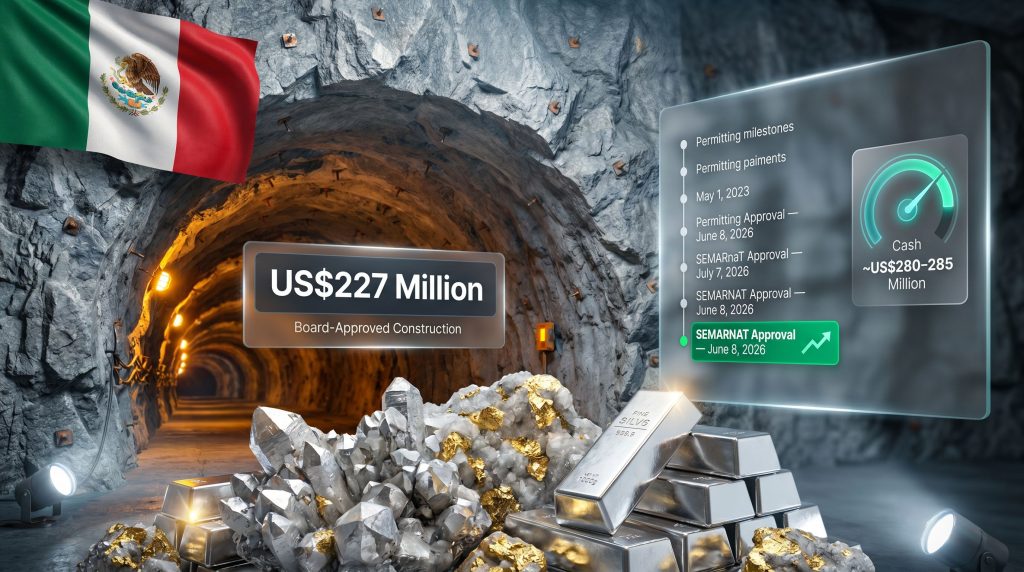
The GoGold Los Ricos Sur construction approval, formalised in June 2026, represents one of the most structurally complete mine-build setups to emerge from Mexico's silver corridor in recent years. With full environmental permitting secured, a board-authorised capital commitment of US$227 million, and a reported corporate cash position of approximately US$280–285 million, the project has arrived at construction commencement with a combination of regulatory clarity and balance sheet readiness that is genuinely uncommon in the junior-to-mid-tier mining space.
Understanding why that matters requires stepping back from the headline figures and examining the architecture of what has actually been achieved.
When big ASX news breaks, our subscribers know first
Why Construction-Ready Silver Projects in Mexico Are Increasingly Rare
The Regulatory Architecture Behind an Underground Mine Permit
Mexico's environmental authorisation framework for underground mining is administered across multiple federal agencies, but the most consequential approval sits with SEMARNAT (Secretaría de Medio Ambiente y Recursos Naturales), the federal body responsible for evaluating environmental impact assessments known as the Manifestación de Impacto Ambiental, or MIA.
The MIA process requires developers to document the full ecological, hydrological, and community impact of a proposed underground operation, submit to technical review by SEMARNAT specialists, and in many cases undertake additional consultations before a determination is issued. Critically, there is no statutory timeline by which SEMARNAT must respond, meaning approval windows are inherently unpredictable. Projects can wait anywhere from 18 months to several years for a determination, depending on deposit complexity, regional sensitivities, and the thoroughness of the original submission.
This uncertainty is not a minor administrative inconvenience. For developers funding feasibility studies and maintaining corporate overhead while awaiting environmental clearance, prolonged permitting timelines directly erode net present value and investor confidence. It is one of the primary reasons that fully permitted underground projects in Mexico trade at a structural premium relative to development-stage peers still navigating the authorisation process. Understanding the mining permitting process helps contextualise just how significant this milestone truly is.
The Structural Gap Between Feasibility and Shovel-Ready Status
One of the least discussed dynamics in mining project development is what industry practitioners sometimes call the feasibility-to-permit valley — the period between a completed bankable feasibility study and the receipt of all construction authorisations. During this phase, a project is technically de-risked from an engineering standpoint but remains legally prohibited from commencing ground disturbance. Capital cannot be productively deployed, contractors cannot be formally engaged, and the project sits in a kind of regulatory limbo.
Many silver and gold projects across Jalisco, Zacatecas, and Sonora have stalled in exactly this phase. The GoGold Los Ricos Sur construction approval closes that gap entirely, converting the project from a technically capable but legally constrained asset into a fully actionable capital deployment vehicle.
"Receiving SEMARNAT's final environmental clearance is widely recognised within the Latin American mining sector as the single most consequential de-risking milestone in an underground project's development lifecycle, often triggering immediate re-evaluation of project economics and financing options by institutional observers."
What Is Los Ricos Sur and How Does It Fit GoGold's Portfolio Strategy?
Project Location, Geology, and the District-Scale Thesis
Los Ricos Sur is an underground silver-gold project located in Jalisco state, Mexico. The Sur designation distinguishes it from GoGold's companion Los Ricos North project, with both sitting within the company's broader district-scale land package in one of Mexico's historically productive precious metals corridors. Furthermore, the Los Ricos project page provides comprehensive detail on the full district land package and both project areas.
The deposit's underground mining methodology is a deliberate architectural choice, not a constraint. Underground extraction carries higher capital intensity per tonne than open-pit methods, but it generates a substantially smaller surface disturbance footprint, which in regions with active agricultural land use and community engagement obligations is both an environmental and a social licence advantage. It also typically supports higher-grade selective mining, which improves the economics of individual ore tonnes processed.
GoGold's strategy of developing both Sur and North within a shared district framework creates opportunities for infrastructure sharing, including shared access roads, power supply arrangements, and potentially centralised processing infrastructure over time. This reduces the per-ounce capital cost across the combined production profile compared with developing each project as a standalone operation.
The Los Ricos District: Exploration Upside Beyond the Construction Footprint
An aspect of the Los Ricos Sur story that tends to receive less analytical attention is the exploration potential that sits adjacent to the construction-approved footprint. District-scale land packages in Mexico's silver belts frequently harbour satellite deposits and vein extensions that become economically accessible once primary infrastructure is in place.
The construction of underground infrastructure, particularly declines and ventilation raises, opens access to geological targets that were previously uneconomic to drill, let alone mine. This means the resource base underpinning GoGold's investment case may grow materially during the construction and early production phases — a dynamic that is difficult to price into pre-construction economic models but represents genuine optionality for long-term holders.
Breaking Down the US$227 Million Capital Commitment
Where Does the Capital Go in an Underground Silver Mine Build?
A US$227 million construction budget for an underground silver-gold mine involves a layered allocation across several distinct work packages. The following framework illustrates how capital of this magnitude is typically distributed in comparable Latin American underground mine developments:
| Capital Category | Typical Allocation (% of Total) | Relevance to Los Ricos Sur |
|---|---|---|
| Underground development and infrastructure | 35–45% | Primary cost driver; includes decline, levels, and ventilation |
| Processing plant and surface facilities | 25–35% | Milling circuits, leaching infrastructure, and refinery |
| Earthworks and site preparation | 10–15% | First-mobilisation activities following permit receipt |
| Contingency and indirect costs | 10–15% | Schedule and cost variance buffer |
| Environmental and community obligations | 5–8% | Ongoing regulatory compliance and social licence maintenance |
For underground operations of this scale, the decline construction and level development typically represent the longest-lead items, as they determine when ore can physically be accessed and moved to the processing facility. The processing plant itself can in many cases be constructed in parallel, but commissioning cannot proceed until underground ore supply is confirmed.
Capital Efficiency Benchmarking: How Does US$227 Million Compare?
Benchmarking Los Ricos Sur's capital commitment against comparable underground silver-gold development projects in Latin America positions it within the mid-scale development tier. Projects of similar mine life and throughput capacity in Mexico, Peru, and Bolivia have historically seen construction budgets ranging from US$150 million to US$400 million, with cost intensity heavily influenced by deposit depth, regional labour costs, and processing complexity.
What distinguishes Los Ricos Sur within this range is not the absolute figure but the capital structure behind it. In addition, a definitive feasibility study of this calibre provides institutional-grade engineering confidence that underpins the entire budget framework.
The Cash-Coverage Advantage: Why ~US$280–285 Million in Liquidity Changes the Risk Profile
Entering a US$227 million construction programme with a reported cash position of approximately US$280–285 million represents near-complete coverage of the projected build cost from existing corporate liquidity. In practical terms, this means:
- No mandatory project debt facility required as a construction precondition
- No equity dilution necessary to fund construction commencement
- Greater schedule flexibility, as cost overruns can be absorbed without triggering lender covenant breaches
- Stronger negotiating position with contractors and equipment suppliers, who price risk premiums into contracts for projects with uncertain financing
"Underground mine builds that commence with highly leveraged balance sheets — where construction financing depends on drawdowns from project debt facilities with attached covenants — carry materially elevated execution risk. Covenant breaches triggered by cost overruns or commodity price weakness have derailed comparable Latin American mine builds at the construction stage. GoGold's reported cash position structurally insulates Los Ricos Sur from this class of risk, though it does not eliminate construction execution uncertainty entirely."
The SEMARNAT Permitting Pathway: From Application to Construction Authorisation
Reconstructing the Regulatory Milestone Sequence
The path from feasibility study to construction approval for Los Ricos Sur involved a multi-stage regulatory sequence. The following table reconstructs the key milestones and their strategic significance:
| Milestone | Strategic Significance |
|---|---|
| Feasibility study completion | Established engineering and economic basis for regulatory submissions |
| Federal concession confirmation | Secured subsurface extraction rights under Mexican mining law |
| Community consultation process | Social licence requirement; a precondition for MIA submission in many regions |
| SEMARNAT MIA submission | Formal environmental impact application lodged with federal authority |
| SEMARNAT approval (June 8, 2026) | Final regulatory clearance received; project declared fully permitted |
| Board construction authorisation | Formal US$227 million capital commitment approved post-permit receipt |
Why the Board Decision Followed Permit Receipt, Not Preceded It
The sequencing of GoGold's board authorisation decision to follow SEMARNAT approval rather than precede it reflects sound mining governance practice. Conditional construction approvals — where boards authorise capital deployment subject to permit receipt — expose companies to the risk of having committed contractor mobilisation costs and procurement spend against a permit that may ultimately be modified or denied.
By waiting for SEMARNAT clearance before issuing the formal construction decision, GoGold's board removed the final conditionality from its capital commitment. The authorisation is not contingent; it is unconditional. That distinction matters to contractors, equipment suppliers, lenders observing from the sidelines, and capital markets participants assessing execution credibility. As confirmed by GoGold's official announcement, this sequencing was a deliberate and considered governance decision.
The 24-Month Construction Roadmap: From Earthworks to First Pour
Phase 1: Site Establishment and Initial Underground Access
The first 90 to 120 days of construction for an underground mine are typically the most logistically intensive. This phase involves establishing site access roads, mobilising earthworks contractors, commencing portal development for the main decline, and establishing surface power and water infrastructure. Contractor mobilisation timelines during this window have an outsized influence on the overall schedule, because delays at the portal development stage push back the entire underground development sequence.
Phase 2: Underground Development and Processing Plant Construction
Once portal access is secured, underground development progresses along two parallel tracks: primary development, which advances the main decline and establishes ore access levels, and secondary development, which opens stoping areas for ore extraction. Simultaneously, surface processing plant construction advances, with the objective of having the processing circuit ready to receive first ore approximately concurrent with underground development reaching sufficient ore exposure.
Key schedule risk factors in this phase include:
- Geotechnical variability, particularly unexpected ground conditions that require additional support and slow advance rates
- Water ingress, a known challenge in Mexico's Jalisco region given groundwater characteristics in volcanic and epithermal geological settings
- Equipment delivery timelines, particularly for long-lead processing plant components such as ball mills, thickeners, and filter presses
- Labour availability, especially for skilled underground miners and processing plant operators in competitive regional labour markets
Phase 3: Commissioning and First Metal Pour
The transition from construction to production mode involves a commissioning phase where processing circuits are tested under operating conditions before first ore is introduced. For underground silver-gold operations of this scale, commissioning typically adds two to four months to the timeline before a sustainable first pour can be achieved.
| Scenario | Key Variable | Projected First Pour |
|---|---|---|
| Base Case | 24-month build, on-schedule execution | Approximately mid-2028 |
| Accelerated | Favourable ground conditions, no supply chain delays | Potentially Q1 2028 |
| Delayed | Geotechnical challenges, equipment procurement issues | Late 2028 or beyond |
Note: Timeline projections are forward-looking estimates based on publicly available information and comparable project precedents. Actual outcomes may differ materially from any scenario modelled above. This article does not constitute financial advice.
The next major ASX story will hit our subscribers first
Mexico's Silver Mining Landscape and the Industrial Demand Dimension
Mexico as the World's Largest Silver Producer
Mexico has consistently ranked as the world's leading silver-producing nation, a position supported by a network of operating underground mines, processing facilities, and a mature base of skilled mining labour. According to the Silver Institute, Mexico produced approximately 6,400 tonnes of silver in 2023, accounting for roughly 26% of global mine supply. Indeed, global silver production from Mexico underpins a substantial portion of the world's total supply each year.
Sustaining that position requires a continuous pipeline of new underground operations as legacy deposits mature and high-grade zones are exhausted. Projects like Los Ricos Sur play a direct role in replenishing that pipeline, entering at a time when several of the country's larger legacy operations are managing declining ore grades.
Silver's Industrial Demand Trajectory: The Solar Photovoltaic Connection
Unlike gold, which derives the majority of its demand from monetary and jewellery applications, silver's industrial role is significant and continues to grow — particularly in photovoltaic solar panel manufacturing, now one of the largest single consumers of silver globally. Each standard crystalline silicon solar panel requires approximately 15 to 20 milligrams of silver in its electrical contacts, and as global solar installation rates accelerate to meet decarbonisation targets, aggregate silver demand from this sector alone is projected to grow substantially through the 2030s.
The Silver Institute has noted that solar photovoltaic demand for silver reached a record high of approximately 232 million ounces in 2023, a figure that has more than doubled over the preceding five years. Furthermore, the broader silver demand drivers underpinning this structural shift provide an industrial floor beneath silver prices that did not exist to the same degree a decade ago, which consequently strengthens the long-term revenue assumptions underpinning projects like Los Ricos Sur.
Key Risk Factors for Investors to Monitor
Construction Execution: The Unique Challenges of Underground Mine Building
Underground mine construction carries an intrinsic complexity that surface operations do not. Geological models, however sophisticated, are probabilistic representations of subsurface conditions based on drill hole data. Actual ground conditions encountered during development invariably differ from the model in ways that affect advance rates, support requirements, and ultimately cost and schedule.
Historical data from comparable Latin American underground mine builds suggests that capex overruns of 10–20% are common even in well-managed projects, with a subset experiencing more significant variances when major geotechnical events occur. GoGold's reported cash position provides a meaningful buffer against such outcomes, but investors should treat the US$227 million figure as a best-estimate baseline rather than a fixed ceiling.
Commodity Price Sensitivity and the Gold Co-Production Hedge
Los Ricos Sur's economics are driven by a silver-equivalent ounce framework that blends silver and gold revenue streams. The gold co-production element provides a natural revenue diversification mechanism, because gold and silver prices do not move in perfect correlation. In periods of silver price weakness, gold revenue contribution can partially offset shortfalls in silver-driven cash flows, improving the project's resilience to single-commodity price shocks.
Investors should independently assess the silver and gold price assumptions embedded in GoGold's feasibility economics and evaluate sensitivity to price scenarios below the base case before forming a view on project viability.
Political and Regulatory Environment for Mining in Mexico
Mexico's federal regulatory environment for mining has evolved under recent administrations, with ongoing discussions around concession taxation, water usage rights, and the role of foreign-owned mining operations in national resource development. While Los Ricos Sur has secured its core permits under current law, the broader regulatory environment for mining in Mexico requires ongoing monitoring, particularly regarding potential changes to the Mining Law, environmental compliance obligations during construction, and federal policy directions on water concessions in water-stressed regions.
This article is intended for informational purposes only and does not constitute investment advice. Readers should conduct independent due diligence before making any investment decisions related to companies or projects discussed herein.
Frequently Asked Questions: GoGold Los Ricos Sur Construction Approval
What is the Los Ricos Sur project?
Los Ricos Sur is an underground silver-gold mining project being developed by GoGold Resources in Jalisco, Mexico. Following receipt of full environmental clearance from SEMARNAT in June 2026, the company's board formally authorised construction with a committed capital budget of approximately US$227 million.
What does SEMARNAT approval mean in practice?
SEMARNAT is Mexico's federal environmental authority. Its approval of the project's MIA represents the final regulatory prerequisite for construction commencement, legally authorising ground disturbance and underground development activities.
How long is the construction timeline?
GoGold has indicated a construction window of approximately 24 months from commencement to first metal pour, placing base-case initial production in the mid-2028 timeframe.
How is the construction being financed?
The project is expected to be funded from existing corporate cash reserves. With a reported liquidity position of approximately US$280–285 million against a construction budget of US$227 million, near-complete cash coverage of the build cost is available without mandatory recourse to project debt or dilutive equity issuance.
What metals will the project produce?
Los Ricos Sur is primarily a silver operation with meaningful gold co-production, commonly measured on a silver-equivalent ounce basis that incorporates both revenue streams.
Strategic Takeaways: What the Los Ricos Sur Approval Signals for Latin American Mining
The GoGold Los Ricos Sur construction approval is analytically interesting not just for what it tells us about a single project, but for what it demonstrates about the pathway to construction-readiness in Latin America's most complex regulatory environments.
Three strategic observations stand out:
-
Permitting success is achievable in Mexico's SEMARNAT framework, even for large-scale underground operations with complex environmental footprints, provided the MIA submission is comprehensive and community consultation processes are managed effectively from the outset.
-
Balance sheet construction at commencement is a genuine competitive differentiator. The combination of full regulatory clearance and near-complete cash coverage of construction costs places Los Ricos Sur in a category of de-risked development assets that are structurally rare in the current capital markets environment for mid-tier precious metals developers.
-
District-scale strategies compound optionality. The existence of Los Ricos North as a companion asset within the same land package means that infrastructure built for Sur's production phase creates a platform from which North's development economics can be materially improved. This is a long-term value dynamic that single-project analysis frameworks tend to underweight.
For observers of Latin American mining development, the Los Ricos Sur approval is a useful reference point for understanding how the best-managed transition from feasibility to construction actually unfolds when regulatory patience, balance sheet discipline, and geological quality converge simultaneously.
For further context on Latin American mining project pipelines, permitting milestones, and capital investment trends, industry intelligence resources such as BNamericas' Mining and Metals coverage at bnamericas.com track regional developments across the full project development spectrum.
Want to Catch the Next Major Silver or Gold Discovery Before the Market Does?
Discovery Alert's proprietary Discovery IQ model delivers real-time alerts the moment significant ASX mineral discoveries are announced, transforming complex geological data into clear, actionable insights for investors at every level — explore the historic returns major discoveries have generated and begin your 14-day free trial to position yourself ahead of the broader market.