
May 14, 2026
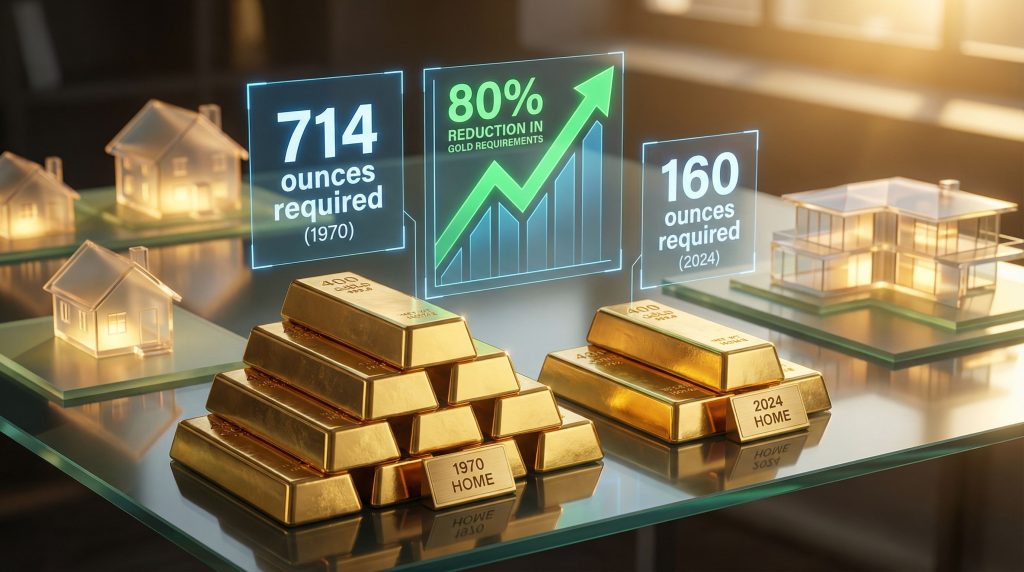
The relationship between gold and real estate reveals fascinating insights into purchasing power dynamics, with how much gold to buy a house serving as a crucial benchmark for understanding monetary trends. Since 1970, the gold required to purchase an average American home has declined by approximately 80%, dropping from over 700 ounces to roughly 160 ounces today. This dramatic shift reflects gold's superior ability to maintain purchasing power while fiat currencies depreciate through systematic monetary expansion.
Understanding Gold's Role as a Monetary Benchmark
Monetary systems across the globe continue to face unprecedented challenges as central bank policies reshape traditional approaches to wealth preservation. The relationship between hard assets and fiat currencies has become increasingly important for investors seeking to understand real purchasing power dynamics in an environment of persistent monetary expansion.
Understanding this historic gold surge provides context for current market conditions. Furthermore, examining gold as inflation hedge helps explain why precious metals continue attracting institutional attention during periods of currency instability.
Why Economists Use Gold to Measure Real Value
Gold's unique position as a monetary benchmark stems from its fundamental supply characteristics. Unlike fiat currencies, which can be created through digital entries and policy decisions, gold production remains constrained by geological realities and mining economics. Annual global mine production typically increases the total above-ground supply by approximately 1-2% per year, creating a natural scarcity that contrasts sharply with modern monetary policy.
Since the departure from the Bretton Woods system in 1971, fiat currencies have operated without tangible backing, allowing for unlimited expansion during periods of economic stress. The M2 money supply has expanded more than 30-fold since 1971, while the U.S. dollar has lost over 88% of its purchasing power according to Consumer Price Index data. During the 2020-2022 period alone, M2 expanded by over $6 trillion in just 24 months.
This stark contrast between constrained gold supply and accelerating currency creation provides the foundation for why gold continues to serve as a purchasing power benchmark. When assets are priced in gold rather than dollars, the effects of monetary expansion can be isolated, revealing whether price increases reflect genuine scarcity or currency depreciation.
The Mathematics Behind Gold-to-Asset Ratios
The calculation for determining how much gold to buy a house follows a straightforward formula:
Asset Price ÷ Gold Spot Price = Ounces Required
Using current market conditions as an example:
- An $800,000 home ÷ $5,000 per ounce = 160 ounces of gold
- A $400,000 home ÷ $5,000 per ounce = 80 ounces of gold
- A $250,000 starter home ÷ $5,000 per ounce = 50 ounces of gold
Regional variations significantly impact these calculations. Premium markets like San Francisco or New York may require substantially more gold ounces, while affordable markets in the Midwest or South may require considerably fewer. Additionally, gold premiums above spot price, storage costs, and transaction fees should be factored into practical calculations.
When big ASX news breaks, our subscribers know first
How Many Ounces of Gold Does It Take to Buy Different Types of Houses?
Understanding the gold requirements across different housing segments provides insight into how precious metals relate to various wealth preservation strategies. The following analysis examines contemporary housing markets through the lens of gold purchasing power.
According to data from long-term trends analysis, the gold-to-housing ratio has shown remarkable consistency in demonstrating gold's purchasing power preservation over decades.
Starter Homes ($250,000-$400,000 Range)
Entry-level housing represents a significant portion of the American real estate market, typically requiring between 48-77 ounces of gold at current pricing levels. This range encompasses:
- Small condominiums in suburban markets: 48-55 ounces
- Single-family starter homes in affordable regions: 55-65 ounces
- Larger starter homes in competitive markets: 65-77 ounces
Geographic variations within this segment remain substantial. Markets like Cleveland, Pittsburgh, or Kansas City often fall toward the lower end of this range, while starter homes near major employment centres like Austin, Denver, or Charlotte trend toward the upper end.
For first-time buyers considering gold allocation strategies, this represents a meaningful but achievable accumulation target over multiple years. Systematic purchasing programmes can help smooth price volatility while building toward housing-equivalent holdings.
Median-Priced Homes ($400,000-$600,000 Range)
The median American home price category requires approximately 77-116 ounces of gold, representing the mainstream housing market across most metropolitan areas:
| Market Type | Price Range | Gold Ounces | Examples |
|---|---|---|---|
| Suburban Standard | $400,000-$450,000 | 77-87 ounces | Phoenix, Tampa, Nashville |
| Growing Markets | $450,000-$550,000 | 87-106 ounces | Atlanta, Dallas, Charlotte |
| Established Markets | $550,000-$600,000 | 106-116 ounces | Portland, Minneapolis, Denver |
This segment represents the core of American homeownership and provides a realistic benchmark for middle-class wealth preservation strategies. Historical data suggests that accumulating 100-120 ounces of gold has consistently maintained purchasing power equivalent to median housing across multiple decades.
Luxury Properties ($800,000+ Range)
High-end residential markets require 155+ ounces of gold, with premium locations demanding significantly more:
- Luxury suburban homes: 155-200 ounces
- Urban luxury condominiums: 200-300 ounces
- Premium waterfront properties: 300-500 ounces
- Ultra-luxury estates: 500+ ounces
International luxury markets present additional considerations. London properties often require 400-800 ounces, while prime Manhattan real estate may demand 600-1,200 ounces. These calculations highlight gold's role in ultra-high-net-worth portfolio construction and international wealth preservation strategies.
Historical Gold-to-Housing Ratios: What the Data Reveals
The long-term relationship between gold and housing provides crucial insights into monetary dynamics and purchasing power preservation. Historical analysis reveals patterns that challenge conventional assumptions about asset appreciation.
For comprehensive analysis of current trends, examining this gold market analysis offers valuable insights into contemporary market dynamics.
The 1970 Baseline: When Gold Was $35 Per Ounce
In 1970, a modest California home priced at $25,000 required approximately 714 ounces of gold at the then-fixed price of $35 per ounce. This baseline establishes a reference point for measuring subsequent purchasing power changes across more than five decades.
The 1970 calculation represents the final year of the Bretton Woods system, before the U.S. dollar's convertibility to gold was suspended. This historical anchor point provides a unique perspective on what occurred to both currencies and real assets following the transition to a pure fiat monetary system.
Contemporary California homes averaging $800,000 require approximately 160 ounces at current gold prices, representing a 77.6% reduction in gold requirements over the 54-year period.
Decade-by-Decade Purchasing Power Evolution
The transformation from 714 ounces to 160 ounces didn't occur linearly. Key periods include:
1970s: Post-Bretton Woods Adjustment
- Gold price volatility increased dramatically after $35 peg removal
- Housing prices began accelerating alongside general inflation
- Gold requirements fluctuated between 400-600 ounces depending on timing
1980s: Inflation Peak and Gold Volatility
- Gold reached $850 per ounce in January 1980
- Housing market experienced significant regional variations
- Gold requirements dropped to 150-250 ounces during peak gold prices
1990s-2000s: Technology Boom and Housing Bubble
- Relatively stable gold prices around $300-400 per ounce
- Housing appreciation accelerated, particularly 2003-2006
- Gold requirements increased to 400-500 ounces during housing bubble peak
2010s: Quantitative Easing and Asset Price Inflation
- Federal Reserve balance sheet expansion began 2008-2009
- Both gold and housing prices rose, but gold outpaced housing
- Gold requirements stabilised around 200-300 ounces
2020s: Pandemic Monetary Expansion
- Unprecedented fiscal and monetary stimulus
- Both asset classes appreciated rapidly
- Gold requirements continued declining toward 160-180 ounces
The 80% Reduction in Gold Requirements
This dramatic reduction carries profound implications for understanding monetary systems and wealth preservation. The decline doesn't suggest that housing became "cheaper" in real terms, but rather demonstrates gold's ability to maintain and increase purchasing power relative to tangible assets.
The statistical significance extends beyond housing to encompass a broader pattern of gold maintaining value while fiat currencies depreciated through systematic expansion.
Several factors contributed to this trend:
- Monetary base expansion outpaced gold production by substantial margins
- Real interest rates remained negative during extended periods
- Currency debasement accelerated during crisis periods (2008, 2020-2022)
- Central bank gold accumulation reached multi-decade highs
Why Gold Maintains Purchasing Power While Currencies Depreciate
The fundamental driver behind gold's purchasing power preservation lies in the mathematical relationship between constrained supply and expanding monetary systems. This dynamic creates a systematic advantage for hard assets over fiat currencies during periods of fiscal stress.
Monetary Supply Expansion vs. Gold Production Constraints
Since 1971, the contrast between gold supply growth and fiat currency expansion has created a widening divergence:
Gold Production Metrics:
- Annual mine production: 1-2% supply increase
- Total above-ground supply: approximately 210,000 tonnes
- New supply constraints: declining ore grades, deeper mining operations
- Production costs: increasingly expensive extraction processes
Monetary Expansion Metrics:
- M2 money supply growth: 30x increase since 1971
- Federal Reserve balance sheet: expanded from $57 billion (1971) to over $8 trillion (2024)
- Digital money creation: instantaneous and unlimited during crisis periods
- Velocity considerations: new money entering asset markets rather than consumer goods
This mathematical relationship suggests that as long as central banks maintain expansionary policies, gold's relative scarcity will continue supporting its purchasing power against fiat-denominated assets.
Federal Debt and Currency Debasement Cycles
U.S. federal debt has expanded from approximately $370 billion in 1970 to nearly $37 trillion today, representing a 9,000%+ increase over the same period that gold requirements for housing declined by 80%.
This correlation isn't coincidental. Growing debt levels require monetary accommodation to remain serviceable, creating systematic pressure for currency depreciation. Key mechanisms include:
- Debt monetisation through quantitative easing programmes
- Financial repression via artificially suppressed interest rates
- Inflation targeting that systematically erodes currency purchasing power
- Modern Monetary Theory implementation expanding fiscal deficits
Historical precedents suggest that heavily indebted nations eventually resort to currency debasement as the primary method for managing unsustainable debt burdens. Gold's performance during previous debasement cycles (1970s, Weimar Germany, numerous emerging market crises) demonstrates its effectiveness as monetary insurance.
Central Bank Gold Accumulation Trends
Central bank gold purchases have reached multi-decade highs in recent years, according to World Gold Council data. This institutional demand reflects growing concerns about currency stability and the need for portfolio diversification away from fiat reserves.
Notable trends include:
- Emerging market central banks leading accumulation efforts
- Geopolitical tensions driving reserve diversification
- Sanctions concerns highlighting gold's sovereignty advantages
- Digital currency development creating demand for monetary anchors
The fact that monetary authorities themselves are accumulating gold while simultaneously expanding currency supplies provides insight into institutional thinking about long-term monetary dynamics.
Comparing Gold Requirements Across Major Life Purchases
The housing analysis reveals a broader pattern that extends across major expenditure categories. Examining gold requirements for other significant purchases provides additional perspective on purchasing power dynamics and monetary distortion effects.
Comprehensive research from ABC Bullion's analysis demonstrates similar patterns across international markets.
Automotive Purchase Power Analysis
The automotive sector demonstrates similar patterns to housing when measured in gold terms:
1970 Baseline:
- Average new car price: $3,500
- Gold price: $35 per ounce
- Gold requirement: 100 ounces
2024 Comparison:
- Average new vehicle price: $48,000
- Gold price: $5,000+ per ounce
- Gold requirement: 9.6 ounces
This represents a 90% reduction in gold requirements over 54 years, even more dramatic than the housing decline. Several factors contribute to this pattern:
- Manufacturing efficiency improvements reducing real production costs
- Technology integration adding value without proportional cost increases
- Global supply chains reducing labour and material expenses
- Currency depreciation making dollar-denominated prices appear inflated
Luxury vehicles show similar trends, with high-end cars requiring 200-300 ounces in 1970 but only 15-25 ounces today for comparable quality levels.
Higher Education Cost Comparison
Educational expenses reveal the most complex relationship with gold pricing:
1970 Baseline:
- Four-year college tuition: $4,000
- Gold requirement: 114 ounces
2024 Comparison:
- Four-year degree cost: $80,000
- Gold requirement: 16 ounces
The 86% reduction in gold requirements challenges conventional narratives about education affordability. While nominal tuition prices have increased dramatically, gold-adjusted costs have declined substantially.
Professional and graduate programmes show similar patterns:
- Medical school: 300 ounces (1970) vs. 50 ounces (2024)
- Law school: 250 ounces (1970) vs. 40 ounces (2024)
- MBA programmes: 200 ounces (1970) vs. 35 ounces (2024)
Consumer Goods and Services Basket
Essential goods and services demonstrate varying relationships with gold pricing:
Food and Agricultural Products:
- Generally maintained stable gold relationships
- Seasonal variations more significant than long-term trends
- Quality improvements offset nominal price increases
Energy Costs:
- Oil prices show strong correlation with gold over decades
- Natural gas and electricity prices vary by regional policy
- Renewable energy development creating deflationary pressures
Healthcare Services:
- Complex regulatory environment affecting pricing
- Technology improvements offsetting labour cost increases
- Insurance and payment system distortions complicating analysis
Technology Products:
- Dramatic improvement in capability per gold ounce
- Computing power increases exponentially while gold costs decline
- Consumer electronics demonstrate extreme deflationary trends
Investment Strategy Implications for Portfolio Allocation
The consistent decline in gold requirements across major asset categories carries significant implications for portfolio construction and wealth preservation strategies. Understanding these dynamics can inform allocation decisions and long-term financial planning.
For detailed insights into future trends, consulting this gold price forecast provides valuable perspective on market developments.
Gold as Purchasing Power Insurance
The historical evidence suggests gold functions as insurance against purchasing power erosion rather than a traditional investment seeking returns. Recommended allocation frameworks include:
Conservative Portfolios (5-10% allocation):
- Focus on wealth preservation during retirement
- Emphasis on principal protection and stability
- Suitable for risk-averse investors with shorter time horizons
Moderate Portfolios (10-15% allocation):
- Balance between growth and protection
- Hedge against inflation and currency risk
- Appropriate for middle-aged investors with diversified objectives
Aggressive Portfolios (15-25% allocation):
- Enhanced protection during monetary instability
- Higher conviction in currency debasement scenarios
- Suitable for investors with longer time horizons and higher risk tolerance
Risk-adjusted return analysis demonstrates gold's negative correlation with traditional assets during stress periods, providing portfolio stabilisation when conventional investments decline.
Physical vs. Paper Gold Considerations
Implementation strategies must address the fundamental differences between physical gold ownership and paper-based exposure:
Physical Bullion Advantages:
- No counterparty risk during financial system stress
- Direct ownership and control
- Privacy and anonymity benefits
- Protection against institutional failures
Physical Bullion Disadvantages:
- Storage and insurance costs (0.5-1.5% annually)
- Transaction costs for buying/selling (2-4% spreads)
- Security and logistics considerations
- Liquidity constraints for large positions
Paper Gold Alternatives:
- Exchange-traded funds (GLD, IAU) with lower costs
- Mining stocks providing operational leverage
- Futures contracts for sophisticated investors
- Digital gold platforms combining convenience with backing
Timing and Dollar-Cost Averaging Strategies
Given gold's volatility, systematic accumulation strategies often outperform attempts at market timing:
Monthly Purchase Programmes:
- Smooth out short-term price fluctuations
- Reduce behavioural biases and emotional decisions
- Allow for gradual portfolio allocation building
- Minimise transaction cost impact through regular activity
Rebalancing Triggers:
- 5% allocation drift: modest rebalancing for conservative approaches
- 10% allocation drift: moderate rebalancing for balanced portfolios
- 15% allocation drift: aggressive rebalancing for active management
Market Volatility Opportunities:
- Increase purchasing during periods of elevated volatility
- Reduce purchasing during extended bull markets
- Maintain core allocation regardless of market conditions
The next major ASX story will hit our subscribers first
Regional Housing Market Variations and Gold Calculations
Housing markets demonstrate significant regional variation that affects gold requirement calculations. Understanding these geographic differences provides insight into local economic conditions and purchasing power dynamics.
Moreover, examining the gold-stock market guide reveals how precious metals relate to broader economic cycles across different regions.
International Housing Markets in Gold Terms
Global real estate markets show varying relationships with gold pricing, influenced by local monetary policies, economic conditions, and regulatory environments:
European Markets:
- London: Prime properties require 400-800 ounces
- Paris: Central arrondissements average 300-600 ounces
- Frankfurt: Financial district properties need 250-400 ounces
- Regional variations reflect local economic strength and Euro stability
Asia-Pacific Region:
- Tokyo: Central Tokyo properties require 200-500 ounces
- Sydney: Harbour area real estate demands 300-600 ounces
- Singapore: Prime districts average 400-700 ounces
- Currency stability and local gold premiums affect calculations
Emerging Markets:
- Gold premiums often exceed developed market levels
- Currency volatility creates additional complexity
- Political risk factors influence long-term calculations
- Local regulations may restrict gold ownership or transactions
U.S. Regional Analysis by Metropolitan Area
American housing markets demonstrate substantial regional variation in gold requirements:
| Region | Gold Ounces Required | Key Markets | Market Characteristics |
|---|---|---|---|
| West Coast | 200-400+ | San Francisco, Los Angeles, Seattle | High income, tech industry, supply constraints |
| Northeast | 150-350 | New York, Boston, Washington DC | Finance centres, established markets |
| Southeast | 80-180 | Atlanta, Miami, Charlotte | Growing economies, favourable demographics |
| Midwest | 60-140 | Chicago, Minneapolis, Detroit | Industrial heritage, affordable housing |
| Southwest | 90-200 | Dallas, Houston, Phoenix | Energy sector, rapid population growth |
These variations reflect local economic conditions, regulatory environments, and supply-demand dynamics that affect both housing costs and gold accessibility.
Rural vs. Urban Property Dynamics
Geographic location significantly impacts the gold-to-housing relationship:
Urban Markets:
- Higher absolute gold requirements
- Greater liquidity for both assets
- More sophisticated precious metals dealers
- Professional storage and security options available
Suburban Markets:
- Moderate gold requirements
- Balance between affordability and amenities
- Standard precious metals dealer networks
- Home storage more feasible for smaller holdings
Rural Markets:
- Lower absolute gold requirements
- Limited precious metals dealer access
- Transportation and security considerations
- Agricultural land values may correlate with commodity cycles
Economic Indicators That Influence Gold-to-Housing Ratios
Multiple macroeconomic factors affect the relationship between gold prices and housing costs. Understanding these drivers provides insight into when ratios may shift and how to position portfolios accordingly.
Interest Rate Policy and Real Estate Financing
Federal Reserve monetary policy significantly impacts both gold prices and housing affordability through interest rate mechanisms:
Mortgage Rate Effects:
- Rising rates reduce housing affordability, potentially lowering prices
- Falling rates increase buyer capacity, supporting housing demand
- Real rates (nominal minus inflation) affect gold opportunity cost
- Negative real rates historically support gold price appreciation
Gold Price Correlations:
- Inverse correlation with real interest rates over long periods
- Positive correlation during periods of financial stress
- Currency effects when rate differentials affect dollar strength
- Inflation expectations embedded in nominal rate structures
The relationship becomes complex during transitional periods when Fed policy shifts create temporary disconnections between traditional correlations.
Inflation Metrics and Cost-of-Living Adjustments
Inflation measurement significantly affects purchasing power calculations:
Official CPI Metrics:
- Headline CPI includes volatile food and energy components
- Core CPI excludes volatile components for policy purposes
- Regional variations affect local purchasing power calculations
- Methodological changes over decades affect historical comparisons
Alternative Inflation Measures:
- Producer Price Index reflects upstream cost pressures
- GDP deflator provides broader economic price perspective
- Shadow statistics suggest higher inflation than official measures
- Asset price inflation not captured in consumer price indices
Housing-Specific Adjustments:
- Owners' equivalent rent methodology affects CPI housing component
- Regional cost variations require local adjustment factors
- Quality improvements complicate price trend analysis
- Tax policy changes affect effective housing costs
Employment and Income Growth Factors
Labour market conditions influence both housing demand and gold investment capacity:
Wage Growth Dynamics:
- Real wage growth determines housing affordability improvement
- Income inequality affects demand distribution across price segments
- Regional variations in employment and wage growth patterns
- Demographic trends influencing household formation rates
Employment Quality Metrics:
- Full-time vs. part-time employment affecting mortgage qualification
- Job security perceptions influencing major purchase decisions
- Gig economy growth creating income volatility considerations
- Remote work trends affecting geographic demand patterns
Future Projections and Scenario Analysis
Forward-looking analysis must consider multiple potential scenarios for monetary policy, housing markets, and gold pricing. While predictions remain inherently uncertain, understanding various possibilities can inform strategic decision-making.
Monetary Policy Scenarios Through 2030
Several potential paths for Federal Reserve policy could significantly affect gold-to-housing ratios:
Continued Expansionary Policy:
- Quantitative easing programmes extending beyond current levels
- Yield curve control implementation to suppress long-term rates
- Central bank digital currencies creating new monetary tools
- Modern Monetary Theory adoption enabling unlimited fiscal expansion
Implications: Likely continued decline in gold requirements for housing
Monetary Policy Normalisation:
- Interest rate increases to combat persistent inflation
- Balance sheet reduction shrinking Fed asset holdings
- Traditional policy tools returning to historical norms
- Currency stabilisation efforts reducing debasement pressure
Implications: Potential stabilisation or modest increase in gold requirements
Crisis-Driven Expansion:
- Financial system stress requiring emergency intervention
- Geopolitical conflicts disrupting normal policy frameworks
- Debt crisis forcing aggressive monetary accommodation
- Economic recession prompting stimulus measures
Implications: Accelerated decline in gold requirements, potentially dramatic
Housing Supply and Demand Fundamentals
Structural changes in housing markets could affect long-term gold relationships:
Supply Constraints:
- Zoning restrictions limiting new construction in desirable areas
- Labour shortages in construction industries increasing costs
- Material inflation raising building expenses beyond general inflation
- Environmental regulations adding compliance costs and delays
Demand Shifts:
- Demographic changes as millennials reach peak homebuying age
- Geographic redistribution from expensive to affordable markets
- Remote work enabling location flexibility
- Investment demand from institutional buyers affecting prices
Technology Disruption:
- Construction automation potentially reducing building costs
- 3D printing and modular construction improving efficiency
- Smart home technology adding value without proportional cost
- Virtual reality changing space utilisation and demand patterns
Geopolitical Risk Factors
International developments could significantly impact both gold demand and housing markets:
Currency Competition:
- Central bank digital currencies challenging traditional monetary systems
- Gold-backed currencies emerging from certain nations
- Cryptocurrency adoption affecting demand for alternative stores of value
- International sanctions driving demand for non-dollar assets
Resource Nationalism:
- Mining jurisdiction risks affecting gold supply chains
- Export restrictions on precious metals during crises
- Nationalisation threats in key producing regions
- Environmental regulations constraining mining operations
Safe-Haven Demand:
- Military conflicts driving flight-to-quality flows
- Trade wars creating economic uncertainty
- Political instability in major economies
- Financial system stress increasing insurance demand
Practical Implementation Guide for Investors
Translating the theoretical understanding of gold-to-housing relationships into actionable investment strategies requires careful attention to practical implementation details.
Calculating Your Personal Gold-to-Housing Target
Individual calculations should reflect specific circumstances and local market conditions:
Step 1: Local Market Analysis
- Research median home prices in target geographic areas
- Identify specific neighbourhoods and property types of interest
- Account for transaction costs, taxes, and closing expenses
- Consider timing factors and seasonal market variations
Step 2: Current Gold Pricing Research
- Monitor spot prices from reliable sources (London Bullion Market Association)
- Understand premiums for different product types (coins vs. bars)
- Account for dealer spreads and transaction costs
- Consider storage and insurance expenses in total cost calculations
Step 3: Goal Setting and Timeline Development
- Determine target accumulation timeframe (5, 10, 15+ years)
- Calculate required monthly or quarterly purchase amounts
- Build flexibility for price volatility and economic changes
- Establish intermediate milestones for progress tracking
Storage and Security Considerations
Physical gold ownership requires careful attention to security and accessibility:
Home Storage Options:
- Fireproof safes rated for precious metals (minimum 1-hour fire protection)
- Safety deposit boxes at banks or credit unions
- Hidden storage systems integrated into home construction
- Insurance coverage through homeowner's or renter's policies
Professional Storage Services:
- Segregated storage maintaining individual ownership
- Allocated storage with specific bars or coins assigned
- Unallocated storage representing claims against general inventory
- International vaulting for geographic diversification
Security Best Practices:
- Discretion regarding holdings and storage locations
- Multiple locations to reduce concentration risk
- Regular audits of stored holdings
- Updated insurance coverage reflecting current values
Exit Strategy and Liquidity Planning
Converting gold holdings to real estate requires advance planning:
Market Timing Considerations:
- Seasonal patterns in both housing and gold markets
- Economic cycles affecting optimal conversion timing
- Tax implications of gains or losses on gold sales
- Transaction costs for both gold sales and real estate purchases
Conversion Mechanics:
- Dealer relationships for efficient gold liquidation
- Real estate professionals familiar with non-traditional financing
- Legal documentation for unusual transaction structures
- Title companies experienced with precious metals transactions
Frequently Asked Questions About Gold and Housing Purchases
Common questions about implementing gold-based housing strategies reveal practical considerations that affect real-world execution.
Can You Actually Buy a House with Gold?
While legally possible, direct gold-to-real estate transactions remain uncommon in the United States:
Legal Framework:
- No federal prohibition on using gold for real estate transactions
- State regulations may vary regarding acceptable forms of payment
- Tax reporting requirements apply to both gold sales and real estate purchases
- Documentation standards require proper valuation and record-keeping
Practical Implementation:
- Most sellers prefer conventional financing due to simplicity
- Gold liquidation followed by cash purchase remains more common
- Specialised dealers can facilitate large conversions efficiently
- Professional guidance recommended for complex transactions
How Do Gold Price Fluctuations Affect the Calculation?
Short-term volatility creates timing challenges that require strategic approaches:
Daily Volatility Management:
- Dollar-cost averaging reduces impact of price fluctuations
- Systematic accumulation over multiple years smooths timing risk
- Rebalancing strategies maintain target allocation percentages
- Hedging techniques for investors requiring price certainty
Long-Term Trend Focus:
- Historical analysis suggests volatility diminishes over decades
- Purchasing power preservation more important than short-term price movements
- Economic cycle awareness helps identify accumulation opportunities
- Patience and discipline essential for successful implementation
What About Other Precious Metals for Housing Purchases?
Alternative precious metals offer different characteristics and considerations:
Silver Considerations:
- Higher volatility than gold, creating larger price swings
- Industrial demand component affects pricing beyond monetary factors
- Storage challenges due to bulk requirements for large values
- Liquidity differences particularly for substantial holdings
Platinum and Palladium:
- Industrial applications dominate demand, reducing monetary characteristics
- Supply concentration in limited geographic regions increases risk
- Market size smaller than gold, creating liquidity constraints
- Price correlations with automotive and industrial cycles
Portfolio Diversification Approach:
- Mixed metals holdings can provide broader precious metals exposure
- Gold emphasis maintains focus on monetary characteristics
- Silver supplement offers potential for enhanced returns with higher risk
- Professional guidance recommended for complex allocation decisions
Disclaimer: This analysis is provided for educational purposes and does not constitute investment advice. Precious metals investing involves risks including price volatility and potential loss of principal. Past performance does not guarantee future results. Individuals should consult qualified financial professionals before making investment decisions based on their specific circumstances and risk tolerance.
Ready to Capitalise on the Next Major Mineral Discovery?
Whilst gold maintains its purchasing power against real estate over decades, smart investors also recognise opportunities in gold mining companies. Discovery Alert's proprietary Discovery IQ model delivers instant notifications on significant ASX mineral discoveries, transforming complex geological data into actionable investment insights that could potentially accelerate your wealth accumulation timeline. Begin your 14-day free trial today to position yourself ahead of the market and discover why major mineral discoveries have historically generated exceptional returns.