
June 4, 2026
Why the 1933 Playbook No Longer Works the Way Most People Think
Investor anxiety about gold confiscation tends to spike during periods of monetary stress, and the current environment, characterised by $2 trillion annual deficits, roughly $1 trillion in annual interest payments on US federal debt, and gold trading near $4,437 per troy ounce as of June 2026, is generating that anxiety at scale. The question of can the government confiscate gold again circulates widely, typically anchored to one historical event and rarely examined against the legal architecture that governs executive power today.
That gap between historical fear and statutory reality is where most investors go wrong. This is not primarily a historical question. It is a legal, structural, and political economy question, and the answer looks materially different when examined through those frameworks rather than through a simple retelling of 1933.
When big ASX news breaks, our subscribers know first
Understanding What Executive Order 6102 Actually Was
The event most people reference when discussing gold confiscation is Executive Order 6102, signed by President Franklin D. Roosevelt on April 5, 1933. What the order actually did is frequently mischaracterised, and furthermore, the mischaracterisation matters for understanding modern risk.
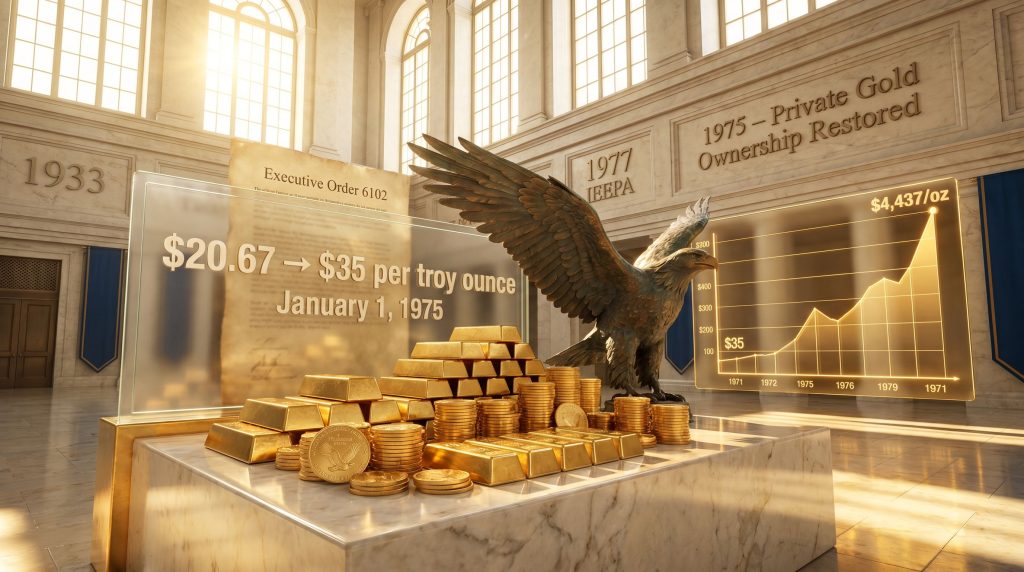
The order did not seize gold without compensation. It compelled a forced exchange at a government-fixed price of $20.67 per troy ounce, the statutory rate then in effect. Every individual, partnership, and corporation within the continental United States was required to deliver gold coins, gold bullion, and gold certificates to a Federal Reserve Bank by May 1, 1933. For a deeper look at Executive Order 6102, Wikipedia provides a thorough overview of its full scope and legal basis.
The Three-Layer Legal Architecture Behind EO 6102
The order rested on a specific and stacked legal foundation, not simply on general presidential authority:
-
The enabling statute: The Trading with the Enemy Act of 1917 had been amended weeks earlier by the Emergency Banking Act of March 1933 to apply to US citizens during a declared national banking emergency, not just foreign adversaries.
-
The executive instrument: EO 6102 itself operationalised the forced exchange, including specific exemptions for rare coins of recognised numismatic value, gold used in industry or the arts, and up to $100 face value in gold coin per individual (approximately five ounces at the then-prevailing rate).
-
Legislative ratification: The Gold Reserve Act of January 1934 formally transferred title of all monetary gold to the US Treasury and revalued it from $20.67 to $35 per troy ounce, a ~69% gain on every ounce the government had acquired through the forced exchange.
The penalties for non-compliance were severe by any standard: civil fines of up to $10,000 (equivalent to roughly $240,000 in 2026 dollars based on Bureau of Labor Statistics CPI data) and up to ten years imprisonment, with gold held in violation subject to forfeiture. In practice, enforcement was uneven and focused primarily on dealers and institutions rather than individual holders.
The Three Preconditions That Made 1933 Legally Possible
Understanding why confiscation worked then requires identifying the specific conditions that enabled it, because those conditions can then be tested against the present environment.
| Precondition | Status in 1933 | Status in 2026 |
|---|---|---|
| Gold standard monetary system | Active, gold was the monetary base | Absent, ended August 1971 |
| Declared national banking emergency | Active, Congress declared it March 1933 | Not declared |
| Enabling legislation granting presidential authority over gold | Active under Trading with the Enemy Act | Replaced by IEEPA (1977) with higher threshold |
The Supreme Court upheld the government's authority in the Gold Clause Cases of 1935, ruling that Congress had the power to abrogate private contracts specifying payment in gold. That ruling reflected a constitutional environment with substantially greater judicial deference to executive emergency powers than modern courts apply. The precedent exists, however, the legal terrain surrounding it has shifted considerably in the ninety years since.
How the Statutory Framework Was Rebuilt: The Road to Restored Ownership
The prohibition on private gold ownership did not last indefinitely, and the timeline of its unwinding is instructive. The end of the gold standard in 1971 fundamentally altered the relationship between government monetary policy and privately held gold.
The Legislative Milestones From 1964 to 1977
-
1964: The Treasury ceased requiring US citizens to surrender gold acquired outside the country, a quiet but meaningful administrative shift.
-
1974: Congress passed Public Law 93-373, ending the 41-year prohibition on private gold ownership entirely.
-
January 1, 1975: Americans legally free to purchase, hold, and sell gold in any form for the first time since 1933.
-
1977: Congress passed the International Emergency Economic Powers Act (IEEPA), restructuring and meaningfully narrowing presidential authority over economic transactions during emergencies.
What the 1977 IEEPA Statute Changed
This is the statutory development that most confiscation discussions overlook entirely, and it is arguably the most important piece of information for a modern gold investor to understand.
Under 50 U.S.C. § 4305 of the IEEPA, as documented by Cornell Law School's Legal Information Institute, the president's authority to regulate or prohibit gold transactions is now conditional on one of two explicit triggers:
-
A Congressional declaration of war, or
-
A formal presidential declaration of national emergency under the National Emergencies Act, which itself carries Congressional oversight authority and the power to terminate a declared emergency.
Additionally, 50 U.S.C. § 4305(b)(2) specifically carves out certain personal transactions from emergency economic restrictions, further narrowing the scope of what any executive order could reach even within a declared emergency.
This represents a materially higher legal bar than the framework FDR operated under in 1933. The banking emergency that underpinned EO 6102 was far less constrained by Congressional oversight mechanisms than a modern national emergency declaration would be.
The Empirical Record: Five Crises, Zero Confiscations
One of the most analytically useful observations about confiscation risk is not speculative. It is empirical. Since private gold ownership was restored in 1975, the United States has passed through five distinct crisis environments that might theoretically have created government motivation to restrict gold, and none produced confiscation.
| Crisis Period | Key Characteristics | Gold Price Range | Confiscation Action |
|---|---|---|---|
| 1970s Stagflation | Double-digit inflation, dollar crisis, oil shock | $35 to $850/oz | None |
| 1980s Savings & Loan Crisis | Approx. 1,000 bank failures, federal bailout | $300 to $500/oz | None |
| 2008 Global Financial Crisis | Systemic bank failures, $700B TARP | $700 to $1,200/oz | None |
| COVID-19 Pandemic (2020-2021) | Largest peacetime monetary expansion in history | $1,500 to $2,075/oz | None |
| 2022-2026 Inflation and Debt Cycle | $2T+ annual deficits, $1T+ annual debt interest | $1,800 to $4,437/oz | None |
The pattern is structurally explained rather than coincidental. When President Nixon ended dollar-gold convertibility in August 1971, the Federal Reserve's mechanism for monetary expansion became electronic credit creation, with no reference to gold reserve ratios. The government no longer needs privately held gold to conduct monetary policy, issue currency, or stabilise the banking system. That fundamental change removed the primary motivation that drove the 1933 action.
Gold has risen from $35 per ounce in 1971 to approximately $4,437 in 2026, a trajectory that reflects the dollar's 96.9% loss of purchasing power since 1913, according to Bureau of Labor Statistics data. That move happened precisely because gold was free to reflect monetary debasement, not because it was inside any government monetary system. Understanding gold in the monetary system helps clarify why this structural shift matters so profoundly for modern investors.
Can the Government Confiscate Gold Again? A Three-Part Assessment
Part 1: The Structural Motivation Has Fundamentally Changed
In a fiat currency architecture, the government acquires no meaningful monetary benefit from seizing privately held gold. Currency issuance, interest rate policy, and banking system stabilisation are all conducted without any reference to gold reserve ratios. The 1933 motivation, expanding the monetary base beyond gold reserve constraints, is categorically absent from the current framework.
Part 2: The Legal Bar Is Materially Higher in 2026
Any restriction on gold transactions under current law requires either a war declaration or a formal national emergency, each of which carries its own substantial political, legal, and constitutional weight. Modern courts operate with significantly less deference to executive emergency powers than the 1935 judiciary that upheld the Gold Clause Cases. Any forced exchange order would face immediate Fifth Amendment Takings Clause challenge in a constitutional environment considerably more resistant to uncompensated property interference than existed ninety years ago.
Part 3: The Political Economy Has Shifted Decisively
In 1933, gold ownership was concentrated among financial institutions and upper-income households, a narrow constituency with limited political leverage in a depression-era emergency. Today, the World Gold Council's consumer research estimates that approximately 10 to 15% of US households hold some form of physical precious metal.
Compelling the surrender of gold from millions of individual American investors, including retirees and savers, would represent a politically extraordinary act with no modern precedent in a functioning democracy. The cost-benefit calculation for any administration is fundamentally different. Furthermore, central bank gold reserves have been expanding significantly, reflecting institutional confidence in gold as a long-term store of value rather than a target for restriction.
Most legal scholars and precious metals analysts who have examined the current statutory framework assess outright confiscation with forced surrender at a government-set price as a low-probability scenario for modern investors. The more plausible risk landscape involves regulatory constraints on gold's liquidity and convertibility, not physical seizure of the asset itself.
The Realistic Regulatory Risk Spectrum
It is important to distinguish between outright confiscation and the more plausible range of regulatory interventions that could affect gold investors in an extreme stress scenario. These are meaningfully different risk profiles. For a comprehensive analysis of US gold confiscation history and modern risk, Birch Gold provides detailed context on how this risk landscape has evolved.
| Risk Scenario | Probability Assessment | Legal Mechanism Required |
|---|---|---|
| Outright confiscation with forced surrender | Low, requires war or national emergency, faces Fifth Amendment challenge | IEEPA declaration plus enabling legislation |
| Expanded IRS transaction reporting requirements | Moderate, incremental expansion of existing 1099-B framework | Ordinary legislation or regulatory rule-making |
| Export restrictions on physical gold | Theoretically possible under emergency trade statutes | Emergency trade authority |
| Capital controls on gold sale proceeds | More plausible in severe dollar crisis than physical seizure | IEEPA emergency declaration |
| Windfall taxation on gold gains | Does not require emergency powers | Ordinary Congressional legislation |
The critical distinction is that the 1933 model required physical surrender of the asset itself. Modern regulatory risk scenarios primarily affect gold's liquidity and convertibility, not the investor's direct ownership of the metal. An investor holding allocated, segregated physical gold faces a categorically different risk profile than the holder of a gold certificate in 1933.
The next major ASX story will hit our subscribers first
How Ownership Structure Intersects With Regulatory Exposure
The form in which gold is held is not a peripheral consideration. It directly determines the legal relationship between the investor and the asset, and therefore the applicable risk framework. In addition, understanding the distinction between physical gold vs ETFs is essential for assessing your actual exposure to any future regulatory action.
-
Gold ETFs and paper gold instruments are financial securities subject to securities regulation. They do not confer direct ownership of physical metal and are most exposed to financial system regulatory changes.
-
Unallocated or pooled vault accounts represent a financial institution's liability rather than direct property ownership, exposing holders to counterparty risk and institutional regulation.
-
Allocated and segregated physical storage confers direct property ownership of specific, identified bars or coins. This is legally distinct from a financial institution liability and most closely resembles outright property ownership under common law.
-
Internationally held allocated gold is subject to the laws of the storage jurisdiction rather than US executive orders, providing geographic diversification of regulatory risk across jurisdictions with strong property rights traditions.
In 1933, virtually all private gold took the form of circulating coins, gold certificates, or vault-held bars already integrated into the financial system. The monetary infrastructure itself tracked and circulated gold, making enforcement logistically straightforward. Modern allocated and segregated ownership exists in a structurally different relationship to both the financial system and any hypothetical executive order.
The numismatic exemption written into EO 6102 is worth noting: coins of recognised collector value were explicitly excluded from the surrender requirement. Whether modern bullion coins or common-date collector coins would qualify under a hypothetical future order is legally uncertain and actively debated among precious metals attorneys. The practical answer depends entirely on the specific language of any future order, which cannot be predicted.
Frequently Asked Questions
Did the US Government Actually Confiscate Gold From Its Own Citizens?
Yes. Executive Order 6102, signed April 5, 1933, required all US persons and entities to deliver gold coins, bullion, and gold certificates to a Federal Reserve Bank by May 1, 1933. Compensation was paid at $20.67 per troy ounce. The Gold Reserve Act of 1934 then revalued that gold to $35 per ounce, generating a approximately 69% gain on every ounce transferred. Private ownership remained illegal until January 1, 1975, when Congress restored it under Public Law 93-373.
What Law Governs the Government's Authority Over Gold Today?
The primary governing statute is the International Emergency Economic Powers Act, 50 U.S.C. § 4305, enacted in 1977. It requires either a Congressional declaration of war or a formal national emergency declaration under the National Emergencies Act before the president can regulate or prohibit gold transactions. This is a meaningfully higher threshold than the banking emergency framework used in 1933.
Is Confiscation Risk a Reason to Avoid Buying Gold?
Most legal and investment analysts who have examined the current framework do not consider it a primary deterrent. The US government has not restricted private gold ownership through any of the five major crises since 1975. The 1977 IEEPA statute raised the legal threshold considerably. An estimated 10 to 15% of US households hold physical precious metals, representing a large and politically engaged constituency. Consequently, the more relevant considerations remain gold's long-term purchasing power preservation, its performance across monetary cycles, and gold as a safe haven against currency debasement.
What Strategies Do Investors Use to Reduce Regulatory Exposure?
-
Hold gold in allocated, segregated storage rather than pooled or unallocated accounts.
-
Diversify storage geographically across multiple jurisdictions with strong property rights traditions.
-
Avoid paper gold instruments that are financial securities rather than direct ownership claims on physical metal.
-
Maintain awareness of the legal distinction between numismatic and bullion coin classifications and the exemption history of each.
No strategy eliminates all regulatory risk in an extreme scenario. The objective is reducing exposure to the most plausible risk vectors while maintaining the core investment thesis.
What the Legal and Historical Record Actually Tells Investors
The 1933 precedent was real, legally sound within its framework, and effective. However, it required three specific structural conditions that are all absent from the current environment: a gold standard monetary system, a declared banking emergency, and enabling legislation explicitly granting presidential authority over gold transactions during that emergency.
The 1977 IEEPA statute replaced the legal architecture FDR used and set a meaningfully higher bar for any future restriction. The empirical record across five major crises since private ownership was restored shows no instance of restriction, a pattern that reflects the changed structural relationship between gold and the modern monetary system.
The realistic risk for a modern gold investor is regulatory, not confiscatory. Transaction reporting expansion, export restrictions, and capital controls on gold's convertibility are more plausible stress scenarios than forced physical surrender at a government-set price. Allocated, segregated physical ownership is legally and structurally distinct from the instruments EO 6102 targeted. Geographic diversification of storage adds a further layer of jurisdictional separation from any single government's emergency powers.
Understanding this distinction, between what happened in 1933, what the law actually permits today, and what the realistic risk spectrum looks like in 2026, is the foundation of a properly informed position on whether the government can confiscate gold again and how to structure ownership accordingly.
This article is intended for informational and educational purposes only. It does not constitute legal or investment advice. Readers should consult a qualified financial adviser and, where relevant, a qualified legal professional before making investment decisions. Past performance is not a guarantee of future results. All investments involve risk, including the possible loss of principal.
Want to Stay Ahead of the Next Major ASX Mineral Discovery?
While understanding gold's legal and regulatory landscape is essential for informed investing, Discovery Alert's proprietary Discovery IQ model delivers real-time alerts on significant ASX mineral discoveries — instantly translating complex data across 30+ commodities into clear, actionable insights for both short-term traders and long-term investors. Explore how historic mineral discoveries have generated substantial returns and begin your 14-day free trial today to position yourself ahead of the broader market.