
June 17, 2026
Why Gold Cycle Positioning Is the Discipline Separating Profitable Traders From Reactive Ones
Most investors approach gold through one of two lenses: macroeconomic fundamentals or conventional technical analysis. They track inflation readings, monitor central bank rhetoric, draw support lines, or follow moving average crossovers. What far fewer investors understand is that gold's price behaviour is governed by a layered architecture of recurring time-based cycles, each nested within the next, each carrying distinct implications for entry timing, exit strategy, and risk calibration. In 2026's complex macro environment, gold cycle positioning has never been more relevant or more misunderstood.
This is not a framework for predicting gold's price to the dollar. It is a probabilistic system, refined over decades, for identifying when the odds favour accumulation, when corrections are likely to find support, and when the broader trend is approaching a phase transition. Understanding that distinction is the first step toward using cycle analysis effectively.
When big ASX news breaks, our subscribers know first
The Structural Case for Gold in 2026: Three Demand Pillars and a Maturing Supercycle
Before examining the mechanics of cycle positioning, it is worth grounding the analysis in the structural forces that define gold's current macro environment. Three demand pillars are converging to sustain elevated price levels even through short-term volatility.
The first is central bank gold demand, which has seen global central banks as net buyers for consecutive years, driven by a strategic desire to diversify reserve assets away from US dollar exposure. The second is ETF inflow acceleration, reflecting institutional and retail investors repositioning toward hard assets amid persistent uncertainty about real interest rates and currency purchasing power. The third is tightening physical supply, where the economics of new mine discovery constrain the rate at which new ounces can enter the market.
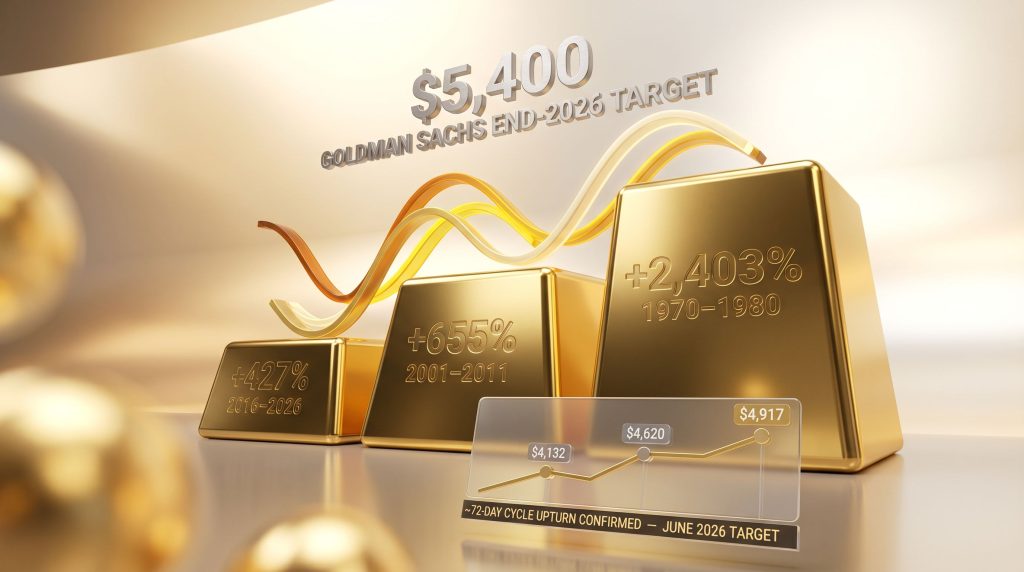
Gold price forecasts from Goldman Sachs include an end-2026 target of $5,400, which has become a widely cited institutional benchmark. Against the backdrop of gold's approximate +427% rise from its 2016 base, that target is ambitious but not disconnected from historical precedent. The current supercycle, which cycle analysts broadly date from 2016, is now roughly a decade old, placing it in a phase of late-cycle maturity where parabolic price behaviour and heightened volatility coexist with genuine structural demand.
The central challenge for gold investors in 2026 is not whether to hold the metal. It is understanding when to accumulate within a complex nested cycle structure, how to interpret corrections without being shaken out of positions, and when emerging rotation signals warrant a reduction in exposure.
How Gold's Historical Supercycles Inform the Current Positioning Framework
Gold has completed two clearly defined supercycles in the modern era, and understanding their anatomy provides essential context for interpreting the current one.
| Supercycle Period | Approximate Duration | Estimated Price Gain | Primary Demand Driver |
|---|---|---|---|
| 1970–1980 | ~10 years | +2,403% | Stagflation, USD debasement |
| 2001–2011 | ~10 years | +655% | Emerging market growth, Global Financial Crisis |
| 2016–Present | ~10 years (ongoing) | +427% to date | Central bank buying, geopolitical risk, Fed policy uncertainty |
Each supercycle shares recognisable structural characteristics: an initial accumulation phase where gold rises steadily against a backdrop of scepticism, a mid-cycle acceleration as institutional capital rotates in, and a terminal phase defined by parabolic price behaviour, elevated volatility, and ultimately a major cycle peak. Critically, in both the 1970s and 2000s cycles, the most explosive price gains occurred in the final two years, not the opening stages.
What Separates the Current Supercycle From Its Predecessors
One important distinction of the 2016-present cycle is that gold's rally has unfolded largely independently of a broader commodity supercycle. The forces driving gold — including gold safe-haven appeal, geopolitical risk premiums, and monetary policy uncertainty — are fundamentally different in character from those driving industrial metal demand. Furthermore, gold's supply growth is structurally constrained in ways that industrial metals are not, given that high-grade gold deposits cannot simply be scaled with additional capital investment in the way copper deposits can.
Distinguishing a Late-Cycle Correction From a Cycle Top
The most dangerous mistake in a mature gold bull market is misidentifying a cyclical correction as a terminal peak. Late-cycle gold markets are characterised by momentum-driven retail participation, institutional repositioning, and sharp options-expiry volatility. These features generate corrections that can feel alarming but are often structurally consistent with cycle continuation. A genuine cycle top, by contrast, is typically marked by deteriorating institutional flows, a sustained breakdown below major cycle support levels, and confirming signals from longer-duration cycles.
The Architecture of Gold's Nested Cycle Structure
The methodology that underlies sophisticated gold cycle positioning draws on principles developed by J.M. Hurst, whose work on cyclic price analysis established the conceptual foundation that many practitioners have since refined and extended. The core insight is that markets are governed by multiple overlapping cycles of different durations, and shorter cycles operate within the directional context of longer ones. According to StoneX research on gold cycles, misreading a short-cycle trough as a trend reversal is consistently identified as one of the most costly errors in gold trading.
The analytical framework relevant to gold in mid-2026 centres on three nested cycles: a short-term wave of approximately 10 days, an intermediate wave of approximately 34 days, and a dominant medium-term cycle of approximately 72 days. Each layer performs a distinct function in the positioning framework.
The 10-Day Cycle: Precision Timing for Near-Term Entry Windows
The shortest tracked cycle serves as a fine-grained timing tool for identifying entry and exit points within an established trend. It does not define the direction of that trend; it identifies the tactical windows within it. A confirmed trough in the 10-day cycle, occurring within an upward-trending intermediate cycle, represents a potential accumulation zone rather than an exit signal.
Based on cycle analysis published on Gold-Eagle.com, the late-March 2026 trough near $4,132 (June 2026 contract) established the baseline for the current upward sequence across multiple cycle layers. The subsequent analysis identified the April 23 to 27, 2026 window as the projected timing range for the next 10-day cycle trough. A countertrend dip that holds above approximately $4,620 (June 2026 contract) is considered structurally constructive. A sustained break below that level would alter the near-term outlook meaningfully.
The anticipated recovery from the 10-day trough targets a return toward or above the prior swing high of approximately $4,917, which would confirm the short-cycle upturn and position gold for the next intermediate-cycle peak.
Tactical Note: Within a bullish intermediate trend, 10-day cycle troughs are potential accumulation windows for disciplined traders, not signals to reduce exposure.
The 34-Day Cycle: The Engine Driving the Current Rally Phase
The 34-day intermediate cycle is the primary directional driver of the rally that followed the early-April 2026 low. A confirmed low in this cycle carries a minimum price expectation of a recovery to the 34-day moving average, a threshold that was met and exceeded in the weeks following the April trough.
Detrend indicators — cycle-specific tools that measure where a given wave sits within its phase — are particularly useful for identifying likely trough formations but carry known limitations in projecting exact peaks. The current signal from the 34-day detrend suggests this cycle is approaching a top, though the broader trend remains upward. The anticipated sequence is a short-cycle correction, followed by recovery toward new highs, then a 34-day cycle peak and countertrend correction, before a renewed advance extending into mid-June 2026.
The 72-Day Cycle: The Macro Directional Anchor for Mid-2026
The 72-day cycle functions as the overarching directional framework within which all shorter cycles operate. In late March 2026, the cycle's oversold indicator dropped below its lower reference band, a signal that cycle analysts have historically associated with proximity to a major trough. The subsequent price action confirmed an upturn in this dominant cycle.
The current upward phase of the 72-day cycle is projected to extend into early-to-mid June 2026. The next trough is anticipated around mid-July 2026, though with meaningful variance in either direction. Consequently, while the 72-day cycle remains in its upward phase, intermediate and short-cycle corrections should be treated as tactical opportunities rather than structural trend reversals.
Key Price Levels and Timing Windows Across the Three Cycle Layers
| Cycle Layer | Key Support Level | Key Target / Resistance | Projected Timing |
|---|---|---|---|
| Short-Term (~10 days) | ~$4,620 (June 2026 contract) | ~$4,917+ (prior swing high) | Late April to Early May 2026 |
| Intermediate (~34 days) | ~$4,132 (March 2026 trough) | 34-day MA and above | Through May 2026 |
| Medium-Term (~72 days) | Late March 2026 low | Cycle peak target | Early-to-mid June 2026 |
| Next 72-Day Trough | N/A | N/A | ~Mid-July 2026 (with variance) |
Interpreting Pullbacks in a Late-Cycle Environment
Corrections in the $4,400 to $4,700 range from recent highs near the $5,100 to $5,600 zone should be understood as structurally consistent with late-cycle intermediate corrections rather than trend-ending events. A well-understood dynamic in mature gold bull markets is what practitioners sometimes call the weak-hand flush: corrections driven by options expiry, margin pressure, and sentiment deterioration tend to accelerate short-term selling precisely when institutional capital is quietly building positions.
The conditions under which a pullback would shift from a buying opportunity to a warning signal are specific: a sustained breakdown below key cycle support levels combined with deteriorating volume, weakening institutional flows, and confirming signals from the 72-day cycle. Absent those confirming factors, corrections remain within the expected anatomy of a continuing bull market. However, reviewing current gold market analysis underscores that even bullish targets require careful monitoring of momentum conditions.
Capital Rotation Dynamics and Positioning Frameworks for Different Investors
Late-cycle gold markets eventually trigger a capital rotation dynamic as investors begin seeking higher-beta opportunities. In historical supercycles, this rotation has moved toward equities, high-risk assets, and alternative stores of value as the gold cycle approaches its terminal phase. In 2026, early rotation signals include Bitcoin's recovery toward the $80,000 to $90,000 range as a risk-on indicator, broader equity market stabilisation, and declining real yield dynamics.
One tactical signal that cycle-aware traders monitor is the 9/21 exponential moving average crossover on the BTC/Gold ratio. When the 9-period EMA crosses above the 21-period EMA on this ratio, it has historically been associated with periods of Bitcoin outperformance relative to gold, signalling a relative shift in speculative capital flows.
Different investor profiles require meaningfully different approaches to late-cycle positioning:
| Investor Profile | Recommended Approach | Key Risk to Monitor |
|---|---|---|
| Long-Term Accumulator | Use cycle troughs as staged entry points; maintain core position | Cycle top misidentification |
| Tactical Trader | Trade short and intermediate cycle swings with defined stop levels | Whipsaw during volatile cycle transitions |
| Portfolio Allocator | Gradually reduce gold weighting as the 72-day cycle approaches its peak | Premature rotation before cycle exhaustion |
| Producer Equity Investor | Focus on producers with 15 to 20+ year mine life and high reserve quality | Operational leverage amplifies both gains and losses |
The Role of Gold Mining Equities in Late-Cycle Positioning
Gold miners' leverage offers a compelling dynamic that attracts investors seeking amplified exposure to rising gold prices. Producers typically outperform the metal itself during strong upswings but carry greater downside risk near cycle peaks. For investors pursuing supercycle exposure through equities, the quality filters that matter most in a late-cycle environment are long mine life, high reserve grade, balance sheet strength, and jurisdictional stability.
These characteristics provide resilience through the inevitable corrections that accompany late-cycle volatility. For Australian-based investors, major ASX-listed resource companies offer the additional advantages of liquidity and regulatory transparency within a well-governed market framework. Furthermore, the gold-silver ratio analysis can provide additional confirmation signals when assessing relative value between precious metals during late-cycle rotations.
The next major ASX story will hit our subscribers first
Three Scenarios for Gold Through Mid-2026
Scenario 1: Base Case (Cycle Continuation)
- The 10-day cycle trough forms in the April 23 to 27 window, holding above ~$4,620
- Recovery to or above the ~$4,917 prior swing high by early May 2026
- The 34-day cycle peaks in May, followed by a countertrend correction
- The 72-day cycle remains dominant into early-to-mid June, with prices testing the $5,000 to $5,500 range
- The next major trough forms around mid-July 2026
Scenario 2: Accelerated Bull Case
- The short-cycle correction is shallow; gold reclaims highs rapidly
- The 34-day cycle peak extends toward the $5,400 to $5,600 range
- The 72-day cycle top is delayed into late June, compressing the correction window
- Longer-duration cycle models project a potential peak in the $5,500 to $6,500 range in more aggressive scenarios
Scenario 3: Bearish Cycle Failure
- The short-cycle trough breaks below ~$4,620, signalling a more aggressive intermediate correction
- The 34-day cycle fails to achieve new highs, raising the probability of an early 72-day cycle top
- Capital rotation accelerates toward equities and Bitcoin
- Gold enters a consolidation phase extending through Q3 2026
Risk Disclosure: Cycle analysis provides probabilistic frameworks, not certainties. All price targets and timing windows carry inherent variance. No positioning decision should be made without defined risk management parameters, and this article does not constitute financial advice.
Frequently Asked Questions: Gold Cycle Positioning in 2026
What exactly is a gold price cycle?
Price cycles in gold are recurring, time-based patterns in the metal's price behaviour, driven by the interaction of supply, demand, sentiment, and macro forces. Cycle analysts identify these patterns using detrend indicators, moving averages, and spectral analysis methods, rooted in mathematical frameworks developed by market cycle theorists including J.M. Hurst, whose foundational work continues to influence practitioners decades after its publication.
How reliable are short-term cycle projections?
Short-cycle projections at the 10-day level carry higher variance than intermediate or dominant cycle analysis. Timing windows such as April 23 to 27 represent probability zones, not fixed dates. Actual troughs may form within a plus-or-minus variance range. The analytical value of the 10-day cycle is not precision prediction but rather the identification of likely inflection zones that can inform tactical gold cycle positioning within a well-understood longer-cycle trend.
Is gold still viable as an investment after a +427% rise?
The historical precedent from prior supercycles suggests yes, with an important caveat about positioning strategy. The 1970s supercycle delivered its most explosive gains in its final two to three years. Late-cycle gold markets can still generate significant returns; however, the approach must change: accumulation on cycle dips, tighter risk management, and continuous monitoring of rotation signals become more critical as the cycle matures.
What does the mid-July 2026 trough mean for long-term investors?
The projected mid-July 72-day cycle trough represents a potential high-conviction accumulation window for long-term holders, assuming the broader supercycle remains intact. The quality of the price recovery from that trough will provide important information about whether the supercycle retains further upside or has entered a terminal distribution phase. That signal is worth monitoring carefully.
Key Takeaways for Navigating Gold Cycle Positioning Through Mid-2026
-
Gold's nested cycle structure spanning approximately 10, 34, and 72-day waves provides a systematic framework for identifying tactical zones within the broader supercycle trend
-
The late-March 2026 trough near $4,132 confirmed upturn signals across the two dominant intermediate cycles, establishing a bullish directional bias through at least early-to-mid June 2026
-
Short-term corrections in the 10-day cycle should be interpreted as accumulation opportunities within the dominant uptrend, provided key support levels around $4,620 hold
-
The next major medium-term trough is projected around mid-July 2026, representing a potential high-conviction entry window for disciplined long-term investors
-
Late-cycle positioning demands heightened awareness of capital rotation dynamics, particularly toward equities and Bitcoin, as the supercycle approaches its terminal phase
-
Institutional price targets cluster in the $5,000 to $5,400 range for end-2026, while more aggressive cycle models project potential peaks in the $5,500 to $6,500 range
-
Risk management, defined support thresholds, and scenario awareness are non-negotiable components of any gold cycle positioning strategy at this stage of the supercycle
Readers interested in deepening their understanding of gold cycle analysis and price forecasting methodology can explore additional perspectives at Gold-Eagle.com, which regularly publishes independent cycle-based market analysis from experienced practitioners.
Want To Catch the Next Major ASX Mineral Discovery at the Right Moment?
Discovery Alert's proprietary Discovery IQ model delivers real-time alerts on significant ASX mineral discoveries, translating complex geological and market data into actionable insights for both short-term traders and long-term investors — precisely the kind of edge that matters when cycle timing is everything. Explore how historic discoveries have generated extraordinary returns on Discovery Alert's dedicated discoveries page, and begin your 14-day free trial today to position yourself ahead of the broader market.