
August 6, 2026
Physical Gold Markets at a Crossroads: Reading the Signals From Asia's Two Biggest Buyers
The mechanics of physical gold pricing across Asia reveal something that headline spot prices rarely capture: the true temperature of demand. When dealers in Mumbai widen their discounts to move inventory, or when buyers in Shanghai pay a premium above international benchmarks to secure immediate delivery, these micro-level signals collectively tell a more honest story about supply-demand dynamics than any single price chart. Right now, those signals are pointing in notably different directions across the continent's two largest gold-consuming economies.
Understanding why India gold demand ticks up as prices slip while China premiums ease requires looking beyond the weekly data and into the structural architecture of each market. Import duty regimes, sovereign buying behaviour, consumer price thresholds, and ETF flows each play a distinct role in shaping how physical gold moves, and to whom.
When big ASX news breaks, our subscribers know first
Why Physical Premiums and Discounts Are the Gold Market's Most Reliable Indicators
Before examining country-specific dynamics, it is worth understanding what dealer premiums and discounts actually measure. In a well-functioning physical gold market, the local price of gold reflects the international benchmark adjusted for import costs, currency conversion, local taxes, and dealer margins. When buyers are abundant relative to available supply, dealers can charge above this theoretical floor, producing a premium. When supply outpaces demand, dealers must offer discounts to clear inventory.
This mechanism makes regional premiums and discounts a real-time sentiment gauge that is structurally harder to manipulate than futures positioning or ETF flow data. The premium or discount is, quite simply, the price at which physical metal actually changes hands.
Dealer pricing spreads are one of the few transparent windows into physical demand conditions in markets where retail transaction data is fragmented, delayed, or unavailable. A rapidly narrowing discount is frequently an earlier signal of demand recovery than formal import statistics.
India and China between them have historically accounted for a substantial portion of global consumer gold demand, particularly across the jewellery and bar-and-coin investment categories. Furthermore, their respective premium and discount structures are disproportionately important to anyone tracking the gold market outlook globally.
India's Demand Uptick: Price Correction as the Catalyst
The Mechanics of Indian Jewellery Demand Elasticity
India's gold market is famously price-sensitive. The country's jewellery buyers, who represent the majority of physical gold consumption, have a well-documented tendency to retreat when prices surge and re-engage when corrections materialise. This behaviour is not irrational; it reflects a deeply practical orientation toward gold as a safe haven purchased at opportune moments rather than a speculative instrument chased on momentum.
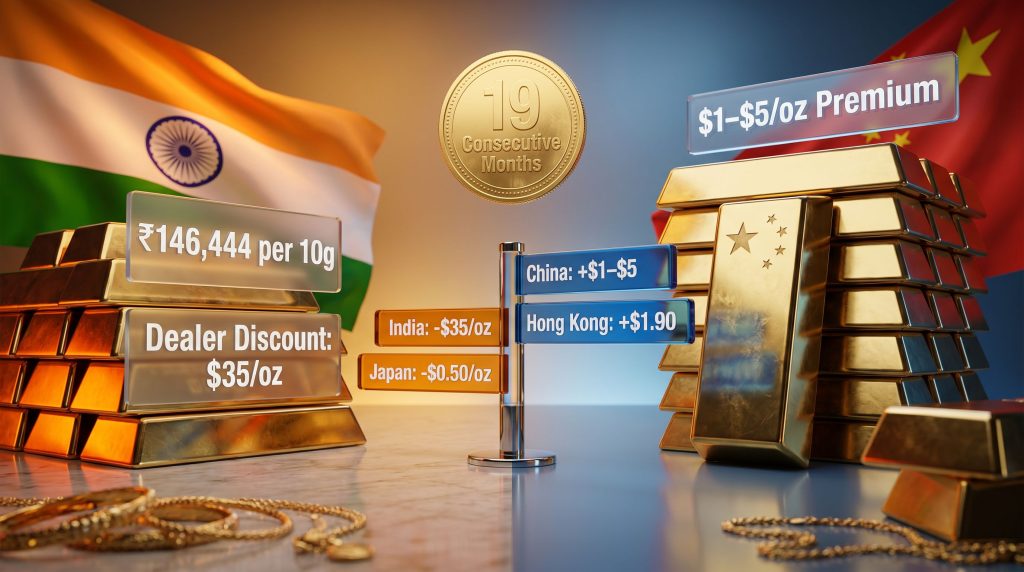
During the week ending mid-June 2026, domestic gold prices in India fell to their lowest level since early April, reaching ₹146,444 per 10 grams, representing a weekly decline of approximately 1.5%. This correction was enough to bring price-sensitive jewellery buyers back to the counter, consistent with the historical elasticity patterns that characterise Indian retail gold demand.
The market evidence for this re-engagement was visible in dealer pricing. Discounts offered by bullion dealers over official domestic prices narrowed sharply, from as wide as $87 per ounce the prior week to a maximum of $35 per ounce. Given that official domestic prices already incorporate a 15% import duty and 3% goods and services tax, these discounts represent a significant additional markdown that dealers use to attract buyers when demand is sluggish.
The halving of dealer discounts within a single week is a meaningful demand signal, but the persistence of discounts above zero confirms that the market has not yet reached equilibrium. Demand has improved but not fully recovered.
According to Reuters reporting on Asia gold markets, price volatility has been a persistent factor keeping Indian demand subdued even as China premiums ease, underlining the nuanced picture emerging across the region.
Restocking Without Conviction: The Cautious Jeweller Dynamic
The improved conditions should not be mistaken for a broad-based demand recovery. Industry participants described jeweller restocking behaviour as measured and selective rather than confident and aggressive. Retail demand confidence for the months ahead remained subdued, with no clear structural catalyst identified to drive a sustained volume recovery in the near term.
This distinction between tactical price-reaction buying and fundamental demand recovery is critical for interpreting the data correctly. The former is driven purely by price opportunity and tends to fade once the discount window closes. The latter requires consumer confidence, income growth, favourable credit conditions, or upcoming cultural demand events such as wedding and festival seasons to sustain momentum.
The current environment in India most closely resembles the former: a floor being established through price-sensitive buying rather than a ceiling being broken through structural demand acceleration.
How India's Import Tariff Restructuring Reshaped the Market
The Structural Impact of Raising Duties From 6% to 15%
The proximate cause of India's current demand suppression is well understood. The country raised import tariffs on gold and silver from 6% to 15%, a move aimed at reducing pressure on foreign exchange reserves in the context of elevated oil import costs. The near-tripling of the duty rate had an immediate and significant effect on the domestic price of gold relative to international benchmarks, effectively creating a structural affordability gap for price-sensitive consumers.
The arithmetic is stark. At a spot gold price of approximately $4,000 per ounce, the duty increase alone adds the equivalent of roughly $360 per ounce to the landed cost before any retail margin or sales tax is applied. Combined with the 3% goods and services tax, Indian consumers now pay a structurally elevated premium over global prices that compresses affordability across the income spectrum.
ETF Outflows as a Window Into Investor Behaviour
India's physically backed gold exchange-traded funds recorded their first net monthly outflow in more than 12 months during May 2026. The trigger was profit-taking activity by investors who had accumulated positions at lower price levels before the duty-driven price surge. Notably, this divergence between physical gold vs ETFs behaviour highlights how different buyer profiles respond to the same price environment in fundamentally different ways.
This development is analytically interesting precisely because it coincides with the partial recovery in jewellery demand. The two trends are not contradictory; they reflect fundamentally different buyer profiles responding to the same price environment in opposite ways.
- ETF investors entered at lower prices, observed sharp gains following the duty announcement, and acted rationally by locking in profits.
- Jewellery buyers saw the same price environment as expensive and retreated, only re-engaging once a correction materialised.
- The divergence illustrates the segmented nature of gold demand: investment-oriented and consumption-oriented buyers are not interchangeable, and their flows should not be aggregated into a single directional narrative.
India Demand Scorecard: Q1 2026 vs. Current Conditions
| Metric | Q1 2026 | Current (June 2026) |
|---|---|---|
| Total Gold Demand (YoY Change) | +10% to approximately 151 tonnes | Modest uptick; trend uncertain |
| Primary Demand Driver | Investment demand | Jewellery price-reaction buying |
| Domestic Price Environment | Record highs post-duty hike | Partial correction underway |
| ETF Flow Direction | Net inflows sustained | First net outflow in 12+ months |
| Dealer Discount Range | Not publicly disclosed | Up to $35/oz below official price |
| Consumer Confidence | Moderate | Subdued |
What China's Cooling Premiums Actually Signal
Deconstructing the Premium Compression
Chinese bullion premiums over the international benchmark contracted meaningfully, falling from a range of $7 to $10 per ounce the prior week to a range of $1 to $5 per ounce. For context, positive premiums in China reflect the willingness of buyers to pay above the global spot price for physical gold delivered domestically, which is a direct expression of physical demand strength relative to locally available supply.
The compression of premiums does not indicate demand collapse. It indicates a reduction in the urgency of physical buying, possibly reflecting some degree of inventory build-up from the prior weeks of stronger purchasing, or a short-term pause as the market digests the global price move.
The $4,000 per ounce level on spot gold emerged as a psychologically significant support zone during this period. Spot gold touched an intraday low of $4,022.29 before recovering, placing the market on course for a weekly loss. Peter Fung, Head of Dealing at Wing Fung Precious Metals, observed that the $4,000 mark was functioning as a credible support level that was generating fresh buying interest from physical participants. This type of price-floor behaviour, where buyers activate at a recognised psychological threshold, is a recurring feature of physical Asian gold markets and distinguishes them from purely paper-driven market dynamics.
The People's Bank of China: 19 Months of Unbroken Accumulation
Beneath the week-to-week premium movements sits a far more consequential structural dynamic. The People's Bank of China extended its gold reserve accumulation programme to 19 consecutive months as of May 2026. This is not tactical buying; it represents a deliberate multi-year programme of reserve diversification that operates independently of retail market conditions.
The significance of this sustained central bank gold demand cannot be overstated:
- Scale insulation: Sovereign-level buying absorbs a meaningful portion of available gold supply regardless of retail demand conditions.
- Price floor support: Consistent institutional demand at any price level provides a structural backstop that limits downside.
- Signal effect: Prolonged central bank accumulation by a major economy functions as a global credibility endorsement for gold as a reserve asset, reinforcing demand from other central banks and institutional investors.
China's programme is part of a broader global trend. Multiple central banks across emerging markets and developing economies have increased their central bank gold reserves over the past several years, partly as a hedge against dollar-denominated asset concentration risk.
The Asian Premium Map: Reading Regional Gold Flows
A Snapshot of Regional Pricing Structures
The variation in premiums and discounts across Asian trading hubs encodes valuable information about the direction of physical gold flows across the region.
| Market | Premium/Discount vs. Global Benchmark |
|---|---|
| China (Mainland) | +$1 to +$5 per ounce |
| Hong Kong | Par to +$1.90 per ounce |
| Singapore | -$0.50 to +$2.00 per ounce |
| Japan | -$0.50 per ounce (discount) |
| India | Up to -$35 per ounce (dealer discount) |
Markets trading at a persistent premium attract physical supply from lower-premium or discount markets. This arbitrage mechanism means gold physically flows from Japan, Singapore, and India toward China, following the premium gradient.
What These Differentials Reveal About Terminal Demand
Several structural observations emerge from this regional pricing map:
-
China's persistent premium, even when compressed, confirms its status as the dominant terminal demand market in Asia. Gold flows toward China because buyers there are consistently willing to pay above global benchmarks for immediate physical delivery.
-
India's deep dealer discounts reflect the artificial demand suppression created by elevated import duties. The 15% tariff rate creates a price wedge that reduces the country's ability to function as a natural outlet for globally priced physical gold.
-
Singapore's near-neutral position is consistent with its role as a regional entrepot and re-export hub. It neither generates sustained terminal demand nor absorbs gold at premiums, instead serving as a transshipment and price discovery node.
-
Japan's discount reflects a mature market where domestic supply from recycling and investor liquidation exceeds immediate buying demand, creating the opposite condition to China.
The next major ASX story will hit our subscribers first
Three Structural Factors That Will Determine India's Demand Trajectory
The current uptick in Indian gold demand is real but fragile. Whether it consolidates into a sustained recovery depends on three variables that will interact over the coming months. As The Hindu Business Line reports, India gold demand ticks up as prices slip, yet the broader trajectory remains contingent on policy, price, and seasonal factors aligning simultaneously.
1. Domestic price trajectory
A continued correction in domestic gold prices toward the ₹140,000 to ₹143,000 per 10 gram range would likely accelerate jewellery restocking and bring a broader base of price-sensitive buyers back to the market. Conversely, any renewed price surge driven by global momentum or a weaker rupee could reinstate demand suppression conditions.
2. Import duty policy stability
The 15% tariff rate is the single most significant structural constraint on Indian gold demand. Any reduction or restructuring of this rate would function as an immediate demand catalyst. Traders and importers are watching policy signals closely, as even the expectation of a duty reduction can shift forward-buying behaviour.
3. Festival and wedding season demand cycles
India's gold demand is not evenly distributed across the calendar. The Diwali and Dhanteras festival period, along with the wedding season, historically generates concentrated demand spikes that can meaningfully influence annual totals. The true test of whether the current price-correction buying represents a genuine demand floor will come when these seasonal catalysts activate.
Frequently Asked Questions
Why did India's dealer discounts narrow so sharply in a single week?
The sharp narrowing from $87 to $35 per ounce reflected the demand response to lower domestic prices. As prices fell, jewellery buyers who had been waiting on the sidelines re-entered the market, absorbing inventory that dealers had been carrying at elevated discount levels. Reduced inventory pressure naturally compressed the discount being offered.
Does a positive gold premium in China always indicate strong demand?
A positive premium confirms that physical buyers are willing to pay above the international spot price for locally delivered gold, which is a direct demand signal. However, the level of the premium matters. A compression from $7–$10 to $1–$5 signals cooling near-term urgency even while the positive sign confirms that net demand absorption continues.
How does India's import duty structure affect global gold flows?
By creating a large artificial price wedge between Indian domestic prices and global benchmarks, the 15% duty effectively reduces India's pull on global physical supply. This redirects gold that might otherwise flow to India toward premium-paying markets like China, consequently reshaping global physical flow patterns in a meaningful way.
What does 19 months of consecutive PBOC gold buying mean for the market?
It signals a strategic, multi-year reserve diversification commitment rather than opportunistic tactical buying. For the broader gold market, sustained central bank demand of this duration and scale provides a structural demand floor that is relatively insensitive to short-term price movements, making it a qualitatively different demand type from retail or investment flows.
Is there a risk that India's demand recovery reverses quickly?
Yes. Because the current uptick is driven primarily by price-correction buying rather than a structural improvement in consumer confidence or purchasing power, it is vulnerable to reversal. Any renewed price appreciation, further currency depreciation, or continuation of weak consumer sentiment could quickly restore the demand suppression conditions seen in preceding weeks. In essence, while India gold demand ticks up as prices slip, the sustainability of this trend remains an open question.
This article is intended for informational purposes only and does not constitute financial or investment advice. Gold market conditions can change rapidly, and past demand patterns are not necessarily indicative of future behaviour. Readers should consult qualified financial advisers before making any investment decisions.
Want to Stay Ahead of the Next Major ASX Mineral Discovery?
Discovery Alert's proprietary Discovery IQ model delivers real-time alerts the moment significant mineral discoveries hit the ASX, transforming complex data across more than 30 commodities into clear, actionable insights for both short-term traders and long-term investors — explore historic discoveries and their remarkable returns to understand what's possible, then begin your 14-day free trial to secure your market-leading edge.