July 23, 2026
The Industrial Reality Behind Gold's Most Misunderstood Intermediate Product
Most people picture gold in one of two forms: raw ore pulled from the earth, or gleaming bars stacked in a vault. The reality of large-scale gold production sits somewhere between these two images, and understanding what are gold doré bars is essential for anyone serious about the gold supply chain, precious metals investing, or the mechanics of how mine-to-market gold actually flows. That intermediate stage has a name: the doré bar. Knowing how they behave chemically and why they occupy a distinct commercial category separates informed market participants from those vulnerable to costly misconceptions.
When big ASX news breaks, our subscribers know first
Three Stages, One Supply Chain: Where Doré Enters the Picture
The journey from underground ore body to a finished investment-grade bar is not a single-step process. It unfolds across three broadly defined phases, each serving a distinct logistical and metallurgical purpose.
- Stage one involves ore extraction and initial concentration, where gold-bearing rock is separated from waste material through crushing, milling, and flotation or leaching processes.
- Stage two is the doré production stage, in which the recovered precious metal concentrate is smelted at the mine site into an intermediate alloy bar.
- Stage three is refinery processing, where the doré is melted, assayed, chemically separated, and purified into a finished, certified product meeting international fineness standards.
Doré exists because it is economically and logistically impractical to ship bulk ore across long distances. By smelting the precious metal content into a dense, consolidated bar at or near the mine, operators dramatically reduce the volume and mass that must be transported, insured, and secured. A single doré bar represents the concentrated metallic value of many tonnes of processed ore.
What Are Gold Doré Bars? Composition, Chemistry, and Appearance
Understanding what are gold doré bars requires moving beyond the misleading phrase commonly attached to them. Doré is frequently described as semi-pure gold, but this label carries no official fineness classification whatsoever. No international body has established a minimum or maximum gold content that a doré bar must contain. The term describes a production stage, not a purity benchmark.
The Variable Composition of Doré: Why No Two Bars Are Identical
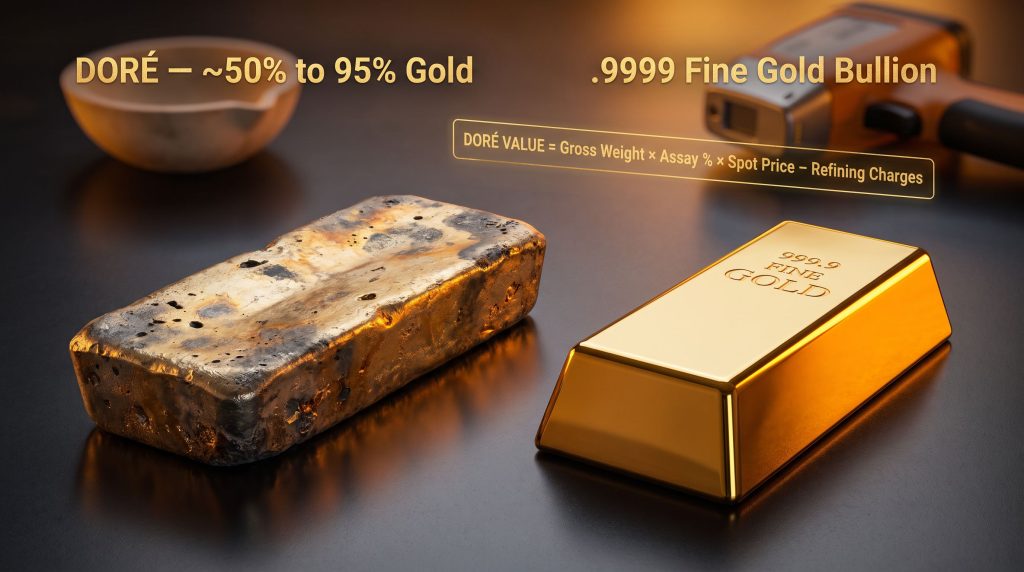
At its core, a doré bar is a variable precious metal alloy. Its primary components are gold and silver, with residual quantities of copper, zinc, lead, and other base metals remaining from the smelting process. According to gold doré industry sources, reported gold content across the industry typically ranges from approximately 50% to 95%, though this spread reflects the enormous diversity of ore deposit geology rather than any inconsistency in production technique.
Several geological factors directly determine where a given mine's doré falls within that range:
- Deposit mineralogy: High-grade epithermal gold deposits tend to produce doré with higher gold-to-silver ratios, while sediment-hosted or polymetallic deposits often yield bars with significantly more silver and base metal content.
- Ore body location and depth: Supergene-enriched shallow ore zones can behave differently from hypogene primary sulphide zones deeper in the same deposit, altering the recoverable metal mix.
- Smelting and recovery methodology: The mine's chosen processing circuit, including the type of leaching applied, the efficiency of the carbon-in-pulp or Merrill-Crowe recovery systems, and the smelting temperature regime, all influence how much base metal contamination remains in the final pour.
Silver deserves particular attention here. In many doré bars, silver is not merely a trace impurity but a commercially significant secondary metal. Mines producing ore from silver-rich geological settings may pour doré that contains as much silver by mass as gold, making the silver recovery at the refinery a meaningful revenue stream in its own right.
What a Freshly Poured Doré Bar Actually Looks Like
The visual characteristics of a doré bar often surprise those accustomed to the mirror-like surfaces of finished bullion. Freshly poured doré typically displays:
- Rough, uneven edges caused by molten metal contracting at different rates as it cools in the mould
- Surface oxidation marks, colour variations, and patches of grey, black, or bronze discolouration from base metal content
- Depressions, voids, or slag inclusions trapped during the pouring process
- Simple batch numbers or mine identifiers stamped or scratched into the surface
Critically, none of these visual features reveal anything meaningful about the bar's gold content. A bar with a relatively bright, golden surface could contain 55% gold, while a darker, more oxidised bar from a different deposit might assay at 90% or higher. Visual inspection is not a valuation tool.
How Gold Doré Bars Are Produced: The Smelting and Pouring Process
Step-by-Step: From Ore Processing to Doré Pour
- Ore extraction and concentration — Gold-bearing material is mined and separated from barren waste rock through crushing, milling, and hydrometallurgical or gravity-based concentration methods.
- Smelting — The precious metal-rich concentrate or loaded carbon is subjected to high-temperature smelting, melting the metallic content into a liquid alloy while slag and remaining impurities are separated off.
- Mould pouring — The molten gold-silver alloy is cast into bar-shaped moulds, typically made from cast iron or graphite.
- Cooling and solidification — As the bar solidifies, uneven thermal contraction and residual gas release create the characteristic rough surface texture associated with doré.
- Mine-site storage and transport preparation — Completed bars are weighed, batch-marked, logged, and consolidated for secure shipment to a licensed refinery under appropriate customs and export documentation.
This consolidation step is where doré delivers its primary logistical value. Shipping a compact, dense metal bar is categorically more efficient, cheaper to insure, and far easier to secure than transporting equivalent precious metal content as bulk ore or concentrate slurry.
From Doré to Investment-Grade Bullion: The Refinery Process
The Refinery Intake Process: Why Re-melting Is Non-Negotiable
When a doré bar arrives at a refinery, it cannot simply be surface-tested and priced. The internal composition of a doré bar is not homogeneous. Metals of different densities and melting points can segregate during the original pour and cooling process, meaning a surface scraping or edge sample may not represent the average metal content of the entire bar.
Furthermore, this is why refineries re-melt all incoming doré and blend multiple bars together before drawing representative samples for laboratory assay. Skipping this homogenisation step would introduce significant valuation error.
Assaying Methods Used to Determine Gold and Silver Content
| Assay Method | Application | Precision Level |
|---|---|---|
| X-Ray Fluorescence (XRF) | Initial screening and surface composition analysis | Moderate — used for rapid preliminary estimates |
| Fire Assay | Definitive precious metal content determination | High — industry gold standard for gold/silver quantification |
| Inductively Coupled Plasma (ICP) | Trace element and base metal analysis | Very High — used for detailed impurity profiling |
Fire assay remains the definitive technique for precious metal quantification because it physically separates gold and silver from the sample matrix, producing a bead of pure metal that can be weighed with exceptional precision. XRF provides a fast initial read but can be influenced by surface contamination and is not considered sufficient for final commercial settlement. ICP analysis adds depth by mapping trace element concentrations, which matters to refineries assessing the complexity and cost of the subsequent separation process.
Metal Separation, Recovery, and Finished Output
Once assayed, the refinery applies chemical or electrochemical processes to isolate gold from silver and base metals. The separated silver is not discarded. Depending on volume and commercial terms, it is refined and sold as silver bars, grain, industrial feedstock, or coin blanks. Base metals recovered from the waste stream are managed according to the refinery's environmental and operational protocols.
The finished gold output must meet internationally recognised fineness thresholds before it can enter the institutional or retail market:
- LBMA Good Delivery bars: minimum fineness of 995 parts per thousand (99.5%), with required markings including refiner's brand, serial number, year of manufacture, declared fineness, and gross weight.
- Retail investment bars and coins: typically refined to .999 (99.9%) or .9999 (99.99%) fineness, depending on the product and producing mint.
The LBMA and COMEX markets both rely on this standardised refinery output as the foundation for institutional trading and settlement. Without verified fineness certification, doré bars cannot participate in these markets under any circumstances.
How Much Is a Gold Doré Bar Worth?
Why Gross Weight Alone Is a Meaningless Measure
One of the most persistent misconceptions about doré valuation is the assumption that a buyer can simply multiply the bar's total weight by the prevailing spot price of gold. This approach is fundamentally flawed. Two bars of physically identical dimensions could carry dramatically different intrinsic values if one assays at 60% gold and the other at 90%. Until assay data is available, the bar's true value is unknown.
The Professional Doré Valuation Framework
- Weigh the bar to establish gross mass in troy ounces or grams.
- Melt and homogenise the bar with other incoming doré to produce a uniform melt pool.
- Draw representative samples from multiple points within the homogenised melt.
- Conduct fire assay to determine verified gold and silver percentages.
- Calculate fine metal weight by multiplying gross weight by the relevant assay percentage for each metal.
- Apply spot price to the fine gold weight and fine silver weight separately.
- Deduct refining charges, treatment charges, and commercial terms to arrive at the net payable value.
The deductions in step seven are significant and non-negotiable. Treatment charges and refining charges represent the cost of processing, and payable percentages for both gold and silver vary by refinery and the terms of the specific offtake agreement. Doré is always purchased at a discount to spot price, and the size of that discount depends on the bar's base metal complexity, the refinery's cost structure, and the volume of material involved.
Key Valuation Principle: A doré bar's market value is derived entirely from its verified fine metal content, not its physical weight or appearance. Professional assay is not optional; it is the foundational step without which no reliable valuation is possible.
The next major ASX story will hit our subscribers first
Gold Doré Bars vs. Gold Bullion Bars: A Direct Comparison
| Feature | Gold Doré Bar | Finished Gold Bullion Bar |
|---|---|---|
| Production Stage | Intermediate — pre-refinery | Final — post-refinery |
| Purity | Variable (~50%–95% gold) | Declared and certified (.999 or .9999) |
| Standardisation | None — varies by mine and batch | Standardised weight, fineness, and markings |
| Authentication | Requires laboratory assay | Refiner stamp, serial number, and assay certificate |
| Pricing Method | Based on assayed fine metal content | Based on declared weight multiplied by spot price |
| Resale Market | Narrow — refineries and industrial buyers | Broad — dealers, exchanges, and private buyers |
| LBMA Good Delivery Eligibility | Not eligible | Eligible if meeting minimum fineness requirements |
| Fraud Risk Profile | High — purity and origin difficult to verify independently | Lower — standardised markings and chain of custody |
The LBMA Good Delivery List serves as the global benchmark for institutional gold acceptance. Bars accredited under this framework can circulate within central bank reserves, trade on major exchanges, and be held by regulated financial institutions. Doré, regardless of its gold content, cannot access this ecosystem until it has been refined and certified. In addition, the London gold vaults that underpin institutional settlement exclusively hold finished, certified bars — never unrefined doré.
Who Actually Trades Gold Doré Bars?
The Legitimate Commercial Ecosystem for Doré
The market for doré is purposefully narrow and operates almost entirely within a business-to-business framework. Legitimate participants include:
- Gold refineries: The primary and natural buyer of doré. It is their core raw material input, and they have the infrastructure, assaying capability, and regulatory frameworks to process it responsibly.
- Mining companies: The producers who sell doré under long-term offtake agreements with specific refineries, often negotiated alongside project financing arrangements.
- Qualified commercial traders: Intermediaries with professional assaying capability, secure logistics, regulatory licensing, and established relationships with both producers and refineries.
- Industrial precious metals buyers: Companies requiring gold or silver as a manufacturing input, typically operating under significant compliance frameworks.
Why Retail Investors Should Not Be in This Market
The barriers to legitimate doré participation are not merely financial. They are structural and regulatory:
- Professional fire assay equipment and laboratory access are not available to retail buyers.
- Secure transport and specialist insurance for unrefined, non-standardised precious metal bars are complex and costly to arrange.
- Responsible sourcing obligations require documented chain-of-custody records, export permits, and origin verification that retail buyers have no practical means of conducting.
- The resale market for doré outside the refinery ecosystem is essentially non-existent for individual holders.
However, for those seeking direct precious metals exposure, understanding the distinction between physical gold vs ETFs is a far more practical starting point than attempting to participate in the doré market.
The Fraud Landscape: Understanding the Risks of Doré Transactions
Warning: Doré bars are among the most commonly misrepresented products in the global precious metals market. Surface testing, seller-provided photographs, and unverified documentation are not substitutes for independent laboratory assay conducted by an accredited facility.
The fraud risk associated with doré is disproportionately high compared to finished bullion. Common schemes include:
- Inflated assay claims: Sellers presenting fabricated or manipulated assay certificates that overstate gold content.
- Physical adulteration: Bars with tungsten or base metal cores beneath a gold-rich outer layer, designed to pass casual inspection or basic surface XRF testing.
- False documentation: Forged export permits, fabricated ownership records, or falsified chain-of-custody paperwork.
- Advance fee schemes: Fraudulent transactions in which buyers are required to pay processing, shipping, or insurance fees upfront before a delivery that never materialises.
These are well-documented investment red flags that should terminate any transaction immediately. Beyond outright fraud, legitimate doré transactions carry supply chain risks that responsible buyers must address. The OECD Due Diligence Guidance for Responsible Mineral Supply Chains provides a framework for assessing and mitigating risks related to conflict financing, environmental harm, human rights abuses, and financial crime. Reputable refineries apply these standards as a matter of course.
Decision Framework: Is Doré Ever Appropriate for You?
| Buyer Type | Doré Appropriate? | Recommended Alternative |
|---|---|---|
| Retail investor seeking wealth preservation | Not appropriate | .999/.9999 fine gold bullion bars or coins |
| Portfolio diversification buyer | Not appropriate | Recognised mint-issued bullion products |
| Refinery or industrial processor | Core business input | N/A — doré is the intended product |
| Qualified commercial precious metals trader | With full due diligence only | N/A — professional infrastructure required |
| Collector (specimen interest only) | Limited and cautious | Small documented specimen; not as investment |
For individual investors seeking physical gold exposure, the calculus is straightforward. Bullion bars and coins produced by established mints such as the Perth Mint, Royal Canadian Mint, or United States Mint offer declared fineness, standardised markings, broad dealer acceptance, and established secondary market liquidity. The pricing is transparent, authentication is accessible, and the resale pathway is well understood. None of these conditions apply to doré.
Frequently Asked Questions About Gold Doré Bars
What is the difference between a gold doré bar and a gold bullion bar?
Doré is an unrefined intermediate product with variable and undeclared purity, produced at the mine site for shipment to a refinery. A bullion bar is a finished, certified product bearing a declared fineness, refiner's stamp, serial number, and weight guarantee. Doré requires professional assay before it can be valued or sold; bullion can be priced instantly using the spot market.
What purity is a gold doré bar?
There is no single answer. Gold content in doré typically ranges from approximately 50% to 95%, depending entirely on the geology of the source deposit and the mine's processing methodology. No universal fineness standard governs doré bars. For further context, the LBMA's own documentation on doré explains the relationship between the doré pour and eventual Good Delivery certification.
Can I buy gold doré bars as an investment?
While technically possible in some jurisdictions, it is generally inadvisable for individual investors. The practical requirements include professional assaying, specialised secure transport, insurance, regulatory compliance, and access to refinery or industrial buyers willing to purchase the material. The cost and complexity involved typically eliminate any apparent pricing advantage. Furthermore, interpreting the underlying value of a mine producing doré requires skill in interpreting gold drill results and geological data that most retail buyers simply do not possess.
How is the value of a doré bar calculated?
Value is established by multiplying gross weight by the verified assay percentage to determine fine metal weight, then applying the relevant spot price for gold and silver separately, and finally deducting refining charges and treatment costs according to the applicable commercial terms.
What does the word doré actually mean?
The term derives from French, where it translates as golden or gilded. The name describes the bar's gold-coloured visual appearance. It is not a reference to purity, fineness, or any measurable precious metal standard.
Key Takeaways: Gold Doré Bars in Context
- Gold doré bars are industrial intermediate products positioned between mine-site ore processing and refinery purification. They are not retail investment instruments.
- Their composition is entirely deposit-dependent and variable, with gold content typically spanning 50% to 95% across different mines and geological settings.
- Accurate valuation requires professional assay using fire assay methodology following homogenisation. Gross weight multiplied by spot price produces an unreliable and potentially misleading figure.
- The legitimate commercial market for doré is structurally narrow, consisting primarily of refineries, mining companies operating under offtake agreements, and qualified industrial processors.
- Fraud exposure in the doré market is disproportionately high. Unsolicited offers, advance fee requirements, and unverifiable origin claims are serious red flags that should terminate any transaction.
- Individual investors are consistently better served by recognised bullion bars and coins with standardised fineness declarations, transparent pricing, and established resale markets.
This article is intended for educational and informational purposes only and does not constitute financial, investment, legal, or tax advice. Precious metals prices are subject to fluctuation, and the value or resale of any gold product is not guaranteed. Readers should consult qualified professionals before making any investment or purchasing decisions.
Want to Know When the Next Major ASX Mineral Discovery Hits the Market?
Discovery Alert's proprietary Discovery IQ model scans ASX announcements in real time, instantly identifying significant mineral discoveries and turning complex data into actionable investment insights — giving subscribers a market-leading edge before the broader market reacts. Explore historic discoveries and their remarkable returns, then begin your 14-day free trial at Discovery Alert to position yourself ahead of the next major find.