July 22, 2026

Ghana's Gold Economy Is Already Huge, but the Informal Segment Distorts the Picture
Mining booms rarely fail because the rock is missing. More often, value leaks out through poor incentives, weak chain-of-custody controls, fragmented buying networks, and mistrust between informal producers and the formal market.
That is why the World Gold Council Ghana artisanal gold mining agreement matters beyond a single memorandum. In practical terms, it targets the plumbing of Ghana's gold economy: who can mine legally, who buys the gold, how it is tracked, where it is refined, and whether the state can convert physically produced ounces into export revenue, reserve strength, and taxable activity.
For Ghana, the upside is unusually large. Gold already sits at the centre of the national balance sheet, export base, and monetary buffer. Yet a substantial part of artisanal and small-scale mining continues to operate outside official channels, creating a gap between what the country produces and what it captures economically. If that gap narrows, the effect could be measured in billions of dollars per year.
Ghana is not trying to build a gold industry from scratch. It is refining control over an industry that already underpins the economy. Furthermore, understanding global gold production trends helps contextualise why Ghana's reforms carry such outsized significance.
Key metrics highlight the scale:
| Indicator | Data Point |
|---|---|
| Gold share of Ghana's reserves, Jan. 2026 | 40% |
| Gold contribution to GDP | About 7% |
| Gold export value in 2023 | $11.6 billion |
| Growth in gold exports in 2023 | More than 50% year on year |
| Provisional gold production in 2025 | 6 million ounces |
| Large-scale mine contribution in 2025 | 2.9 million ounces |
| ASM share of total output | Roughly one-third |
| Gold price peak cited for Jan. 29, 2026 | $5,595.42 per troy ounce |
| Year Ghana overtook South Africa as Africa's top producer | 2019 |
These figures, drawn from reported government and market data, show why gold remains a stabilising asset for Ghana, especially after the country's 2022 sovereign debt default reduced access to international financing markets.
Historically, Ghana's identity as the former Gold Coast reflects more than branding. It reflects a long-running concentration of mineral wealth, commercial mining know-how, and export dependence. However, reserve strength and production scale do not automatically translate into fiscal efficiency. A country can produce large volumes of gold and still lose value if a major slice of output bypasses formal sales channels.
The core issue is not whether Ghana has enough gold. It is whether Ghana can capture enough of the gold value chain inside the formal economy.
When big ASX news breaks, our subscribers know first
What the World Gold Council Ghana Artisanal Gold Mining Agreement Actually Does
The agreement is a Memorandum of Understanding between the World Gold Council and the Government of Ghana focused on creating a functional framework for artisanal and small-scale gold mining, often abbreviated as ASGM or ASM. The World Gold Council's artisanal and small-scale gold mining programme provides broader context for how this initiative fits into global reform efforts.
Rather than treating small miners only as an enforcement problem, the framework aims to formalise the sector through a combination of standards, training, registration, and traceability.
The Four Operating Pillars
-
Policy and standards development
This involves helping shape rules that bring artisanal production closer to recognised responsible sourcing frameworks.
-
Traceability and origin verification
Gold is difficult to govern once it becomes an anonymous commodity. Traceability systems aim to preserve provenance from mine site to buyer to processor.
-
Training and capacity building
Formalisation fails if miners cannot meet technical, safety, or administrative requirements. Training is meant to raise compliance capacity at the community level.
-
Cooperative registration support
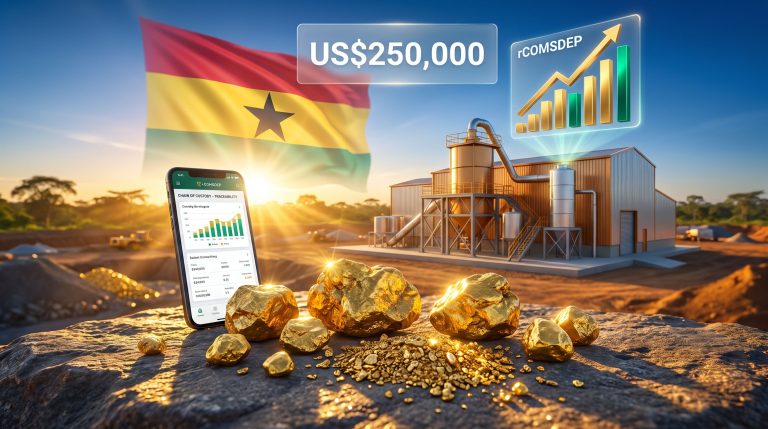
The structure channels miners into legal entities under Ghana's Responsible Cooperative Mining Scheme Development Programme, or rCOMSDEP.
The World Gold Council also committed an initial $250,000 development fund to support cooperative registration under rCOMSDEP. That is not a sector-wide financing solution, but it is a targeted starter pool for implementation.
According to reporting cited in the source material, Ghana's Lands and Natural Resources Minister said the partnership is intended to strengthen formalisation, reduce harmful practices, and improve how mining benefits reach communities and the broader nation.
The Smuggling Gap Explains Why Formalisation Could Be Worth Billions
The economic case becomes clearer when the leakage is quantified.
| Smuggling and informality metric | Figure |
|---|---|
| Estimated gold lost to smuggling over 5 years | 229 metric tons |
| Estimated value of that gold | $11.4 billion |
| Undeclared output in 2023 | 34 metric tons |
| Official artisanal production recorded in 2023 | About 34 metric tons |
| Major destination cited for smuggled flows | Dubai, UAE |
The five-year estimate comes from Swissaid, which highlighted discrepancies between Ghana's reported exports and import data recorded in destination markets. The striking detail is that undeclared gold in 2023 was nearly equal to officially recorded artisanal production. In other words, for every visible unit of ASM production, there may have been another comparable unit slipping out of sight.
Why More Than 85% of Operations Remain Informal
Although small-scale mining is recognised in law, studies indicate that over 85% of operations remain informal and unregulated.
Common barriers include:
- Limited access to simple, affordable registration pathways
- Weak availability of licensed processing and offtake infrastructure
- Poor confidence that formal channels will offer fair pricing and legal certainty
- Established networks of informal buyers who pay quickly and ask fewer questions
This matters because informal markets win when they are faster, simpler, and more liquid than official systems. Consequently, any formalisation programme that ignores miner economics is likely to underperform.
Public Pressure and Environmental Damage Pushed the Issue Higher
The challenge is not only financial. Illegal and poorly regulated mining has also been associated with river pollution, land degradation, and soil damage, making the issue politically visible beyond mining districts. In this context, mine reclamation importance has become an increasingly central theme in responsible resource governance.
In October 2024, hundreds of Ghanaians reportedly protested and demanded stronger action against illegal mining. That public pressure helped elevate the issue within national policymaking, and the administration that followed made control of small-scale mining a clear priority.
Environmental recovery will not happen overnight. Formalisation can reduce harmful practices, but only if it is paired with enforcement, alternative processing methods, and real monitoring of water and land impacts.
GoldBod Is Trying to Create a Formal Buying Machine
A major part of Ghana's restructuring effort sits with the Ghana Gold Board, or GoldBod.
Finance Minister Cassiel Forson told Parliament that GoldBod is required to buy a minimum of 2.45 metric tons of ASM gold per week. On an annualised basis, the government has said it wants to redirect roughly 127 metric tons of artisanal and small-scale gold each year into official trade channels.
What Those Targets Imply
- A weekly target of 2.45 metric tons indicates a standing procurement system, not a one-off campaign
- A 127-metric-ton annual diversion target suggests Ghana is trying to absorb a large share of artisanal output into the legal market
- Government statements have linked that pipeline to a potential annual inflow above $20 billion, though realised value will depend on price, recovery, compliance, and actual purchased volumes
GoldBod said it purchased between 50 and 54 metric tons from ASM operators in the first half of 2026. If sustained, that pace would indicate the formal channel is gaining traction, though year-end outcomes still depend on enforcement, miner participation, and market pricing.
Investors and policy observers should treat early procurement numbers as directional rather than definitive. Scale-up periods often look strong before bottlenecks emerge in logistics, payments, or compliance.
These developments also reflect broader central bank buying trends globally, where sovereign institutions are increasingly focused on securing and formalising gold supply chains.
Why Refining Capacity Changes the Economics of Control
Formalisation works better when legal gold has a clear downstream destination. Ghana's launch of domestic refining in February 2026 addresses that part of the chain.
The Gold Coast Refinery began operations with a technical partnership involving South Africa's Rand Refinery, identified as the only refinery on the continent accredited by the London Bullion Market Association, or LBMA. The refinery's reported capacity is 2 metric tons per week.
Why Local Refining Matters
- It reduces dependence on exporting raw doré or semi-processed material
- It can support higher chain-of-custody discipline
- It improves the link between formal buying and standards-compliant processing
- It may enhance Ghana's ability to capture more value domestically, though actual uplift depends on throughput, fees, and market acceptance
In technical terms, refining is where traceability becomes commercially meaningful. A provenance system is only useful if downstream processors and buyers recognise it. That is why the combination of registration, procurement, traceability, and refining is stronger than any one element on its own.
The next major ASX story will hit our subscribers first
Can This Really Unlock $12 Billion a Year?
The $12 billion annual revenue figure has been associated with comments by GoldBod CEO Sammy Gyamfi, who said that effective control of small-scale mining under Ghana's gold policy objectives could generate that level of annual value.
There is also a higher-end scenario in circulation. If Ghana formally channels 127 metric tons annually and average realised prices are close to $5,000 per troy ounce, the gross value of that gold stream would exceed $20 billion. For context, central bank gold reserves data shows how critical formalised supply chains are to sovereign reserve strategies worldwide.
Scenario Table
| Scenario | Estimated value |
|---|---|
| Historical leakage based on $11.4B over 5 years | About $2.3B per year |
| GoldBod-linked formalisation estimate | Around $12B per year |
| High-price gross value scenario for 127 metric tons | More than $20B per year |
Important Caution on These Figures
These are not equivalent measures.
- $12 billion appears to represent a policy-linked revenue potential estimate
- $20 billion plus is closer to a gross value scenario based on assumed volume and price
- Net fiscal benefit would be lower after purchases, operating costs, refining charges, leakage, and compliance expenses
That distinction matters for anyone using the World Gold Council Ghana artisanal gold mining agreement as an investment or macro thesis.
How Ghana's Model Compares with Global ASGM Reform Efforts
Ghana's framework fits into a wider international push to make artisanal mining more governable and less environmentally destructive. The what needs to be done guidance from the World Gold Council outlines the structural reforms considered essential for sustainable ASGM formalisation globally.
Relevant benchmarks include:
- The Minamata Convention, which sets an international baseline on mercury risks in artisanal gold mining
- OECD due diligence guidance for responsible mineral supply chains, which influences provenance and responsible sourcing expectations
Compared with some other formalisation attempts in countries such as Peru, Colombia, and the Democratic Republic of Congo, Ghana's approach stands out for trying to connect several moving parts at once:
- Cooperative legalisation
- State-backed purchasing infrastructure
- Traceability systems
- Local refining capacity
- Export market alignment with recognised standards
That integrated structure is promising; however, execution risk remains high.
Risks, Investing Implications, and What to Watch Next
For market participants, the most important question is not whether the framework sounds credible. It is whether behaviour changes on the ground. Furthermore, gold safe-haven demand dynamics mean that any disruption to formal supply chains can have outsized effects on global pricing sentiment.
Key Risks
- Price competitiveness: if informal buyers pay faster or offer better local prices, leakage may continue
- Enforcement consistency: rules that exist on paper but are patchily applied tend to entrench grey markets
- Technology adoption: digital traceability systems are only as strong as field-level participation and record integrity
- Political continuity: long-term mining reforms often weaken when administrations change priorities
- Environmental compliance: formal status alone does not guarantee responsible practices
Practical Indicators to Monitor
- Quarterly GoldBod purchase volumes
- Evidence of reduced export-import discrepancies
- Growth in registered cooperatives under rCOMSDEP
- Refinery throughput relative to nameplate capacity
- Any measurable decline in pollution and illegal site activity
Investor Perspective
For investors watching Ghana, this is best viewed as a governance and monetisation story, not purely a commodity story. Higher gold prices help, but governance determines how much of that price windfall stays in-country.
The real signal from the World Gold Council Ghana artisanal gold mining agreement is that Ghana is trying to transform artisanal gold from a leakage-prone informal resource into a traceable, purchasable, refinable export stream.
That ambition could prove economically significant. However, until the country shows durable gains in formal volumes, reduced smuggling, and stronger environmental outcomes, the headline upside should be treated as potential rather than achieved value.
Disclaimer: This article is for informational purposes only and does not constitute investment, legal, or financial advice. Revenue projections, volume targets, and gold price scenarios are inherently uncertain and depend on policy execution, market conditions, compliance rates, and operational performance.
Want to Capitalise on the Next Major Mineral Discovery Before the Broader Market?
Discovery Alert's proprietary Discovery IQ model delivers real-time alerts on significant ASX mineral discoveries, instantly converting complex geological and market data into actionable investment insights for both short-term traders and long-term investors — begin your 14-day free trial today and explore how historic discoveries have generated substantial returns for those positioned ahead of the market.