July 22, 2026
The Hidden Architecture Behind Gold's Safe-Haven Surges
Most investors treat gold price movements as reactive phenomena, jumping when headlines appear and fading when tensions cool. But beneath the surface of every significant bullion rally lies a sophisticated interplay of monetary mechanics, geopolitical transmission channels, and investor psychology that determines not just whether gold moves, but how far and how fast. Understanding this architecture is what separates informed positioning from reactive noise.
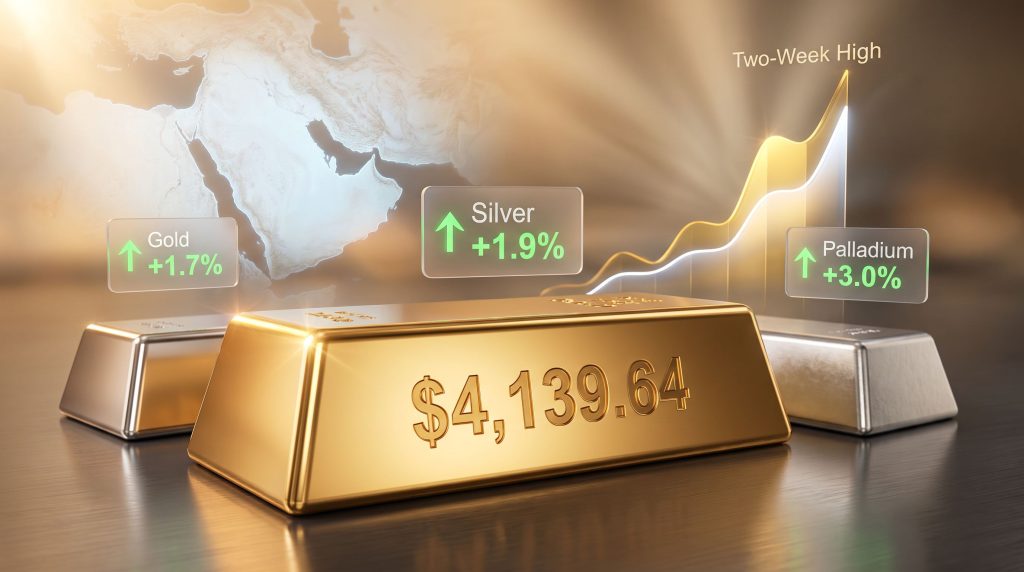
In late July 2026, gold hits two-week high on Fed outlook and Middle East conflict pressures converging simultaneously, pushing spot bullion to $4,139.64 per ounce and August futures to $4,144.20, a gain of 1.7% intraday. However, the more instructive story is not the price itself. It is the structural machinery that produced it.
When big ASX news breaks, our subscribers know first
The Opportunity Cost Engine: Why the Fed Is Gold's Most Powerful Counterparty
How Monetary Policy Shapes the Price of a Non-Yielding Asset
Gold's most enduring vulnerability is also its most fundamental characteristic: it produces no income. No coupon, no dividend, no yield. This creates what economists describe as an opportunity cost dynamic, where the attractiveness of holding gold moves inversely with the returns available from interest-bearing alternatives. Furthermore, the gold safe-haven role amplifies this dynamic considerably during periods of elevated monetary uncertainty.
When the Federal Reserve raises rates, the spread between what an investor can earn from Treasury bills and what gold pays (nothing) widens. Capital gravitates toward yield. When that spread narrows, or when the trajectory of rates becomes uncertain, gold's relative appeal strengthens considerably.
| Rate Environment | Gold's Opportunity Cost | Typical Bullion Reaction |
|---|---|---|
| Aggressive rate hikes | Very high | Significant selling pressure |
| Rates on hold, hawkish tone | Moderate to high | Volatile, data-dependent |
| Rates on hold, neutral tone | Moderate | Gradual accumulation |
| Rate cut cycle beginning | Low and falling | Strong structural bid |
| Extended policy uncertainty | Variable | Event-driven positioning |
The 2026 Fed Dilemma and Its Gold Market Implications
A Reuters poll of economists conducted ahead of the late July 2026 Federal Reserve meeting found that the consensus expectation was for the central bank to hold its benchmark interest rate steady through the remainder of the year. That baseline sounds benign for gold, but the more revealing finding was buried in the same survey.
When respondents were asked separately about the probability of a rate hike occurring during 2026, a majority characterised the likelihood as high. In the prior month's equivalent survey, most had described that same probability as low. This is not a minor statistical footnote. It represents a fundamental shift in the distribution of rate expectations within a single polling cycle.
Markets do not simply price what central banks have done. They price the full probability distribution of what central banks might do. A shift in that distribution, even without any actual policy change, is sufficient to reprice assets.
For gold, this creates a specific and historically recognisable dynamic: pre-meeting accumulation. Institutional traders and macro-oriented funds increase allocations to non-correlated assets in the weeks ahead of high-uncertainty Fed decisions. Gold consistently absorbs a meaningful share of this flow, contributing to the technical momentum that preceded the late July rally.
The Pre-FOMC Positioning Effect: What the Data Shows
Academic research into gold's behaviour around Federal Open Market Committee meetings has identified a persistent pattern: bullion tends to exhibit elevated volatility in the five trading sessions immediately preceding a Fed decision when policy outcome uncertainty is high. This pattern intensified noticeably during the post-2020 rate cycle and appears to have carried forward into the 2026 environment.
The mechanism is straightforward. Uncertainty about the direction or tone of Fed guidance creates a demand for optionality. Gold, with its deep liquidity and non-correlation to equities, functions as a macro hedge that pays off across multiple outcome scenarios simultaneously. In addition, central banks influencing gold through their accumulation strategies reinforces this structural demand floor.
Geopolitical Risk Transmission: From Red Sea Tankers to Gold Bids
The Energy-Inflation-Bullion Chain
Geopolitical disruption rarely affects gold directly. Instead, it operates through a chain of transmission mechanisms that ultimately arrive at bullion demand via inflation expectations and risk sentiment. The mid-July 2026 developments in the Middle East illustrated this chain with unusual clarity, as reported by Reuters.
Three Saudi crude oil tankers reversed course in the Red Sea following threats from Houthi forces aligned with Iran, disrupting shipping through one of the world's most critical energy chokepoints. Separately, a senior Iranian official confirmed receipt of a mediator-proposed ten-day ceasefire framework, and Iran's Interior Minister conducted diplomatic visits to Pakistan requesting continued mediation efforts.
The transmission from these events to gold prices followed a predictable sequence:
- Shipping disruption raises near-term oil supply concerns.
- Oil price increases elevate forward inflation expectations.
- Higher inflation expectations complicate the Fed's policy calculus.
- Policy uncertainty increases demand for non-correlated macro hedges.
- Gold absorbs institutional and retail safe-haven capital simultaneously.
- Technical buyers identify the setup and amplify the directional move.
This six-step chain typically compresses into 24 to 48 hours of price action during periods of acute geopolitical escalation. Understanding its internal logic allows investors to anticipate gold's response rather than simply observe it after the fact. For broader context on the geopolitical gold price outlook, the structural drivers appear consistent across multiple conflict cycles.
What Ceasefire Diplomacy Does to Gold's Risk Premium
An underappreciated nuance in the mid-July 2026 gold rally is that diplomatic progress and conflict escalation were occurring simultaneously. The active ceasefire framework negotiations involving Iran, while fragile, introduced a degree of optimism that partially offset the pure safe-haven bid.
This bidirectional geopolitical signal creates what traders sometimes call a geopolitical premium sandwich: the floor is supported by conflict risk, while the ceiling is compressed by diplomatic hope. Gold's resulting price behaviour tends to be strong but not exponential, with buyers absorbing supply at a measured pace rather than triggering momentum-driven breakouts.
Tim Waterer, Chief Market Analyst at KCM Trade, characterised the dynamic around this period by noting that buyers were entering the market seeking perceived value after the recent pullback, while optimism around diplomatic developments between the United States and Iran was also contributing to directional price movement. This dual-signal interpretation captures the complexity of geopolitical risk premium pricing more accurately than a simple fear-driven narrative.
Why Gold Dropped Before It Rallied: The Weekly Decline Decoded
Reading the Counterintuitive Selloff
Before the late July 2026 rally, gold recorded its steepest weekly decline since early June 2026. On the surface, this appears paradoxical. Middle East tensions were escalating, which would normally support bullion. However, three factors combined to overwhelm the safe-haven bid temporarily.
- Inflation-driven rate hike fears: Rising oil prices from geopolitical disruption reinforced expectations of Fed tightening, increasing gold's opportunity cost and triggering institutional selling.
- Sentiment reversal in rate expectations: The shift in the Reuters poll from majority "low probability hike" to majority "high probability hike" represented a repricing event that hit gold before any actual policy change occurred.
- Profit-taking at elevated levels: Gold had accumulated significant long positioning during the earlier safe-haven surge. The combination of rate concerns and geopolitical complexity gave traders sufficient justification to exit positions and crystallise gains.
The Mean-Reversion Setup That Followed
After a sharp decline driven by sentiment rather than fundamental deterioration, the macro backdrop remained structurally supportive. The geopolitical risk had not resolved. The Fed's policy direction had not clarified. These conditions created a classic buy the dip on fundamentals environment, where technically-oriented investors identified the pullback as a potential re-entry point with asymmetric risk characteristics.
When sentiment overshoots in either direction during periods where the underlying macro drivers remain intact, the subsequent correction tends to be both rapid and substantial. This is precisely what characterised the late July 2026 gold recovery.
The Broader Precious Metals Signal: Confirmation Across the Complex
Why Cross-Metal Strength Matters for Interpreting Gold Moves
A gold rally occurring in isolation can reflect idiosyncratic factors such as central bank buying from a specific country, a temporary currency dislocation, or exchange-specific flows. A rally accompanied by broad-based gains across the precious metals complex is far more likely to reflect genuine macro drivers.
The late July 2026 session delivered precisely this confirmation, with the Business Times noting that gold's gains were underpinned by both Middle East tensions and the Fed's cautious outlook:
| Metal | Spot Price | Session Move | Notable Context |
|---|---|---|---|
| Gold (Spot) | $4,139.64/oz | +1.6% | Two-week high, highest since July 7 |
| Gold (Aug Futures) | $4,144.20/oz | +1.7% | Technical breakout above resistance |
| Silver (Spot) | $59.87/oz | +1.9% | Strongest reading since July 10 |
| Platinum | $1,667.22/oz | +2.4% | Broad safe-haven accumulation |
| Palladium | $1,320.75/oz | +3.0% | Strongest performer across the complex |
Palladium's Outperformance: An Industrial Demand Signal
Palladium's 3% gain deserves particular analytical attention. Unlike gold and silver, palladium carries substantial industrial demand exposure, particularly from automotive catalytic converter manufacturing. When palladium rallies alongside gold during a geopolitical episode, it suggests that the risk repricing is broad enough to compress premiums across asset categories with different demand profiles simultaneously.
This is a relatively rare phenomenon. It implies that market participants are not merely hedging political risk in isolation but are reassessing the broader operating environment for industrial supply chains, energy costs, and manufacturing inputs in parallel. Consequently, the signal is more nuanced than a simple flight-to-safety narrative and warrants monitoring as geopolitical conditions evolve. The gold-silver ratio analysis provides additional context for interpreting these cross-metal dynamics.
Scenario Framework: Three Pathways for Gold from Here
Modelling the Key Variables
Investors navigating the current environment should resist the temptation to anchor on a single outcome. The intersection of Fed policy uncertainty and Middle East conflict creates a multi-dimensional decision tree. Furthermore, recession and gold performance data suggests that macro deterioration could add another structural layer to any sustained rally. The three most plausible scenarios, and their likely gold market implications, are outlined below.
Scenario One: Fed Holds, Diplomatic Progress Accelerates
- The central bank maintains rates with a neutral tone, and ceasefire negotiations produce meaningful de-escalation.
- Safe-haven premium partially unwinds. Gold consolidates near current levels with downside limited by residual policy uncertainty.
- Likely price behaviour: range-bound with a modest downward drift from the two-week high.
Scenario Two: Fed Signals Potential Hike, Conflict Continues
- Forward guidance language shifts hawkish without an immediate rate change, while geopolitical conditions remain unresolved.
- Conflicting signals create elevated volatility. The opportunity cost headwind partially offsets the geopolitical floor.
- Likely price behaviour: sharp intraday swings, indeterminate directional trend, technically complex environment.
Scenario Three: Fed Adopts Indefinite Pause, Ceasefire Collapses
- Both structural pillars supporting gold reinforce simultaneously: low opportunity cost and maximum safe-haven demand.
- This represents the strongest near-term bullish case for gold hits two-week high territory being revisited and potentially surpassed.
- Likely price behaviour: sustained upward momentum with institutional accumulation accelerating.
Investors should track not only the Fed's rate decision but the precise language of the accompanying statement and press conference. A hold delivered with hawkish qualifications can exert as much downward pressure on gold as an actual rate increase, while a genuinely neutral hold can function as a de facto positive catalyst.
The next major ASX story will hit our subscribers first
Frequently Asked Questions
Why does gold respond to Middle East tensions even when the conflict is geographically distant from gold-producing regions?
Gold's response to Middle East geopolitics operates through inflation expectations and risk sentiment rather than direct supply disruption. When conflict threatens energy shipping lanes, oil prices rise, and rising oil prices increase inflation projections globally. Since gold is one of the most widely used inflation hedges across institutional and retail portfolios, higher inflation expectations translate directly into increased bullion demand regardless of where the conflict occurs physically.
What makes the opportunity cost concept so important for gold investors specifically?
Because gold generates no cash flow whatsoever, its entire valuation is relative. When risk-free assets yield 5%, holding gold means forfeiting that return. When yields fall to 1%, the cost of holding gold becomes negligible. This means the direction of interest rates matters as much as their absolute level, and the expectation of rate changes can move gold prices before any actual policy shift occurs.
Is silver's performance a reliable leading indicator for gold?
Silver amplifies gold's directional moves rather than leading them, due to its dual exposure as both a monetary metal and an industrial commodity. When the two metals rally in tandem, it generally confirms the macro-driven nature of the move. Significant divergence between silver and gold, by contrast, can signal that gold's movement is driven by idiosyncratic factors rather than broad macro conditions.
Disclaimer: This article is intended for informational and educational purposes only and does not constitute financial advice, investment recommendations, or a solicitation to buy or sell any financial instrument. All price figures and economic data referenced reflect conditions reported in July 2026. Past performance of any asset class is not indicative of future results. Investors should conduct their own due diligence and consult qualified financial professionals before making investment decisions. Scenario projections included in this article are speculative in nature and involve assumptions that may not materialise.
Want to Identify the Next Major Mineral Discovery Before the Broader Market?
Discovery Alert's proprietary Discovery IQ model delivers real-time alerts on significant ASX mineral discoveries, transforming complex mineral data into clear, actionable insights for investors at every experience level — start your 14-day free trial today and explore historic discoveries that have generated extraordinary returns.