June 23, 2026
The Macro Forces Compressing Gold in a Rate-Hike Environment
Precious metals markets operate on a deceptively simple logic: when the cost of holding a non-yielding asset rises, capital seeks alternatives. That logic is playing out with precision right now. Gold falls as dollar holds firm on Fed rate-hike expectations, and understanding why requires looking beyond the headlines to the deeper monetary transmission mechanisms at work.
The current environment is not merely a short-term blip. It reflects a structural collision between three simultaneous forces: a Federal Reserve signalling tighter policy for longer, a U.S. dollar near multi-year highs, and a gradual unwinding of the geopolitical risk premium that had been quietly supporting gold prices above the $4,000 per ounce threshold.
When big ASX news breaks, our subscribers know first
Understanding Why Dollar Strength Mechanically Suppresses Gold
The Currency Pricing Channel
Gold's global pricing architecture is denominated entirely in U.S. dollars. This single fact creates a direct mathematical relationship between currency strength and commodity affordability. When the dollar appreciates against the euro, yen, yuan, or rupee, buyers transacting in those currencies face a higher effective price for the same ounce of gold, even if the nominal dollar price has not moved.
This dynamic acts as an automatic demand suppressor in major physical consumption markets. Asia and the Middle East together represent the majority of global physical gold demand, and buyers in both regions are currently experiencing the compounding effect of dollar strength translating into local currency price spikes.
Critically, this transmission channel operates entirely independently of gold's supply fundamentals. Mine output, refinery throughput, and reserve depletion rates become secondary considerations when monetary policy dominates the price-setting mechanism.
The Opportunity Cost Equation
Gold generates no yield, pays no dividend, and offers no coupon. Its entire investment thesis rests on capital appreciation and preservation of purchasing power. In a zero-rate world, that thesis is compelling. In a rising-rate environment, however, it faces a structural challenge that has historically proven difficult to overcome.
When the Federal Reserve tightens monetary policy, U.S. Treasury securities become increasingly competitive. Furthermore, a 10-year Treasury offering a rising real yield is a direct substitute for gold in a portfolio allocation framework, and institutional capital responds accordingly by rotating out of non-yielding positions. For a deeper look at how gold and bond dynamics interact across economic cycles, this relationship becomes even clearer.
The opportunity cost of holding gold does not wait for the rate hike to arrive. Market pricing of anticipated hikes often delivers more damage to gold prices than the actual policy implementation, because futures markets front-run the outcome weeks or months in advance.
This front-running dynamic is precisely what is playing out right now. Traders are not waiting for the Federal Reserve to act. They are already repositioning based on probability shifts measured through tools like the CME FedWatch system.
Fed Rate-Hike Expectations: The Numbers Behind the Selloff
A 27-Point Probability Swing in a Single Week
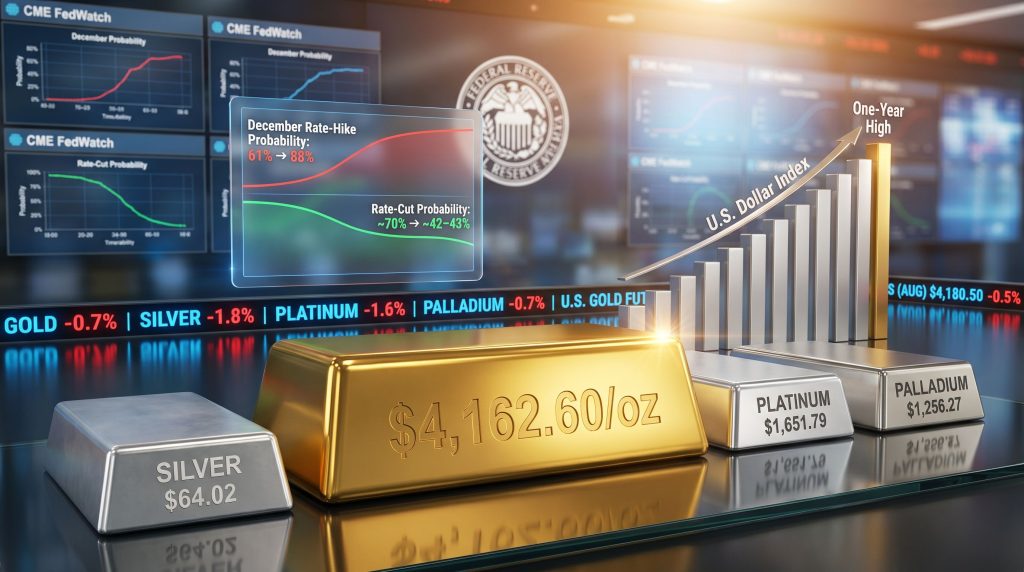
The speed of the current repricing is notable. According to the CME FedWatch Tool, traders are now pricing an 88% probability of a rate hike in December 2026, compared to just 61% before the most recent Federal Reserve meeting. That 27-percentage-point shift within a single week represents a significant recalibration across interest-rate-sensitive asset classes.
Simultaneously, expectations for a December rate cut have collapsed, falling from roughly 70% to approximately 42–43%. This reversal eliminates what had been a meaningful tailwind for gold prices in prior months. For context on how this fits into broader gold price forecasts, the shift marks a notable turning point in analyst sentiment.
| Indicator | Previous Reading | Current Reading | Change |
|---|---|---|---|
| December Rate-Hike Probability | 61% | 88% | +27 percentage points |
| December Rate-Cut Probability | ~70% | ~42–43% | -27 to -28 percentage points |
| Spot Gold | Prior session | $4,162.60/oz | -0.7% |
| U.S. Gold Futures (August) | Prior session | $4,180.50/oz | -0.5% |
Fed Officials Sustaining the Hawkish Tone
The probability shift is being reinforced by communication from regional Federal Reserve presidents. Chicago Fed President Austan Goolsbee has indicated his primary focus is determining whether elevated inflation proves persistent or gradually retreats as tariff impacts normalise and geopolitical pressures ease.
His commentary reflects the broader institutional disposition within the Fed: the default posture is hawkish until the inflation data conclusively argues otherwise. This consensus among policymakers amplifies dollar strength by confirming to currency traders that the yield advantage of U.S. dollar-denominated assets is unlikely to erode quickly. CNBC's coverage of fading Fed cut hopes provides further context on how this hawkish messaging has been received by markets.
Current Gold and Precious Metals Price Snapshot
Where Prices Stand
Spot gold declined 0.7% to $4,162.60 per ounce during early Asian trading (0228 GMT), after touching session lows that represented a decline of close to 1%. The partial recovery from those lows reflects residual buy-the-dip demand, but the broader directional trend remains bearish under current macro conditions.
U.S. gold futures for August delivery retreated 0.5% to $4,180.50 per ounce, with COMEX futures recording an approximate 0.302% decline on the session.
The Broader Precious Metals Complex Under Pressure
The weakness is not isolated to gold. Every major precious metal is trading lower, reflecting coordinated institutional repositioning rather than a gold-specific narrative.
| Metal | Price | Session Change |
|---|---|---|
| Spot Gold | $4,162.60/oz | -0.7% |
| Spot Silver | $64.02/oz | -1.8% |
| Platinum | $1,651.79/oz | -1.6% |
| Palladium | $1,256.27/oz | -0.7% |
Silver's sharper decline of 1.8% warrants specific attention. Unlike gold, which functions primarily as a monetary metal, silver carries a dual identity: it is both a store-of-value asset and an industrial input used heavily in solar panels, electronics, and electric vehicle components. This dual sensitivity makes silver more volatile than gold during monetary policy-driven repricing events.
Silver futures fell a more pronounced 2.484% on the session, indicating heavier institutional liquidation compared to gold positions. This spread between silver and gold performance is a useful signal of market stress. In fact, monitoring the gold-silver ratio analysis during such periods often reveals deeper insights into broader risk sentiment. When silver underperforms gold significantly during a selloff, it typically reflects broader risk-off sentiment rather than a narrowly gold-specific development.
Gold's Inflation Paradox: Why the Hedge Narrative Breaks Down
The Dual Headwind Problem
Gold's long-standing reputation as an inflation hedge creates a cognitive trap for investors who assume rising inflation automatically benefits gold prices. The relationship is considerably more nuanced. Gold does tend to appreciate during inflationary periods when central banks are passive or slow to respond. However, when central banks respond aggressively with rate hikes, the policy reaction overwhelms the inflation-driven demand impulse.
The current environment presents exactly this dual-headwind structure:
- Inflation remains elevated, nominally supporting the case for gold as a purchasing-power hedge
- The Federal Reserve's policy response to that inflation (higher rates) simultaneously suppresses gold's relative appeal
- Oil price volatility adds a third layer of complexity, feeding into headline inflation metrics and reinforcing expectations for sustained tightening
Oil prices had declined sharply earlier in the week, providing brief relief to gold through reduced inflation expectations. However, a subsequent rebound in crude prices has renewed concerns about sustained inflation. As KCM Trade's Chief Market Analyst Tim Waterer observed, while gold benefited from lower oil prices earlier in the week, dollar strength driven by rate-hike expectations has more than offset that relief. Reuters reporting on gold's recent dip further corroborates this assessment.
Think of gold's price as being pulled in two directions simultaneously. Inflation expectations exert upward pressure, while the policy response to that inflation exerts downward pressure. When the Fed's hawkish reaction dominates market pricing, the suppression force wins.
Geopolitical Risk Premium: Another Tailwind Fading
How U.S.-Iran Talks Are Affecting Safe-Haven Demand
Beyond monetary policy, gold has historically commanded a geopolitical risk premium during periods of elevated conflict and global uncertainty. That premium is currently being discounted as diplomatic developments reduce the perceived urgency of defensive positioning.
The United States issued a 60-day sanctions waiver on Iran from Monday, following initial discussions under a nascent peace framework. Negotiations held in Switzerland generated cautious optimism, with U.S. Vice President JD Vance describing the talks as having established a constructive foundation for a potential comprehensive agreement. Furthermore, a sustained reduction in regional hostilities, including in Lebanon, has further eroded gold safe-haven demand that had been supporting prices.
The Compounding Negative Effect
The timing of this geopolitical de-escalation is particularly damaging for gold because it coincides precisely with the monetary policy headwind intensifying. When two major sources of gold demand support — geopolitical risk premium and rate-cut expectations — contract simultaneously, the resulting price pressure is amplified rather than additive.
This explains the relative speed of gold's decline despite prices remaining at historically elevated levels above $4,000 per ounce. The absolute price level offers cold comfort when multiple demand pillars are being removed at the same time.
The next major ASX story will hit our subscribers first
Forward Price Scenarios and Analyst Targets
Scenario Modelling for Gold Through 2026
| Scenario | Primary Catalyst | Projected Gold Price Range |
|---|---|---|
| Bearish (Base Case) | Fed hikes in December; geopolitical de-escalation continues | $3,816 to $4,370/oz |
| Neutral | PCE data mixed; Fed holds rates steady | ~$4,100 to $4,500/oz |
| Bullish | PCE undershoots; rate-hike expectations collapse | Potential retest above $4,500/oz |
| Goldman Sachs 2026 Target | No Fed rate cuts in 2026 | $4,900/oz (revised lower) |
Goldman Sachs has revised its 2026 gold price target downward to $4,900 per ounce, explicitly anchoring that projection to an expectation that the Federal Reserve will not implement rate cuts during 2026. This institutional forecast establishes a ceiling on near-term upside potential, even as it acknowledges that gold's structural bull case remains intact over a longer horizon.
The PCE Data Event: The Most Critical Near-Term Catalyst
The upcoming release of the U.S. Personal Consumption Expenditures index — the Federal Reserve's preferred inflation gauge — represents the most significant near-term decision point for gold price direction. The market's reaction function is relatively straightforward:
- A PCE reading that exceeds expectations confirms persistent inflation, validates the hawkish Fed posture, strengthens the dollar further, and extends gold's decline
- An in-line PCE reading likely sustains current market positioning without a significant directional break
- A PCE undershoot relative to consensus would challenge the rate-hike narrative, potentially triggering rapid dollar weakness and a sharp gold reversal
Historical precedent supports the speed of that potential reversal. Institutional capital in gold futures markets can reposition quickly when the macro narrative shifts, given the high liquidity and leverage available in COMEX gold contracts.
Dollar Positioning and the Self-Reinforcing Cycle
Near One-Year Highs and What That Means
The U.S. dollar index has held firm near the one-year high established late last week. This sustained strength creates a persistent structural headwind for gold that extends beyond pure monetary policy mechanics. At current dollar levels, international buyers in Asia and the Middle East face materially higher effective gold prices in local currency terms, compressing physical demand from the world's largest consuming regions.
The dollar's strength in this environment is partially self-reinforcing. Consequently, the cycle perpetuates itself through several interconnected mechanisms:
- Higher rate-hike expectations attract capital inflows into dollar-denominated assets
- Those inflows bid up the dollar further
- A stronger dollar increases the opportunity cost of holding gold for international buyers
- Reduced international demand feeds further downward price pressure on gold
Additionally, the central bank impact on gold cannot be overlooked here, as reserve managers adjust their holdings in response to the same dollar dynamics influencing retail and institutional investors alike.
Breaking this cycle requires either a softening in U.S. economic data, a downside surprise in inflation metrics, or an explicit shift in Federal Reserve communication toward a more neutral stance. Until one of those conditions is met, the structural headwind for gold remains intact.
Frequently Asked Questions
Why does gold fall when the U.S. dollar strengthens?
Gold is priced globally in U.S. dollars. When the dollar appreciates, foreign currency buyers face a higher effective cost for the same ounce of gold, reducing international purchasing demand. Additionally, dollar strength typically reflects tighter monetary conditions, which raises the opportunity cost of holding a non-yielding asset.
What is the relationship between Fed rate hikes and gold prices?
Federal Reserve rate hikes increase the returns available on U.S. dollar-denominated instruments such as Treasury bonds. Since gold generates no income, rising yields make competing assets comparatively more attractive, prompting capital rotation away from gold into yield-bearing alternatives.
What is the CME FedWatch Tool and why does it matter for gold?
The CME FedWatch Tool calculates market-implied probabilities of Federal Reserve interest rate decisions by aggregating federal funds futures pricing. For gold investors, it functions as a real-time barometer of monetary policy expectations, which are among the most powerful macro drivers of gold price direction.
What is the PCE index and how does it affect gold?
The Personal Consumption Expenditures price index is the Federal Reserve's preferred inflation measurement framework. A higher-than-expected reading reinforces the case for continued rate hikes, which is bearish for gold. A reading below consensus, however, reduces tightening pressure and typically provides support to gold prices.
Why is silver falling more sharply than gold in this environment?
Silver carries dual sensitivity as both a monetary metal and an industrial commodity. During monetary policy-driven selloffs, silver tends to underperform gold because it absorbs additional downside from concerns about global industrial demand cycles, amplifying its decline relative to pure monetary metals.
Can gold recover if rate-hike expectations ease?
Yes. Gold historically responds rapidly to shifts in the rate-hike probability curve. If economic data weakens, inflation moderates, or the Fed shifts its communication toward neutrality, the primary headwind can reverse quickly, allowing institutional capital to return to gold positions at pace.
Key Takeaways for Gold Investors
- Gold falls as dollar holds firm on Fed rate-hike expectations, with December hike probability now sitting at 88%, up from 61% before the most recent Fed meeting
- The entire precious metals complex is under pressure, with silver leading declines at -1.8%, followed by platinum at -1.6%, and palladium and gold both down -0.7%
- Gold's inflation-hedge narrative is being structurally overridden by the policy response to that inflation, a pattern that historically persists until either the Fed pivots or data forces reassessment
- Simultaneous fading of the geopolitical risk premium through U.S.-Iran peace talks creates a compounding negative catalyst alongside the monetary headwind
- The PCE data release is the most critical near-term event, with the potential to either accelerate gold's decline or trigger a sharp reversal
- Goldman Sachs' revised 2026 target of $4,900 per ounce reflects institutional consensus that no Fed rate cuts will occur in 2026, establishing a structurally lower ceiling on near-term upside
- Investors monitoring gold should prioritise the CME FedWatch probability curve, dollar index movements, and Federal Reserve speaker commentary as the primary leading indicators of future price direction
This article is intended for informational purposes only and does not constitute financial advice. Precious metals markets involve significant risk, and price forecasts referenced herein represent analyst projections that may not be realised. Investors should conduct independent research and consult qualified financial advisers before making investment decisions.
Want to Capitalise on Major Mineral Discoveries Before the Broader Market?
While gold navigates the headwinds of dollar strength and shifting Fed rate-hike expectations, Discovery Alert's proprietary Discovery IQ model scans ASX announcements in real time, instantly identifying significant mineral discoveries and turning complex data into actionable investment opportunities for both short-term traders and long-term investors — start your 14-day free trial at Discovery Alert and position yourself ahead of the market.