
June 23, 2026
Inside the Lydian Amulsar Project Contracts: Engineering a Gold Mine in the Caucasus
Greenfield gold mining in emerging markets rarely follows a straight line. Between geological complexity, community dynamics, financing structures, and the sheer logistical challenge of building industrial infrastructure in remote terrain, the gap between a definitive feasibility study and a producing mine is littered with failed procurement strategies and capital missteps. The Lydian Amulsar project contracts represent one of the most technically ambitious and financially layered attempts to bridge that gap in the modern history of the South Caucasus — and the story of how those contracts were structured, who won them, and what ultimately challenged their execution offers a masterclass in both mining development best practice and its inherent vulnerabilities.
When big ASX news breaks, our subscribers know first
Understanding the Amulsar Deposit's Physical and Strategic Context
Situated approximately 10 kilometres from the spa resort town of Jermuk and roughly 170 kilometres southeast of Yerevan, the Amulsar gold deposit occupies a geographically and politically loaded position in Armenia's landscape. It is widely regarded as the largest greenfield gold mining project in the country's modern history, a distinction that amplified both its commercial appeal and the scrutiny it attracted from communities, environmental groups, and multilateral institutions alike.
The project's operating entity, Lydian Armenia CJSC, sits beneath an ownership structure that evolved significantly over the project's turbulent development history. As of January 2024, the Armenian government formalised a 12.5% equity stake in the project, with the remaining 87.5% held by United Gold. Toronto-based Lydian International served as the original parent company that drove the project through its early-stage development and, critically, through the contract award phase that unfolded in early 2017.
Understanding who holds equity in a mining project matters enormously when assessing long-term execution risk. Government co-ownership introduces a layer of political alignment that can accelerate the securing of mining permits and reduce sovereign risk, but it also introduces governance complexity that purely private structures avoid. At Amulsar, this tension between alignment and complexity has been a recurring theme throughout the project's lifecycle.
The Major Lydian Amulsar Project Contracts: A Technical Breakdown
When Lydian International awarded the primary Amulsar contracts in early 2017, the procurement framework touched every critical operational system from earth movement to gold recovery. The selection of Tier-1 global suppliers was a deliberate bankability signal, communicating to project financiers that the development would be built to international standards.
| Contract Category | Awarded To | Scope |
|---|---|---|
| Mobile Mining Fleet | Zeppelin International (Caterpillar) | Haul trucks, shovels, loaders, dozers, support equipment |
| Materials Handling and Crushing | Sandvik Mining and Construction | Crushing plant, screening, 5.6 km overland conveyor |
| Electrical Systems and Automation | ABB Automation | Substations, distribution grid, motors, process control, E-houses |
| Gold Recovery Plant | Azmet Technology and Projects | ADR plant design and supply |
| Worker Accommodations | Renco and Renco Armestate | 680-bed camp facility |
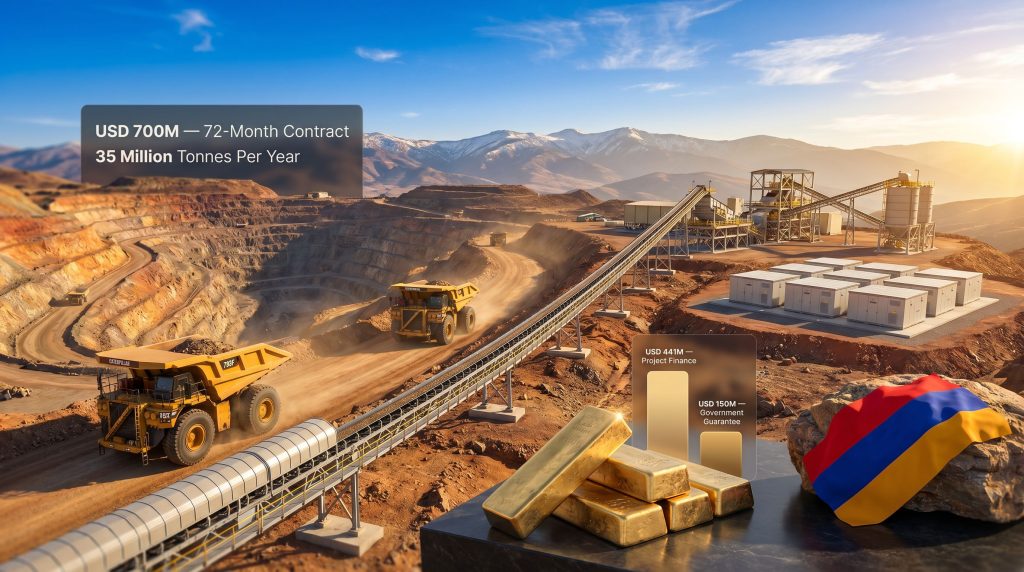
| Contract Mining Services | MOTA-ENGIL Mining Caucasus LLC | Comprehensive industrial engineering (USD 700M, 72 months) |
Each of these awards reflected specific technical requirements shaped by the project's heap-leach processing model and its challenging mountainous terrain. The logic behind each selection deserves closer examination.
The Caterpillar Fleet: Scaling a 35 Million Tonne Per Year Open-Pit Operation
Zeppelin International, acting as the authorised Caterpillar dealer for the region, secured the contract for the complete mobile mining fleet at Amulsar. The equipment package encompasses the full spectrum of open-pit mining machinery: haul trucks, hydraulic shovels, wheel loaders, bulldozers, and ancillary support vehicles.
The production targets built into this contract are substantial:
- Year one mining throughput: 25 million total tonnes
- Steady-state average capacity: 35 million tonnes per year following phased fleet additions
- Equipment delivery schedule: Commencing Q3 2017
The phased approach to fleet commissioning is worth noting from an investment analysis perspective. Rather than deploying the full 35 Mtpa equipment complement from day one, the project was structured to add incremental fleet capacity as production ramped up. This approach reduces upfront capital exposure significantly, as each haul truck in a large open-pit fleet can represent an individual capital commitment of USD 3 to 5 million depending on payload class.
Phased fleet deployment in open-pit mining is a well-established capital efficiency strategy. Tying additional equipment tranches to measurable production milestones rather than upfront procurement orders means capital follows operational performance rather than preceding it.
Sandvik's Materials Handling System: The 5.6 Kilometre Conveyor Solution
Sandvik Mining and Construction's contract at Amulsar covers one of the project's most technically distinctive infrastructure elements. The materials handling scope includes a complete crushing and screening plant alongside a 5.6-kilometre overland conveyor that connects the crushing facility directly to the heap-leach pad.
The crushing circuit architecture follows a conventional two-stage approach:
- A vibrating feeder delivers run-of-mine ore to a primary jaw crusher for initial size reduction.
- Three secondary cone crushers provide further comminution before the screening plant classifies the product by particle size.
- The sized ore is then transported via the overland belt system to the leach pad, supplemented by a storage reclaim system and truck loadout feed configuration.
The practical significance of the overland conveyor is often underappreciated in project summaries. Eliminating truck haulage between the crusher and the leach pad reduces diesel consumption, lowers tyre costs, and cuts CO2 emissions across the mine's operational life. For a project in a politically sensitive environment where environmental performance was already under scrutiny, this design choice carried both economic and reputational logic.
Furthermore, at 5.6 kilometres, the Amulsar conveyor sits at the longer end of the range for comparable heap-leach gold operations globally, where 2 to 4 kilometre systems are more typical. This length reflects the topographic separation between the processing area and the designated leach pad footprint.
ABB's Electrical Infrastructure: Why Premanufactured E-Houses Matter
ABB Automation's scope at Amulsar goes well beyond simple power supply. The contract covers the full electrical nervous system of the processing facility, including:
- High- and medium-voltage substation design and supply
- Complete distribution grid engineering across the plant footprint
- Automation and process control systems using SCADA and distributed control system (DCS) architecture
- Motors and variable frequency drives (VFDs) for process equipment
- Premanufactured electrical rooms, commonly referred to as E-houses
The deployment of premanufactured E-houses is a detail that often receives insufficient attention in project announcements but carries real execution value. E-houses are factory-assembled and pre-tested electrical enclosures that arrive on-site ready for connection. In a remote, mountainous location like Amulsar, where skilled electrical construction labour is scarce and Armenian winter conditions create substantial on-site construction risk, the ability to install a pre-tested electrical assembly rather than construct it in the field can translate into months of schedule compression and meaningful cost savings.
This procurement philosophy, favouring modular and premanufactured systems, has become increasingly standard in remote mining projects globally. Consequently, Amulsar's adoption of it in 2017 positioned the project at the more sophisticated end of the emerging market development spectrum.
The next major ASX story will hit our subscribers first
The Azmet ADR Plant: How Amulsar's Gold Recovery Circuit Was Designed
For heap-leach gold operations, the adsorption, desorption, and recovery plant (ADR plant) is the financial heart of the operation. Azmet Technology and Projects secured the contract for design and supply of this critical system, with technical specifications that reflect the project's substantial production ambitions.
| Technical Parameter | Specification |
|---|---|
| Pregnant solution throughput | Up to 1,100 m³ per hour |
| Carbon loading cycle | 4 tonnes of loaded carbon eluted twice daily |
| Elution circuit type | Pressurised system |
| Downstream process | Zinc precipitation |
| Final product | Gold and silver doré bars via gas-fired furnace |
Processing 1,100 m³/h of gold-bearing pregnant solution places Amulsar among the larger throughput ADR circuits for a heap-leach operation globally, where comparable projects typically handle between 400 and 800 m³/h. The pressurised elution circuit was specifically chosen over atmospheric alternatives because it operates at elevated temperatures, improving gold stripping efficiency and reducing cycle times.
The decision to produce doré bars directly on-site rather than shipping pregnant carbon or loaded solution to an off-site facility reduces transportation risk, lowers refining costs, and improves revenue recognition timing. For a project in Armenia, with its relatively constrained logistics infrastructure, on-site doré production was the operationally superior choice.
The integration of ABB's process control architecture directly into the ADR circuit reflects a design philosophy that treats automation and recovery chemistry as inseparable systems rather than independently procured components. This level of systems integration is a marker of mature project engineering.
Capital Structure: The Financing Architecture Behind the Amulsar Contracts
The Lydian Amulsar project contracts did not exist in isolation; they were underwritten by one of the most complex financing structures ever assembled for a mining project in the South Caucasus region.
| Financing Instrument | Provider | Value | Notes |
|---|---|---|---|
| Project Finance Package | Advised by Endeavour Financial | USD 441 million | Largest greenfield mining finance in Armenian history |
| Contract Mining Services Agreement | MOTA-ENGIL Mining Caucasus LLC | USD 700 million | 72-month duration |
| Government Loan Guarantee | Armenian Government | USD 150 million | Via six Armenian banks; up to 5-year term at approximately 9% interest |
| Equipment and Heap-Leach Loan | Ameriabank | USD 24 million | Executed late 2016 |
| Equity Investment | EBRD | CAD 11.4 million | Directed to Environmental and Social Mitigation Measures |
| Previous Equity Stake (Divested) | IFC | Greater than USD 13 million | Divested September 2016 as private funding secured |
The USD 700 million MOTA-ENGIL Mining Caucasus LLC contract warrants specific attention. As a single contract mining services agreement covering comprehensive industrial engineering over 72 months, it ranks among the largest individual mining services commitments ever executed in the broader Caucasus and Central Asian region. The scale of this agreement reflects both the project's industrial complexity and the contractor's confidence in the financing structure that backed it.
The USD 441 million project finance package advised by Endeavour Financial established a new benchmark for greenfield mining finance in Armenia, demonstrating that the country's capital markets and risk profile could support institutional-scale project lending. This was not a trivial signal for subsequent mining investment in the country.
Environmental Commitments Within the Contract Framework
The EBRD's CAD 11.4 million equity injection in 2016 was specifically directed toward an Environmental and Social Mitigation Measures framework, funding a biodiversity offset programme and a dedicated water treatment facility. The involvement of the European Bank for Reconstruction and Development brought the project into alignment with IFC Performance Standards and EBRD Environmental and Social Policy requirements, a condition that also provided reputational insurance for the broader lender syndicate.
The 680-bed worker accommodation village contracted through Renco and Renco Armestate, with planned occupation beginning Q2 2017, addressed a practical operational necessity that carries environmental co-benefits in remote terrain. Centralised on-site accommodation reduces daily vehicle movement across mountain roads, lowering both safety risk and fuel emissions compared to a commute-based workforce model.
Obstacles, Restructuring, and Persistent Financing Risk
Despite the technical sophistication of the Lydian Amulsar project contracts and the depth of the financing package assembled to support them, the project encountered sustained community opposition that its contract framework had not adequately anticipated. Community-led blockades, centred on concerns about the project's proximity to Jermuk's tourism economy and its potential impact on regional water resources, disrupted supply chains and ultimately contributed to the financial distress of the original operating entity.
The aftermath included corporate restructuring, with operational rights transferring to Lydian Ventures, and the Armenian government's formal acceptance of its 12.5% equity stake in January 2024 representing an attempt to restore institutional confidence in the project's trajectory.
However, the rejection of a USD 100 million memorandum of understanding with the Eurasian Development Bank (EDB) in November 2024 highlighted that financing fragility remains the project's most pressing structural challenge. Without resolved financing, even a technically complete and contractually sound development cannot proceed to production.
What Amulsar's Contract Architecture Reveals About Emerging Market Mining Development
Comparing the Lydian Amulsar project contracts against typical greenfield gold developments reveals several distinctive features that offer lessons for investors and developers considering similar jurisdictions.
| Feature | Amulsar (Armenia) | Typical Greenfield Gold Mine |
|---|---|---|
| Contract Mining Model | USD 700M, 72-month fixed-scope agreement | Often phased or owner-operated |
| Overland Conveyor Length | 5.6 km | Typically 2 to 4 km |
| ADR Plant Throughput | 1,100 m³/h | Generally 400 to 800 m³/h |
| Government Equity Participation | 12.5% (formalised 2024) | Uncommon in private greenfield developments |
| Multilateral Finance Involvement | EBRD and IFC (historical) and EDB (attempted) | Less common in Caucasus region projects |
Three broader lessons emerge from this analysis:
-
Community engagement is a contractual obligation, not an afterthought. The Amulsar experience demonstrates that technical excellence in procurement does not insulate a project from social opposition. A well-considered community engagement strategy needs to be embedded into development timelines from feasibility stage, not layered on after contracts are awarded.
-
Multilateral finance is a double-edged instrument. The EBRD and IFC involvement provided capital and environmental credibility, but multilateral co-investment also imports stringent conditionality that can slow execution and create friction with commercial lenders operating to different timelines.
-
Modular procurement strategies reduce execution risk in remote environments. The use of premanufactured E-houses, phased fleet deployment, and an overland conveyor to replace truck haulage collectively represent an approach to capital efficiency. In addition, thoughtful mine reclamation planning from the outset reinforces this approach, as it is increasingly replicable in logistically constrained emerging market projects. Furthermore, a coherent critical materials strategy at the national level can provide the policy backbone that makes such procurement frameworks viable in the first place.
Disclaimer: This article is intended for informational purposes only and does not constitute financial or investment advice. References to project timelines, financing figures, and operational targets reflect publicly available information and historical reporting. Readers should conduct independent due diligence before making investment decisions related to any mining project or company discussed.
Want to Identify the Next Major Gold Discovery Before the Broader Market?
Discovery Alert's proprietary Discovery IQ model delivers real-time alerts on significant ASX mineral discoveries, turning complex geological and market data into actionable investment insights for both short-term traders and long-term investors. Explore historic examples of major mineral discoveries and their exceptional returns, then begin your 14-day free trial at Discovery Alert to position yourself ahead of the market.