
June 22, 2026
The Hidden Fractures in America's Monetary Infrastructure
Few topics reveal more about the health of a nation's financial architecture than how it accounts for its sovereign gold. For most of the post-war era, the question of whether America's gold reserves at Fort Knox are intact, fully owned, and fit for modern use was treated as settled. That assumption is now being challenged with growing urgency — not just by fringe commentators, but by sitting senators, congressional representatives, and the sitting president of the United States.
Alongside this renewed push for gold accountability, a parallel legislative effort targeting the structural vulnerabilities of the U.S. precious metals market, the SILVER Act, is advancing through Congress with bipartisan support. Together, the Fort Knox gold audit and the Silver Act represent the most substantive attempt to reform U.S. precious metals policy in generations.
When big ASX news breaks, our subscribers know first
Understanding Why the Fort Knox Gold Audit Debate Has Resurfaced
The Accountability Gap That Never Closed
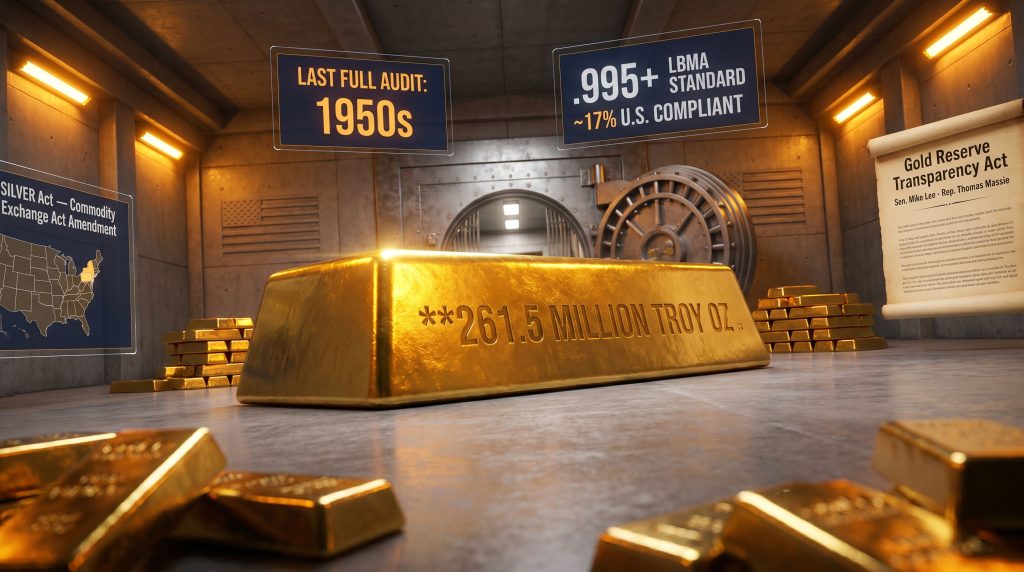
The last widely accepted comprehensive independent physical audit of U.S. gold reserves is generally cited as having occurred in the 1950s. What has followed over the intervening decades is a series of partial inspections, most of which were conducted by parties connected to the custodian itself rather than independent third-party verifiers operating to modern institutional standards.
This is not a minor procedural gap. Sovereign wealth management in the 21st century demands transparency mechanisms that are rigorous, independent, and publicly verifiable. By that standard, the U.S. gold reserve system has operated with a level of opacity that would not be acceptable for any major institutional asset manager, let alone a government holding assets on behalf of its citizens.
Presidential Attention and the CIA Official Incident
The conversation intensified dramatically after President Donald Trump publicly acknowledged doubts about whether the gold at Fort Knox remains fully intact and free of encumbrances. Trump's statements, made across multiple platforms including social media and broadcast interviews, gave mainstream political legitimacy to questions that had previously been confined to monetary policy circles.
The catalyst for one of those statements was a report involving a former CIA official, David Rush, who was allegedly found storing approximately $40 million worth of gold bars — roughly 303 kilogram bars — at a private residence. The incident, amplified through a Presidential social media post referencing a New York Post report, became a flashpoint for a broader question: if an individual could extract that volume of gold without triggering institutional safeguards, what does that imply about the robustness of custodial controls over the entire reserve system?
The Sound Money Defense League has argued publicly that the U.S. government has accumulated genuine scepticism through decades of limited disclosure and non-independent verification, and that this scepticism has been earned rather than manufactured. Furthermore, questions about gold reserves in London vaults add another dimension to the global accountability debate.
What the Gold Reserve Transparency Act Would Actually Require
A Structural Framework for Sovereign Gold Accountability
The Gold Reserve Transparency Act, introduced in both the Senate by Senator Mike Lee of Utah and in the House by Representative Thomas Massie of Kentucky, proposes the most comprehensive gold accountability framework the U.S. has considered in modern times. The legislation has been introduced in consecutive congressional sessions, which signals sustained political momentum rather than a one-cycle curiosity.
The bill's core requirements include:
- A complete physical inventory and assay of all U.S. gold holdings across every federal depository, not just Fort Knox
- A full public disclosure of all financial encumbrances, including any leases, swaps, derivatives, or other obligations placed against U.S. gold reserves
- A published accounting of gold purity standards across the entire reserve, addressing the question of how much U.S. gold actually meets international delivery benchmarks
Why Encumbrances Are the Most Sensitive Question
The disclosure of financial encumbrances may ultimately prove more consequential than the physical inventory itself. Central banks and sovereign wealth funds can, and sometimes do, lend or swap gold reserves through complex financial instruments while still listing them as assets on official balance sheets. Consequently, if U.S. gold has been subject to such arrangements, the nominal reserve figure and the freely available reserve figure could diverge significantly.
No publicly accessible list of any such encumbrances currently exists. The Gold Reserve Transparency Act would make that information available for the first time. In addition, understanding how central banks influence gold prices provides critical context for why this disclosure matters so profoundly.
The Purity Problem: A Strategic Vulnerability Hidden in Plain Sight
Why Gold Quality Standards Matter Beyond the Vault
Understanding why gold purity is a policy issue requires a brief technical explanation. The London Bullion Market Association (LBMA) sets the global benchmark for institutionally tradeable gold. Its good delivery standard requires bars of .995 fineness or higher, with a global trend toward the stricter .999 fineness standard among central banks and institutional participants.
The United States holds an alleged 261.5 million troy ounces of gold across its federal depositories. However, only an estimated 17% of that gold meets the .999 fineness standard. A significant portion of U.S. gold is reported to contain approximately 0.91 gold content, meaning it falls well short of international delivery requirements.
| Purity Benchmark | Standard | U.S. Reserve Status |
|---|---|---|
| LBMA Good Delivery | .995+ fineness | Majority of U.S. gold does not meet this |
| Institutional preference | .999 fineness | Only ~17% of U.S. holdings estimated to qualify |
| U.S. legacy gold | ~0.91 fineness | Dominant share of Fort Knox holdings |
The Refining Bottleneck: A Four to Eight Year Problem
The practical implication of this purity gap is severe. To refine the majority of U.S. gold reserves up to LBMA-compliant standards, every major U.S. refiner would need to completely halt all existing commercial operations and dedicate 100% of capacity exclusively to U.S. government gold. Even under those conditions, the process is estimated to take four to eight years to complete.
This is not a theoretical vulnerability. In any scenario requiring rapid monetisation of U.S. gold — whether in response to a geopolitical crisis, a financial emergency, or a structural shift in global reserve currency arrangements — the friction costs of transacting with sub-standard gold on international markets would be enormous. Impure gold is, in practical terms, illiquid at the moment it matters most.
An audit mandated by the Gold Reserve Transparency Act would make this purity gap impossible for policymakers to continue quietly ignoring. For broader context, exploring how LBMA and COMEX gold markets function helps illustrate why purity standards carry such significant consequences.
What Is the SILVER Act and Why Does It Matter for Market Infrastructure?
The 150-Mile Rule That Most Investors Have Never Heard Of
While the Fort Knox debate captures public attention, the SILVER Act (System Integrity Through License Vault Expansion Act) addresses a structural market vulnerability that is arguably just as consequential for everyday precious metals investors and institutional participants alike.
Currently, approved depositories eligible to receive deliveries under precious metals futures contracts must be located within approximately 150 miles of New York City. This rule, which predates modern logistics infrastructure and digital markets, effectively means that the entire western two-thirds of the United States cannot host a depository eligible for futures contract delivery approval. The SILVER Act proposes to amend the Commodity Exchange Act to remove this geographic restriction and open depository eligibility to facilities across the entire country.
The Risk Profile Created by Geographic Concentration
| Risk Category | Consequence |
|---|---|
| Geographic concentration | Entire U.S. precious metals futures market flows through a single corridor |
| Natural disaster exposure | A major hurricane or earthquake in the Northeast could disrupt the entire market |
| Geopolitical vulnerability | Military or security threats to the New York region carry outsized systemic impact |
| Anti-competitive structure | Depositories outside the 150-mile radius cannot compete for institutional business |
| Western U.S. exclusion | The majority of domestic precious metals production occurs in states with no approved depositories |
Under the Dodd-Frank Act of 2010, derivative clearing organisations are classified as systemically important financial utilities. The fact that these utilities remain geographically constrained by a rule that predates modern risk management frameworks represents a significant policy inconsistency that the SILVER Act is designed to resolve.
CFTC Recognition of the Problem
At a House Oversight hearing, the Chair of the Commodity Futures Trading Commission (CFTC) was directly questioned about the SILVER Act. The Chair acknowledged the systemic risks the legislation identifies, publicly commended the Congressional effort to address them, and committed to working collaboratively with lawmakers to resolve the geographic concentration issue.
This regulatory acknowledgment is significant. It suggests that the SILVER Act is not simply a lobbying effort by regional depositories, but a reform with recognised policy merit at the highest levels of commodities market oversight. The coalition supporting the SILVER Act has grown to include banks, mints, refineries, manufacturers, wholesalers, and investors operating outside the Northeast corridor, alongside the mining states where domestic precious metals production is concentrated.
How U.S. States Are Splitting on Precious Metals Tax Policy
States Moving Toward Sound Money Protections
Alaska recently enacted legislation reaffirming gold and silver as legal tender in alignment with the U.S. Constitution. While Alaska has no state-level sales tax, local municipalities retained the ability to impose their own taxes on precious metals purchases. The new law removes that remaining layer entirely, establishing Alaska as a tax-free environment for precious metals transactions at every level of government. This development reflects a broader national trend, similar to Alabama's legal tender law passed in 2025.
New Jersey passed sales tax exemption legislation on precious metals with a unanimous vote, with every representative and senator voting in favour before the governor signed it into law. For a state adjacent to New York, this creates a stark and practically significant contrast.
Maryland provides one of the most instructive case studies. After imposing a new sales tax on precious metals, the state reversed course within less than a year following significant pushback. Testimony before the Maryland legislature included a dealer who reported losing 72% of their business within days of the tax taking effect. Investor and dealer mobilisation, coordinated in part by the Sound Money Defense League, drove the legislative reversal.
States Moving Against Sound Money Principles
New York is currently considering a sales tax on precious metals purchases, with projections of generating approximately $5 billion in state revenue. The tax would apply to both in-store purchases and online orders shipped into New York.
Washington State imposed a new precious metals sales tax within the past two years and, like Maryland before its reversal, experienced measurable market displacement as investors and dealers shifted activity to neighbouring tax-free jurisdictions.
The mobility of the precious metals investor base means that high-tax states typically experience revenue displacement rather than revenue generation. Investors in affected states can legally avoid sales taxes by purchasing online and storing in tax-exempt states such as Idaho or Texas, making aggressive tax projections difficult to realise in practice.
The next major ASX story will hit our subscribers first
Scenario Analysis: What a Fort Knox Audit Could Reveal
Three Possible Outcomes and Their Market Implications
Scenario 1: Full Reserves Confirmed, Purity Disclosed
If a full audit confirms that U.S. gold holdings are physically intact but reveals the scale of the purity gap, the immediate result would be a public policy mandate for a multi-year refining programme. Gold markets would experience moderate volatility, with long-term implications depending on how policymakers frame and fund the remediation effort.
Scenario 2: Financial Encumbrances Discovered
If the audit reveals that significant portions of U.S. gold have been encumbered through leases, swaps, or derivatives, the implications for U.S. dollar credibility would be substantial. International partners holding dollar-denominated reserves would be forced to reassess their assumptions, and gold prices globally would likely face strong upward pressure. Analysts projecting gold at $4,500 suggest such a discovery could accelerate that trajectory considerably.
Scenario 3: Material Shortfall in Physical Holdings
The most consequential scenario would involve a discovery that actual physical holdings fall materially short of official figures. The policy, financial, and geopolitical consequences of such a finding would be difficult to fully model in advance, but would almost certainly involve extreme upward pressure on gold prices and a fundamental reassessment of U.S. monetary architecture. Understanding gold's role in the global monetary system is therefore essential context for evaluating the full weight of these scenarios.
Legislative Comparison: Gold Reserve Transparency Act vs. the SILVER Act
| Feature | Gold Reserve Transparency Act | SILVER Act |
|---|---|---|
| Primary Focus | Full audit and disclosure of U.S. sovereign gold | Geographic expansion of approved precious metals depositories |
| Legislative Mechanism | Amends federal audit and disclosure requirements | Amends the Commodity Exchange Act |
| Key Sponsors | Sen. Mike Lee (UT), Rep. Thomas Massie (KY) | Bipartisan, mining and non-mining states |
| Regulatory Body | U.S. Treasury / Federal Reserve | CFTC |
| Market Impact | Sovereign monetary credibility and reserve transparency | Futures market infrastructure and systemic risk reduction |
| Primary Beneficiaries | U.S. taxpayers, international creditors, monetary policy | Depositories, miners, institutional investors outside Northeast U.S. |
Key Considerations for Investors and Policy Observers
Several developments are worth tracking closely as these legislative efforts progress through the current congressional session:
- Congressional progress on the Gold Reserve Transparency Act, particularly whether it advances beyond the committee stage in consecutive sessions
- CFTC rulemaking activity related to depository geographic eligibility following the Chair's public acknowledgment of systemic risk
- State-level precious metals tax legislation, particularly the outcome of New York's proposed sales tax, which could either set a precedent or face the same reversal seen in Maryland
- Gold purity policy implications, especially if the broader debate around U.S. monetary architecture begins incorporating questions about whether sub-standard reserves undermine the credibility of any future gold-backed financial instrument
- Coalition dynamics around the SILVER Act, where the breadth of support across mining states, non-mining states, and the full institutional supply chain signals that this reform has moved well beyond a narrow industry lobbying effort. U.S. lawmakers seeking a new Fort Knox audit continue to build momentum that reinforces the case for both pieces of legislation
Disclaimer: This article is for informational and educational purposes only. It does not constitute financial, investment, or legal advice. Scenario analysis and forward-looking statements involve inherent uncertainty. Readers should conduct their own research and consult qualified advisers before making any financial decisions.
Want to Capitalise on the Next Major Precious Metals Discovery Before the Market Does?
The legislative push for gold and silver market reform signals renewed investor focus on precious metals — and Discovery Alert's proprietary Discovery IQ model ensures subscribers receive real-time alerts the moment significant ASX mineral discoveries are announced, turning complex data across 30+ commodities into clear, actionable opportunities. Explore historic discoveries and their exceptional returns on Discovery Alert's dedicated discoveries page, and begin your 14-day free trial today to position yourself ahead of the market.