June 22, 2026
The Three Demand Engines Driving Gold in 2026 — and Why Only One Is Missing
Precious metals markets rarely move for a single reason. Behind every major price cycle, multiple structural forces operate simultaneously, each running on a different clock and responding to different signals. Understanding which forces are currently active, which are paused, and which are building toward reactivation is far more useful than watching a daily price chart and drawing conclusions from short-term noise.
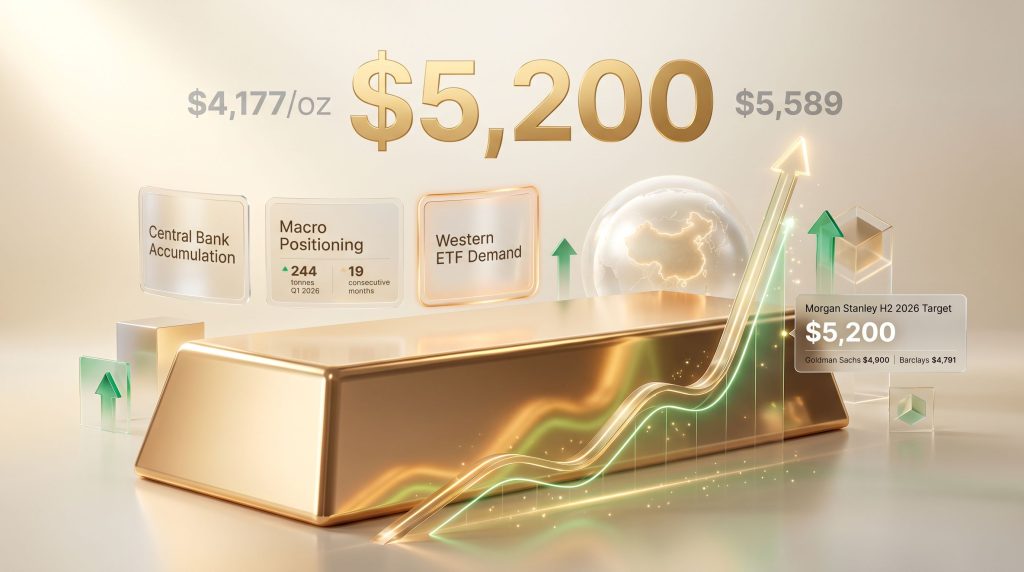
That framework explains why the Morgan Stanley gold price target of $5,200 for the second half of 2026 is generating serious institutional attention, even as gold trades roughly 25% below its January 2026 all-time high of $5,589/oz. As of late June 2026, spot gold is changing hands near $4,177/oz — yet the year-over-year gain still sits at approximately 28%. The correction has been sharp, but the structural context is not broken. It is suspended, waiting on one specific catalyst.
Morgan Stanley's commodities research team has identified exactly which catalyst that is, and why its arrival depends on a sequence of macro events rather than a single policy decision.
When big ASX news breaks, our subscribers know first
Why the $5,200 Target Is a Conditional Thesis, Not a Price Prediction
It is worth establishing what the Morgan Stanley gold price target of $5,200 actually represents. The bank simultaneously published a base-case 2026 forecast of approximately $4,400/oz, which means $5,200 is the upside scenario, not the central expectation. That distinction matters enormously for investors who read institutional targets as consensus views.
The $5,200 figure also reflects a revision downward from an earlier target of $5,700, updated after gold's correction gathered momentum. This is not institutional capitulation — it is a recalibration of timing assumptions. The underlying thesis remains intact: the conditions required to reach $5,200 are possible within 2026, but they depend on a sequence of events unfolding in the right order.
Furthermore, the gold price forecast context across Wall Street reveals a wide spread of institutional views. Here is where the broader picture stands as of late June 2026:
| Institution | 2026 Gold Target | Notable Characteristic |
|---|---|---|
| Morgan Stanley | $5,200 (H2 2026 upside) | Conditional on ETF demand return |
| Goldman Sachs | $4,900 (year-end) | Revised down from prior higher target |
| JPMorgan | Maintained prior target | No revision post-correction |
| Barclays | $4,791 | Fair-value framework held through correction |
The $1,400 spread between the most and least bullish institutional forecasts is not noise. It reflects fundamentally different conclusions about which demand category is gold's primary price driver right now.
Mapping the Three Structural Forces Behind Gold Demand
Gold demand operates through three distinct categories. Each runs on a different time horizon, each responds to different triggers, and each is currently in a different state of activity.
Engine One: Sovereign and Official Sector Buying
Central banks, reserve managers, and sovereign wealth funds operate on timescales that make quarterly earnings cycles look short-term. Their gold allocation decisions are governed by three core criteria, consistently identified in World Gold Council research: safety (no counterparty risk), liquidity (globally traded with deep markets), and portfolio diversification away from dollar-denominated reserve assets.
The data from 2026 shows this engine running at historically elevated levels. Central bank gold buying has been particularly notable across the following metrics:
- The People's Bank of China added approximately 9.95 tonnes in May 2026, the largest single monthly purchase in 16 months, extending its buying streak to 19 consecutive months
- Since resuming purchases in November 2024, the PBOC has accumulated approximately 67 tonnes in total
- Gold now represents roughly 9% of China's total foreign exchange reserves, according to World Gold Council and Bloomberg data
- Global central banks collectively purchased an estimated 244 tonnes in Q1 2026, exceeding both the prior quarter and the five-year average, per World Gold Council data
- A record 45% of central banks globally indicated plans to increase their gold allocations over the next 12 months in the most recent World Gold Council survey
What makes this data analytically significant is the context in which it occurred. The PBOC continued buying through three consecutive months of declining gold prices. Reserve managers operating on multi-decade time horizons are not reacting to a chart. They are responding to something structural about the monetary system — specifically, the strategic logic of reducing dependence on dollar-denominated assets at scale.
This is the demand category that does not reverse on a single FOMC decision. It is being built by institutions with 20-year investment horizons, accelerating through price weakness, not retreating from it.
Engine Two: Institutional Macro Positioning Around Stagflation
The Bank of America Global Fund Manager Survey conducted between June 5 and June 11, 2026, covered 198 fund managers overseeing $540 billion in assets under management. Its findings are materially relevant to gold investors.
58% of respondents identified stagflation as their dominant 12-month economic outlook. Stagflation combines stagnant or deteriorating economic growth with persistent inflation — a combination that historically compresses real returns on nearly every conventional asset class simultaneously. Indeed, gold as an inflation hedge has rarely been more relevant than in this macro environment:
- Equities underperform when growth is stalling and profit margins are squeezed by elevated input costs
- Bonds lose real purchasing power when inflation outpaces yield
- Cash suffers erosion at the same rate as broader purchasing power
- Gold, which carries no counterparty risk and pays no nominal yield, loses its competitive disadvantage in a low-growth environment precisely because competing assets lose their yield advantage in real terms
The same BofA survey surfaced a second data point that receives less attention than the stagflation figure. Earlier in 2026, approximately 45% of surveyed managers described gold as overvalued — the highest such reading since 2012. That consensus has since unwound. The proportion calling gold overvalued has fallen to its lowest level since February 2024, meaning the institutional view that gold was a crowded trade has quietly reversed.
This shift matters for the price outlook because it removes a headwind. When institutional managers broadly considered gold expensive, they were unlikely to add to existing positions. With that consensus now dissolving, the marginal buyer bias within the institutional community is shifting toward accumulation.
Engine Three: Western ETF Demand — The Missing Piece
Gold exchange-traded funds are the demand category that is currently not contributing to the market, and it is precisely the one the Morgan Stanley gold price target of $5,200 depends on reactivating. Understanding physical gold vs ETFs helps clarify why these two vehicles respond very differently to the same rate environment.
Western ETF investors are primarily institutional and retail allocators who make decisions on quarterly or annual cycles. Their sensitivity to the Federal Reserve is direct and well-documented. The mechanism works as follows:
- The Federal Reserve signals additional monetary tightening
- Nominal and real Treasury yields rise in response
- The opportunity cost of holding non-yielding gold increases relative to Treasury alternatives
- ETF investors reduce gold allocations during portfolio reviews
- Net outflows from gold ETFs create selling pressure on the spot price
Following the June 16-17 FOMC meeting, Fed Chair Kevin Warsh held rates steady but indicated that further tightening may be warranted. Nine of nineteen Federal Reserve policymakers projected at least one additional rate hike before year-end, with markets pricing a potential move as early as October 2026. The 10-year nominal Treasury yield rose to approximately 4.48% in the aftermath, while 10-year TIPS real yields are running at approximately 2.2% — a meaningful hurdle for any non-yielding asset to clear in a quarterly portfolio review.
Morgan Stanley's own rate cut expectations are anchored to January and March 2027, which means the full ETF catalyst may not materialise until early next year. The $5,200 target for H2 2026 would require that timeline to compress.
The Mechanism That Could Reactivate ETF Buying Before Year-End
Morgan Stanley's research identifies a specific chain of events that could bring ETF demand back online sooner than the baseline Fed timeline suggests. The sequence begins with energy prices.
When Middle East tensions drove oil prices higher earlier in 2026, oil-importing central banks faced a compounding problem. Higher energy costs inflated their import bills simultaneously while their currencies weakened. Some were consequently forced to liquidate gold reserves to defend their fiscal positions, creating a structural headwind within the official sector itself. That is a rarely discussed dynamic: sovereign gold selling, not from a change in long-term strategy, but from short-term balance of payments pressure driven by energy costs.
With Brent crude falling below $80 per barrel in June 2026 following Middle East de-escalation, that pressure is reversing. The downstream effect on gold's price path runs through the following sequence:
| Trigger | Mechanism | Gold Market Impact |
|---|---|---|
| Brent crude below $80/barrel | Reduces headline inflation readings | Lowers probability of additional Fed hikes |
| Softer inflation data | Weakens case for higher-for-longer rates | Compresses real yield expectations |
| Lower real yields | Reduces opportunity cost of holding gold | ETF inflows resume |
| Weaker U.S. dollar | Improves gold's relative value globally | Broadens demand base internationally |
| Markets pricing 2027 Fed cuts | Confirms rate cycle turning point | Institutional re-allocation to gold accelerates |
The $5,200 thesis is not a standalone price call. It is a forecast that this specific sequence of macro events will complete before December 2026.
Why Hawkish Fed Policy Does Not Automatically Suppress Gold
The assumption that Federal Reserve rate hikes are categorically negative for gold is among the most persistent misunderstandings in precious metals analysis. The full historical record does not support it as a reliable rule.
Morgan Stanley's research notes that gold has averaged a +0.84% return in the month following a 25-basis-point rate hike. That is a modest figure, but its direction contradicts the dominant narrative. Three historical episodes are particularly instructive:
| Period | Fed Action | Gold's Response | Driving Factor |
|---|---|---|---|
| June 2006 | Rate hike | Gold rallied | Post-hike growth concerns emerged |
| December 2018 | Rate hike | Gold rallied | Policy error fears triggered safe-haven demand |
| March 2023 | Rate hike | Gold rallied | Banking system stress (SVB collapse) drove safe-haven flows |
The common thread across all three episodes is not the rate hike itself. It is the consequence of the hike: when tightening triggers growth fears, policy error concerns, or acute financial system stress, investors seek real asset protection even as nominal rates rise. Gold's non-yielding characteristic becomes less of a competitive disadvantage precisely when the assets that do yield are perceived as more risky.
The current environment contains elements of that dynamic. Nine of nineteen Fed policymakers are projecting additional tightening into an economy where 58% of major fund managers already expect stagflation. If the Fed hikes into deteriorating growth conditions, the historical pattern suggests gold could benefit from that move rather than suffer from it.
Physical Gold vs. ETF Exposure: Why the Distinction Matters Now
The ETF outflow dynamic that has weighed on spot gold prices since January 2026 affects financial instrument holders very differently from investors who hold allocated physical metal directly.
Gold ETFs provide exposure to the gold price but typically do not confer legal ownership of a specific, identifiable bar of metal held in the investor's name. When ETF investors reduce positions, they are adjusting a financial instrument — a transaction that occurs within the fund structure and does not represent the same kind of commitment as acquiring physical metal.
Physical gold held in allocated, segregated vault storage gives the holder direct, unencumbered legal title with no counterparty exposure. The metal is not an asset of the custodian or fund operator. It cannot be claimed in insolvency proceedings against the fund. It does not respond to quarterly portfolio rebalancing decisions made by other investors in the same product.
| Factor | Physical Gold (Allocated Storage) | Gold ETF |
|---|---|---|
| Legal ownership | Direct title to specific metal | Share in a fund vehicle |
| Counterparty risk | None | Fund operator and custodian |
| Annual storage cost (example) | ~$72/year on $10,000 position | ~$25/year (at 0.25% ETF fee) |
| Physical delivery rights | Available on request | Cash settlement only |
| Insolvency protection | Metal is legally yours | Subject to fund insolvency risk |
| Sensitivity to ETF outflow cycles | Not affected | Directly affected |
The approximately $47 annual difference in holding costs between allocated physical storage and a low-cost ETF buys meaningful structural differences in legal title, delivery rights, and independence from fund-level flows. For investors whose thesis is long-term monetary hedging rather than quarterly portfolio optimisation, these distinctions are not trivial. In addition, the gold and bond dynamics at play in 2026 further reinforce why physical ownership offers structural insulation that financial instruments cannot replicate.
Central banks acquiring 244 tonnes in Q1 2026 are obtaining physical metal with zero counterparty risk. ETF investors reducing quarterly allocations are adjusting financial exposure. These are not equivalent activities, and they will not respond to the same catalysts.
The next major ASX story will hit our subscribers first
The Signal Hierarchy: What to Watch for the Rest of 2026
For investors tracking whether the conditions for the Morgan Stanley gold price target of $5,200 are materialising, the following indicators carry the most analytical weight. Kitco's analysis of Morgan Stanley's positioning provides additional context for how these signals are being interpreted across institutional desks:
- Brent crude oil price: Sustained movement below $80/barrel feeds into inflation expectations and relieves pressure on oil-importing central banks that were previously selling gold
- PCE inflation readings: The Federal Reserve's preferred inflation gauge — softening prints directly reduce the probability of an October 2026 rate hike
- 10-year TIPS real yields (FRED: DFII10): The most direct measure of gold's opportunity cost relative to Treasury alternatives; directional shifts matter more than absolute levels
- Weekly gold ETF flow data: Published by the World Gold Council; net inflow resumption would be the earliest confirmation that Western institutional demand is returning
- FOMC communications: Any revision to the nine-of-nineteen projection for additional hikes would materially alter the ETF timeline
- 2027 rate cut pricing: Markets beginning to price January and March 2027 cuts represent the most powerful single catalyst for institutional ETF re-engagement with gold
The structural floor beneath the gold price is not in question. It is being built by sovereign buyers and macro-oriented fund managers whose time horizons extend decades beyond the current rate cycle. The variable is timing — specifically, how quickly the energy, inflation, and rate expectations sequence resolves in favour of the missing demand engine.
Furthermore, gold's role as an inflation hedge remains a foundational consideration for long-term allocators, regardless of whether the $5,200 upside scenario resolves in H2 2026 or slides into early 2027. Whether gold reaches $5,200 in H2 2026 or consolidates near current levels into early 2027 depends on that sequencing. The structural thesis does not change either way.
This article is for informational purposes only and does not constitute financial or investment advice. Precious metals investing involves risk, including the possible loss of principal. Past performance is not indicative of future results. Consult a qualified financial adviser before making any investment decisions.
Want to Capitalise on the Next Major ASX Mineral Discovery Before the Broader Market?
Discovery Alert's proprietary Discovery IQ model delivers real-time alerts on significant ASX mineral discoveries, instantly transforming complex mineral data into actionable investment insights for both short-term traders and long-term investors — explore historic discoveries and their remarkable returns, then begin your 14-day free trial to position yourself ahead of the market.