July 29, 2026
The Macro Architecture Behind Gold's Pre-FOMC Pause
Few financial instruments reveal the inner psychology of markets quite like gold. As a non-yielding asset with no earnings, no dividends, and no coupon, its price is almost entirely a function of what investors believe about the future: future inflation, future interest rates, future geopolitical stability, and the future credibility of monetary policy. That makes gold uniquely sensitive to moments of collective uncertainty, and no moment produces more collective uncertainty than a Federal Open Market Committee (FOMC) meeting day.
When gold holds steady ahead of a Fed rate decision, it is not indifference. It is deliberate restraint. Traders are not selling because the downside case is unconfirmed. They are not buying because the upside catalyst has not yet materialised. The result is the kind of lateral price action that looks quiet on a chart but masks significant positioning tension beneath the surface.
When big ASX news breaks, our subscribers know first
Understanding Why Pre-FOMC Sessions Produce Lateral Price Action
The mechanics behind pre-decision gold consolidation are rooted in risk management, not fundamental shifts. Institutional traders systematically reduce directional exposure ahead of binary events, knowing that the Fed can produce four or five distinct market outcomes depending on the rate decision itself and the language used to communicate it.
This pre-meeting compression is well-documented across multiple rate cycles. Gold's realised volatility typically contracts in the 24 to 48 hours before an FOMC announcement, then expands sharply in the 30 to 90 minutes following the Chair's press conference. The decision itself is the starting gun, but the Chair's language is the race.
"The near-term direction of gold is rarely determined by the rate decision itself. The Fed's tone, updated projections, and policy signalling carry significantly greater market weight than the basis point arithmetic of any single meeting."
The Three Transmission Channels That Shape Gold's Next Move
To understand where gold is headed after any Fed decision, three interconnected transmission channels must be tracked simultaneously.
How Does the U.S. Dollar Index Affect Gold?
The U.S. Dollar Index (DXY) is the first critical channel. Gold is priced globally in U.S. dollars. A stronger dollar raises the effective cost of gold for buyers transacting in other currencies, which reduces international demand and typically suppresses the spot price. A weakening dollar has the inverse effect, broadening gold's accessible buyer pool and providing price support.
What Role Do Real Yields Play?
Real yields, calculated by subtracting the inflation rate from nominal Treasury yields, represent the true opportunity cost of holding gold. When real yields are positive and rising, interest-bearing assets become structurally more attractive than a zero-yield metal. When real yields compress or turn negative, gold's relative appeal strengthens considerably. Furthermore, the gold-bond dynamics at play during any rate cycle remain one of the most closely watched relationships in global macro investing.
Why Does Forward Guidance Matter?
The Fed's Summary of Economic Projections, which includes the dot plot showing individual policymakers' rate expectations, often moves markets more than the headline decision. A dovish shift in the projected rate path reduces future real yield expectations and can catalyse a meaningful gold rally even if rates are held steady today. Consequently, this is where the gold price forecast for the remainder of the year becomes particularly relevant for investors monitoring directional signals.
What Markets Are Currently Pricing In
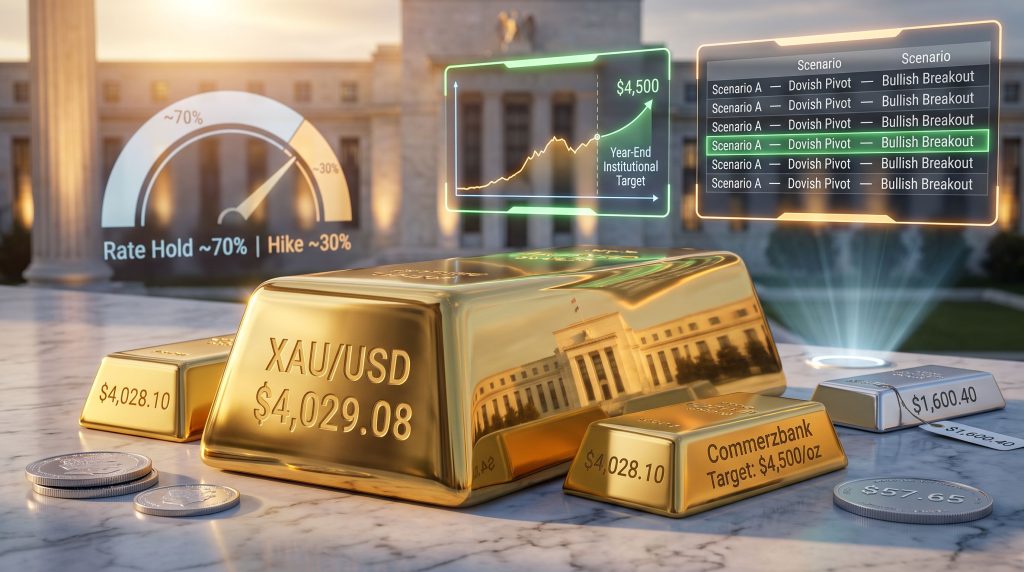
According to the CME FedWatch tool, market-implied probabilities ahead of this meeting show a roughly 70% likelihood of a rate hold and a 30% probability of a 25 basis point hike. These probabilities carry specific implications for gold:
| Scenario | Market Probability | Implied Gold Reaction |
|---|---|---|
| Rates held steady | ~70% | Neutral to mildly bullish |
| 25 bps hike | ~30% | Short-term bearish pressure |
| Dovish forward guidance | Variable | Potentially bullish breakout |
| Hawkish tone despite hold | Variable | Renewed bearish bias |
Importantly, markets are simultaneously pricing in a 76% probability of a rate increase at the September meeting. This forward-looking expectation is functioning as a ceiling on gold's upside, even in a hold scenario. Traders are not responding to today's decision in isolation; they are pricing the entire projected rate path.
This dynamic is critical for investors to understand. A hold today accompanied by language that reinforces September tightening expectations would likely be read as a hawkish hold, which tends to be more bearish for gold than an outright hike that signals the end of a tightening cycle.
Current Price Structure Across Precious Metals
Spot gold (XAU/USD) was trading at approximately $4,029.08 per ounce in early Asian session trade, with U.S. gold futures for August delivery slipping 0.2% to $4,028.10. The negligible spread between spot and front-month futures reflects subdued near-term volatility expectations, consistent with the pre-FOMC positioning pattern described above. According to reporting from Business Times, gold prices have remained near record highs as markets await the Fed's decision.
The broader precious metals complex tells a nuanced story:
| Metal | Recent Price | Movement |
|---|---|---|
| Silver (XAG/USD) | $57.65/oz | +0.9% |
| Platinum (XPT/USD) | $1,600.40/oz | +0.3% |
| Palladium | $1,261/oz | -0.7% |
Silver's outperformance relative to gold on a percentage basis is notable. Silver carries a hybrid demand profile, with roughly half of annual consumption driven by industrial applications including solar panel manufacturing and electronics. When industrial demand signals remain constructive, silver can decouple modestly from gold's purely monetary price drivers. In addition, monitoring the gold-silver ratio provides further context on relative value between the two metals during periods of policy uncertainty.
Commerzbank has revised its year-end gold price forecast to $4,500 per troy ounce, while projecting silver to reach $67 per troy ounce by the close of the year. These institutional targets suggest that sell-side analysts are treating near-term Fed-driven volatility as a transient feature rather than a structural inflection point for the metals complex.
Why Fed Rhetoric Matters More Than the Rate Decision Itself
Gold's sensitivity to Fed communication rather than Fed action reflects a fundamental characteristic of the asset: it is a non-yielding instrument. When the Fed signals a more aggressive rate path, each additional basis point of expected tightening increases the yield advantage of competing assets, mechanically raising the opportunity cost of gold ownership.
The inverse relationship functions as follows:
- Rising real yields make Treasury bonds and money market instruments more competitively attractive versus gold
- A softening in rate guidance reduces the projected yield advantage of interest-bearing assets
- This reduction in opportunity cost lowers the implicit penalty for holding gold, increasing its relative attractiveness
- The effect is amplified when currency markets simultaneously price in dollar weakness in response to a less hawkish Fed
"Gold functions simultaneously as a monetary hedge against currency debasement and a geopolitical hedge against systemic risk. This dual-demand structure means that two entirely distinct investor cohorts can drive buying simultaneously, creating price floors even during environments of elevated interest rates."
The next major ASX story will hit our subscribers first
Geopolitical Risk as a Secondary Price Support Layer
Beyond monetary policy mechanics, geopolitical escalation has added a secondary dimension to gold's current price support structure. U.S. military forces intercepted multiple ballistic missiles launched from Iran targeting American positions in the Middle East, with Iran's Revolutionary Guards subsequently confirming strikes on a U.S. air base and a U.S. Central Command facility in Jordan.
Historically, geopolitical shock events produce sharp but short-duration gold price spikes, followed by gradual normalisation unless escalation is sustained or broadens into a wider regional conflict. The critical distinction for investors is between a geopolitical spike (a temporary risk premium) and a geopolitical bid (a sustained repricing of systemic risk). Understanding gold safe-haven demand in this context helps distinguish between temporary and structural price support.
Oil prices edged higher on the back of shrinking U.S. crude inventory levels, a development that carries an indirect implication for gold. Rising energy prices feed into consumer price inflation, reinforcing the inflation narrative that underpins gold's role as a monetary hedge. This creates a secondary demand channel that can sustain bullion interest even when rate expectations are hawkish.
The Multi-Central-Bank Context: Bank of England and Bank of Japan
Gold's FOMC-driven price dynamics do not occur in isolation. The Bank of England and Bank of Japan are both widely expected to maintain their current rate settings in decisions scheduled later in the week. A synchronised hold across major central banks reduces the cross-currency interest rate differentials that typically create dollar strength, which in turn provides a more supportive environment for gold pricing.
When major central banks are in policy alignment or a period of uncertainty, gold tends to consolidate rather than sell off aggressively. Central bank gold demand remains a structurally important driver, particularly when coordinated global policy uncertainty keeps institutional buyers active. Coordinated global hawkishness across the Fed, Bank of England, and Bank of Japan simultaneously would represent the primary structural risk to bullion.
Scenario Modelling: Four Post-FOMC Outcomes
Traders and investors are effectively managing four distinct probability-weighted scenarios heading into the decision:
| Scenario | Fed Action | Tone | Likely Gold Response |
|---|---|---|---|
| Scenario A | Hold | Dovish pivot signal | Bullish breakout above resistance |
| Scenario B | Hold | Hawkish hold (higher for longer) | Mild sell-off, bearish bias reinforced |
| Scenario C | 25 bps hike | Signals end of cycle | Mixed: initial drop with recovery potential |
| Scenario D | 25 bps hike | Open-ended tightening language | Sharply bearish near-term |
The most underappreciated scenario in this matrix is Scenario C. If the Fed delivers a hike but simultaneously signals that this represents the terminal rate of the current cycle, the initial bearish reaction in gold could reverse quickly. Markets have historically bought gold on confirmation that a tightening cycle has peaked, anticipating the eventual pivot toward accommodation that follows.
Institutional year-end targets of $4,500 per ounce from Commerzbank imply that the base case among some sell-side analysts is a path toward reduced tightening pressure, creating room for gold to appreciate meaningfully from its current consolidation range of approximately $4,028 to $4,030. However, as Reuters notes, gold has edged higher as rate hike fears begin to ease ahead of the Fed's final determination.
Frequently Asked Questions: Gold and the Federal Reserve
Why Does Gold Hold Steady Before Fed Decisions?
Pre-FOMC sessions are characterised by reduced directional conviction. Institutional traders systematically reduce position size ahead of binary policy outcomes, producing the lateral price action commonly described as gold holds steady ahead of a Fed rate decision. This behaviour reflects risk management discipline, not a fundamental reassessment of gold's value.
Does a Fed Rate Hike Automatically Push Gold Lower?
Not necessarily. If a rate hike is widely anticipated and already reflected in market pricing, the actual announcement can produce a muted or even counterintuitively bullish reaction. Markets trade expectations, not just events. A hike that confirms the end of a tightening cycle can be more bullish for gold than a hold accompanied by aggressive forward tightening language.
What Is the Relationship Between Real Yields and Gold?
Real yields represent nominal interest rates minus inflation. When real yields rise, the opportunity cost of holding a non-yielding asset like gold increases. When real yields compress, gold's relative attractiveness improves. This relationship is one of the most reliable medium-term predictors of gold price direction.
Is Gold's Inflation Hedge Function Still Intact in a High-Rate Environment?
Gold's inflation hedge thesis remains structurally valid, but it competes directly with real yield dynamics. The key variable is not the inflation rate alone but the gap between inflation and interest rates. When that gap closes in gold's favour, the hedge narrative strengthens. When positive real rates dominate, gold faces structural headwinds regardless of the inflation backdrop.
Reading Gold's Stability as a Policy Barometer
The current stability in gold prices ahead of the Fed decision is best interpreted not as a lack of interest but as disciplined positioning under conditions of maximum uncertainty. Investors are holding exposure without extending it, waiting for the information required to make high-conviction directional bets.
What the price action communicates is that neither the bull nor the bear case has been conclusively confirmed. Sellers are not willing to press aggressively against a backdrop of geopolitical risk, potential dollar weakness, and globally synchronised policy uncertainty. Buyers are not willing to pay up ahead of a decision that could reinforce hawkish expectations for September.
The resolution of that tension will come from the language used in the press conference, not the basis points on the rate announcement itself. For gold, as always, rhetoric is the more powerful variable.
Disclaimer: This article is intended for informational purposes only and does not constitute financial advice. All price levels, probability figures, and institutional forecasts referenced reflect conditions at the time of reporting and are subject to change. Forecasts and scenario projections involve inherent uncertainty and should not be interpreted as guarantees of future performance. Readers should conduct independent research and consult a qualified financial adviser before making investment decisions.
Want to Capitalise on the Next Major Mineral Discovery Before the Broader Market?
Discovery Alert's proprietary Discovery IQ model delivers real-time alerts on significant ASX mineral discoveries, transforming complex geological data into actionable investment insights for traders and investors at every experience level — start your 14-day free trial today and explore Discovery Alert's discoveries page to understand why historic mineral discoveries have generated extraordinary market returns.