July 29, 2026
The Quiet Compounders: Why Operational Reliability Is the Most Underrated Edge in Gold Mining
In a sector defined by geological uncertainty, commodity volatility, and execution risk, the most durable competitive advantage a gold producer can possess is rarely the flashiest. It is not the discovery of a world-class deposit or a single quarter of record output. It is the methodical, repeated ability to do exactly what was promised, year after year, while keeping costs under control and capital allocated intelligently.
This is the framework through which the Ramelius Resources June quarter results deserve to be examined. The numbers themselves are significant. But the pattern behind them — six consecutive years of production guidance delivery, a cash-generative balance sheet with zero debt, and a credible pathway to more than doubling annual output by FY30 — tells a more compelling structural story about what kind of business Ramelius Resources (ASX: RMS) has become.
When big ASX news breaks, our subscribers know first
June Quarter 2026: Production, Cash Flow, and Cost Performance
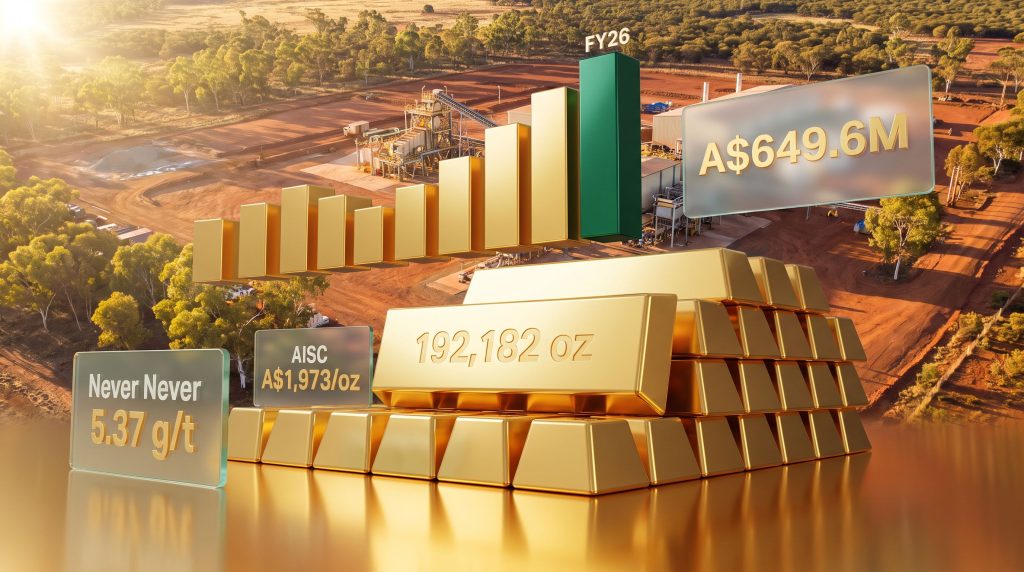
The June 2026 quarter represented the strongest production period of FY26 for Ramelius, with group gold output of 53,466 ounces at an all-in sustaining cost (AISC) of A$1,973 per ounce. This quarterly result was roughly 40% higher than the prior quarter, driven primarily by the processing of high-grade ore from the Never Never underground mine at Mt Magnet rather than any temporary operational windfall.
Key Production and Financial Metrics at a Glance
| Metric | June Quarter FY26 | Full Year FY26 |
|---|---|---|
| Gold Production (oz) | 53,466 | 192,182 |
| AISC (A$/oz) | $1,973 | $1,983 |
| Operating Cash Flow | $191.2 million | N/A |
| Underlying Free Cash Flow | $138.3 million | N/A |
| Cash and Gold Balance | $649.6 million | N/A |
| Share Buybacks Completed | $140.7 million (56% of program) | N/A |
| Interim Dividend | 3 cents per share (fully franked) | N/A |
Full-year FY26 production of 192,182 ounces landed comfortably within the stated guidance range of 185,000 to 205,000 ounces. The full-year AISC of A$1,983 per ounce is particularly notable given persistent cost inflation across the Australian mining sector, where labour, energy, and consumables have continued to pressure operating margins industry-wide.
Six Consecutive Years of Guidance Delivery: What This Signals to Investors
Operational consistency of this calibre is rarer than it appears. The mining industry is littered with examples of companies that set aspirational guidance only to revise it downward mid-year due to geotechnical surprises, equipment failures, or processing bottlenecks. Ramelius has now navigated six full financial years without that outcome.
Why Guidance Delivery Matters Beyond the Number Itself
- Investor trust compounds over time. Each year of guidance delivery reduces the discount rate investors implicitly apply to forward estimates, which supports valuation multiples.
- It reflects deep operational knowledge. Consistently accurate guidance requires genuine understanding of ore body behaviour, processing variability, and maintenance cycles across multiple operating hubs.
- It creates predictability for capital allocation. Management can plan exploration, expansion, and capital returns programs with confidence because the production base is reliable.
- It differentiates Ramelius from higher-volatility peers. Mid-tier ASX gold producers with inconsistent delivery records often trade at structural discounts, regardless of asset quality.
The AISC Discipline Argument
Keeping AISC below A$2,000 per ounce across a full financial year, in the current Australian cost environment, represents meaningful cost discipline. To understand why this matters, consider the margin mathematics:
| Scenario | Australian Gold Price (A$/oz) | AISC (A$/oz) | Margin (A$/oz) |
|---|---|---|---|
| Current Ramelius | ~$5,000+ | $1,983 | ~$3,000+ |
| Peer at $2,300 AISC | ~$5,000+ | $2,300 | ~$2,700+ |
| Downside scenario (-20% gold) | ~$4,000 | $1,983 | ~$2,000 |
| High-cost peer in downturn | ~$4,000 | $2,300 | ~$1,700 |
Note: Gold price figures are illustrative of the margin differential concept and should not be treated as price forecasts.
The buffer created by sub-$2,000 AISC means Ramelius can sustain meaningful free cash flow across a wider range of gold price scenarios than higher-cost competitors. Furthermore, the gold price outlook for Australian producers remains broadly supportive, reinforcing why cost discipline at this level carries strategic weight.
Balance Sheet Strength: Zero Debt, A$649.6 Million, and Capital Returns
At the end of the June 2026 quarter, Ramelius held a cash and gold balance of A$649.6 million, up from A$606.5 million at the end of the March quarter. The company carries approximately A$100 million in listed investments alongside this position and holds zero debt.
A gold producer with no debt obligations, nearly A$650 million in liquid assets, and a completed share buyback exceeding A$140 million occupies a structurally different risk position than most of its mid-tier peers. The balance sheet is not merely a safety net; it is a strategic weapon for growth.
Capital Returns Framework
The combination of capital returns deployed during FY26 reflects management's confidence in the durability of the business's cash generation:
- Share buybacks: A$140.7 million completed, representing 56% of the announced buyback program.
- Dividends: A fully franked interim dividend of 3 cents per share was distributed during the period.
- The buyback program, in particular, signals that management views the current share price as an attractive use of surplus capital, rather than accumulating cash beyond what is needed for growth investment.
The Never Never Mine: Understanding the Tier 1 Transformation Thesis
Among the most technically significant developments in the Ramelius Resources June quarter results is the first full quarter of ore processing from the Never Never underground mine at the Mt Magnet hub. This is not a marginal operational update; it represents the beginning of a structural grade transformation at Mt Magnet.
Processing Performance in the Quarter
During the June quarter, the Mt Magnet hub processed 146,000 tonnes of Never Never ore at a grade of 5.37 grams per tonne (g/t). To contextualise this figure, the global average open-pit gold mine operates at grades typically below 1.5g/t, while underground operations above 4g/t are considered high-grade by industry standards.
Management has indicated that at targeted production of 1 million tonnes per annum (Mtpa), with ore grades exceeding 7g/t, the Never Never mine is expected to elevate Mt Magnet to Tier 1 status. Investors interested in how such developments influence gold equities performance will find the grade trajectory at Never Never particularly relevant.
What Defines a Tier 1 Gold Operation?
| Characteristic | Typical Tier 1 Threshold |
|---|---|
| Annual Production | 250,000+ ounces |
| Mine Life | 10+ years |
| AISC | Below industry average |
| Reserve Grade | Consistently above 3 to 4g/t |
| Processing Capacity | Scalable infrastructure |
Never Never's projected grades of 7g/t and above would place it well above the reserve grade thresholds typically associated with Tier 1 classification. To put the grade differential in practical terms: an ore body at 7g/t produces roughly four to five times the gold per tonne processed compared to a 1.5g/t open-pit operation, dramatically improving cost per ounce recovered and mill utilisation economics.
The Mt Magnet Plant Upgrade: Throughput Leverage
The ongoing plant upgrade at Mt Magnet is targeting processing capacity of 4.3 million tonnes per annum (Mtpa) by FY28. Once Never Never reaches full run-rate production and the expanded plant capacity comes online, the combination of higher throughput and elevated head grades creates multiplicative leverage on gold output. This is the mechanism behind the company's broader FY30 production target.
Capital Allocation Strategy: Growth Investment and Portfolio Rationalisation
Ramelius deployed A$42.1 million in growth capital expenditure during the June quarter, directed toward the Mt Magnet plant upgrade and Dalgaranga site works. Exploration spending reached A$33.9 million for the quarter alone, with the FY27 exploration budget earmarked at A$90 to A$110 million.
This dual-track approach — simultaneously executing near-term production growth while sustaining heavy exploration investment to extend the resource base — is relatively unusual among mid-tier producers, many of which prioritise one at the expense of the other. When interpreting drill results from such an active exploration programme, investors should pay close attention to grade consistency and the proximity of new intercepts to existing infrastructure.
Edna May Hub Divestment: Concentrating the Portfolio
Ramelius completed a A$300 million agreement to divest the Edna May hub, with settlement expected in the September 2026 quarter. Upon completion, the company will become a major shareholder in Forrestania Resources.
This divestment reflects a deliberate portfolio concentration strategy. By exiting a lower-grade, higher-cost asset, Ramelius redirects operational focus and capital toward Mt Magnet and other higher-grade, higher-margin assets. In mining finance, this type of rationalisation is often undervalued by the market at announcement but tends to be rewarded over subsequent reporting periods as the improved portfolio quality becomes visible in margins. Broader Australian gold M&A trends suggest this kind of portfolio pruning is becoming increasingly common among mid-tier producers seeking to sharpen their competitive positioning.
The next major ASX story will hit our subscribers first
The FY30 Production Target: Pathways to 500,000 Ounces
Management has publicly outlined a target of more than 500,000 ounces of annual gold production by FY30. With FY26 production of 192,182 ounces, the company needs to more than double output over approximately four years. The key growth levers required to achieve this are:
- Never Never underground mine reaching full production at 1Mtpa, with grades exceeding 7g/t.
- Mt Magnet plant capacity expansion to 4.3Mtpa completed by FY28.
- Rebecca-Roe project regulatory approvals advancing toward development decision.
- Ongoing high-grade exploration success converting resources into reserves across active hubs.
- Full-year FY27 guidance and an extended FY30 outlook expected to be released in the September 2026 quarter.
Rebecca-Roe: The Development Pipeline's Next Horizon
The Rebecca-Roe project represents a potential future production source beyond the existing hub network. Regulatory approvals are advancing, though the timeline for development decisions remains subject to the inherent uncertainty of approval processes. Investors should treat this as a medium-term optionality component of the Ramelius growth story rather than a near-term production catalyst.
However, should Rebecca-Roe proceed to development, it would likely require the completion of a definitive feasibility study to underpin the capital commitment — a process that adds rigour to the investment case but also introduces timeline variability.
Share Price Context: 17% Versus 3%
Over the 12 months to the date of the quarterly report, Ramelius Resources shares appreciated approximately 17%, compared to a return of approximately 3% for the S&P/ASX 200 Index (ASX: XJO) over the same period. This represents outperformance of approximately 14 percentage points relative to the broader market.
This outperformance reflects both the tailwind of elevated Australian dollar gold prices and increasing investor recognition of Ramelius' operational consistency, balance sheet strength, and credible growth pathway. However, markets are forward-looking, and the question for investors is whether the current price adequately reflects the FY30 growth optionality or has already begun to price it in. Investors seeking further detail can review the company's official reports directly from the Ramelius Resources website.
Past share price performance does not indicate or guarantee future returns.
Key Risks and Considerations for Investors
No growth thesis is without risk. The following factors warrant careful consideration before any investment decision:
- Gold price sensitivity: Even at sub-$2,000 AISC, a sustained and significant decline in the Australian dollar gold price would compress margins and free cash flow generation.
- Never Never ramp-up execution: Achieving 1Mtpa at 7g/t grades requires successful geological and operational execution across an underground mining environment that carries inherent variability.
- Exploration conversion risk: The FY27 exploration budget of A$90 to A$110 million is substantial, but exploration expenditure does not guarantee the conversion of inferred resources to measured reserves at projected grades or economics.
- Regulatory timing uncertainty: The Rebecca-Roe project's development timeline depends on regulatory processes that are difficult to predict with precision.
- Edna May settlement conditions: The A$300 million divestment remains subject to completion conditions and counterparty execution risk until formally settled.
- Grade variability in underground mining: Underground ore bodies, even high-quality ones like Never Never, can exhibit grade variability that differs from resource models. This is a routine feature of underground mining rather than a unique risk, but it bears monitoring through quarterly reporting.
Important Disclaimer: This article contains general information only and does not constitute financial or investment advice. Investors should conduct their own independent due diligence and consider consulting a licensed financial adviser before making any investment decisions. Past performance is not necessarily indicative of future results.
Frequently Asked Questions: Ramelius Resources June Quarter 2026
What was Ramelius Resources' gold production in the June 2026 quarter?
Ramelius produced 53,466 ounces of gold in the June 2026 quarter at an all-in sustaining cost of A$1,973 per ounce, representing the strongest quarterly output of FY26.
Did Ramelius Resources meet its FY26 production guidance?
Yes. Full-year FY26 production of 192,182 ounces fell within the guidance range of 185,000 to 205,000 ounces, marking the sixth consecutive year of guidance delivery.
How much free cash flow did Ramelius generate in the June quarter?
Ramelius generated A$138.3 million in underlying free cash flow and A$191.2 million in operating cash flow during the June 2026 quarter. For additional context on these figures, the investor presentations page on the Ramelius website provides supplementary materials from management.
What is the Never Never mine and why is it important?
Never Never is a high-grade underground gold mine within the Mt Magnet hub in Western Australia. The first full quarter of ore processing delivered 146,000 tonnes at 5.37g/t. At targeted production of 1Mtpa with grades exceeding 7g/t, management expects it to elevate Mt Magnet to Tier 1 operational status — a transformation that underpins the company's FY30 production growth ambitions.
What happened to the Edna May hub?
Ramelius agreed to divest the Edna May hub for A$300 million, with settlement expected in the September 2026 quarter. The company will hold equity in Forrestania Resources upon completion, reflecting a strategic shift toward higher-grade portfolio concentration.
What is Ramelius Resources' production target for FY30?
Management has outlined a target of more than 500,000 ounces of annual gold production by FY30, supported by the Never Never mine ramp-up, the Mt Magnet plant expansion to 4.3Mtpa, and sustained organic exploration investment. The Ramelius Resources June quarter results provide the most current operational baseline from which to assess progress toward this target.
Want to Catch the Next Major ASX Gold Discovery Before the Market Does?
Discovery Alert's proprietary Discovery IQ model scans ASX announcements in real time, instantly identifying high-potential mineral discoveries across gold and beyond — turning complex data into clear, actionable insights for investors at every level. Explore how historic discoveries have delivered extraordinary returns on the Discovery Alert discoveries page, and begin your 14-day free trial today to position yourself ahead of the broader market.