
July 29, 2026
When Gold Becomes a Criminal Asset: Understanding Illegal Mining in Ecuador
Across Latin America, the intersection of commodity value and institutional weakness has repeatedly created conditions where extractive industries shift from engines of development into instruments of criminal control. Gold, with its universal liquidity, anonymity in small quantities, and ease of blending into legitimate commodity flows, has become the preferred financial tool for organised crime groups. Nowhere is this dynamic more visible, or more dangerous, than in Ecuador, where illegal mining in Ecuador has grown from a localised governance failure into a nationally recognised security emergency.
When big ASX news breaks, our subscribers know first
The Anatomy of an Illegal Mining Economy
Understanding why Ecuador became a focal point for criminal gold extraction requires examining both the commodity itself and the structural conditions that enabled its exploitation. Gold extracted through illegal artisanal and small-scale methods carries a remarkably low barrier to entry compared to drug production. The equipment is widely available, the processing chemistry is well-understood, and the resulting product moves through established commodity channels that are structurally difficult to audit.
Criminal organisations operating in Ecuador recognised this opportunity well before government agencies responded with adequate force. What began as opportunistic informal extraction by small, unaffiliated groups gradually transformed into structured operations with defined territorial control, supply chains, and processing partnerships. This evolution mirrors patterns seen in Colombia, Peru, and regions shaped by Congo mining dynamics, where gold mining shifted from subsistence activity to organised criminal revenue within a single decade.
Why Ecuador's Geography Matters
A key factor specific to Ecuador is its geography. The country's territory spans Andean highlands, Amazon lowland basin, and Pacific coastal zones, creating multiple distinct ecological and jurisdictional environments. Each presents different enforcement challenges. The Amazon's remoteness and limited road infrastructure make sustained state presence costly and logistically difficult.
Border provinces in the north share porous frontiers with Colombia, where criminal networks have decades of experience operating across international boundaries. The southern highlands carry a legacy of artisanal mining that predates modern regulatory frameworks, creating ambiguity that criminal actors exploit deliberately.
The Scale of the Problem: Key Data Points
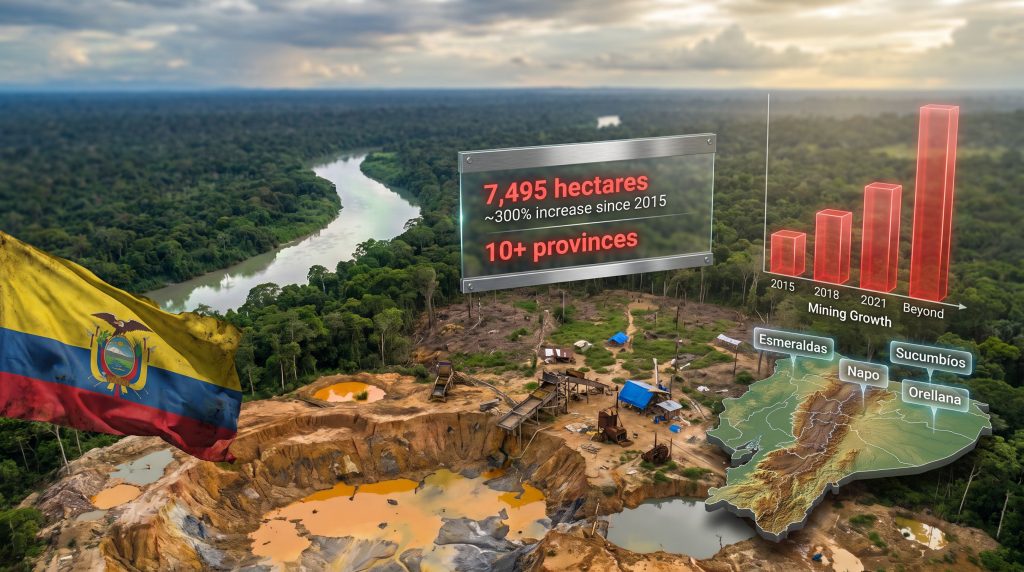
The quantitative picture of illegal mining's growth in Ecuador is striking. By 2021, the documented footprint of illegal gold mining activity covered approximately 7,495 hectares, representing a growth of roughly 300% compared to 2015 coverage levels. Furthermore, since 2020 alone, overall illegal mining activity has approximately doubled. These figures likely understate the true extent, given the deliberate concealment strategies employed by criminal operators.
| Metric | Data Point |
|---|---|
| Illegal gold mining area (2021) | 7,495 hectares |
| Growth since 2015 | ~300% increase |
| Mining activity growth since 2020 | Approximately doubled |
| Provinces with confirmed activity | 10+, spanning Amazon, highlands, and border zones |
| 2026 government response | Indefinite suspension of all mining in Napo province |
The provinces most severely affected span three distinct geographic clusters: the Amazon basin provinces of Napo, Sucumbíos, and Orellana; the southern highland and border zones of Azuay, El Oro, Zamora Chinchipe, and Morona Santiago; and the northern border provinces of Esmeraldas, Imbabura, and Carchi.
Province-Level Dynamics: Where Illegal Gold Is Extracted
Amazon Basin: Remote, Under-Governed, and Exploited
The Amazon provinces represent the most complex enforcement environment in Ecuador's illegal mining crisis. In Napo province specifically, a combination of suspended concessions, revoked permits, and areas under regulatory review created a patchwork landscape where distinguishing legal from illegal operations became practically impossible. By 2026, the situation had deteriorated to the point where the Ecuadorian government ordered an indefinite suspension of all mining activity in Napo, an emergency measure reflecting the failure of incremental enforcement approaches.
Illegal operations in Sucumbíos and Orellana benefit from their overlap with Ecuador's nationally protected areas, zones where legal mining is prohibited but state surveillance infrastructure is minimal. As research on protected area mining in Ecuador documents, criminal operators treat these boundaries as irrelevant, with satellite monitoring data consistently showing extraction activity inside formally protected ecological zones.
Southern Highlands: Laundering Through Legacy Infrastructure
Ecuador's southern mining provinces carry a centuries-long tradition of artisanal gold extraction. Towns like Portovelo in El Oro province developed processing infrastructure that predates modern regulation. Criminal networks have strategically inserted themselves into this legacy ecosystem, using established processing facilities to blend illegally extracted material with legally sourced ore.
This co-mingling strategy is one of the most effective laundering mechanisms in the illegal gold supply chain because it exploits the inherent difficulty of tracing specific material once it enters a shared processing stream. In response to documented abuses, the Ecuadorian government imposed restrictions on mineral processing plants in El Oro and Loja provinces in 2026. However, enforcement of these restrictions faces the same institutional capacity constraints that have limited broader regulatory effectiveness.
Cross-border dynamics along the Peruvian frontier add another layer of complexity. Gold that crosses into Peru can re-enter international commodity markets through Peruvian export channels, further obscuring its Ecuadorian origin and the illegal conditions under which it was extracted.
Northern Border Provinces: The Colombian Spillover Effect
In Esmeraldas, Imbabura, and Carchi, the primary driver of illegal mining escalation is the proximity of Colombian criminal networks with established expertise in operating extractive industries outside state oversight. These groups bring operational knowledge, capital, and enforcement capacity that overwhelms local institutional responses. Consequently, the mining geopolitical risk in this region has become increasingly difficult for Ecuador to manage unilaterally.
Criminal Organisations and Their Roles
The criminal ecosystem sustaining illegal mining in Ecuador is not monolithic. Multiple organised crime groups have staked territorial claims over specific extraction zones, creating competitive dynamics that periodically escalate into violent confrontations.
| Criminal Group | Documented Role | Primary Geographic Focus |
|---|---|---|
| Los Lobos | Primary extraction operator; gold as revenue diversification | Amazon and border provinces |
| Los Lobos splinter group | Independent operations following internal fracture | Northern and Amazon zones |
| Los Choneros | Territorial control over mining access routes | Coastal and transitional zones |
| Los Galarza | Enforcement, supply chain protection, intermediary roles | Multiple provinces |
For criminal organisations, gold mining offers a lower-risk revenue profile than drug trafficking. Gold is a legitimate commodity, its value is universally recognised, and once processed and blended into formal supply chains, its origins become extraordinarily difficult to establish.
This risk calculus explains why criminal diversification into gold extraction has accelerated globally as drug interdiction capabilities have improved. Gold functions as a financial instrument, a store of value, and a laundering mechanism simultaneously — properties that no drug product can replicate. Understanding the broader strategic role of gold helps explain why it remains the preferred asset for both legitimate investors and criminal enterprises alike.
Environmental Destruction: The Hidden Cost of Illegal Gold
The environmental consequences of illegal mining in Ecuador extend far beyond the immediate extraction site. Mercury amalgamation, the dominant gold recovery method in artisanal and illegal operations, releases elemental mercury into surrounding waterways. Downstream river communities, many of them Indigenous populations with deep dependencies on freshwater fisheries, face compounding public health emergencies from mercury accumulation in food chains.
Scientific documentation of heavy metal contamination in Amazonian river systems connected to illegal mining zones shows mercury levels exceeding safe thresholds for human consumption at points significantly downstream from active extraction sites. This contamination is not temporary; mercury binds to sediment and bioaccumulates through trophic chains, meaning communities experience health impacts long after extraction activity ceases.
| Impact Category | Observed Outcomes |
|---|---|
| Water access | River contamination limiting safe drinking water availability |
| Food systems | Decline in fish stocks; agricultural viability reduced |
| Human health | Mercury exposure linked to neurological and developmental conditions |
| Land rights | Indigenous territorial claims displaced by illegal operators |
| Community security | Violence and intimidation from criminal mining groups |
Deforestation associated with illegal mining compounds the ecological damage. Unlike regulated mining, illegal operations have no rehabilitation obligations, and the mine reclamation challenges left behind are substantial. Mined-out zones in the Amazon experience permanent landscape alteration, as the topsoil and subsoil structure required for forest regeneration is physically removed during extraction.
The next major ASX story will hit our subscribers first
How Illegal Gold Enters Formal Supply Chains
One of the least-understood aspects of illegal mining in Ecuador is the sophistication of the laundering architecture that moves extracted material into formal commodity markets. The process typically follows a structured pathway:
- Extraction at illegal or technically suspended sites using artisanal or mechanised methods.
- Primary processing at informal facilities near extraction zones, producing crude gold or amalgam.
- Secondary processing at established facilities, often in recognised centres like Portovelo, where illegal material is co-mingled with legally sourced ore.
- Commercialisation through registered traders or exporters who, knowingly or otherwise, handle blended material.
- Export through regional commodity hubs where origin verification is limited.
The critical vulnerability in this chain is step three. Processing plant oversight is the most actionable intervention point because it represents the last moment at which illegal material can be separated from the legal supply chain before it becomes irrecoverable within global gold markets. An investigation into Ecuador's small-scale gold mining has further revealed just how deeply embedded these laundering mechanisms have become within the broader industry.
What Illegal Mining Means for Legitimate Investment
For foreign mining companies and investors evaluating Ecuador as a jurisdiction, the expansion of illegal mining creates layered risk exposures that extend beyond physical security at project sites.
Sovereign risk elevation occurs when criminal control over significant portions of a country's mineral resources demonstrates the limits of state authority. Investors conducting country risk assessments incorporate this as a negative factor in capital allocation decisions, placing Ecuador in competition with more stable jurisdictions for limited exploration and development capital.
Supply chain due diligence obligations are intensifying globally. Under frameworks including the OECD Due Diligence Guidance for Responsible Supply Chains of Minerals from Conflict-Affected and High-Risk Areas, companies purchasing Ecuadorian gold face growing verification burdens. The structural difficulty of distinguishing legal from illegal material within Ecuador's processing network means that responsible sourcing compliance carries elevated cost and reputational risk.
Emergency suspension risk represents a direct operational threat. The indefinite shutdown of all mining in Napo province demonstrates that legitimate operations can be suspended as a consequence of systemic illegal activity in the same geographic zone, regardless of individual project compliance status. This creates a form of collective punishment risk that is difficult to price into project economics at the feasibility stage.
The fiscal cost of inaction compounds over time. Gold that bypasses Ecuador's formal royalty and tax collection system represents a direct revenue loss to the state, simultaneously reducing the government's capacity to fund the enforcement and institutional reforms needed to address the crisis. These dynamics are closely tied to broader gold price drivers that continue to make gold an attractive target for criminal exploitation globally.
The Path Forward: Structural Reform Over Emergency Measures
Ecuador's trajectory on illegal mining will not be determined by emergency suspensions alone. Shutting down entire provinces temporarily displaces rather than dismantles criminal operations, which reconstitute in adjacent areas or resume activity once enforcement pressure subsides. Sustainable control requires a layered reform agenda.
Short-term priorities:
- Strengthening processing plant oversight as the most immediate supply chain intervention.
- Expanding verified state presence in high-risk Amazon and border provinces.
- Emergency community protection frameworks for Indigenous populations in directly affected territories.
Medium-term structural reforms:
- Unified licensing legislation that clearly defines the legal boundary between artisanal, small-scale, and illegal operations.
- Investment in gold traceability technology, including blockchain-based chain of custody systems piloted in other gold-producing nations.
- Anti-corruption measures targeting local regulatory and enforcement agencies, which represent the internal governance failure that illegal operators most effectively exploit.
Long-term strategic positioning:
- Developing Ecuador's identity as a responsible mining destination capable of attracting ethical institutional capital.
- Regional cooperation architecture with Colombia and Peru to close cross-border laundering pathways.
- Integrating environmental remediation commitments into the national mining development strategy as a credibility signal to international markets.
Furthermore, sustained international scrutiny — including analysis of illegal mining and gold supply chains across the region — will be essential in pressuring both governments and commodity buyers to raise traceability standards.
Ecuador's credibility as a mining investment destination over the next decade will depend not on the strength of its emergency response measures, but on whether it can build durable institutional separation between the legal mining economy and the criminal one that has grown alongside it.
Frequently Asked Questions: Illegal Mining in Ecuador
What is the current scale of illegal mining in Ecuador?
Documented illegal gold mining covered approximately 7,495 hectares in 2021, reflecting a roughly 300% expansion from 2015 levels. Since 2020, overall illegal mining activity has approximately doubled, with the Amazon provinces and northern border zones recording the most acute growth.
Which criminal groups are involved in illegal mining in Ecuador?
Organised crime groups including Los Lobos, a Los Lobos splinter faction, Los Choneros, and Los Galarza have been identified as key actors. Each plays distinct roles across extraction, territorial control, supply chain protection, and processing, creating a structured criminal economy around gold.
How does illegal gold from Ecuador reach international markets?
Illegally extracted gold typically moves through informal primary processing before entering established facilities, where it is co-mingled with legally sourced material. Weak traceability infrastructure and licensing ambiguities allow this blended output to enter domestic commercialisation and international export channels without reliable detection.
What environmental damage has illegal mining caused?
Documented impacts include widespread deforestation in Amazon provinces, mercury contamination of river systems affecting downstream communities, destruction of ecosystems within nationally protected areas, and severe public health consequences for Indigenous populations dependent on affected waterways for drinking water and food supply.
What action did Ecuador take against illegal mining in 2026?
In 2026, the Ecuadorian government ordered an indefinite suspension of all mining activity in Napo province and imposed restrictions on mineral processing plants in El Oro and Loja provinces, reflecting the escalating severity of the illegal mining crisis across multiple regions.
Want to Stay Ahead of Significant Mineral Discoveries Before the Broader Market Does?
While Ecuador's illegal gold economy highlights the complex risks embedded in global mineral supply chains, legitimate ASX mineral discoveries continue to generate substantial opportunities for informed investors — Discovery Alert's proprietary Discovery IQ model instantly identifies these high-potential ASX announcements across 30+ commodities, delivering real-time, actionable insights direct to subscribers. Explore historic discovery returns on Discovery Alert's dedicated discoveries page and begin your 14-day free trial today to secure a market-leading edge.