
July 29, 2026
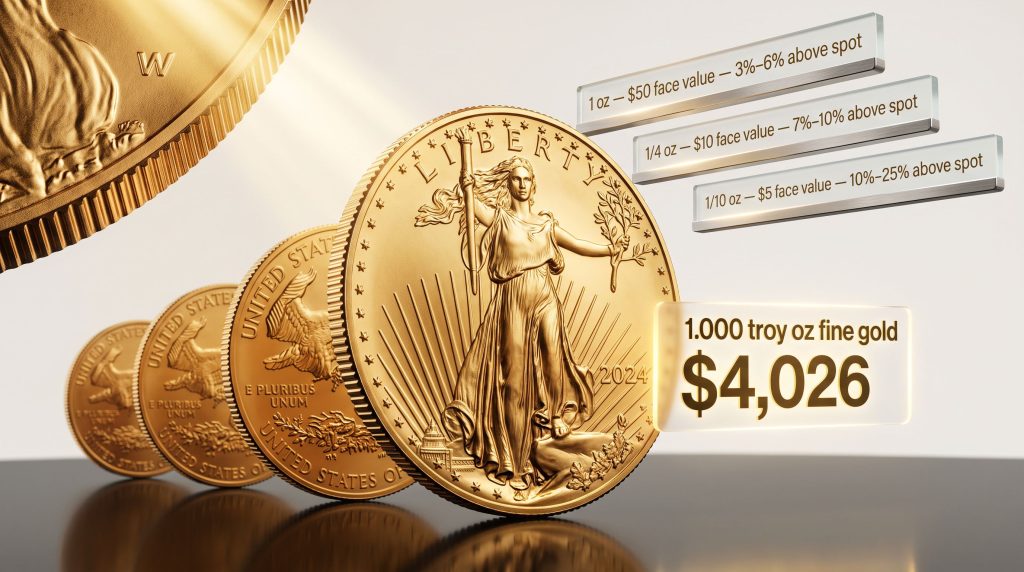
The Metallurgical and Legislative Architecture That Makes One Coin Unique
Sovereign bullion coins have existed for centuries, but the engineering behind them rarely receives serious analytical attention. Most investors evaluate gold coins through a single lens: how much gold does it contain, and what does it cost above spot? That framework, while useful, misses the deeper mechanical, legislative, and market-structural forces that determine which coins actually function best as financial instruments across decades of ownership.
This American Gold Eagle coin guide approaches the question from first principles. Rather than treating the coin as a simple product, this analysis examines the legislative architecture that created it, the metallurgical decisions embedded in its composition, the regulatory exemption that distinguishes it from every other 22-karat coin on the planet, and the premium mechanics that determine true cost of ownership. For investors considering buying gold in Australia, understanding these layers is equally relevant when evaluating globally recognised bullion products.
Understanding these layers changes how you buy, store, and eventually liquidate. It also surfaces several non-obvious distinctions that most investors never encounter before making their first purchase.
When big ASX news breaks, our subscribers know first
Legislative Foundation: How a Congressional Act Created a Permanent Market Standard
The Gold Bullion Coin Act of 1985 (Public Law 99-185), signed into law on December 17, 1985, did more than authorise a government coin programme. It established a supply-chain mandate with no equivalent in global sovereign bullion: all gold used in American Gold Eagles must originate from newly mined domestic U.S. deposits. (U.S. Mint)
This requirement means that every Eagle minted is, by legal definition, a product of American mineral extraction. No other major government bullion programme imposes a domestic-sourcing requirement at this level. The Canadian Maple Leaf, the Austrian Philharmonic, and the South African Krugerrand all draw from global supply chains. The Eagle is structurally different at the source.
The coin entered commercial distribution in 1986, establishing over four decades of uninterrupted production. That continuity matters beyond sentiment. Forty years of consistent minting has created a secondary market of extraordinary depth and standardisation, which directly affects liquidity in ways explored below.
The face value system deserves specific attention because it confuses many first-time buyers. The four denominations carry nominal legal tender designations of $50, $25, $10, and $5. These are Congressional designations that confer legal currency status, not market valuations.
At current gold prices near $4,026 per troy ounce, a 1 oz American Gold Eagle's actual market value is approximately 80 times its $50 face value. The face value exists to satisfy the legal definition of currency, not to reflect the coin's worth.
Metallurgical Specification: Why 22-Karat Outperforms 24-Karat in Real-World Use
The composition of the American Gold Eagle is often mischaracterised as a purity compromise. It is not. The 22-karat alloy is a deliberate engineering solution to a physical property problem: pure gold, at 24 karats (99.99% fineness), is one of the softest commercially used metals. A pure gold coin struck and handled under normal storage conditions will accumulate scratches, surface compression marks, and edge wear that, while cosmetic, affect secondary market perception.
The Eagle's alloy matrix addresses this directly:
| Component | Percentage | Metallurgical Role |
|---|---|---|
| Gold | 91.67% | Primary precious metal content |
| Copper | 5.33% | Surface hardness and wear resistance |
| Silver | 3.00% | Colour balance and corrosion inhibition |
| Total | 100% | 22-karat (916.7 fine) |
The critical distinction: the copper-silver matrix increases the coin's total gross weight without displacing pure gold atoms. A 1 oz American Gold Eagle contains exactly one full troy ounce of pure gold (31.103 grams of fine gold). The gross weight of 1.0909 troy ounces (33.931 grams) reflects the added alloy metals, not a reduction in gold content. (U.S. Mint)
Physical dimensions for the 1 oz coin are specified by the U.S. Mint at 32.70 mm diameter and 2.87 mm thickness.
Placing the Eagle directly alongside its 24-karat counterpart eliminates a persistent misconception. Furthermore, understanding the distinction between physical gold vs ETFs can help investors determine whether coin ownership or paper exposure better suits their broader portfolio goals.
| Specification | American Gold Eagle (22K) | American Gold Buffalo (24K) |
|---|---|---|
| Gold Fineness | 91.67% | 99.99% |
| Pure Gold per 1 oz coin | 1.000 troy oz | 1.000 troy oz |
| Gross Weight | 1.0909 troy oz | 1.0000 troy oz |
| Surface Hardness | Higher (alloy-enhanced) | Lower (pure gold softness) |
| IRA Eligible | Yes (statutory exemption) | Yes (meets 99.5% threshold) |
Neither coin delivers more pure gold than the other in a 1 oz format. Composition is an engineering variable, not a value hierarchy.
Denomination Architecture: The Real Cost of Fractional Sizes
The American Gold Eagle programme offers four weight denominations. Each carries distinct premium economics that investors must understand before selecting a size:
| Denomination | Face Value | Diameter | Gold Content | Approx. Market Value* | Typical Premium Range |
|---|---|---|---|---|---|
| 1 oz | $50 | 32.70 mm | 1.000 troy oz | ~$4,026 | 3%–6% above spot |
| 1/2 oz | $25 | 27.00 mm | 0.500 troy oz | ~$2,013 | 5%–8% above spot |
| 1/4 oz | $10 | 22.00 mm | 0.250 troy oz | ~$1,007 | 7%–10% above spot |
| 1/10 oz | $5 | 16.50 mm | 0.100 troy oz | ~$403 | 10%–25% above spot |
*Based on approximate gold price of $4,026/oz. Values fluctuate continuously with spot price movements. (Gainesville Coins; USAGOLD)
Why Fractional Premium Costs Are Not Linear
The premium expansion in fractional coins is a direct consequence of fixed production economics. Die production, quality assurance protocols, regulatory compliance, and individual coin packaging each carry costs that remain relatively constant regardless of the coin's gold content. When those fixed costs are distributed across a smaller quantity of gold, the per-ounce premium rises nonlinearly.
A 1/10 oz Eagle, which costs roughly $400 in gold content, can carry a premium of 10% to 25% above spot. (Gainesville Coins) That same premium structure applied to a 1 oz coin at comparable conditions would represent a substantially larger absolute dollar cost per ounce of gold acquired. For further context on broader gold investment strategies, understanding denomination economics is a foundational element of smart allocation decisions.
Strategic implications by investor objective:
- Maximise gold per dollar spent: The 1 oz denomination delivers the lowest per-ounce premium and the deepest secondary market liquidity
- Incremental accumulation or flexible position-building: The 1/4 oz and 1/2 oz sizes allow gradual entry without full-ounce commitment at each transaction
- Accessibility, gifting, or partial liquidation: The 1/10 oz coin serves specific use cases but carries a meaningful cost penalty versus the 1 oz equivalent
The IRA Exemption: A Statutory Carve-Out That No Other 22-Karat Coin Holds
This is one of the least understood and most consequential features in this American Gold Eagle coin guide. The mechanics require careful unpacking.
The Internal Revenue Code, under IRC Section 408(m)(3), establishes that gold held inside a self-directed IRA must meet a minimum fineness threshold of 99.5%. The American Gold Eagle, at 91.67% purity, falls below this threshold by a significant margin. Under the standard rule, it should not qualify.
However, Congress embedded a specific statutory exemption within 31 U.S.C. § 5112, which explicitly designates American Gold Eagles as IRA-eligible instruments, overriding the standard fineness requirement through legislative authority rather than IRS discretion. (IRC §408(m)(3)(A))
The practical scope of this exemption is narrow and precise:
The exemption is coin-specific, not category-specific. No other 22-karat gold coin in the world holds an equivalent Congressional carve-out. The South African Krugerrand shares the identical 91.67% purity profile as the Eagle but is explicitly excluded from IRA eligibility because Congress granted it no such designation. (Cedar Gold Group; IRC §408(m)(3))
| Coin | Fineness | IRA Eligible | Basis for Eligibility |
|---|---|---|---|
| American Gold Eagle | 91.67% | Yes | Congressional statutory exemption |
| American Gold Buffalo | 99.99% | Yes | Meets standard 99.5% IRS threshold |
| Canadian Gold Maple Leaf | 99.99% | Yes | Meets standard 99.5% IRS threshold |
| South African Krugerrand | 91.67% | No | No statutory exemption; below IRS threshold |
| Austrian Gold Philharmonic | 99.99% | Yes | Meets standard 99.5% IRS threshold |
Critical Compliance Rules for IRA-Held Eagles
Both bullion and proof American Gold Eagles qualify for self-directed IRA placement. However, third-party graded Eagles carrying PCGS or NGC certification risk IRS reclassification as collectibles, which immediately disqualifies them from IRA inclusion. (U.S. Money Reserve)
For retirement account purposes, only ungraded bullion Eagles or proof Eagles in original U.S. Mint packaging should be considered. Additionally, IRS regulations mandate that all IRA-held physical gold must be stored at an IRS-approved depository. Home storage of IRA-held Eagles is not permitted under current rules.
Premium Mechanics: What Investors Actually Pay and Recover
Every American Gold Eagle transaction involves two distinct price components that operate independently of each other:
- Spot price — The real-time global benchmark price for one troy ounce of gold, determined by futures markets and updated continuously throughout trading hours
- Premium above spot — The additional cost covering minting fabrication, distribution infrastructure, dealer margin, and the liquidity premium that government-certified coins command in secondary markets
The U.S. Mint distributes bullion Eagles exclusively through a network of Authorised Purchasers rather than selling directly to the public. This wholesale distribution structure adds a layer to pricing that is worth understanding: the premium investors pay includes the economics of that distribution chain, not just raw minting costs.
Premium behaviour is not static. It responds to supply and demand dynamics specific to the physical coin market, independently of the gold price itself. Consequently, gold as a safe haven during crisis periods can dramatically amplify the premiums investors encounter at the point of purchase.
| Market Environment | Typical 1 oz Eagle Premium | Primary Driver |
|---|---|---|
| Normal conditions | 3%–6% above spot | Standard dealer margin plus minting cost |
| High demand / supply squeeze | 8%–15%+ above spot | Inventory depletion, Mint production lag |
| Low demand / ample supply | 2%–4% above spot | Dealer competition, surplus inventory |
| Crisis or panic buying | 15%–25%+ above spot | Extreme demand surge, constrained supply |
One underappreciated aspect of premium economics: a portion of the entry premium is recoverable at exit. Government-certified coins like the Eagle typically sell above spot in secondary markets, which means the effective net cost of ownership is lower than the raw purchase premium suggests. The premium paid on entry is not entirely a sunk cost.
The next major ASX story will hit our subscribers first
Bullion, Proof, and Burnished: Matching the Production Variant to the Investment Objective
Bullion Eagles
Produced using standard striking methods and distributed through the Authorised Purchaser dealer network rather than directly from the U.S. Mint. Pricing tracks closely to spot plus a modest premium of 3% to 6% for the 1 oz denomination under normal conditions. Bullion Eagles are the correct choice for investors whose primary objective is efficient gold accumulation, IRA funding, or liquid wealth preservation. For a comprehensive overview of American Gold Eagle specifications, Provident Metals provides detailed technical reference material.
Proof Eagles
Manufactured through a specialised multi-strike production process that generates mirror-field surfaces and frosted design relief. Sold directly by the U.S. Mint at prices that adjust weekly to reflect current gold values, typically several hundred dollars above the bullion equivalent for identical gold content. (U.S. Mint)
Proof Eagles are IRA eligible, but their collector premium is aesthetically and historically driven, not gold-content-driven. The 2026 edition carries a Liberty Bell privy mark and a dual-date designation of "1776~2026," commemorating the 250th anniversary of American independence. Proof coins must never be removed from original Mint packaging; surface contact permanently destroys the collector grade and the premium associated with it.
Burnished (Uncirculated) Eagles
A distinct third production variant carrying a matte-like surface finish and a "W" West Point mint mark. Sold in limited quantities directly by the U.S. Mint. Occupies a middle position between bullion and proof in both price point and collector appeal. For those interested in the numismatic history of this variant, there is detailed coverage of burnished Eagle collecting available for further reading.
Decision framework by primary objective:
- Maximise gold per dollar: Choose the 1 oz bullion Eagle
- IRA-eligible physical gold: Ungraded bullion or proof Eagle in original packaging
- Commemorative or anniversary acquisition: 2026 proof Eagle with Liberty Bell privy mark
- High-grade certified collection: Graded proof or burnished variant, but not for IRA placement
Liquidity Infrastructure: Why the Eagle Trades Differently from Other Bullion
Liquidity in physical gold is not purely a function of the metal's price. It is a function of recognition speed, verification requirements, secondary market depth, and counterparty confidence. On every one of these dimensions, the American Gold Eagle holds structural advantages over most alternatives.
Three reinforcing liquidity drivers:
- Universal domestic recognition — Every U.S.-based precious metals dealer, estate buyer, and institutional platform prices an Eagle on sight, with no authentication delay or buyer hesitation. That frictionless recognition is a financial property embedded in the coin itself.
- Depth of secondary market — Four decades of continuous production since 1986 have created a large, mature pool of Eagles in active circulation, producing tighter bid-ask spreads and faster execution under both rising and falling gold conditions.
- Government weight and purity guarantee — The U.S. government's legal backing of each coin's stated gold content eliminates counterparty verification risk, a risk that routinely affects privately minted bars and rounds from lesser-known refiners.
| Product | Recognition Level | Verification Required | Secondary Market Depth | IRA Eligible |
|---|---|---|---|---|
| American Gold Eagle | Very High | None | Very Deep (U.S.) | Yes |
| Canadian Gold Maple Leaf | High | Minimal | Deep (Global) | Yes |
| American Gold Buffalo | High | None | Deep (U.S.) | Yes |
| Gold Bar (major refiner) | Moderate | Sometimes | Moderate | Yes (LBMA) |
| South African Krugerrand | High | Minimal | Deep (Global) | No |
Design Evolution: Type 1 vs. Type 2 and the 2026 Anniversary Edition
The obverse of the American Gold Eagle has retained Augustus Saint-Gaudens' Liberty design throughout the coin's history, maintaining artistic continuity with the iconic $20 Double Eagle gold coin produced from 1907 to 1933. (U.S. Mint)
The reverse underwent a significant redesign in 2021. The original Type 1 reverse, designed by Miley Busiek, depicted a male eagle carrying an olive branch toward a nesting pair. The Type 2 reverse, designed by Jennie Norris, replaced this with a high-relief close-up portrait of a single bald eagle and incorporated enhanced anti-counterfeiting security features.
For investors focused on pure bullion value, the Type 1 and Type 2 distinction carries no pricing relevance. Both contain identical gold content under identical government guarantees. Secondary market pricing treats them equivalently on a spot-plus-premium basis.
For collectors, certain transitional Type 1 production years, particularly 2021, may carry modest above-bullion premiums due to the scarcity created by the design transition. The 2026 edition adds a further commemorative dimension with its Liberty Bell privy mark and dual-date designation. In addition, the broader role of central bank gold reserves in supporting long-term gold demand underscores why government-backed bullion programmes like the Eagle retain enduring institutional credibility.
Storage Specifications and Preservation Standards
| Holding Size | Recommended Storage Method | Key Considerations |
|---|---|---|
| 1 to 5 coins | Home safe (fire/burglary rated) with 32.70 mm capsules | Cool, dry environment; humidity below 50% |
| 5 to 25 coins | High-security home safe or bank safe deposit box | Humidity control; written inventory documentation |
| 25+ coins | Third-party private vault or allocated storage | Insurance coverage, audit rights, accessibility |
| IRA-held Eagles | IRS-approved depository only | Home storage of IRA metals is prohibited under IRS rules |
Physical handling protocol is straightforward but frequently ignored:
- Handle all Eagles by the edge only, never touching the obverse or reverse surfaces
- Store 1 oz bullion Eagles in 32.70 mm coin capsules to prevent surface contact and environmental oxidation
- Avoid direct sunlight, humidity above 50%, and significant temperature variation
- For proof Eagles: original U.S. Mint packaging must remain sealed permanently; any surface contact destroys collector grade
- Maintain a written or digital inventory recording purchase dates, premiums paid, denominations, and storage locations for insurance and estate planning purposes
Frequently Asked Questions
Can investors purchase American Gold Eagle bullion coins directly from the U.S. Mint?
No. Bullion American Gold Eagles are distributed exclusively through the Mint's Authorised Purchaser network, a system of licensed wholesale dealers who then supply retailers and individual investors. Proof and burnished collector editions are available for direct purchase from the U.S. Mint's website, generally at a substantial premium above the bullion equivalent. (U.S. Mint)
Does the 22-karat composition mean buyers receive less gold than stated?
No. The alloy metals add mass but do not replace gold content. A 1 oz Eagle contains exactly one troy ounce of pure gold. The total gross weight of 1.0909 troy ounces reflects the copper and silver additions, not a reduction in the guaranteed gold content. (U.S. Mint)
Do older production years carry higher value for bullion investors?
Generally not. Bullion Eagles are priced based on gold content and the prevailing spot price plus a market-determined premium, regardless of the production year. Date-specific premiums are a collector consideration, not a bullion investment variable, with limited exceptions for certain low-mintage transitional years.
This article is intended for informational and educational purposes only. It does not constitute financial or investment advice. Precious metals prices fluctuate and past performance is not indicative of future results. Investors should consult a qualified financial adviser before making investment decisions.
Want to Know Which ASX Miners Could Be the Next Major Discovery?
While physical gold provides a proven store of value, significant wealth has also been built by identifying transformative mineral discoveries early — Discovery Alert's proprietary Discovery IQ model delivers real-time ASX alerts that turn complex mineral data into actionable insights, just as historic finds by De Grey Mining and WA1 Resources demonstrated. Explore Discovery Alert's dedicated discoveries page to understand the extraordinary returns major mineral discoveries can generate, and begin a 14-day free trial to position yourself ahead of the broader market.