June 13, 2026
When Central Bank Language Moves More Than Rates: Understanding Gold's Sensitivity to Fed Signals
Seasoned market participants have long understood a counterintuitive truth about gold pricing: the metal often moves more sharply on what central bankers say than on what they actually do. Rate decisions themselves are frequently priced in weeks before they arrive. It is the shift in language, the subtle rewording of committee statements, and the number of officials willing to dissent publicly that can catch markets off guard and reprice assets quickly. This dynamic was on full display during the week ending May 1, 2026, when hawkish FOMC pressures gold markets experienced were driven by a Federal Reserve meeting that produced no change in interest rates, yet nonetheless delivered one of the more hawkish signals seen in over three decades, sending spot gold prices briefly below a critical technical floor before buyers stepped in to stabilise the situation.
Understanding the week's price action requires more than tracking a line on a chart. It demands a grasp of the mechanics connecting monetary policy language, institutional positioning, real yield dynamics, and geopolitical risk premiums — all of which converged simultaneously to shape gold's trajectory.
When big ASX news breaks, our subscribers know first
The Opportunity Cost Mechanism: Why Language Moves Gold
Gold occupies a unique position in investment portfolios. Unlike equities, it pays no dividend. Unlike bonds, it offers no coupon. Its value rests on what it is not rather than what it produces: a non-yielding, politically neutral store of value that investors gravitate toward when the real return on competing assets looks unattractive or when systemic risk feels elevated.
This structure makes gold acutely sensitive to the direction of monetary policy signals rather than just the level of rates. When a central bank communicates that borrowing costs will remain elevated, the yield available on Treasury bonds, money market instruments, and short-duration assets rises relative to gold's zero yield. Institutional portfolio managers running allocation models respond by trimming gold exposure in favour of yield-bearing alternatives — not because gold is "worse," but because the opportunity cost of holding it has mathematically increased.
Critically, this repricing does not require an actual rate hike. A signal of tighter conditions for longer carries much of the same effect. Furthermore, the relationship between gold and bond yields plays a central role in how quickly these signals translate into price movement:
- Forward guidance language that removes expected rate cuts prompts bond markets to price in higher yields
- Higher yields strengthen the US dollar, since dollar-denominated assets become relatively more attractive
- A stronger dollar makes gold more expensive in foreign currencies, suppressing international demand
- Quantitative models at major funds trigger systematic gold selling as yield differentials widen
This chain of cause and effect explains why hawkish FOMC pressures gold markets even when the committee votes unanimously to stand pat on rates — and why internal dissent within the Fed can amplify market reactions far beyond the rate decision itself.
Decoding the Hawkish Hold: What the 8-4 FOMC Vote Actually Signalled
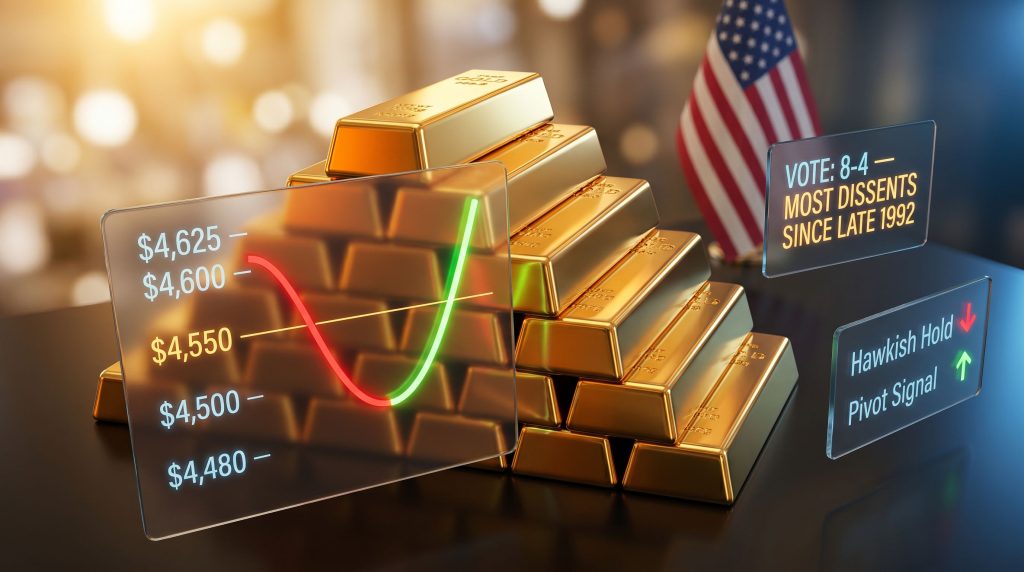
The May 2026 FOMC meeting delivered a decision to leave rates unchanged, which was widely anticipated. What was not anticipated with such clarity was the character of the vote behind that decision. The final tally came in at 8-4, marking the highest number of dissenting votes recorded at any Federal Open Market Committee meeting since late 1992, according to reporting on hawkish Fed signals.
The significance of four dissents cannot be overstated in the context of how the Fed operates. The FOMC is a consensus-driven institution by design, and public dissent from voting members is relatively uncommon. Three of those four dissenting governors specifically objected to language in the committee's joint statement that implied an "easing bias" — essentially, the verbal scaffolding that markets interpret as signalling future rate reductions.
FOMC Event Snapshot: May 2026
| Metric | Detail |
|---|---|
| Vote outcome | 8-4 in favour of holding rates unchanged |
| Number of dissents | 4, the most since late 1992 |
| Basis of three dissents | Rejection of "easing bias" language in committee statement |
| Rate cut signals for 2026 | Withdrawn by dissenting governors |
| Immediate gold reaction | Spot gold broke below $4,550/oz intraday |
| Week's closing price | Near $4,625/oz following Thursday recovery |
The removal of easing bias language functions as a de facto policy tightening even without any change in the benchmark rate. When three voting members of the Federal Reserve publicly signal their rejection of language implying future cuts, bond markets respond by repricing yields upward. Gold, given its inverse relationship to real yields, follows in near-lockstep.
A hawkish hold is not a neutral event. When the committee's statement language shifts to remove forward-cut signals, the bond market effectively tightens financial conditions on the Fed's behalf — and gold markets price in that tightening immediately.
What makes the historical comparison particularly instructive is context. The last time dissents reached this level was in the early 1990s, during a period of significant monetary policy uncertainty. The reappearance of such internal disagreement suggests the current rate environment is genuinely contested among policymakers — a reality that introduces lasting uncertainty about the rate trajectory, which gold markets must then price into their own volatility expectations.
Gold's Price Architecture: The $4,500 Line and Why It Matters
Technical price levels in liquid markets are not arbitrary. They emerge from the intersection of historical price memory, options market positioning, algorithmic trigger points, and the psychological tendency of traders to cluster activity around round numbers. The $4,500/oz level for spot gold currently carries all of these characteristics simultaneously.
When gold broke below $4,550 intraday on Wednesday, it was crossing from a short-term battleground zone into territory where the risk of cascading stop-loss orders became meaningful. Quantitative models at major funds frequently embed automatic selling triggers near key technical floors — and a confirmed close below $4,500 would likely have activated many of them, potentially accelerating a move toward levels closer to $4,300-$4,350 before structural buying could re-emerge.
Gold Price Level Reference: Week of May 1, 2026
| Price Zone | Technical Significance |
|---|---|
| $4,625 | Thursday recovery high and Friday stabilisation level |
| $4,600 | Near-term resistance, weekly closing zone |
| $4,550 | Intraday breakdown trigger, short-covering activation zone |
| $4,500 | Major psychological support, breach risks cascading sell orders |
| $4,480 | Secondary technical floor below the $4,500 level |
That scenario did not materialise. Buyers in Asian and London trading sessions stepped in below $4,550 on Wednesday evening, absorbing selling pressure and triggering a nearly 2% rally on Thursday that carried spot gold back to approximately $4,625. Understanding who steps in at these levels matters for assessing whether a recovery represents genuine demand or simply tactical short-covering.
Short-covering rallies share a common characteristic: they can look identical to bullish trend reversals in the moment but lack the volume confirmation and positioning follow-through that characterises structural buying. A single-session gain of nearly 2% following a brief breakdown, while visually encouraging, should be assessed against futures positioning data, exchange-traded fund flows, and options market activity before being interpreted as a trend change.
Reading the Weekly Price Arc Through an Institutional Lens
The week's price behaviour described a recognisable pattern for experienced gold market observers: early-week weakness driven by macro catalyst anticipation, a mid-week capitulation event driven by the FOMC outcome, followed by a late-week recovery that stopped short of reclaiming previous highs cleanly.
This pattern matters because of what it reveals about the composition of participants at each stage:
- Pre-FOMC positioning phase: Institutional funds reduce gold exposure ahead of potential hawkish signals, creating gradual selling pressure
- Event-driven breakdown: The FOMC vote detail triggers algorithmic and rules-based selling, accelerating the move below $4,550
- Asian session reversal: Regional buyers, often operating with longer time horizons and different risk frameworks than US-centric funds, absorb dips at value levels
- London session continuation: European institutional buyers reinforce the Asian bid, generating momentum into the North American open
- Thursday recovery: Short-covering amplifies the move, creating a rally that exceeds what structural demand alone would likely generate
- Friday consolidation: Price stabilises as the week closes near $4,625 with the market awaiting the next major catalyst
The absence of a clean push above $4,650 or $4,700 by week's end reflects the ongoing weight of hawkish FOMC pressures on gold's near-term ceiling, even as buyers successfully defended the $4,500 floor.
The Iran Variable: How Geopolitical Risk Premiums Work — and Fade
Geopolitical risk premiums embedded in gold prices are among the most misunderstood elements of precious metals analysis. Conventional wisdom holds that escalating conflict drives gold higher via gold safe-haven demand, and that is broadly true in the initial stages of a geopolitical event. What is less appreciated is how quickly those premiums erode.
Several forces govern the lifecycle of a geopolitical risk premium in gold:
- Certainty reduction: As a geopolitical situation becomes more predictable (whether through escalation or de-escalation), the premium shrinks because uncertainty itself was the driver
- Duration decay: Markets discount ongoing but static conflicts at progressively lower risk premiums over time
- Competing asset response: When conflict drives crude oil sharply higher, the resulting inflation concerns can actually cap gold upside by tightening financial conditions via energy costs
- Dollar interaction: Conflict-driven dollar strength (safe-haven dollar buying) can offset gold's safe-haven premium by raising the USD denominator
Geopolitical Factor Analysis: US-Iran Dynamics
| Factor | Directional Impact on Gold |
|---|---|
| Active US-Iran military operations | Bullish via safe-haven demand |
| Iranian peace proposals | Bearish, reduces uncertainty premium |
| Elevated crude oil prices | Mixed: inflation supportive but risk-off dampened |
| First sustained USD weakness since bombing began | Bullish via inverse correlation |
| Anticipated US-Iran agreement | Potentially bearish short-term |
During the week of May 1, 2026, renewed Iranian peace overtures coincided with the first period of sustained US dollar weakness since the US bombing campaign against Iran began. That USD softening provided some offset to the hawkish FOMC headwinds for gold — however, the elevated level of crude oil prices simultaneously placed a firm ceiling on any new upside momentum.
This three-way tension between diplomatic progress (reducing safe-haven premium), dollar weakness (bullish for gold), and energy-driven inflation (complicating the rate outlook) illustrates why gold price forecasting during periods of simultaneous macro and geopolitical flux carries exceptional difficulty. Each force is real; their relative weighting shifts constantly.
The next major ASX story will hit our subscribers first
Fed Chair Transition: Powell Exits, Warsh Enters, and What It Means for Markets
The May 2026 FOMC meeting carried an additional layer of significance beyond the vote outcome: it represented Jerome Powell's final meeting as Chair of the Federal Reserve. Kevin Warsh is set to assume the chair position, while Powell has indicated his intention to remain on the Federal Reserve Board as a governor rather than departing the institution entirely.
Powell's decision to stay on as governor is a relatively unusual choice in the post-millennium era of Federal Reserve leadership and provides a degree of institutional continuity that markets tend to value during transition periods. The presence of a former chair among the voting membership introduces an interesting dynamic: a degree of policy memory and public credibility remains embedded in the committee even as leadership formally changes.
For gold markets specifically, central bank leadership transitions introduce what might be termed a forward guidance credibility discount. Markets had spent years calibrating their interpretation of Powell's communication style, press conference language, and response patterns. Warsh brings his own policy temperament and rhetorical approach, and until markets develop a calibrated model for interpreting his signals, uncertainty premiums tend to run slightly elevated.
Central bank leadership transitions rarely produce immediate policy reversals, but they do widen the confidence interval around forward guidance interpretation — and gold markets tend to price in that uncertainty through modestly elevated volatility premiums during the transition window.
Global Rate Expectations: A Synchronised Hawkish Backdrop
The hawkish FOMC outcome did not occur in isolation. Reports circulating during the same week suggested that analysts were increasingly expecting both the Bank of England and the European Central Bank to raise interest rates within the coming months. This synchronised tightening expectation across major central banks compounds the headwind for gold internationally.
When only one central bank signals a hawkish stance, the impact is partially absorbed by currency adjustments — gold may weaken in dollar terms while remaining stable in euro or sterling terms. When multiple major central banks signal tighter conditions simultaneously, that offset mechanism diminishes, and the suppression of gold demand becomes more broadly distributed across currency zones. In addition, central bank gold demand from non-Western institutions has continued to provide a structural underpinning that partially offsets these policy headwinds.
The divergence scenario — where the Fed eventually pivots to cuts while other central banks continue tightening — would be distinctly bullish for gold. Dollar weakness combined with rising yields elsewhere would make gold's zero-yield profile more competitive globally, while simultaneously reducing the opportunity cost of holding the metal for US-based investors. That scenario, however, requires either a significant deterioration in US economic data or an unexpected shift in FOMC consensus, neither of which appears imminent based on current conditions.
What Gold Investors Should Monitor in the Days Ahead
With gold stabilised near $4,625 as the week closed, the path over the following sessions will be shaped by a specific cluster of catalysts. Each has a defined directional implication:
Forward-Looking Catalyst Framework
| Upcoming Catalyst | Potential Gold Impact |
|---|---|
| Strong April Jobs Report | Bearish: reinforces higher-for-longer narrative |
| Weak April Jobs Report | Bullish: reopens rate cut expectations |
| Fed officials signal no 2026 cuts | Bearish: confirms hawkish hold stance |
| Fed officials soften tone in public remarks | Bullish: short-covering rally likely |
| US-Iran peace agreement reached | Bearish short-term: removes geopolitical premium |
| Breakdown in US-Iran talks | Bullish: safe-haven demand re-emerges |
| BoE or ECB rate hike confirmation | Bearish: strengthens global hawkish backdrop |
The April Non-Farm Payrolls report carries particular weight in this environment. A labour market reading that exceeds expectations would reinforce the dissenting governors' argument that the economy does not require near-term rate relief, further validating the higher-for-longer thesis and placing renewed downward pressure on gold. A weaker-than-expected print would do the opposite — reopening the debate about 2026 rate cuts and likely triggering short-covering activity.
Weekend developments on US-Iran diplomacy represent the wildcard. Any material progress toward a peace framework would reduce the geopolitical risk premium embedded in gold, potentially setting a negative tone for early-week trading. A breakdown in negotiations would have the inverse effect, particularly if combined with energy market disruption.
A Historical Framework: How Gold Performs Across Fed Tightening Cycles
Placing the current environment in historical context reveals important nuance about the relationship between Fed policy and gold performance. The relationship is not uniformly negative for gold during tightening cycles — context matters significantly. Furthermore, understanding gold in downturns and across varying policy cycles provides valuable perspective on how the metal has historically navigated similar conditions.
Historical Gold Behaviour Across Fed Policy Phases
| Fed Policy Phase | Typical Gold Market Behaviour |
|---|---|
| Rate hike cycle begins | Initial weakness as real yields rise and dollar strengthens |
| Sustained tightening period | Gold stabilises if inflation remains meaningfully elevated |
| Hawkish hold with no cuts signalled | Moderate downward pressure, range-bound trading common |
| Pivot signal or first rate cut | Strong gold rally typically follows within weeks |
| Full easing cycle underway | Gold historically outperforms most major asset classes |
The critical variable that separates gold's underperformance from outperformance during tightening cycles is the inflation environment. During the 1970s, gold surged despite rising interest rates because inflation was rising even faster, keeping real yields negative. During the early 1980s, gold fell sharply when the Fed pushed real yields decisively into positive territory by raising nominal rates above inflation.
The current environment sits in an ambiguous middle ground. Nominal rates remain elevated, the Fed's dissenting governors are resisting any pivot language, and inflation appears neither collapsing nor reaccelerating sharply. This configuration historically correlates with the "hawkish hold" row in the table above: moderate downward pressure and range-bound trading rather than dramatic directional moves — which is broadly consistent with gold spending the week oscillating between $4,500 and $4,625.
FAQ: Hawkish FOMC and Gold Price Dynamics
Does a hawkish FOMC always cause gold prices to fall?
Not always, and the exceptions are instructive. When inflation expectations are rising faster than nominal rates, real yields remain negative even during tightening cycles, providing support for gold. Additionally, if hawkish signals trigger risk-off behaviour across equity and credit markets simultaneously, safe-haven demand can offset the yield-driven selling pressure in gold. The net direction depends on which force dominates in the specific macro context.
What is the difference between a hawkish hold and a rate hike in terms of gold market impact?
A rate hike is a concrete action that produces immediate repricing of yields and dollar strength. A hawkish hold achieves a similar effect through language rather than action, often creating initial uncertainty about how persistent the message will be. Hawkish holds can sometimes be more disruptive to gold in the short term because they introduce ambiguity: markets must infer the policy duration from verbal signals rather than actual rate changes. The removal of easing bias language, as occurred in May 2026, can function as a tightening mechanism without any mechanical rate change. For a broader perspective on how these dynamics shape the gold price outlook over the medium term, the interplay between language and real yields remains the most critical factor to monitor.
Why do gold prices sometimes rise even when the Fed signals tighter policy?
Several dynamics can override the expected negative relationship. Elevated geopolitical risk can generate safe-haven demand strong enough to outweigh yield headwinds. Dollar weakness driven by deteriorating fiscal or current account dynamics can lift gold even as rates rise. According to analysis on hawkish central bank impacts, central bank buying from non-Western institutions — particularly sovereign wealth funds and emerging market central banks diversifying away from dollar reserves — can provide price support independent of Fed policy direction.
What gold price level would signal a structural breakdown in the current bull market?
While specific price targets involve inherent uncertainty and should not be taken as investment advice, market participants are watching the $4,500 level as the immediate critical threshold. A confirmed close below that level would likely activate systematic selling from quantitative funds, potentially accelerating losses toward the $4,300-$4,350 zone before structural buyers could re-establish support. Technically, a sustained breach of $4,500 with follow-through selling in subsequent sessions would represent a meaningful deterioration in the near-term bullish structure.
What does the FOMC "easing bias" language mean, and why does removing it matter?
Easing bias language refers to wording in the Federal Reserve's official policy statement that implies rate reductions are the likely next directional move. Phrases referencing the committee's readiness to adjust policy or acknowledging downside risks to growth typically constitute this forward guidance signal. When voting members publicly reject that language — as three governors did in May 2026 — they are signalling to bond markets that rate cuts are not the consensus next step, which pushes yields higher and creates headwinds for gold. The removal of this language is a soft tightening mechanism that operates through market expectations rather than the federal funds rate itself.
Key Takeaways: Navigating Gold in a Hawkish Policy Environment
The week ending May 1, 2026, crystallised three overlapping forces that will continue to define gold's medium-term trajectory:
-
Monetary policy language risk: Hawkish FOMC pressures gold markets through yield and dollar channels even without rate action. The record-high dissent count and removal of easing bias represent genuine tightening of financial conditions via communication alone.
-
Technical price architecture: The $4,500 level functions as the structural line in the sand for near-term confidence in the gold bull market. Its defence by Asian and London buyers this week preserved that structure, but the margin for error is narrowing.
-
Geopolitical risk premium complexity: The US-Iran situation adds a volatile and often misread dimension to gold pricing. Peace overtures reduce the safe-haven component while dollar weakness from the same diplomatic developments can partially offset that loss. Neither force is stable enough to anchor a directional thesis independently.
In the current environment, gold's price trajectory is being determined less by what the Federal Reserve does and more by what it signals. Hawkish language, particularly the withdrawal of easing bias and the emergence of internal dissent at historically high levels, functions as a tightening mechanism in its own right, pressuring gold even in the absence of actual rate increases.
For investors and traders monitoring precious metals through this period, the most valuable discipline is tracking Fed communication between meetings rather than waiting for rate decisions. Public remarks from governors who dissented, any moderation in their tone, and the framing of economic data in official communications will provide earlier and more actionable signals than the rate decisions themselves.
This article is intended for informational and educational purposes only and does not constitute financial or investment advice. Gold price forecasts, technical levels, and geopolitical scenarios involve inherent uncertainty and should not be relied upon as the basis for investment decisions. Past correlations between monetary policy and gold prices are not guaranteed to repeat. Readers should conduct their own research and consult qualified financial professionals before making investment decisions.
Want to Stay Ahead of the Next Major Mineral Discovery on the ASX?
While gold prices navigate the complexities of hawkish Fed signals and geopolitical risk premiums, Discovery Alert's proprietary Discovery IQ model cuts through the noise — delivering real-time alerts on significant ASX mineral discoveries the moment they are announced, turning complex data across 30+ commodities into clear, actionable opportunities for traders and investors alike. Explore how major mineral discoveries have historically generated substantial returns on Discovery Alert's dedicated discoveries page, and begin your 14-day free trial today to position yourself ahead of the broader market.