
June 13, 2026
The Hidden Mechanics Behind Gold's Most Critical Price Level
In futures markets, not all price levels are created equal. The architecture of technical analysis rests on a fundamental truth that experienced traders understand intuitively: certain numbers carry gravitational weight far beyond what raw price data alone would suggest. Round numbers, particularly those divisible by one thousand, function as invisible force fields in commodity markets. They concentrate decision-making, cluster algorithmic triggers, and create the conditions for outsized price reactions. Understanding gold technical support at 4000 is just as important as knowing what the charts are showing right now.
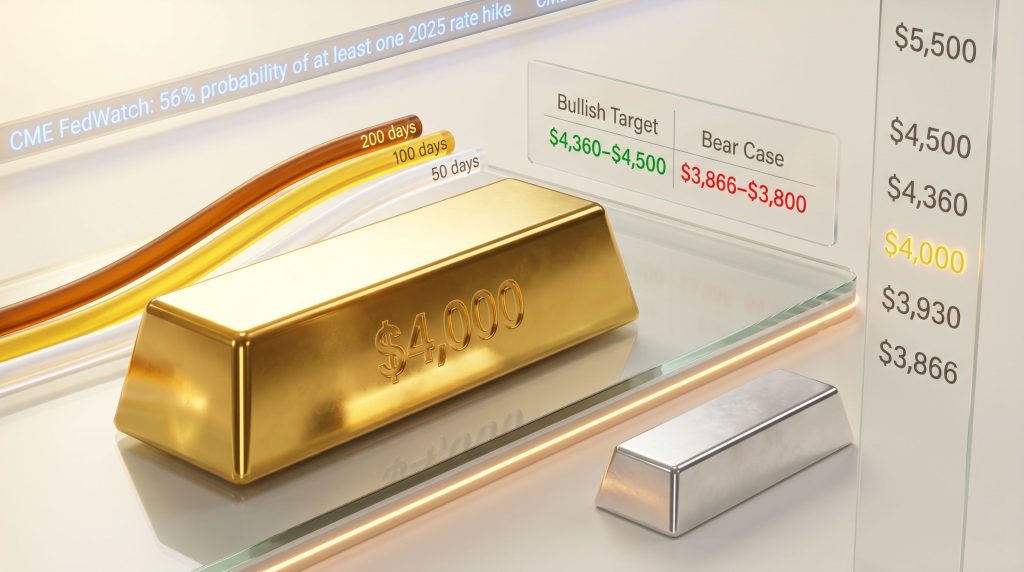
Gold's current battle at $4,000 per ounce is not simply a number on a screen. It represents the intersection of institutional psychology, macro uncertainty, and technical structure, making it arguably the most consequential price level the precious metals market has faced in recent memory.
When big ASX news breaks, our subscribers know first
Why Century Marks Dominate Gold Trading Psychology
The concept of "century marks" in futures trading refers to price levels ending in three or more zeros. Levels like $3,000, $4,000, and $5,000 attract disproportionate market activity compared to arbitrary prices like $3,847 or $4,213. This is not coincidence; it reflects deep-seated cognitive anchoring.
Institutional algorithms are frequently calibrated around these levels for stop-loss placement and order clustering. Retail traders, who account for a meaningful percentage of open interest, treat round numbers as natural entry and exit targets. Discretionary fund managers reference them in risk models. The result is a self-reinforcing dynamic: because everyone expects price reactions at $4,000, price reactions at $4,000 actually occur, validating the expectation and strengthening the level further.
This feedback loop is precisely why technical analysts assign elevated importance to gold technical support at 4000, rather than the numerically closer prior swing low of $3,930.
The Macro Headwinds Compressing Gold Into This Zone
Gold's path to the $4,000 battleground was not a sudden shock. It was the product of a multi-month corrective sequence following an extraordinary bull run that pushed active futures contracts above $5,500 per ounce, an all-time record high. From that peak, the metal traced a textbook series of lower highs and lower lows, a bearish structural pattern that signalled distribution by large holders rather than organic selling pressure.
Several macro forces converged to accelerate the decline:
-
Inflation data running at approximately 4.2% on an annual basis, well above the Federal Reserve's 2% target, initially appeared bullish for gold. However, rising inflation simultaneously elevated rate hike expectations, creating a paradox.
-
The CME FedWatch tool reflected approximately a 56% probability of at least one rate hike in 2025, which inverted gold's traditional inflation-hedge narrative by shifting market focus toward forward-looking monetary tightening rather than current purchasing power erosion.
-
Capital flows rotated toward competing assets, including a high-profile institutional IPO event that absorbed significant market attention and liquidity from commodities broadly.
Furthermore, the precious metals tariff impact added another layer of complexity, as shifting trade policy created additional headwinds for commodity markets broadly.
The relationship between inflation and gold is not as straightforward as conventional wisdom suggests. When rising inflation increases the probability of rate hikes, futures markets can price in the anticipated tightening before it occurs, creating bearish pressure on gold even as consumer prices climb well above central bank targets.
What Does the Gold Futures Chart Actually Show at $4,000?
Mapping the Technical Structure from Peak to Support
The anatomy of gold's corrective phase reveals a coherent, if painful, technical story. The sequence unfolded as follows:
-
All-time high above $5,500 established the structural ceiling.
-
A two-day collapse on approximately January 30 saw gold open near $5,400 and close around $4,900, a single-session decline of roughly $500 that rattled institutional confidence and triggered forced liquidation.
-
A recovery produced a lower high, confirming that sellers remained in control at elevated levels.
-
Consolidation between approximately $4,457 and $4,561 gave traders false hope before a breakdown below $4,500 triggered accelerated selling.
-
A close at $4,360 was followed by a drift lower throughout the subsequent week until gold reached the lowest level observed since November 2024, testing the $4,000 psychological level before staging a meaningful intraday recovery.
The recovery session itself was technically significant: gold opened near $4,100 and closed around $4,230, representing a substantial single-session reversal from deeply oversold conditions. According to analysis from FX Street, the downside remains vulnerable even after this bounce, underscoring the importance of sustained follow-through.
Technical Scorecard: The $4,000 Support Level
| Technical Factor | Bullish Reading | Bearish Risk |
|---|---|---|
| Round-number psychology | Concentrated buyer re-entry observed near $4,000 | Limited historical consolidation data at this exact level |
| Intraday reversal | Opened ~$4,100, closed ~$4,230, a strong single-session recovery | Occurred amid reduced volume and competing market attention |
| November 2024 base | Prior consolidation near $3,900 provides secondary reference | Break below $4,000 opens path to $3,930 with limited technical barriers |
| Moving average position | Recovery underway from deeply oversold conditions | Price currently trading below all three major moving averages |
Understanding Moving Average Breakdown in Gold's Current Structure
Technical analysts use three primary moving averages to define trend structure in futures markets:
-
50-day moving average: Defines short-term trend direction; price above is bullish, price below is bearish.
-
100-day moving average: Intermediate signal; particularly useful for identifying trend transitions.
-
200-day moving average: The definitive long-term trend indicator; widely regarded as the most important single line on any commodity chart.
Full bullish alignment occurs when the 200-day sits at the base with the lowest value, the 50-day occupies the middle, and the 100-day trades on top, with price above all three. Gold maintained this structure for an extended period beginning in early 2024.
A critical inflection point occurred on May 8, when the 100-day moving average crossed above the 50-day, a confirmed bearish crossover signal. Gold is now trading below all three major moving averages simultaneously, placing the full burden of proof on bulls to reclaim these levels before any structural recovery can be declared.
When price breaks below the 200-day moving average and fails to reclaim it across multiple sessions, market technicians treat this as a fundamental shift in trend bias. The 200-day does not simply represent resistance at that point; it becomes the gatekeeping level that separates a corrective phase from a structural bear market.
Key Price Levels Bulls and Bears Are Watching
Critical Support Zones Below $4,000
-
$4,000 (primary): The psychological century mark; the observed re-entry level for buyers during the recent session.
-
$3,930 (secondary): Derived from prior swing lows; the most logical technical floor if $4,000 fails on a closing basis.
-
$3,866 to $3,845: Deeper downside targets in more aggressive bearish scenarios; limited consolidation history in this zone.
-
$3,800: Broader corrective target cited in bearish scenario models where structural selling accelerates.
Resistance Levels Required for a Confirmed Bullish Recovery
-
$4,360 to $4,378: First meaningful resistance band based on real-body consolidation from mid-March; the initial hurdle gold must clear to establish recovery momentum.
-
$4,500: Key psychological resistance with mixed historical consolidation data; prior support that became resistance after the breakdown.
-
$5,500 to $5,600: The structural ceiling from the prior all-time high; a full recovery target only achievable after systematically clearing intermediate resistance levels.
In addition, the broader gold price forecast for 2025 suggests that upward momentum could resume if these resistance levels are cleared convincingly.
Is Gold's Recovery Genuine? The Confirmation Signals Traders Need
What Follow-Through Buying Actually Looks Like
A single session of strong intraday recovery is encouraging from a technical perspective. However, experienced futures traders distinguish carefully between a dead-cat bounce and a genuine structural low. The distinction comes down to follow-through behaviour in subsequent sessions.
Genuine technical recoveries typically exhibit:
-
Consecutive sessions of higher lows and higher closes.
-
Expanding volume confirming participation rather than thin-market bounces.
-
Progressive recapture of moving average levels, beginning with the 50-day.
-
Sustained price action above, not just brief touches of, resistance levels.
The probability framework used by experienced technicians assigns approximately 60% to 70% confidence that gold technical support at 4000 is functioning as a genuine technical floor, based primarily on the psychological weight of the century mark and the proximity to the November 2024 consolidation base near $3,900. This is a plausible floor, not a confirmed one, and traders are advised to demand follow-through evidence before treating the level as reliable.
Scenario Modelling: Three Possible Paths for Gold Through Summer 2025
Scenario A: Bullish Recovery (Base Case, ~60-70% probability)
Gold holds $4,000 as a durable floor. Buyers build on the single-session reversal. Gold clears the $4,360 to $4,378 resistance band within two to three weeks, opening the path toward $4,500. An Elliott Wave structure pointing toward a $6,000 year-end target remains theoretically intact, though significant technical damage would require a careful recount given recent price action.
Scenario B: Sideways Consolidation (Secondary Case)
Gold chops between $4,000 and $4,360 for several weeks as moving averages compress and directional bias remains unclear. The FOMC meeting outcome and subsequent inflation data become decisive catalysts. Either bullish or sideways outcomes following a drop from above $5,500 would represent meaningful technical resilience.
Scenario C: Breakdown and Deeper Correction (Bear Case)
Failure to hold $4,000 on a closing basis triggers accelerated selling toward $3,930. Deeper risk extends to the $3,866 to $3,800 zone. An Elliott Wave recount would be required, and the $6,000 year-end target would need to be shelved pending structural repair.
Silver's Role as a Confirming or Warning Signal for the Metals Complex
Why Silver's Behaviour Matters More Than Many Traders Realise
Silver's technical behaviour at moving average inflection points has historically provided early warning signals for the broader precious metals complex. As the higher-beta metal, silver amplifies moves in both directions, typically outperforming gold on a percentage basis during both rallies and selloffs. Monitoring the gold-silver ratio analysis provides an additional layer of context when assessing whether the metals complex is genuinely recovering or merely consolidating.
Silver futures reached a prior all-time high above $120 per ounce before suffering severe structural damage during the corrective phase. The metal subsequently broke below its 200-day moving average, a bearish long-term signal, before recently reclaiming that level. However, silver remains below its 50-day moving average, creating an internal inconsistency: the long-term signal is turning positive while the short-term signal remains negative.
Silver Moving Average Dynamics: Current Readings
| Moving Average | Current Status | Technical Implication |
|---|---|---|
| 200-day MA | Recently reclaimed from below | Positive long-term structural development if sustained |
| 50-day MA | Price still trading below | Short-term trend remains bearish; needs recapture |
| MA convergence | 50 and 200-day contracting after prior widening | Momentum decelerating; directional resolution pending |
The contraction between the 50-day and 200-day moving averages in silver suggests momentum is fading rather than building. When these averages contract after widening significantly during a trending phase, it typically signals that a directional resolution is approaching, though the outcome remains ambiguous until price confirms a clear break in either direction.
When silver fails to confirm a gold recovery with proportional upside momentum, this divergence functions as a caution signal for the broader metals thesis. It does not necessarily predict a reversal, but it raises the evidentiary bar required before a bullish position can be held with full conviction.
The next major ASX story will hit our subscribers first
How 24/7 Gold Futures Trading Could Reshape the Technical Landscape
The Weekend Gap Problem: A Long-Standing Technical Distortion
One of the least-discussed challenges in precious metals technical analysis is the distortion created by weekend trading gaps. Gold futures currently open Sunday afternoon, corresponding approximately to the start of the Australian trading session, and close on Friday. During this window, geopolitical events, military conflicts, and major economic announcements can cause dramatic gap openings that create false signals and trigger stop-losses without any actual intraday trading having occurred.
Technicians have historically treated gap-fill behaviour as a short-term price target, but weekend gaps introduce noise that complicates clean trend identification. The gold market's transition from daily open-close cycles to near-24-hour trading represented a major evolution in market structure, but the weekend gap problem persisted. Consequently, gold's safe-haven appeal becomes especially pronounced during these gap-open periods when geopolitical shocks strike over weekends.
The CME's 24/7 Micro Contract Proposal
The CME Group announced plans to launch 24-hour, 7-day-per-week trading for its 1-troy-ounce micro gold futures contract, with a proposed start date of July 26, 2025, pending regulatory review. The initiative is specifically designed to address the Sunday night gap problem that has long plagued retail futures traders.
Understanding who this proposal actually targets is important for contextualising its market impact:
| Participant Type | Primary Motivation | Contract Preference |
|---|---|---|
| Gold miners | Hedging production output against price risk | Standard full-size contracts |
| Manufacturers and technology companies | Securing raw material input costs | Standard full-size contracts |
| Institutional traders | Directional positioning and arbitrage | Standard and E-micro contracts |
| Retail investors | Speculative exposure and portfolio diversification | Micro and mini contracts |
The bulk of open interest and volume in gold futures is generated by producers hedging output and manufacturers locking in input costs, not retail speculation. Miners need to know that if gold prices collapse, their revenue is protected. Manufacturers need certainty in production costs. These participants use standard full-size contracts and would not be affected by a micro-contract 24/7 extension.
The 24/7 micro contract expansion is therefore a retail-focused initiative. While it may produce cleaner chart data for individual traders and reduce the psychological impact of gap openings on retail sentiment, it is unlikely to materially alter the institutional liquidity dynamics and price discovery mechanisms that actually drive gold's trend direction. Furthermore, central bank gold demand remains the dominant structural force underpinning price discovery at the institutional level, irrespective of retail contract innovations.
Frequently Asked Questions: Gold Technical Support at $4,000
What makes $4,000 such a significant level in gold's current technical picture?
The $4,000 level functions as a century mark, a round-number psychological threshold where institutional algorithms, retail stop-losses, and discretionary traders all naturally concentrate decision-making. In a market where historical consolidation data at this specific level is limited due to gold's rapid ascent through it on the way up, the psychological weight carries more significance than usual. The observed recovery from just above $4,000 to $4,230 in a single session provides the first empirical evidence that buyers treated this level as meaningful.
What happens technically if gold closes decisively below $4,000?
A confirmed daily close below $4,000 would remove the primary psychological support and likely trigger the next phase of selling toward $3,930, which represents the next identifiable swing low reference. Below that level, limited technical structure exists until approximately $3,866 to $3,845. The rapid nature of gold's ascent through this price range on the way up left minimal consolidation history, meaning there are few well-established support levels between $4,000 and the November 2024 base. Forex.com's gold forecast notes that improved risk appetite could further pressure the metal if this key level fails.
How does the upcoming FOMC meeting factor into the technical setup?
The Federal Reserve meeting introduces a binary macro catalyst into an already fragile technical picture. A hawkish signal or elevated inflation language could reignite selling pressure toward or below $4,000, while a dovish surprise could provide the follow-through buying needed to validate the gold technical support at 4000. With CME FedWatch data reflecting approximately a 56% probability of at least one 2025 rate hike, markets are not clearly committed to either directional outcome.
Is silver's underperformance a genuine warning for gold bulls?
Silver's failure to match gold's recovery momentum on a percentage basis creates a structural inconsistency that warrants monitoring. Given silver's historical tendency to lead gold on both upside and downside moves, a muted bounce while gold recovers strongly suggests that broad-based institutional conviction in the metals rally is not yet fully restored. It does not constitute a standalone bearish signal, but it raises the bar for confirmation.
Key Takeaways: Gold's Technical Roadmap Heading Into a Critical Window
-
The $4,000 level is the definitive line in the sand: a confirmed hold opens the path toward $4,360 to $4,378 as first resistance, and ultimately $4,500.
-
Moving average structure remains bearish: gold trading below its 50-day, 100-day, and 200-day moving averages simultaneously places full technical burden on bulls.
-
The 60% to 70% probability estimate for $4,000 holding reflects a technically plausible but unconfirmed floor; follow-through sessions are the only genuine validation.
-
Silver's 200-day recapture is a constructive long-term signal, but sustained follow-through above the 50-day is required before structural recovery in the metals complex can be declared.
-
The FOMC meeting is the immediate wildcard: rate hike expectations are partially priced in, but any surprise in either direction will amplify volatility and either validate or invalidate the $4,000 floor.
-
The CME's proposed 24/7 micro contract addresses a genuine retail trading pain point but is unlikely to shift the institutional dynamics that drive gold's structural price discovery.
Disclaimer: This article is for informational and educational purposes only and does not constitute financial advice. All price levels, probability estimates, and scenario projections referenced reflect technical analysis commentary and are inherently speculative. Past price behaviour does not guarantee future results. Readers should conduct their own research and consult a licensed financial adviser before making any investment decisions.
Want to Stay Ahead of the Next Major Mineral Discovery on the ASX?
While gold's technical structure plays out at critical price levels, Discovery Alert's proprietary Discovery IQ model delivers real-time alerts on significant ASX mineral discoveries — instantly translating complex data into actionable opportunities for traders and investors alike. Explore historic discoveries and their extraordinary returns, then begin your 14-day free trial to position yourself ahead of the broader market.