July 22, 2026
The Hidden Architecture of Gold's 2026 Rally
Commodity markets have a long memory, but gold's memory is longer than most. Across centuries of monetary upheaval, sovereign default, and geopolitical fracture, one pattern has proven remarkably durable: when the institutional architecture that underpins global stability begins to crack, gold does not merely rise in price. It reprices at a structurally higher level, absorbing a new layer of risk that analysts call the geopolitical risk premium lifting gold prices. Understanding how and why that premium forms, expands, and occasionally retreats is essential context for anyone trying to make sense of gold's extraordinary behaviour in 2026.
When big ASX news breaks, our subscribers know first
What the Geopolitical Risk Premium Actually Means
The geopolitical risk premium is not simply a synonym for a price spike during a crisis. It refers to a durable increment added to gold's baseline valuation, reflecting the collective judgement of market participants that the world has become structurally more dangerous and that this danger is unlikely to resolve quickly. It is, in essence, a forward-looking fear discount embedded in spot prices.
There is a meaningful distinction between a short-term, event-driven spike and a sustained structural premium. When a single geopolitical event occurs, gold may rally sharply and then retrace as the immediate danger passes. A structural premium, by contrast, builds gradually and persists because the underlying conditions generating uncertainty do not dissipate. Prolonged regional conflict, persistent inflation, and accelerating fragmentation of the global monetary order all qualify as structural rather than episodic drivers.
Why Gold Outperforms Other Crisis Hedges
Investors facing geopolitical uncertainty have several traditional refuges available: U.S. Treasury bonds, the Swiss franc, the Japanese yen, and gold. Each serves a purpose, but gold occupies a unique position in this hierarchy for one fundamental reason: it carries no issuer risk.
Unlike government bonds or fiat-denominated assets, gold carries no counterparty obligation. That property becomes increasingly valuable precisely when geopolitical instability threatens sovereign creditworthiness or the credibility of currency-issuing institutions.
U.S. Treasuries, despite their historical safe-haven status, are denominated in a currency that itself can be weaponised through sanctions or monetary policy. The Swiss franc and Japanese yen, while stable, are still sovereign instruments subject to central bank intervention. Gold exists outside this framework entirely, which is why safe-haven gold demand maintains its premium even when other safe-haven assets diverge or underperform. In extended conflict environments, this non-sovereign quality becomes a differentiating investment thesis rather than a minor technical footnote.
The Confluence of Forces Driving the 2026 Premium
Regional Conflict and the Safe-Haven Feedback Loop
The escalation of conflict across the Middle East has served as the primary catalyst for elevated safe-haven demand throughout 2026. The effects extend well beyond direct regional exposure. Energy supply chains running through conflict-affected areas introduce oil price volatility, which feeds into global inflationary pressures, which in turn reinforces the narrative case for holding gold as a store of value. This is a compounding signal, not a linear one.
According to the World Gold Council's Q1 2026 demand report, global geopolitical tensions, particularly the ongoing conflict in the Middle East, are expected to remain the dominant drivers of gold demand through 2026 and beyond. The Council specifically noted that investment and central bank demand will be supported by ongoing geopolitical risk, with further investment impetus from elevated inflation and persistently high gold prices.
Gold prices surged to a record high above $3,500 per ounce during the initial escalation phase of Middle East conflict, before pulling back to the $3,000 to $3,100 range in late April 2026, pressured by a combination of U.S. dollar strength and inflationary concerns tied to elevated oil costs. This pullback illustrates an important nuance in how geopolitical premiums are actually priced: markets often front-run the fear, building the premium in anticipation of escalation, then partially unwind it once the initial shock is absorbed.
The Stagflation Scenario: When Gold and Oil Rise Together
One of the more counterintuitive dynamics in 2026 has been the simultaneous rise of both gold and oil. Historically, rising oil tends to hurt gold indirectly by strengthening petrodollar flows and lifting yields. However, the current environment is disrupting that relationship. When both commodities trend higher together, markets are not simply pricing in inflation. They are pricing in growth risk alongside price risk, the classic stagflation signature.
Furthermore, the energy-to-gold transmission mechanism operates through a recognisable sequence:
- Geopolitical conflict disrupts regional energy supply infrastructure
- Oil prices spike, transmitting inflationary pressure through global supply chains
- Central banks face a policy dilemma: tighten aggressively and risk recession, or tolerate elevated inflation to support growth
- Policy uncertainty expands the premium investors are willing to pay for non-sovereign stores of value
- Gold demand accelerates simultaneously across institutional, retail, and sovereign channels
Concerns about gold in stagflation fears have played out with particular intensity in 2026 because the underlying conflict is neither brief nor geographically contained.
Central Bank Accumulation: The Structural Demand Floor
Perhaps the most underappreciated driver of the current geopolitical risk premium lifting gold prices is the sustained accumulation programme conducted by emerging market central banks. Unlike retail or speculative demand, which can reverse rapidly on sentiment shifts, central bank gold demand reflects multi-year strategic repositioning.
The motivations are well-documented: reducing exposure to U.S. dollar reserve assets, diversifying away from assets that can be frozen or sanctioned, and building monetary credibility in a fragmenting global order. These are not reactive decisions. They are structural. Central bank net buying provides a consistent demand floor that both amplifies and sustains the geopolitical risk premium independent of what retail investors or short-term traders are doing.
Central bank gold demand represents a qualitatively different signal from speculative flows. It reflects long-horizon strategic repositioning by sovereign institutions rather than short-term fear responses, making it far more durable as a price support mechanism.
Breaking Down the Q1 2026 Gold Demand Data
The World Gold Council's Q1 2026 figures offer a detailed map of where the premium is actually being expressed across demand segments.
| Demand Metric | Q1 2026 Result | Year-on-Year Change |
|---|---|---|
| Total gold demand (incl. OTC) | 1,231 tonnes | +2% |
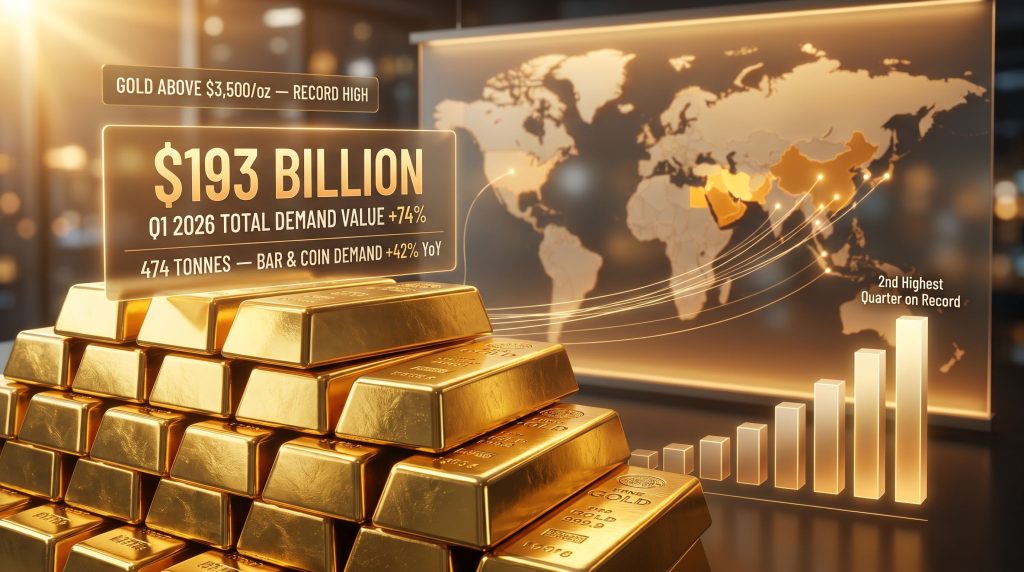
| Total demand value | $193 billion | +74% |
| Bar and coin demand | 474 tonnes | +42% |
| Bar and coin ranking | 2nd highest quarter on record | N/A |
| Gold price peak | Above $3,500/oz | Record high |
| Gold price (late April 2026) | $3,000 to $3,100/oz | Pulled back from peak |
The most telling feature of this data is not the volume growth, which at 2% is modest by historical standards. It is the 74% surge in demand value to a record $193 billion. This divergence between volume and value signals that price appreciation, not expanding tonnage, is the dominant force reshaping the gold market in 2026.
Bar and Coin Demand: Reading the Retail Conviction Signal
The 42% year-on-year increase in bar and coin demand to 474 tonnes deserves particular attention. This is the second-highest quarterly figure on record, and it was driven primarily by Asian investors. What makes this significant is the market context: prices were at or near record highs during the period, which would typically deter price-sensitive buyers. The fact that demand surged anyway suggests these are not opportunistic or speculative buyers chasing momentum. These are conviction-driven accumulators who are largely indifferent to short-term price levels.
Several factors are reinforcing this behaviour pattern in key Asian markets:
- A relative scarcity of liquid, high-quality alternative investment vehicles in certain domestic markets
- Persistent inflation concerns reducing confidence in cash and fixed-income instruments
- Cultural and historical familiarity with gold as a household store of wealth
- Heightened geopolitical uncertainty driving precautionary allocation into physical assets
When high prices filter out speculative buyers but conviction demand continues to grow, that is a structurally meaningful signal for longer-term price sustainability.
ETF and Jewellery Demand: The Diverging Segments
ETF and over-the-counter institutional demand is expected to remain supportive through 2026, though the World Gold Council anticipates it will fall short of the elevated 2025 levels. This reflects a more measured, longer-duration positioning rather than panic-driven inflows. Institutional investors who built gold positions through 2025 are largely holding rather than adding aggressively, which is consistent with a mature allocation cycle rather than a speculative frenzy.
Jewellery demand presents a more complex picture. Spending in value terms is proving resilient, but tonnage consumption is declining as high prices reduce the physical quantity consumers can afford. Regional tax policy changes in key markets, including parts of the Middle East and South Asia, are compounding this effect. The World Gold Council has noted that jewellery spending is likely to remain resilient absent significant economic shocks, but that tonnage demand is expected to continue slipping as elevated prices and regional tax dynamics work against volume growth.
Can the Premium Hold? Risks and Structural Supports
The Case for Persistence
The current geopolitical risk premium lifting gold prices has several characteristics that differentiate it from historically shorter-lived episodic premiums:
- The conflict driving safe-haven demand is regional in scope and has not shown signs of rapid resolution
- Central bank buying, which operates on multi-year cycles, provides a demand floor independent of sentiment
- Inflation remains persistently elevated, reinforcing gold's dual role as both a crisis hedge and an inflation store of value
- ETF positioning, while below 2025 peaks, continues to add structural institutional demand
Historical precedent supports the case for duration. The post-2001 geopolitical premium, which was partly structural rather than purely event-driven, sustained elevated gold prices for nearly a decade as central bank buying accelerated and institutional interest in gold as a portfolio asset grew substantially. In addition, the gold price outlook remains supported by multiple structural demand characteristics, which historically correlates with longer premium duration.
What Could Erode the Premium?
| Risk Factor | Potential Impact on Gold |
|---|---|
| Strengthening U.S. dollar | Negative: reduces relative appeal of dollar-priced gold |
| Rising U.S. Treasury yields | Negative: increases opportunity cost of non-yielding gold |
| Federal Reserve tightening signals | Negative: tighter liquidity reduces speculative positioning |
| Conflict de-escalation | Negative: removal of fear premium may trigger profit-taking |
| Improved global growth outlook | Mixed: reduces safe-haven bid, but may sustain inflation hedging |
The late April 2026 pullback from record highs to the $3,000 to $3,100 range is a useful reminder that even a structurally supported premium is not immune to macro headwinds. Dollar strength and yield expectations can temporarily suppress gold prices even when the underlying geopolitical conditions have not materially changed.
Supply Side: Modest Growth, Real Constraints
On the supply side, the World Gold Council projects that mine production will rise modestly in 2026, responding to the improved economics generated by higher gold prices. However, this supply response faces a meaningful constraint: energy shortages in certain key producing regions are limiting operational capacity and raising extraction costs simultaneously.
This creates an unusual supply dynamic where the price incentive to produce more gold exists but cannot be fully acted upon because the energy required to run mining operations is itself subject to disruption and cost escalation. In regions where power availability is uncertain, producers face a dual squeeze of rising operational costs and constrained output, even as the gold at $3,000 environment is theoretically the most favourable in years.
Energy-intensive gold mining operations in regions experiencing power shortages face a dual squeeze: rising operational costs and constrained output, even as gold prices provide historically strong production incentives.
The next major ASX story will hit our subscribers first
Frequently Asked Questions: Gold's Geopolitical Risk Premium
What exactly is a geopolitical risk premium in gold?
It is the additional price investors are willing to pay for gold above what macroeconomic fundamentals alone would justify, specifically driven by elevated uncertainty around war, political instability, supply chain disruption, or financial system stress. When these conditions are sustained rather than temporary, the premium tends to be structural rather than episodic.
Why did gold pull back from its record high even though tensions remained elevated?
The pullback from above $3,500 per ounce to the $3,000 to $3,100 range in late April 2026 reflects the influence of U.S. dollar strength and inflation concerns tied to elevated oil costs. This is consistent with a well-documented pattern in geopolitical pricing: fear is often priced in before events fully materialise, leading to partial unwinding even when underlying tensions have not resolved.
How long can a geopolitical premium realistically sustain gold prices?
Duration depends on whether demand is primarily structural or event-driven. Premiums backed by central bank accumulation, sustained institutional positioning, and persistent inflation tend to last years rather than months. The 2026 environment exhibits multiple structural rather than purely event-based demand characteristics, which historically correlates with longer premium duration.
Could rising U.S. interest rates undermine the premium?
Yes, higher Treasury yields increase the opportunity cost of holding non-yielding gold, creating a meaningful headwind. However, in a genuine stagflation scenario, where inflation remains persistently high even as rates rise, gold's inflation-hedge properties can partially offset the yield disadvantage, sustaining the geopolitical risk premium lifting gold prices at a lower level than it would otherwise reach.
Disclaimer: This article is intended for informational and educational purposes only and does not constitute financial or investment advice. Gold markets are subject to significant volatility, and past performance during historical geopolitical cycles does not guarantee future outcomes. Readers should consult qualified financial advisers before making investment decisions. All statistics and data points are sourced from the World Gold Council's Q1 2026 Gold Demand Trends report. Forward-looking statements reflect analyst expectations and are subject to change.
Want to Capitalise on the Next Major Mineral Discovery Before the Market Moves?
While gold's geopolitical risk premium continues to reshape global markets, Discovery Alert's proprietary Discovery IQ model scans ASX announcements in real time, delivering instant alerts on significant mineral discoveries — from gold to over 30 other commodities — so subscribers can act on actionable opportunities ahead of the broader market. Explore how historic discoveries have generated substantial returns on Discovery Alert's dedicated discoveries page, and begin your 14-day free trial today to secure a genuine market-leading edge.