August 25, 2026
The Hidden Architecture of Value: Understanding What Gold Is Actually Good For
Few materials in human history have generated more debate about intrinsic worth than gold. Critics argue it is a relic asset that extracts economic value without contributing productive output. Proponents counter that this framing fundamentally misunderstands a material whose properties are embedded in the architecture of modern civilisation. The question of what is gold good for is not simply rhetorical — it cuts to the heart of how we define value in an era dominated by energy transition narratives and critical mineral policy frameworks.
The most accurate answer is that gold is not one thing. It is simultaneously a monetary anchor, an industrial input, a medical material, and a cultural artifact spanning millennia. Understanding why requires examining the physical science behind gold's properties, the sectors that depend on it, and the emerging applications that could reshape demand over the decades ahead.
When big ASX news breaks, our subscribers know first
Why Gold's Physical Properties Make It Structurally Irreplaceable
The Science Behind Gold's Uniqueness
Gold's practical superiority in precision applications is not accidental. It emerges directly from the metal's atomic structure. Gold carries 79 protons in its nucleus, creating such a powerful positive charge that inner-shell electrons approach relativistic speeds. This relativistic quantum chemistry effect contracts the inner orbitals and stabilises the outer electron shell, which is the primary reason gold resists oxidation so effectively under normal environmental conditions.
The practical consequences of this atomic behaviour are significant:
- Gold does not tarnish, rust, or form surface oxides in air, water, or most chemical environments
- Its face-centred cubic crystal structure enables extreme ductility, allowing one gram to theoretically be drawn into a wire approximately 2.4 kilometres long
- A single troy ounce of gold can be beaten into a sheet covering roughly 9 square metres, making it economically viable for gilding large architectural surfaces
- Gold's electrical conductivity measures approximately 44.5 million siemens per metre, roughly 75% of copper's value, but unlike copper it maintains that conductivity indefinitely without surface degradation
- Its infrared reflectivity exceeds 98% in thin-film applications, a property that no cost-competitive alternative currently matches
How Gold Compares to Other Industrial Metals
| Property | Gold | Silver | Platinum | Copper |
|---|---|---|---|---|
| Corrosion Resistance | Excellent | Moderate | Excellent | Poor |
| Electrical Conductivity | Very High | Highest | Moderate | High |
| Malleability | Highest | High | Moderate | Moderate |
| Biocompatibility | Excellent | Moderate | Good | Poor |
| Long-Term Surface Stability | Best in class | Degrades | Good | Poor |
| Approximate Cost | ~$3,200/oz | ~$32/oz | ~$1,000/oz | Cents/lb |
Gold's combination of corrosion resistance, conductivity, malleability, and biocompatibility is unmatched among commercially viable industrial metals. In applications where failure carries catastrophic consequences, substitution is not merely inconvenient — it is technically unjustifiable.
While silver technically outperforms gold in raw electrical conductivity under laboratory conditions, silver tarnishes through sulphide formation in ambient environments containing even trace quantities of hydrogen sulphide gas. In real-world operating conditions, gold's stable surface translates to measurably lower failure rates, a consideration that matters enormously in aerospace, defence, and medical device manufacturing.
What Is Gold Good For? A Sector-by-Sector Analysis
Jewellery: The Dominant but Underestimated Use Case
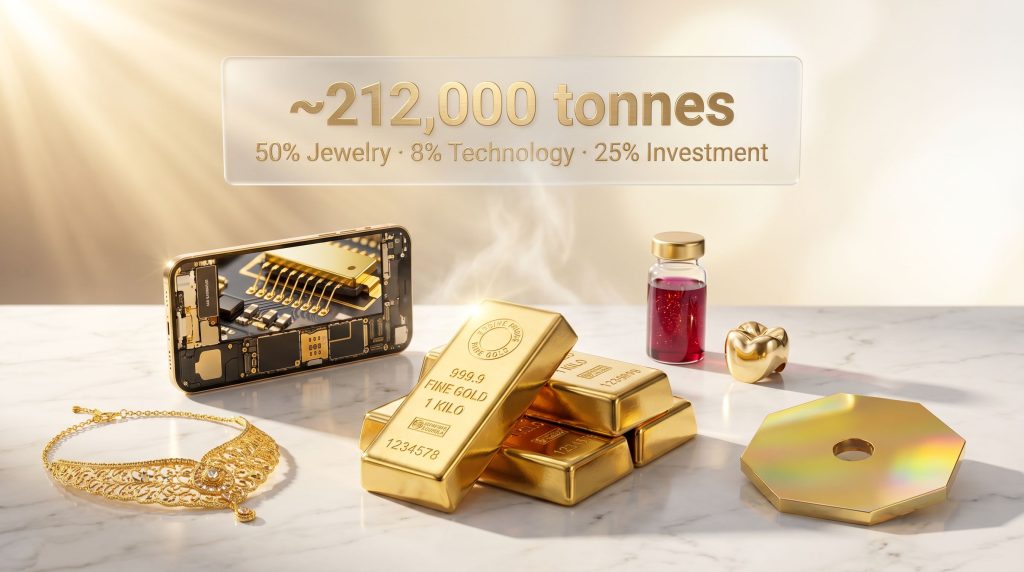
Jewellery accounts for approximately 50% of annual global gold demand, representing roughly 2,100 tonnes in recent years. This statistic is frequently dismissed by critics as purely discretionary spending, but that interpretation overlooks the dual function gold jewellery performs across much of the developing world.
In South Asia, the Middle East, and parts of East Asia, gold jewellery functions simultaneously as an aesthetic item and a portable, liquid savings vehicle. In economies where banking access has historically been limited or institutional trust is low, gold jewellery represents a rational wealth preservation strategy accessible to ordinary households. India and China together account for approximately 45% of global jewellery demand, with purchases concentrated around weddings, festivals, and cultural ceremonies that carry both social significance and financial planning logic.
Key facts about gold in jewellery:
- 24-karat gold represents 99.9% pure gold, used in investment coins and some cultural jewellery
- 18-karat alloys (75% gold, with copper, silver, and zinc) are standard for fine jewellery, balancing colour and durability
- 14-karat alloys offer greater hardness and lower price points, dominating Western fashion jewellery markets
- Gold's workability allows artisans to create intricate filigree designs without specialist industrial tooling
- Recycled jewellery contributes approximately 55% of the total gold recycling stream, estimated at 1,010 tonnes annually
Electronics and Technology: Gold's Invisible Industrial Footprint
The global electronics sector consumes an estimated 300 to 340 tonnes of gold annually, a figure that has grown at a compound annual rate of approximately 2.3% since 2018, driven by 5G infrastructure deployment, artificial intelligence hardware proliferation, and the expanding electronics content in electric vehicles.
The typical smartphone contains approximately 0.03 grams of gold distributed across roughly 50 connectors and bonding wires. This figure sounds trivial until multiplied across global smartphone production volumes exceeding 1.2 billion units annually, at which point the aggregate demand becomes material. Furthermore, as detailed in resources exploring gold's many everyday uses, electronics represent one of the metal's fastest-growing application areas.
Gold's specific technical roles in electronics include:
- Bonding wires in integrated circuits, typically 99.999% pure gold drawn to diameters of 15 to 50 microns
- Connector plating on USB ports, HDMI jacks, and circuit board edge connectors, preventing corrosion-induced signal degradation
- Semiconductor packaging, where gold bumps as small as 20 to 50 microns create thousands of electrical connections between processor dies and packaging substrates
- Printed circuit board surface finishes, where electroless nickel immersion gold (ENIG) coatings protect soldering surfaces during assembly and operation
As electronic components continue shrinking toward nanometre-scale dimensions, gold's importance is likely to intensify rather than diminish. At nanoscale dimensions, alternative conductors experience quantum tunnelling effects that disrupt signal integrity, a problem gold's stable electron configuration helps mitigate.
Medical and Pharmaceutical Applications: A Growing Frontier
Gold's biocompatibility — meaning the human immune system largely ignores its presence — has enabled a century of dental applications and is now opening doors into oncology and nanotechnology. In addition, the metal's unique physical properties make it exceptionally well suited for precision medical environments.
Established medical uses include:
- Dental alloys containing 60 to 80% gold (high-noble alloys per ASTM F67 specifications) used in crowns, bridges, inlays, and fillings, with documented failure rates below 1% over 15-year periods versus 5 to 10% for base metal alternatives
- Injectable gold compounds such as sodium aurothiomalate, used historically as disease-modifying treatments for rheumatoid arthritis
- Gold-198 isotope therapy, where the element's 2.7-day half-life enables precisely calibrated radiation delivery to tumours while limiting exposure to surrounding healthy tissue
Emerging and speculative medical applications are generating significant research interest:
- Gold nanoparticles exhibit plasmonic resonance properties, shifting absorption wavelengths from approximately 520 nanometres in smaller particles to longer wavelengths as particle size increases, enabling colour-change-based diagnostic tests
- The lateral flow assay tests deployed globally during the COVID-19 pandemic relied on gold nanoparticle technology to generate visible colour signals indicating positive results
- Researchers are investigating gold nanoparticles as agents that concentrate radiation energy absorption within tumour cells, potentially enhancing the effectiveness of existing radiation therapy protocols
- Targeted drug delivery systems using functionalised gold nanoparticles are under active investigation, with early-stage clinical data suggesting improved tumour-to-tissue drug concentration ratios
Disclaimer: Emerging medical applications of gold nanoparticles remain in various stages of clinical research. Projections about future pharmaceutical applications should not be interpreted as confirmed commercial outcomes.
Aerospace and Defence: Where Failure Is Never an Option
The aerospace sector's use of gold represents perhaps the clearest demonstration of the metal's irreplaceable status. No regulatory body governing spacecraft or astronaut safety equipment accepts the concept of acceptable failure rates from corrosion-induced connector malfunction.
Documented aerospace applications include:
- The James Webb Space Telescope's primary mirror carries approximately 48 grams of gold deposited to a thickness of just 100 nanometres, enabling the infrared reflectivity required to observe the earliest galaxies in the observable universe
- Astronaut helmet visors are coated with thin gold films reflecting approximately 60% of visible light and 99% of infrared radiation, protecting vision against solar irradiance levels reaching 1,366 watts per square metre in Earth orbit
- Gold-coated polyimide (Kapton) thermal blankets regulate spacecraft internal temperatures by reflecting solar radiation and retaining equipment heat in the extreme cold of deep space
- Military and aviation electronics use gold-plated contacts manufactured to stringent plating thickness standards (0.5 to 2.0 microns) to ensure signal reliability under vibration, humidity, and temperature extremes
Architecture and Luxury Manufacturing
Gold leaf gilding allows one troy ounce of gold to cover approximately 9 square metres of architectural surface, making it economically viable for decorating building domes, religious monuments, and civic structures. The Dome of the Rock in Jerusalem and numerous temple structures across Southeast Asia demonstrate gold's multi-millennial track record as an architectural material.
In luxury manufacturing, gold serves both aesthetic and functional purposes in high-end watches (movement jewels and case materials), audio equipment (connector plating to prevent signal degradation), and premium writing instruments, where gold nibs flex to match individual writing pressure without cracking.
Gold's Contested Status: Is It a Critical Mineral?
Why Governments Exclude Gold From Critical Mineral Lists
Most governmental critical mineral frameworks — including those published by the United States, European Union, and Australian governments — exclude gold. The rationale reflects energy transition priorities rather than a comprehensive assessment of material criticality.
Critical mineral designations generally target materials essential to:
- Lithium-ion battery manufacturing (lithium, cobalt, nickel, manganese)
- Permanent magnet production for wind turbines and EV motors (rare earth elements)
- Solar panel manufacturing (silicon, indium, tellurium)
- Hydrogen electrolyser technology (platinum group metals)
Gold does not fit neatly into any of these categories, leading policymakers to frame it as a commodity that extracts existing value rather than enabling new productive capacity.
The Counter-Argument Worth Taking Seriously
The exclusion of gold from critical mineral frameworks is a policy choice reflecting current priorities, not a settled scientific or economic conclusion. The reasons why gold remains valuable are, in fact, more structural and wide-ranging than policy classifications suggest.
The case for reconsidering gold's strategic status rests on several pillars:
- Monetary system stability: Central banks globally hold approximately 36,000 tonnes of gold as reserve assets. Net central bank gold purchases exceeded 1,000 tonnes annually in both 2022 and 2023, with the trend continuing as nations pursue reserve diversification strategies in a multipolar monetary environment. Indeed, central banks influencing gold prices have become one of the most significant demand drivers in the modern era
- Electronics-grade irreplaceability: No cost-competitive material matches gold's combination of conductivity and corrosion resistance for high-reliability electronic applications
- Expanding medical applications: Gold's role in oncology, diagnostics, and nanotechnology is growing, not shrinking
- Economic development: Gold mining generates significant royalty revenue, employment, and infrastructure investment in developing economies, including many nations in Africa, South America, and Southeast Asia
The debate over gold's critical mineral status ultimately reflects a narrow framing of criticality. A material underpinning global financial reserves, embedded in every advanced electronic device, and expanding into precision medicine occupies a more strategically significant position than current policy classifications acknowledge.
How Much Gold Exists? Understanding Scarcity and Supply
Global Gold Supply at a Glance
| Metric | Estimated Figure |
|---|---|
| Total gold ever mined | ~212,000 tonnes |
| Annual global mine production | ~3,500 tonnes |
| Central bank gold reserves | ~36,000 tonnes |
| Gold held in jewellery form | ~96,000 tonnes |
| Gold in electronics and industrial use | ~25,000 tonnes |
| Known below-ground reserves | ~57,000 tonnes |
One of gold's most frequently cited supply facts is that all gold ever mined throughout human history would fit within a cube approximately 22 metres on each side. This is not merely a curiosity. It reflects the genuine physical scarcity of a metal that has been relentlessly extracted for over 5,000 years of recorded history, yet remains finite in a way that distinguishes it from any fiat currency.
Unlike most commodities, gold is rarely consumed or destroyed. It circulates continuously through jewellery, financial products, industrial applications, and recycling streams. Recycled gold contributes approximately 25 to 30% of annual supply, with recovery rates varying significantly by source:
- Industrial and electronic scrap: 80 to 90% recovery in formal recycling operations
- Consumer electronics at end of life: 15 to 25% recovery, reflecting collection rate limitations
- Jewellery recycling: variable but improving, driven by price sensitivity among consumers
Gold Mining's Sustainability Challenge
The Environmental Reality of Primary Gold Production
Gold mining carries substantial environmental costs that the industry cannot credibly minimise. Producing one troy ounce of gold generates an estimated 0.8 to 1.0 tonnes of CO₂ equivalent on average across the industry, though leading producers operating with renewable energy inputs have achieved reductions to approximately 0.6 to 0.8 tonnes per ounce.
Key environmental challenges include:
- Cyanide leaching remains the dominant gold extraction method, processing ore grades as low as 0.5 to 1.0 grams per tonne. Containment failures can cause severe ecological damage to surrounding waterways
- Tailings dam failures represent a critical safety and environmental liability, with high-profile failures in recent years reinforcing regulatory scrutiny across major mining jurisdictions
- Artisanal and small-scale gold mining (ASGM) accounts for approximately 20% of global production while generating a disproportionate share of mercury pollution, as mercury amalgamation remains the dominant small-scale extraction technique
- Water consumption in arid mining regions creates community and ecological tensions, particularly in water-stressed jurisdictions in South America and Southern Africa
How the Industry Is Responding
The gold mining sector's response to decarbonisation pressure has accelerated but remains uneven:
- Major producers are investing in solar and wind-powered processing facilities, with several operations now drawing over 50% of their energy from renewable sources
- The World Gold Council's Responsible Gold Mining Principles (RGMPs) provide a structured ESG compliance framework covering environmental management, human rights, and community engagement
- Blockchain-based traceability systems are being deployed to verify ethical sourcing from mine to finished product, addressing growing demand from electronics manufacturers and luxury brands for certified responsible gold
- Recycled and certified gold designations are gaining commercial traction, with some technology companies now committing to increasing recycled content in product supply chains
Gold presents a structural sustainability paradox. The metal itself is infinitely recyclable, chemically stable across centuries, and non-degrading in any application. Yet extracting it from the earth for the first time remains one of the more environmentally complex processes in the entire mining industry.
The next major ASX story will hit our subscribers first
The Future of Gold: Emerging Demand Drivers
Gold Nanoparticles and Advanced Technology
Perhaps the most underappreciated growth vector in gold demand lies at nanoscale dimensions. Gold nanoparticles exhibit fundamentally different optical and electronic properties from bulk gold, driven by surface plasmon resonance effects that make them highly responsive to molecular interactions.
Active research and commercial development areas include:
- Rapid diagnostic tests: lateral flow assays using gold nanoparticles as signal generators, now deployed globally across infectious disease testing
- Targeted cancer therapy: gold nanoparticles functionalised to bind selectively to tumour cell surface receptors, enabling concentrated radiation or drug delivery
- Catalysis: gold nanoparticles demonstrate surprising catalytic activity at room temperature for carbon monoxide oxidation, a property bulk gold does not exhibit
- Quantum computing research: gold's stable conductivity at nanoscale dimensions is under investigation for use in superconducting qubit connection architectures
Gold in the Hydrogen Economy
A less commonly discussed but potentially significant demand driver is gold's catalytic role in certain hydrogen fuel cell and chemical manufacturing processes. As the hydrogen economy expands, gold catalyst applications could grow materially, representing a demand segment currently too small to feature prominently in analyst projections but worth monitoring closely.
Some high-efficiency photovoltaic manufacturing processes also incorporate gold in contact layer applications, creating a modest but real linkage between gold demand and solar energy deployment.
Demand Projections by Segment
| Demand Segment | Current Share | Growth Outlook to 2030 |
|---|---|---|
| Jewellery | ~50% | Stable to modest growth |
| Technology and Electronics | ~8% | Moderate growth driven by AI and 5G |
| Investment (bars, coins, ETFs) | ~25% | Cyclical, geopolitically driven |
| Central Bank Purchases | ~10% | Elevated, de-dollarisation trend |
| Medical and Nanotechnology | ~2% | Strong long-term growth potential |
Disclaimer: Demand projections involve inherent uncertainty and should not be interpreted as investment advice. Future demand is subject to technological substitution, macroeconomic cycles, and policy changes that cannot be reliably predicted.
Frequently Asked Questions About Gold's Uses
What is gold most commonly used for?
Jewellery represents gold's largest single application by volume, accounting for approximately half of all annual demand. Electronics, investment products, and central bank reserve accumulation follow as significant secondary uses, with medical applications representing a smaller but rapidly evolving segment. Understanding gold investment options — from physical holdings to ETFs — is increasingly relevant for those seeking exposure to these demand trends.
Is gold used in smartphones and computers?
Every modern smartphone, laptop, and server contains gold, primarily in connectors, circuit board surface finishes, and semiconductor bonding wires. The approximately 0.03 grams per smartphone seems minimal but aggregates to hundreds of tonnes annually across global production volumes.
Why is gold used in space exploration?
Gold reflects more than 98% of infrared radiation and maintains its optical properties indefinitely in vacuum environments where other materials would degrade. This makes it uniquely suited for telescope mirrors, thermal management systems, and astronaut visor coatings, where performance cannot be compromised by corrosion over mission lifetimes.
Can gold be used in medicine?
Gold has established roles in dentistry spanning over a century and has been used as an injectable compound for rheumatoid arthritis treatment. The frontier of gold medicine lies in nanoparticle applications for cancer diagnostics, targeted drug delivery, and enhanced radiation therapy — all currently in various stages of research and clinical development. As outlined by physical gold insights, the breadth of gold's medical applications continues to expand.
Why doesn't gold corrode or rust?
Gold is classified as a noble metal, sitting at the positive end of the standard electrode potential series. Its filled d-electron band and the relativistic stabilisation of its outer electron orbital prevent the electron transfer reactions that form corrosion products in other metals. This chemical inertness underpins virtually every practical application gold has across industry, medicine, and technology.
Is gold environmentally sustainable to mine?
Primary gold mining carries significant environmental costs, particularly around energy consumption, water use, cyanide chemistry, and land disturbance. However, gold's infinite recyclability means existing above-ground stocks of approximately 212,000 tonnes can continue to be recovered and reused, reducing the long-term dependence on primary extraction as recycling infrastructure and collection rates improve.
Reframing the Question of Gold's Value
Gold Is Not One Thing
The question of what is gold good for contains a hidden assumption: that a material must serve a single, clearly definable purpose to be considered valuable. Gold systematically defies this assumption.
Across its applications, gold functions as:
- A monetary anchor for central banks navigating an increasingly multipolar global financial system
- A precision industrial material embedded in every advanced electronic device powering modern civilisation
- A biocompatible medical material with expanding pharmaceutical and diagnostic applications
- A cultural and aesthetic asset carrying millennia of human significance across diverse civilisations
- A nanotechnology platform enabling next-generation diagnostics, therapeutics, and catalysis
- An environmental challenge demanding serious decarbonisation investment from producers and honest engagement from consumers
The debate over whether gold is critical, useful, or merely a relic commodity reveals more about the framing assumptions of current policy discourse than about the metal's actual role in the global economy. Gold's value is structural and multi-dimensional, spanning monetary systems, advanced technology, precision medicine, and culture simultaneously. Furthermore, for those tracking gold as a safe haven investment, the metal's enduring industrial relevance reinforces its financial credibility in periods of economic uncertainty.
Investors and analysts seeking broader context on gold's evolving role — from mining stocks and investment types to ESG and sustainability — will find that the metal's structural demand profile makes it far more than a passive store of value in today's global economy.
Want to Stay Ahead of the Next Major ASX Gold Discovery?
Discovery Alert's proprietary Discovery IQ model delivers real-time alerts the moment significant mineral discoveries are announced on the ASX, transforming complex data across 30-plus commodities into clear, actionable investment insights — explore historic discovery returns to understand the scale of opportunity, then begin your 14-day free trial at Discovery Alert to position yourself ahead of the broader market.