June 24, 2026
When Tax Policy Meets the World's Most Emotionally Charged Commodity
Physical commodity markets have a long memory for policy shocks. When governments adjust the cost of imported goods sharply and without extended transition periods, the immediate price signal travels faster than buyers can psychologically process it. In gold markets specifically, where purchasing decisions are tied to weddings, inheritance, religious festivals, and generational savings habits, the gap between official benchmark repricing and actual transactional willingness can widen dramatically within hours.
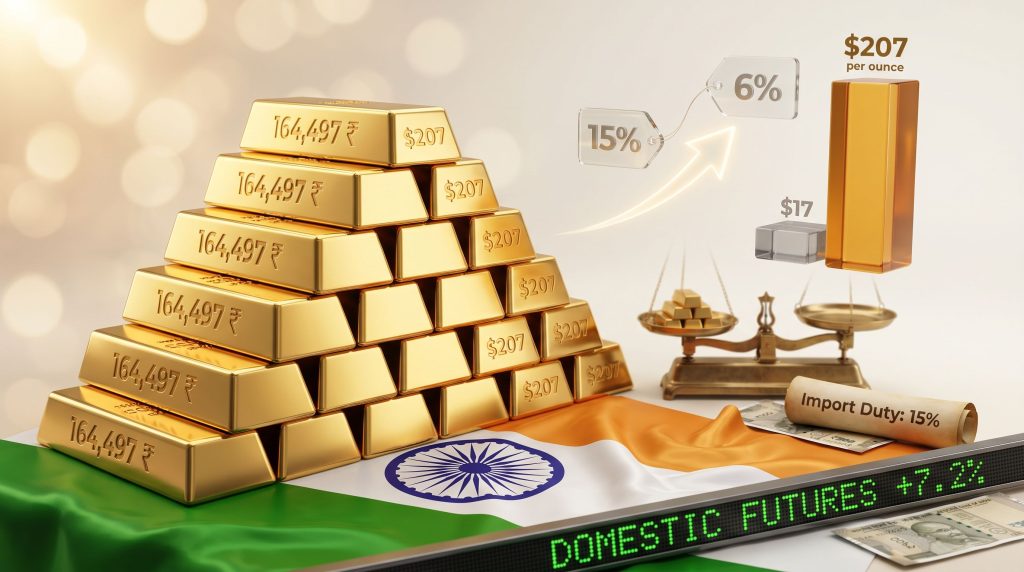
That is precisely the mechanism that drove gold discounts in India breach record territory on May 13, 2026, when physical bullion in the country's dealer networks was being offered at discounts exceeding $207 per ounce against official domestic benchmark prices inclusive of applicable levies. Understanding why this happened requires examining not just the tax change itself, but the layered behavioural, structural, and informal-market dynamics that amplify policy shifts in one of the world's most complex gold ecosystems.
When big ASX news breaks, our subscribers know first
A Snapshot of the Pricing Shock
Before diving into mechanics, the scale of this dislocation deserves immediate context. The table below captures the key metrics and their transformation following India's tariff adjustment.
| Metric | Before Tariff Change | After Tariff Change | Why It Matters |
|---|---|---|---|
| Gold import duty | 6% | 15% | Raises landed cost of all officially imported bullion |
| Sales levy | 3% | 3% | Unchanged but compounds overall tax burden |
| Physical dealer discount | ~$17 per ounce | Up to $207 per ounce | Signals extreme mismatch between supply and buyer willingness |
| Domestic gold futures move | Baseline | +7.2% in a single session | Benchmark repriced faster than retail demand could absorb |
| Domestic futures benchmark | Prior level | 164,497 rupees per 10 grams | Highest reading in over two months |
| Grey-market operator margin | ~9% | ~18% | Illicit trade becomes substantially more economically attractive |
The single most striking figure is the discount itself. A move from $17 to $207 per ounce represents a more than twelvefold widening within roughly 24 hours. That kind of compression is not bargaining behaviour. It is structural dislocation.
How a Tariff Increase Creates Physical Market Chaos
The Policy Transmission Chain
The sequence connecting a government tariff decision to record discounts at the dealer level is not instantaneous, but under certain conditions it compresses into a single trading session. Here is how each step played out in this case:
- The Indian government raised gold import duties from 6% to 15%, citing pressure on foreign exchange reserves and a desire to curb overseas metal purchases.
- Landed cost of officially imported bullion rose immediately, as duty is applied at the point of import clearance.
- Domestic benchmark prices, anchored to import cost plus applicable levies, repriced sharply upward on futures exchanges.
- Retail buyers, already operating in a cautious demand environment, faced sticker shock from prices that had risen 7.2% in a single session.
- Existing holders of physical gold, including individual investors, institutions, and ETF participants, recognised an opportunity to monetise gains at elevated official prices.
- Selling pressure from profit-takers flooded into a market where retail demand had effectively stalled.
- Dealers, holding inventory they could not move at revised official price levels, widened discounts aggressively to attract any buyers willing to transact.
The critical insight here is that discounts widened not because gold became less valuable, but because the official price moved faster than the market could clear inventory at those levels. Benchmark appreciation and physical market health are two separate conditions that can diverge sharply under policy shock conditions.
Why Abrupt Repricing Hits Harder in Price-Sensitive Markets
India's gold market is unlike almost any other. Demand is not primarily speculative. It is structural, tied to cultural obligations that carry emotional and social weight. When a household in Rajasthan or Tamil Nadu plans to purchase jewellery for a daughter's wedding, their budget is fixed months in advance. A sudden 7% to 9% jump in the rupee cost of gold does not get absorbed through flexible demand. It creates a hard stop.
This price sensitivity means that abrupt tax-led repricing produces an asymmetric outcome: sellers need to move metal, buyers will not move at all, and the price discovery process happens not through orderly trading but through emergency discounting. Furthermore, tariffs affect precious metals markets in ways that extend well beyond simple cost increases, layering in behavioural and structural responses that can persist for weeks.
"When a sharp price jump hits a market defined by rigid purchasing occasions and culturally fixed demand calendars, the physical clearing price can detach from the benchmark almost instantly. The discount becomes the real price."
What the Numbers Reveal About Stress Beneath the Surface
Beyond the Headline: Futures vs. Physical Reality
Gold futures in India jumping 7.2% to 164,497 rupees per 10 grams made for a dramatic headline. However, the more revealing signal was buried in the physical market. While the futures benchmark reached its highest point in more than two months, dealers were simultaneously offering gold at prices more than $200 below the very benchmark that futures were celebrating.
This divergence is a textbook symptom of what market practitioners call basis dislocation, where the relationship between a derivative benchmark and the underlying physical commodity breaks down. In normal conditions, Indian dealers might offer small premiums or modest discounts of a few dollars per ounce. A $207 discount is not a trading position. It is a distress signal. According to Reuters reporting on Indian gold discounts, this record-breaking discount reflects an unprecedented breakdown between paper pricing and physical market reality.
What 164,497 Rupees Per 10 Grams Means at Street Level
For context, this benchmark translates into a purchasing decision with significant consequences for Indian consumers across several categories:
- Wedding jewellery buyers who had budgeted at pre-hike price levels found their purchasing power materially reduced overnight, prompting deferrals or switches to lighter-weight designs.
- Retail jewellers faced a difficult choice: restock at the new higher replacement cost, or deplete existing inventory and wait for price stabilisation before committing capital.
- Inventory financing became more expensive in real terms, because the rupee value of gold held on balance sheet rose, but the ability to sell it at full benchmark prices weakened simultaneously.
| Buyer Profile | Before Tariff Hike Psychology | After Tariff Hike Psychology |
|---|---|---|
| Wedding jewellery buyer | Active purchasing, comparing designs | Deferral, budget reassessment, lighter options |
| Retail jeweller | Routine restocking cycles | Inventory freeze, margin anxiety |
| Individual investor | Moderate accumulation | Profit-taking, holding off new purchases |
| Grey-market participant | Marginally profitable | Substantially more profitable, higher activity incentive |
Why Investor Behaviour Amplified the Dislocation
Profit-Taking in a Rising Price Environment
One of the less intuitive aspects of this episode is that the selling pressure driving record discounts came partly from investors responding rationally to higher prices. When a tax shock lifts local gold prices sharply, holders who purchased at lower levels have a straightforward incentive: realise gains now, before the market adjusts, buyers retreat, and prices potentially correct.
This creates a simultaneous double pressure on physical supply. Retail demand weakens at the top of the price move, while investment supply enters the market from holders liquidating into strength. That combination, rather than either factor alone, is what turns a policy adjustment into a record discount event. In addition, gold movement and COMEX inflows during periods of tariff uncertainty demonstrate how quickly capital flows can shift in response to policy signals.
The Role of Gold ETF Profit-Booking
Alongside direct physical selling, investor activity in gold exchange-traded funds contributed to supply-side pressure. When ETF holders book profits, the redemption and market-making processes associated with those instruments can add incremental selling into an already oversupplied physical market, according to dealer commentary reported by Reuters.
It is worth being precise about this mechanism. ETF outflows in a local market context do not necessarily reflect global bearishness on gold. International gold sentiment was clearly constructive, given that gold futures globally were trading near multi-decade highs during this same period. The local ETF selling was a tactical response to a domestic policy shock, not a structural retreat from gold as an asset class.
Why Jewellers and Retail Buyers Stepped Away
Elasticity in a Culturally Embedded Market
India's physical gold demand has a reputation for being structurally resilient across economic cycles. That resilience, however, has important limits. It depends on gradual price changes and predictable cost environments. Abrupt tariff increases of nine percentage points in a single announcement destroy the planning assumptions that retailers and consumers rely on.
Ashok Jain, proprietor of Mumbai-based gold wholesaler Chenaji Narsinghji, confirmed to Reuters that retail buyers and jewellers remained on the sidelines following the duty hike, intensifying selling pressure and pushing discounts to exceptional levels. This sidelining effect is a well-documented demand-side response to sudden cost increases in price-sensitive physical markets. Consequently, Trump-era tariff impacts on global gold investment provide a useful comparative lens for understanding how abruptly imposed trade barriers reshape buyer behaviour across different markets.
Jeweller Inventory Pressures in Detail
The pressures on mid-sized jewellers during an episode like this are multi-directional and reinforcing:
- Higher replacement cost means any restocking requires more working capital than budgeted.
- Customer footfall slows because buyers are waiting for price clarity, reducing revenue needed to service inventory financing.
- Holding existing inventory becomes a risk if prices correct after the shock subsides, leading to mark-to-market losses.
- The incentive to sell existing stock at a discount becomes rational from a cash flow perspective, even if it depresses margins.
- New orders from customers shift toward lighter designs, lower purities, or old-jewellery exchange programmes, reducing the demand for fresh bullion entirely.
This is not theoretical. It is the standard operational response of a mid-sized jeweller managing restocking risk after an abrupt duty shock.
The next major ASX story will hit our subscribers first
Could Record Discounts Fuel Gold Smuggling?
The Grey-Market Economics Are Straightforward
This is perhaps the most consequential and underappreciated dimension of record discounts in India's gold market. When the official import duty rises from 6% to 15%, the economics of smuggling change in a predictable and measurable way. A Chennai-based bullion dealer told Reuters that the tariff increase widened grey-market operator margins to approximately 18%, from around 9% before the hike.
The arithmetic is simple. Grey-market operators source gold from overseas without paying Indian duties, transport it across borders or through unofficial channels, and sell it at a cash discount to official market prices. When the duty gap widens, the potential margin expands, the cost of enforcement risk becomes comparatively smaller relative to profit, and the volume of illicit trade tends to increase.
What Doubling the Grey-Market Margin Signals
A move from approximately 9% to 18% in illicit operator margins is not a marginal change. It represents a doubling of the financial incentive to circumvent official import channels. The implications cascade across several dimensions:
- Formal trade volumes decline as compliant importers cannot compete with untaxed supply priced below their cost basis.
- Tax collection efficiency deteriorates because the official import volumes that duties are designed to capture shrink.
- Official demand statistics become distorted, as physical consumption continues through unofficial channels that do not appear in formal import data.
- Compliant dealers face competitive pressure from grey-market supply offered at discounts they cannot legally match.
Historically, India has experienced significant gold smuggling activity during periods of high import duties. The country's customs authorities have documented seizure patterns that tend to correlate with duty increases. This episode's tariff structure brings the incentive environment back to levels historically associated with elevated smuggling activity.
Does a Higher Import Duty Actually Reduce Gold Demand?
The Short Answer
Not necessarily. A higher duty can suppress formal imports and disrupt near-term buying behaviour, but it typically redirects underlying demand into recycled metal, deferred purchases, or unofficial supply channels rather than eliminating the cultural and investment appetite for gold that drives Indian consumption.
Three Possible Market Paths Over the Near Term
| Scenario | Key Conditions | Likely Outcome |
|---|---|---|
| Discounts normalise | Buyers adapt to higher prices over 2 to 4 weeks; dealers clear inventory; smuggling stays contained | Physical clearing prices converge back toward benchmark; discounts return to single-digit dollars per ounce |
| Informal supply expands | Grey-market volumes grow; official imports soften; cash transactions increase | Discounts remain volatile; official data understates actual consumption; compliant dealers lose market share |
| Demand freezes temporarily | Jewellers defer purchases; ETF selling continues; no major festival demand catalyst | Local benchmark and physical clearing prices decouple further; import volumes contract sharply for 1 to 2 quarters |
Understanding Premiums and Discounts in Bullion Markets
A Plain-English Explanation
For readers encountering these terms for the first time, the distinction is worth clarifying precisely:
- A premium means physical gold is changing hands at a price above the reference benchmark. This typically signals strong local demand relative to available supply, import constraints, or logistical bottlenecks limiting delivery.
- A discount means physical gold is selling below the reference benchmark. This signals that available supply exceeds what buyers are willing to absorb at official prices, often due to policy friction, weak demand, or distress selling.
India typically oscillates between modest premiums during festival and wedding seasons and small discounts during quieter periods. A $207 discount sits in a category entirely separate from normal seasonal variation. For those considering how to position themselves in response to such volatility, understanding how to buy gold in Australia during periods of global pricing dislocation offers a practical starting point.
Why India's Discount Matters Beyond Its Borders
As the world's second-largest gold-consuming market, India's physical pricing signals carry weight for global bullion trade flows. Extreme local discounts can affect refiner allocation decisions, the economics of Dubai-linked re-export trade routes that serve as a gateway for gold entering South Asia, and the pricing calculations of international bullion banks managing physical inventory across multiple jurisdictions.
When India's physical market goes into deep discount, it creates a temporary pricing anomaly that sophisticated traders will attempt to arbitrage, but only if they can navigate the tariff structure legally. If the duty wall prevents profitable arbitrage through official channels, that arbitrage increasingly happens through the grey market instead. Furthermore, central banks influencing gold prices in 2025 added another layer of complexity to the global supply and demand equation during this period.
What to Watch as This Situation Evolves
Leading Indicators for Market Normalisation
Analysts and market participants tracking this dislocation should monitor several key signals over the weeks following the tariff change:
- Discount magnitude trends over one to two week windows. Narrowing discounts suggest inventory is clearing and buyers are returning at revised price expectations.
- Retail footfall and jewellery order volumes, particularly around upcoming festival or wedding dates that create non-deferrable purchasing occasions.
- ETF flow data from Indian exchanges, which can signal whether investment-side supply pressure is stabilising.
- Official import volume data from government sources, which will reveal whether the duty increase is compressing formal trade as intended.
- Customs seizure reports, which serve as a lagging but meaningful indicator of grey-market activity levels.
Practical Guidance for Different Audiences
- For consumers: a large physical market discount does not automatically mean gold is cheap. If official prices including duties remain elevated, the discount reflects dealer distress rather than consumer opportunity.
- For jewellers: restocking discipline and customer conversion rate monitoring are critical in the weeks following a price shock. Premature restocking at peak prices amplifies margin risk if prices subsequently correct.
- For policymakers: measuring the effectiveness of a duty increase requires tracking both formal import compression and unintended shifts into unofficial supply channels. Success on one metric can mask failure on the other.
- For market observers: the gold discounts in India breach record story is fundamentally about the gap between paper-price strength and physical-market weakness, a distinction that carries important implications for how demand data should be interpreted during policy transition periods.
FAQ: Gold Discounts in India Breach Record
Why did gold discounts in India exceed $200 per ounce?
The import duty increase from 6% to 15% lifted official domestic benchmark prices by approximately 7.2% in a single session. Buyers pulled back due to sticker shock while existing holders sold into the price strength, flooding a weak-demand market with excess supply. Dealers responded by cutting prices dramatically below official levels to clear inventory.
Did gold prices rise or fall in India after the duty hike?
Official benchmark prices rose sharply, with domestic futures reaching 164,497 rupees per 10 grams. Physical transaction prices, however, fell well below those official levels through the mechanism of extreme dealer discounts. Both things were simultaneously true. In addition, market data from ScanX Trade analysis of record gold rallies corroborates this divergence between benchmark performance and physical demand conditions.
Does a record discount mean gold demand collapsed in India?
Not necessarily. It reflects a temporary breakdown in formal-market demand at current official price levels. Underlying cultural and investment demand for gold in India remains structurally present but was redirected into waiting, old-jewellery recycling, or unofficial supply channels in the immediate aftermath of the shock.
Could the tariff increase boost gold smuggling?
This is a material risk. Grey-market operator margins reportedly widened from approximately 9% to 18% following the duty increase, making illicit trade substantially more profitable. Historical precedent from India's previous duty increase cycles suggests that elevated tariff differentials reliably stimulate grey-market activity over time.
Are record discounts bullish or bearish for gold globally?
They are locally bearish for India's physical market conditions in the near term, but they carry no direct implication for global gold sentiment. The same tariff shock that created domestic discounts coincided with international gold futures trading near multi-decade highs, illustrating how local policy distortions can produce outcomes that diverge sharply from the global picture.
The Core Lesson from India's Record Discount Event
Policy Shock, Physical Dislocation, and the Limits of Benchmark Pricing
The episode in which gold discounts in India breach record levels above $207 per ounce is ultimately a story about the limits of what official benchmarks can tell us about real market conditions. Futures prices, by their nature, reprice quickly in response to cost inputs like import duties. Physical markets, governed by human psychology, cultural purchasing habits, cash flow constraints, and dealer inventory decisions, move much more slowly.
When those two systems are forced to reconcile in real time following a nine-percentage-point duty increase, the friction appears first and most visibly in the discount. The benchmark celebrates the higher price. The physical market reveals that nobody is willing to pay it yet.
India's gold market has absorbed duty shocks before and recovered its equilibrium. The question this time is how long that equilibrium takes to return, and how much of India's gold demand migrates into informal channels during the transition period. Those two outcomes, not the size of the initial discount, will determine whether this tariff increase achieved its stated goals or simply redirected the demand it was designed to suppress.
Want To Stay Ahead of Major Mineral Discoveries Before the Broader Market Reacts?
Just as India's gold market illustrates how quickly commodity dynamics can shift on policy signals, Discovery Alert's proprietary Discovery IQ model delivers real-time alerts on significant ASX mineral discoveries, translating complex data across 30-plus commodities into clear, actionable insights the moment they are announced. Explore how historic discoveries have generated substantial returns and begin your 14-day free trial today to position yourself ahead of the market.