June 20, 2026
The Hidden Tax on Wealth: Why Precious Metals Belong in Every Serious Portfolio
Most investors focus on what the market gives. Fewer stop to examine what monetary systems quietly take away. Over long stretches of economic history, fiat currencies have followed a predictable arc: expansion, debasement, and gradual erosion of purchasing power. The mechanism is rarely dramatic. It operates incrementally, through interest rate decisions, deficit spending, and the quiet expansion of the money supply. By the time the damage becomes visible in everyday prices, the wealth transfer is already well underway.
Understanding gold and silver as inflation hedge and Fed rate cuts as the catalyst that drives their repricing is not simply a matter of tracking commodity charts. It requires a deeper look at monetary architecture, fiscal mathematics, and the behavioural patterns of central banks operating under structural constraints.
When big ASX news breaks, our subscribers know first
Why Fiat Currency Loses and Precious Metals Hold
The 50-Year Purchasing Power Problem
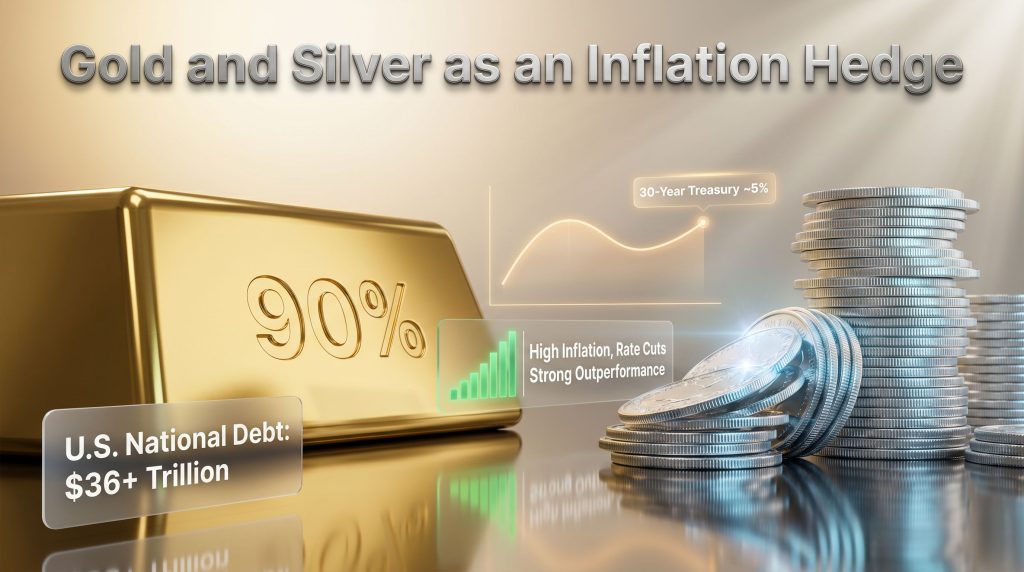
The U.S. dollar's purchasing power, measured against gold, has declined by approximately 90% over the past five decades. This is not a short-term statistical anomaly. It reflects the systematic consequence of an economic model that relies on currency expansion to manage public debt, stimulate growth, and fund government deficits.
Every dollar created beyond the economy's productive capacity dilutes the value of existing dollars. When governments spend more than they collect in tax revenue, and when central banks accommodate that gap through monetary policy, the unit of account loses ground to tangible assets. Gold and silver have historically absorbed that erosion because their supply cannot be expanded by decree. Furthermore, gold as an inflation hedge has been validated repeatedly across multiple economic cycles and regimes.
Gold's Role as a Monetary Anchor
Gold has functioned as a reference point for monetary value across multiple economic regimes, from the classical gold standard to the Bretton Woods era and into the current floating-rate system. Even after the U.S. severed the dollar's formal link to gold in 1971, central banks around the world continued accumulating gold reserves. That behaviour reflects institutional recognition of something that public narratives often downplay: gold is not simply a speculative asset. It is a store of value with no counterparty risk and no dependency on issuer credibility. In addition, central bank gold demand has accelerated considerably in recent years, further reinforcing this monetary role.
Silver's Dual Nature: Monetary and Industrial
Silver occupies a more complex position. Unlike gold, which derives its investment value almost entirely from monetary demand, silver's dual nature as both a monetary asset and an industrial input creates a different risk and return profile. It is a critical component in photovoltaic solar panels, electric vehicle systems, medical devices, and electronics. This dual identity means industrial demand cycles can amplify or dampen the monetary tailwinds that drive both metals.
Silver's price behaviour tends to lag gold during the early stages of a rally, then frequently outperforms in the later phases of a bull market, reflecting a combination of monetary repricing and accelerating industrial demand.
How Federal Reserve Policy Moves Gold and Silver Prices
The Opportunity Cost Mechanism
Neither gold nor silver pays a dividend or coupon. This means their relative attractiveness as investment assets is directly influenced by the prevailing return on interest-bearing alternatives. When the Federal Reserve cuts rates, the return on cash, Treasury bills, and short-duration bonds falls. The opportunity cost of holding non-yielding metals declines in parallel. Capital that was previously drawn to yield-bearing instruments finds precious metals comparatively more attractive.
The relationship is not simply directional. It is proportional. Larger and more sustained rate-cut cycles historically produce stronger and more durable precious metals bull markets. For a broader perspective, how Fed rate cuts impact gold and silver is explored in depth by analysts tracking real interest rate movements.
Real Yields: The Metric That Actually Moves Gold
Nominal interest rates matter less than real interest rates, which are calculated by subtracting the inflation rate from the nominal rate. When real yields turn negative, meaning inflation exceeds the interest rate offered by risk-free government instruments, gold tends to outperform strongly. Investors holding cash or low-yielding bonds are effectively paying a negative return after adjusting for inflation. In that environment, gold becomes the more rational store of value.
A critically important and often overlooked dynamic is currently in play: if the official U.S. inflation rate sits above the federal funds rate, real interest rates are already negative in effective terms. That configuration historically represents one of the most reliably bullish environments for gold and silver as inflation hedge and Fed rate cuts play out that the markets have produced.
The Rate Sensitivity Comparison
| Factor | Impact on Gold | Impact on Silver |
|---|---|---|
| Fed Rate Cuts | Strong positive | Moderate positive |
| Rising Real Yields | Negative pressure | Negative pressure |
| Dollar Weakening | Strong positive | Positive |
| Industrial Demand Shift | Minimal | Significant |
| Inflation Spike | Strong positive | Moderate positive |
| Geopolitical Shock | Safe-haven surge | Lagging, then catching up |
What Happens When Rate-Cut Language Disappears?
In mid-2025, the Federal Reserve's updated policy communications removed forward guidance that had previously indicated openness to rate reductions later in the year. Markets responded swiftly and broadly. Cryptocurrencies, equities, and precious metals all sold off simultaneously. The mechanism behind that response is straightforward: forward guidance shapes capital allocation decisions before rate changes actually occur. When the Fed signals cuts, capital pre-positions into rate-sensitive assets. When that signal is withdrawn, the trade unwinds.
When the Federal Reserve removes language suggesting future rate cuts from its policy statements, markets interpret this as a shift toward a tightening bias. The result is a rotation out of non-yielding assets into interest-bearing instruments, which can trigger broad simultaneous sell-offs across multiple asset classes.
However, what sophisticated investors understand is that this kind of sell-off — driven by language rather than fundamental change — represents the type of correction that historically provides accumulation opportunities for long-term precious metals holders.
The 2025 Fed Policy Dilemma: Debt, Deficits, and Structural Constraints
When Fiscal Mathematics Override Monetary Orthodoxy
The United States currently carries a national debt exceeding $36 trillion, with the annual deficit approaching figures that would have been considered structurally catastrophic by prior-generation economists. These numbers impose a hard constraint on monetary policy that is rarely discussed openly in mainstream financial media.
Hiking interest rates in an environment of extreme debt levels is not merely politically uncomfortable. It is mathematically destabilising. Rising rates increase the cost of servicing existing debt, which widens the deficit further, which requires more bond issuance, which puts upward pressure on long-term yields, creating a feedback loop that deteriorates fiscal conditions at an accelerating pace. Consequently, understanding gold and bond dynamics becomes essential for investors navigating this environment.
The Yield Curve Strategy: Short-Term Cuts, Long-Term Consequences
One plausible policy pathway that emerges from this constraint involves cutting short-term rates, potentially back toward 2%, while allowing long-term Treasury yields to remain elevated near 4.5% to 5%. In this scenario, commercial banks would face a powerful incentive to absorb long-duration government bonds offering 5% returns while funding themselves at 2%. This effectively achieves monetary easing without requiring the Fed to formally expand its balance sheet through quantitative easing.
The consequence for ordinary savers and investors is straightforward: more currency flows through the financial system, dollar purchasing power faces sustained downward pressure, and real yields remain suppressed. Historically, that combination has been consistently favourable for gold and silver holders.
If short-term rates fall to approximately 2% while 30-year Treasury yields hold near 5%, banks are effectively incentivised to absorb government debt, creating monetary loosening without formal balance sheet expansion. The beneficiaries are holders of hard assets. The losers are holders of depreciating currency.
Is Official Inflation Data Capturing the Full Picture?
The CPI Methodology Gap
The Consumer Price Index, while widely cited, excludes or underweights several categories of spending that represent significant portions of household budgets. Housing costs in particular have historically been captured through an imputed rent methodology that lags actual market rents by months or years. Energy prices, another major inflation driver for everyday households, are frequently stripped out of core inflation readings.
This creates a divergence between the inflation rate that officials report and the inflation rate that individuals experience in their daily financial lives.
Oil Prices as an Inflation Engineering Tool
Falling oil and energy prices offer central banks a mechanism for engineering lower headline inflation numbers without addressing underlying monetary inflation. If energy costs decline, the official CPI figure can compress toward the 2% to 2.5% range, even while prices in other categories — including housing, services, and food — remain persistently elevated.
This dynamic creates a potential political opening: with headline inflation appearing to moderate, the Fed can justify rate cuts without appearing to abandon its price stability mandate. The effect on real purchasing power, however, is not captured in the headline number. Precious metals respond to monetary inflation, not just the official index. For further context, precious metals and inflation protection is a topic increasingly discussed as fiscal pressures mount.
Gold vs. Silver: Which Metal Performs Better and When?
Performance Across Economic Scenarios
| Scenario | Gold Performance | Silver Performance |
|---|---|---|
| High inflation, rate cuts | Strong outperformance | High upside, high volatility |
| Moderate inflation, stable rates | Steady appreciation | Mixed, industrial demand dependent |
| Low inflation, rate hikes | Underperformance | Underperformance |
| Negative real yields | Strong outperformance | Moderate outperformance |
| Geopolitical shock | Safe-haven surge | Lagging, then catching up |
Gold Leads, Silver Follows
In most rate-cut cycles, gold moves first. It benefits immediately from the monetary repricing effect, as falling rates reduce the opportunity cost of holding a non-yielding asset. Silver tends to follow with a delay, initially tracking gold's monetary repricing and then accelerating as industrial demand picks up alongside broader economic activity stimulated by lower rates.
This sequencing means that silver often delivers larger percentage gains in the later stages of a bull market, but with considerably greater volatility in both directions. For investors with higher risk tolerance and longer time horizons, silver's amplified moves can be attractive. For those seeking more stable purchasing power preservation, gold remains the primary vehicle.
The Gold-to-Silver Ratio as a Valuation Signal
The gold-to-silver ratio — which measures how many ounces of silver are required to purchase one ounce of gold — has historically oscillated between 40 and 80. When the ratio is elevated, silver is relatively cheap compared to gold on a historical basis. Investors who track this metric use it as a signal for relative value allocation, and a thorough gold-silver ratio analysis can help determine when to rotate between the two metals.
The next major ASX story will hit our subscribers first
Anatomy of a Rate-Cut Cycle for Precious Metals Investors
The Four Phases of a Cutting Cycle
Understanding how precious metals behave across the stages of a Fed easing cycle helps investors manage both expectations and positioning:
-
Anticipation phase — Markets begin pricing in cuts before any official announcement. Gold and silver start rising as forward guidance shifts.
-
Confirmation phase — The first rate cut is announced. Spot prices respond, sometimes with a short-term sell-the-news reaction before resuming the broader uptrend.
-
Sustained easing phase — Successive cuts compress real yields. Institutional capital rotates into gold as a reserve asset substitute. Silver benefits from both monetary tailwinds and renewed industrial demand.
-
Inflation re-acceleration phase — If easing stimulates the economy while supply constraints persist, inflation accelerates. At this stage, the inflation hedge thesis becomes self-reinforcing, as rising prices validate and amplify precious metals demand.
Practical Strategy: Positioning in Gold and Silver During a Rate-Cut Environment
Think in Ounces, Not Dollars
One of the most practically powerful frameworks for precious metals investors involves measuring positions in physical weight rather than currency value. Setting an accumulation target — such as reaching 100 ounces of silver or a specific weight of gold — anchors the investment thesis to tangible wealth rather than nominal currency exposure. Because the long-term trajectory for the dollar involves continued purchasing power erosion, framing a position in ounces removes the psychological noise created by short-term price fluctuations denominated in a depreciating unit.
Dollar-Cost Averaging as the Core Discipline
Rather than attempting to time entry points precisely, regular incremental purchases across different price levels reduce the impact of short-term volatility on average acquisition cost. This approach is particularly well-suited to precious metals because price corrections, while sometimes sharp, do not alter the underlying monetary case for holding the metals.
Market corrections in gold and silver, driven by temporary sentiment shifts or policy language changes, represent accumulation opportunities rather than exit signals for investors focused on long-term purchasing power preservation.
Comparing Investment Vehicles
| Investment Vehicle | Inflation Protection | Liquidity | Counterparty Risk | Rate Sensitivity |
|---|---|---|---|---|
| Physical Gold | High | Moderate | None | Indirect |
| Physical Silver | Moderate to High | Moderate | None | Indirect |
| Gold ETFs | High | High | Low to Moderate | Direct |
| Silver ETFs | Moderate | High | Low to Moderate | Direct |
| Mining Equities | Variable | High | Moderate | Operational leverage |
Physical bullion carries no counterparty risk, meaning its value is not dependent on any issuer, custodian, or financial intermediary remaining solvent. ETFs offer greater liquidity and ease of access but introduce custodial and structural dependencies. Mining equities provide leveraged exposure to metal prices but add operational, geological, and management risks.
Geopolitical Factors and Their Role in Price Volatility
Conflict, Peace, and Short-Term Price Dislocations
Geopolitical events can create sharp but often temporary deviations from the monetary pricing trend. When conflict escalates, safe-haven demand for gold surges rapidly. When peace agreements are reached or tensions de-escalate, some of that demand premium reverses. Investors who understand this pattern recognise that geopolitically driven price spikes in gold can create entry opportunities for silver, which tends to lag the initial safe-haven surge but often catches up once the monetary repricing resumes.
The Dollar's Reserve Status and Long-Term Gold Demand
The dollar's position as the world's primary reserve currency has historically suppressed gold prices relative to what they might otherwise be, because global demand for dollars creates artificial support for the currency. Any erosion of that reserve status — driven by geopolitical fragmentation, bilateral trade agreements in non-dollar currencies, or accelerating de-dollarisation — would represent a structural tailwind for gold demand from both institutional and sovereign buyers.
Frequently Asked Questions: Gold, Silver, Inflation, and Fed Rate Cuts
Is gold a reliable inflation hedge in 2025?
Gold has historically preserved purchasing power across extended periods of monetary expansion and inflation. In environments where real interest rates are negative, meaning inflation exceeds the interest rate available on risk-free assets, gold has consistently outperformed. That configuration appears present in 2025.
Does silver benefit from Fed rate cuts the same way gold does?
Silver benefits from rate cuts through the same opportunity cost mechanism as gold but is also influenced by industrial demand cycles. Its response tends to be more volatile and sometimes delayed relative to gold's initial move.
What happens to gold and silver if the Fed cuts rates but inflation stays high?
This scenario, which is central to the broader thesis of gold and silver as inflation hedge and Fed rate cuts operating simultaneously, represents the most bullish environment for both metals. Falling nominal rates combined with persistent inflation deepens negative real yields, which has historically driven the strongest phases of precious metals bull markets.
Should I buy gold or silver during a rate-cut cycle?
Both serve different roles. Gold provides more stable purchasing power preservation. Silver offers higher upside potential with greater volatility. Many investors hold both, with allocation weighted toward personal risk tolerance and investment horizon.
What is dollar-cost averaging in precious metals?
Dollar-cost averaging involves making regular purchases of a fixed value or fixed weight of metal regardless of the current price. Over time, this smooths out the average acquisition cost and reduces the risk of buying a large position at a short-term price peak.
How do negative real interest rates affect gold and silver?
Negative real rates mean that holding cash or low-yielding bonds produces a guaranteed loss of purchasing power after inflation. In that environment, gold and silver become comparatively more attractive stores of value, and institutional capital historically rotates into them.
Key Takeaways: Structuring a Precious Metals Position for a Rate-Cut and Inflationary Environment
-
Gold remains the more dependable long-term inflation hedge, particularly in high-inflation or negative real yield environments
-
Silver offers higher upside potential during rate-cut cycles but carries greater volatility due to its industrial demand component
-
Fed rate cuts reduce the opportunity cost of holding non-yielding assets, creating a structural tailwind for both metals
-
Official inflation metrics may understate true price pressures, reinforcing the long-term case for precious metals as purchasing power protection
-
Accumulation strategy matters more than entry timing, with consistent stacking measured in physical weight rather than currency value reducing behavioural risk
-
The U.S. fiscal position, with debt exceeding $36 trillion and a deficit approaching multi-trillion-dollar levels, structurally limits the Fed's ability to maintain restrictive policy indefinitely
-
Think in ounces rather than dollars, setting physical weight accumulation targets to anchor strategy to tangible wealth rather than depreciating currency
Disclaimer: This article is intended for informational and educational purposes only and does not constitute financial advice. Precious metals prices are subject to significant volatility, and past performance is not indicative of future results. Readers should conduct their own research and consult a qualified financial adviser before making any investment decisions.
Want to Stay Ahead of the Next Major Mineral Discovery Alongside Your Precious Metals Strategy?
While gold and silver offer powerful protection against monetary erosion, Discovery Alert's proprietary Discovery IQ model delivers real-time alerts on significant ASX mineral discoveries — instantly translating complex geological data into actionable investment opportunities for both short-term traders and long-term investors. Explore historic examples of exceptional discovery returns and begin your 14-day free trial today to position yourself ahead of the broader market.