June 20, 2026
Why Market Mechanics, Not Fundamentals, Drive Post-FOMC Commodity Sell-Offs
Every experienced commodity trader knows the pattern: a major Federal Reserve policy announcement lands, prices spike, and then within hours or days, a sharp liquidation event wipes out a significant portion of those gains. The post-FOMC sell-off buy opportunity in gold and crude oil is one of the most consistently recurring and potentially profitable setups the commodities market produces. For those who understand the mechanics driving these moves, the sell-off represents a strategic entry point rather than a warning signal.
The post-FOMC sell-off is not a random phenomenon. It is the product of predictable, repeatable forces that interact at specific points in the policy calendar. Understanding those forces is what separates reactive traders from strategic ones.
When big ASX news breaks, our subscribers know first
What Is a Post-FOMC Sell-Off and Why Does It Keep Happening?
The Federal Open Market Committee meets eight times per year to set the federal funds rate and communicate the Fed's broader policy intentions. Each meeting generates an announcement, followed by a press conference from the Fed Chair, and markets respond to both the decision itself and the tone of the language used.
What most casual observers miss is that the anticipation of these meetings drives much of the pre-event price action. Commodity prices, particularly gold as a safe haven and crude oil, frequently rally in the days leading up to an FOMC statement as traders position for a dovish outcome or simply ride the momentum. Once the announcement is made, however, a wave of profit-taking, options hedging, and institutional repositioning hits the market simultaneously.
The Role of Quadruple Witching in Amplifying the Dislocation
When an FOMC meeting coincides with a quadruple witching expiry date, the resulting price moves can be significantly more exaggerated than normal. Quadruple witching refers to the simultaneous expiration of four derivative contract types:
- Stock index futures
- Stock index options
- Single-stock futures
- Single-stock options
This occurs four times per year, typically on the third Friday of March, June, September, and December. During these windows, trading volumes surge as market participants scramble to close, roll, or exercise expiring contracts. The mechanical selling pressure this generates has nothing to do with whether gold is fundamentally overvalued or whether crude oil demand is deteriorating. It is purely structural.
When a post-FOMC liquidation event overlaps with quadruple witching expiry, the resulting dislocation is almost always temporary. The key question is not whether prices will recover, but how quickly, and whether a trader has the conviction and capital management discipline to hold through the noise.
How Fed Policy Shapes Gold's Price Trajectory
Gold is a non-yielding asset, meaning it generates no interest or dividend income. This characteristic makes it acutely sensitive to real interest rates, which represent the return available on competing assets like Treasury bonds after adjusting for inflation. When real yields rise, the opportunity cost of holding gold increases and prices tend to fall. When real yields fall, gold becomes more attractive, and prices tend to rise.
This relationship creates a direct transmission mechanism between Fed policy and gold prices. Furthermore, a dovish Fed signal — whether through language suggesting rate cuts are approaching, economic projections being revised lower, or an actual reduction in the federal funds rate — typically causes real yields to decline. That decline structurally supports higher gold prices. Understanding gold and bond dynamics is therefore essential context for any trader evaluating post-FOMC positioning.
Gold's Pre-FOMC Rally and the Post-Announcement Pullback
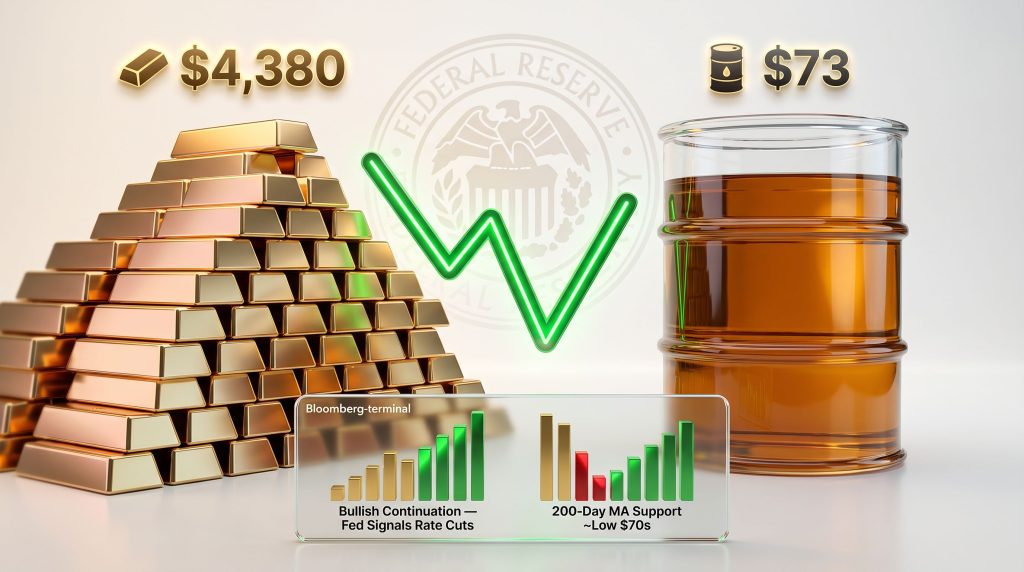
The current cycle has demonstrated this dynamic clearly. Gold rallied to approximately $4,380 USD per ounce in the lead-up to a recent FOMC announcement, as traders positioned for a policy signal favouring easier financial conditions. Following the statement, the predictable post-FOMC liquidation combined with options expiry pressure pulled prices back sharply, creating what many seasoned commodity traders view as a discounted re-entry opportunity into the same bullish trend.
The US Dollar Index (DXY) plays an important amplifying role here. Gold is priced in US dollars globally, so when the dollar weakens following a dovish Fed signal, gold becomes cheaper in foreign currency terms, stimulating additional demand from international buyers. This dollar-gold feedback loop is one of the most reliable in commodity markets. According to Investopedia's analysis of gold price drivers, this inverse relationship between the dollar and gold remains one of the most consistent forces shaping gold's trajectory across economic cycles.
Mapping Gold Price Scenarios After an FOMC Event
| Gold Price Scenario | Primary Trigger | Trader Implication |
|---|---|---|
| Bullish continuation | Fed signals rate cuts; real yields fall | Post-FOMC dip is a high-probability entry |
| Sideways consolidation | Fed holds rates; neutral commentary | Wait for technical confirmation before adding |
| Bearish reversal | Surprise hawkish language; yields spike | Dip may extend; avoid premature positioning |
The distinction between a mechanical correction and a genuine trend reversal is critical. A mechanical correction unfolds when the broader fundamental picture remains intact — meaning dovish Fed trajectory, declining real yields, and a softening dollar — but short-term selling pressure from options expiry or institutional repositioning temporarily depresses prices. A trend reversal, however, requires a fundamental shift, such as a surprise rate hike or inflation data that forces the Fed to adopt a materially more hawkish stance.
Is the Post-FOMC Crude Oil Dip a Comparable Opportunity?
Crude oil responds to Fed decisions differently than gold, and this distinction matters enormously for traders evaluating whether to treat a WTI sell-off as a buy signal. Monitoring crude oil price trends alongside FOMC developments is consequently essential for any structured approach to commodity trading.
Gold's primary sensitivity is to real yields and the dollar. Crude oil, by contrast, is subject to a far wider array of variables simultaneously: geopolitical risk premiums, OPEC+ production discipline, global demand forecasts, inventory levels, refinery capacity utilisation, and broader risk appetite across financial markets. This complexity means that a dip in WTI following an FOMC event requires a higher degree of confirmation before it can be treated as a reliable entry.
WTI's Recent Price Action and the 200-Day Moving Average
The volatility in crude oil has been striking. WTI prices surged toward $96 USD per barrel earlier in the trading cycle, driven by a combination of geopolitical tension and supply constraints. Following that spike, WTI has pulled back sharply to approximately $73 USD per barrel, a level that carries significant technical weight.
The 200-day moving average, which for WTI has been tracking in the low-$70s range, represents one of the most closely watched support levels in energy markets. This moving average serves as a long-term trend indicator, and a sustained hold above it is generally interpreted as a sign that the broader uptrend remains intact despite short-term volatility. For further context on near-term energy market dynamics, IG's oil and gold analysis offers a useful perspective on how these assets interact around key policy events.
Crude oil's dip to the $73 per barrel region, if driven primarily by options expiry and risk-off sentiment rather than deteriorating demand fundamentals, historically represents the kind of technically significant support zone that active commodity traders look to accumulate near.
Variables That Can Invalidate a Crude Oil Dip Trade
Not every WTI sell-off is a buy opportunity. The following developments can shift a tactical dip into a more sustained decline:
- Meaningful diplomatic breakthroughs that reduce geopolitical risk premiums embedded in the price
- PMI data or major economic reports pointing toward weakening global demand
- Unexpected increases in non-OPEC supply from producers not bound by cartel discipline
- OPEC+ internal disagreements leading to production quota violations or outright supply increases
The asymmetry between gold and crude oil dip-buying opportunities is worth emphasising. Gold's primary driver post-FOMC is relatively singular: Fed policy and its effect on real yields. Crude oil's drivers are plural, overlapping, and sometimes contradictory, requiring traders to conduct a more thorough multi-variable assessment before committing capital.
The Institutional Case for Treating This as a Trading Market
Major institutional voices, including Goldman Sachs, have described the current macro environment as an exceptionally favourable period for active commodity traders. The rationale centres on the elevated and repeatable nature of volatility cycles driven by FOMC meetings, geopolitical developments, and supply-side shocks — all of which create structured entry and exit opportunities across gold, silver, crude oil, natural gas, and palladium.
This environment rewards a specific trading discipline rather than a passive buy-and-hold approach. Furthermore, the rinse-and-repeat framework involves capitalising on pre-event momentum, banking profits into strength, and then systematically reloading positions during the post-event liquidation window. Employing well-defined commodity volatility strategies is, consequently, central to executing this approach with discipline and consistency.
A Step-by-Step Framework for Post-FOMC Commodity Trading
- Pre-FOMC Momentum Phase: Monitor gold, crude oil, silver, and natural gas in the five to ten trading days preceding the meeting; identify assets with strong technical setups and emerging institutional flows.
- Into the Announcement: Begin reducing or taking partial profits as prices approach key resistance levels; avoid holding full positions through the announcement volatility window.
- Post-FOMC Liquidation Assessment: Determine whether the sell-off is mechanical (driven by options expiry and institutional rebalancing) or fundamental (driven by a genuine policy shift or deteriorating macro data).
- Confirmation Entry: Wait for price stabilisation or a reversal signal at key technical support before adding exposure; avoid chasing a falling price without confirmation.
- Position and Risk Management: Define clear invalidation levels in advance; understand the specific capital required per contract and the risk-reward ratio before entry.
The profit potential in this cycle has been substantial. Trading across the combined complex of gold, silver, crude oil, natural gas, and palladium in a single recent cycle, active participants who followed this structured approach were able to bank more than 10,000 points of profit — a figure that translates to approximately $100,000 per single-lot contract and $1 million per ten-lot contract for those with sufficient position sizing.
Note: These figures reflect reported outcomes from a specific trading cycle and should not be interpreted as typical or guaranteed returns. Commodity trading involves substantial risk of loss, and past performance is not indicative of future results.
Comparing Gold and Crude Oil as Post-FOMC Dip-Buy Assets
| Factor | Gold | Crude Oil |
|---|---|---|
| Primary post-FOMC driver | Real yields and Fed language | Risk sentiment plus supply and demand |
| Clarity of buy signal | Higher, more policy-sensitive | Lower, more variable drivers |
| Confirmation threshold | Moderate | High |
| Structural tailwind in 2025 | Strong, rate cut cycle underway | Mixed, demand uncertainty persists |
| Key technical support zone | Key moving averages | 200-day moving average in low $70s |
| Role of geopolitics | Limited | Significant |
The gold price forecast for 2025 and beyond continues to support the case that post-FOMC sell-offs in gold represent tactical re-entry opportunities within a structurally bullish trend, rather than signals of fundamental deterioration.
The next major ASX story will hit our subscribers first
Frequently Asked Questions: Post-FOMC Sell-Offs in Gold and Crude Oil
Does gold automatically rally after every FOMC meeting?
Gold does not rally after every FOMC meeting. The direction of price movement depends on whether the Fed's language is interpreted as dovish — favouring lower rates ahead — or hawkish, signalling rates will remain elevated for longer. The strongest gold rallies following FOMC events tend to occur when real yields decline in response to the Fed's guidance, not simply because a meeting has taken place.
Why does crude oil frequently drop after FOMC decisions?
Crude oil is categorised as a cyclical, risk-sensitive asset. When Fed announcements trigger broader risk-off sentiment, investors reduce exposure to cyclical positions, including energy. This effect is compounded when the FOMC meeting coincides with quadruple witching expiry, adding mechanical selling pressure that is unrelated to oil's supply and demand fundamentals.
How can a trader identify whether a post-FOMC dip in gold is genuinely buyable?
The strongest confirmation signals include: dovish or neutral Fed language, falling real yields, a softening US Dollar Index, and gold's price holding above key moving averages during the sell-off. When all four conditions align, the probability that the dip is a mechanical correction rather than a trend reversal is meaningfully higher. Recognising the post-FOMC sell-off buy opportunity in gold and crude oil at precisely these moments is what distinguishes disciplined traders from reactive ones.
Is WTI crude oil at $73 per barrel a compelling tactical entry?
At approximately $73 per barrel, WTI is trading near a historically significant technical support area aligned with the 200-day moving average. Whether this constitutes a compelling entry depends on the concurrent demand environment, OPEC+ production policy, and geopolitical developments. Traders should treat this level as a potential tactical opportunity with defined risk parameters rather than a guaranteed price floor.
Key Takeaways for Active Commodity Traders
- Post-FOMC sell-offs in gold and crude oil are frequently mechanical, liquidity-driven events rather than signals of deteriorating fundamentals
- Gold offers a more structurally clear dip-buy opportunity during dovish Fed cycles due to its direct sensitivity to real yields and the US dollar
- Crude oil dips require a higher confirmation threshold given the complexity of supply, demand, geopolitical, and sentiment variables that simultaneously influence price
- The most disciplined approach involves banking profits into pre-FOMC price strength and systematically reloading exposure during the post-announcement liquidation window
- Goldman Sachs' framing of this environment as a golden age for active trading reflects the repeatable, high-volatility cycle that structured commodity traders can systematically exploit across gold, silver, crude oil, natural gas, and palladium
This article is intended for informational and educational purposes only and does not constitute financial advice. Commodity trading involves significant risk, including the potential loss of principal. Past performance is not indicative of future results. Always consult a qualified financial professional before making investment decisions.
Want to Stay Ahead of the Next Major ASX Mineral Discovery?
While macro traders navigate post-FOMC volatility across gold and crude oil, Discovery Alert's proprietary Discovery IQ model delivers real-time alerts on significant ASX mineral discoveries the moment they are announced — instantly translating complex mineral data into actionable opportunities for both short-term traders and long-term investors. Explore historic discovery returns on Discovery Alert's dedicated discoveries page and begin your 14-day free trial today to position yourself ahead of the broader market.