May 12, 2026
The Structural Case for Hard Assets When Financial Systems Crack
History does not warn us before a financial crisis arrives. It arrives quietly through bond markets, liquidity mismatches, and policy traps that have been building for years. Gold investing amid economic collapse fears has become an increasingly serious conversation among institutional and retail investors alike. When financial systems begin to fracture, the logic of owning something finite, uncreatable, and politically immune becomes self-evident.
The question for investors today is not whether gold has value. That argument has been settled across centuries and continents. The question is whether the current macro environment represents a genuine inflection point, and whether those who have not yet established a position in gold and related hard assets still have meaningful upside remaining.
When big ASX news breaks, our subscribers know first
Is the Global Economy Approaching a Structural Breaking Point?
The Debt, Yield, and Inflation Convergence
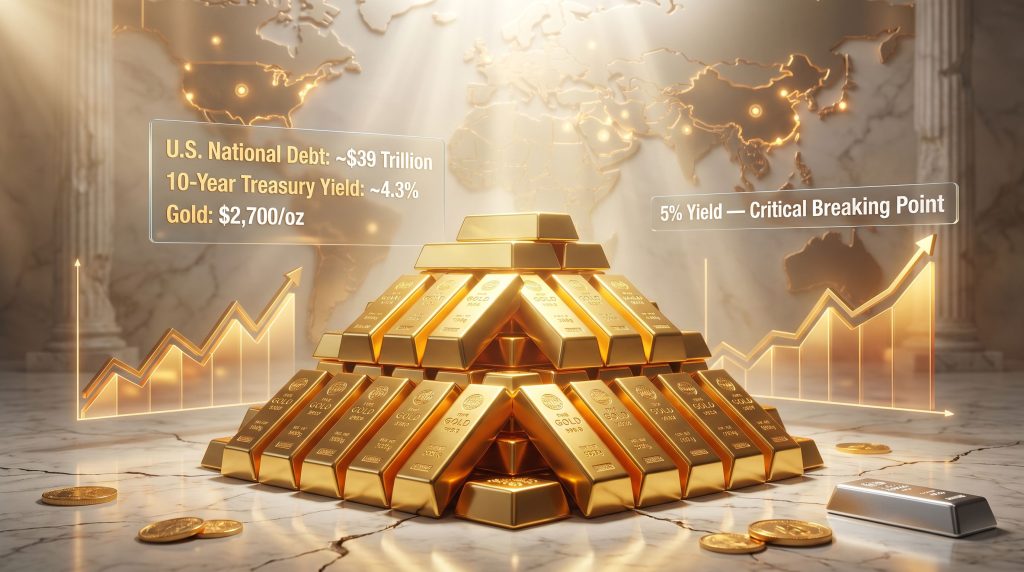
The United States is carrying approximately $39 trillion in national debt, and for more than a decade, mainstream economists dismissed concerns about sovereign debt accumulation as outdated thinking. The prevailing argument was that debt does not matter for a currency-issuing nation. That theory is now being tested in real time, and the consequences of getting the answer wrong are being felt across every layer of the economy.
The 10-year Treasury yield, hovering near 4.3%, sits at a level that is already straining the government's debt servicing capacity. Many seasoned fixed-income analysts have flagged 5% as the threshold beyond which the interest burden on existing debt becomes structurally unsustainable. At that point, the feedback loop accelerates: higher yields require more borrowing to service existing obligations, which increases total debt, which pushes yields higher still.
Simultaneously, inflation remains stubbornly above the Federal Reserve's 2% target, tracking near 2.7%. The policy response is theoretically straightforward: raise rates to reduce demand and slow price growth. However, in practice, raising rates when debt service costs are already stretched creates a second problem. Every basis point increase amplifies the government's annual interest burden across trillions of dollars of outstanding obligations.
This is the structural trap: the government cannot simultaneously reduce inflation through higher rates, maintain economic activity through low borrowing costs, and service its existing debt at manageable levels. One of those three objectives must give way.
Energy Costs as the Root Cause of Credit Conditions
There is a connection between energy affordability and credit availability that receives far less attention than it deserves. Energy underpins the cost of production across every sector of the economy. When energy becomes more expensive, production costs rise, corporate margins compress, and the cost of capital increases to compensate lenders for higher default risk.
Affordable energy is not merely an economic convenience. It is the physical foundation upon which cheap credit is built. Without low-cost energy inputs, the entire cost structure of modern civilisation shifts upward, and borrowing costs follow. This chain from energy prices to credit contraction represents one of the least-discussed but most consequential macro drivers of gold demand.
When credit contracts, consumer spending slows, corporate investment stalls, and systemic liquidity stress builds across financial institutions. That is the environment in which capital historically migrates toward assets that do not depend on credit creation to maintain their value. Furthermore, understanding the strategic role of gold within a diversified portfolio becomes especially important in such conditions.
What a Liquidity Crisis Actually Looks Like in Practice
The Institutional Cash Problem
A liquidity crisis is distinct from a solvency crisis. In a solvency crisis, assets are worth less than liabilities. In a liquidity crisis, assets exist but cannot be converted to cash quickly enough to meet obligations. The distinction matters enormously because liquidity crises can strike institutions that are technically solvent, and the resolution requires either forced asset sales at distressed prices or external financing support.
Large institutional asset managers holding portfolios of real estate, private equity, and infrastructure face exactly this dynamic. The assets appear on balance sheets at assessed valuations, but when investors request redemptions, those valuations do not translate to immediate cash. The firm must either borrow against the asset base to fund redemptions or delay and restrict investor withdrawals.
The downstream consequences of large-scale redemption restrictions extend far beyond institutional balance sheets. Pension funds, insurance companies, and the retirement accounts of everyday savers carry indirect exposure to these dynamics through their holdings in fixed-income instruments and equity funds managed by these institutions.
The Bond Market's Quiet Crisis
Sovereign bonds were once the unquestioned bedrock of institutional portfolios. Rising yields have changed that assumption fundamentally. As yields climb to attract buyers in a crowded Treasury market, the market value of existing bond holdings falls. This is not speculative. It is a mathematical relationship: bond prices move inversely to yields.
Pension funds and insurance companies, which collectively represent the largest domestic holders of U.S. government debt, face mark-to-market losses on portfolios they cannot easily reposition without crystallising those losses. The individuals with most at stake are the Baby Boomer generation, whose retirement savings are disproportionately allocated to fixed income and equity accounts exposed to this dynamic.
| Risk Factor | Current Status | Crisis Threshold |
|---|---|---|
| U.S. National Debt | ~$39 Trillion | Unsustainable servicing beyond current trajectory |
| 10-Year Treasury Yield | ~4.3% | 5% flagged as potential breaking point by analysts |
| Inflation Rate | ~2.7% | Persistently above Fed's 2% target |
| Institutional Liquidity | Stressed | Redemption freezes signal systemic risk |
| Retirement Account Exposure | High | Pension and 401(k) bond holdings at mark-to-market risk |
The historical record shows that banking system stress does not announce itself with advance notice. The U.S. bank holiday of 1933, declared by President Franklin D. Roosevelt, demonstrated that access to liquid capital can be suspended without warning. Investors who had diversified into tangible assets prior to that event maintained financial flexibility that bank deposit holders did not.
Why Gold Specifically Outperforms During Financial System Stress
The Structural Properties That Make Gold Irreplaceable
Gold's crisis-era performance is not a matter of sentiment or tradition alone. It derives from a specific combination of structural characteristics that no financial instrument can replicate:
- Finite geological supply that cannot be expanded by central bank decisions or government policy
- No counterparty risk, meaning its value is not contingent on any institution's ability to meet an obligation
- Universal recognition as a store of value across cultures, legal systems, and centuries
- Inflation resistance rooted in the inability to manufacture additional supply in response to currency debasement
- Crisis decorrelation from equity and credit markets, particularly once the initial liquidity shock phase of a crisis passes
Gold's Historical Track Record Across Major Crises
| Crisis Event | Gold's Behaviour | Primary Driver |
|---|---|---|
| 2008 Global Financial Crisis | Initial decline (forced liquidations), then +100% by 2011 | Quantitative easing programs devalued major currencies |
| COVID-19 Pandemic (2020) | Reached record nominal highs | Unprecedented fiscal stimulus and inflation expectations |
| 2022-2026 Volatility Cycle | Sustained appreciation amid uncertainty | Geopolitical fragmentation, central bank accumulation, dollar scepticism |
| 1970s Stagflation | Significant multi-year appreciation | Inflation acceleration, dollar deanchoring from gold standard |
The 2008 example deserves particular attention for investors evaluating whether current gold prices are too high to justify entry. Gold experienced an initial decline during the acute phase of the crisis as institutions sold liquid assets to cover losses elsewhere. That temporary dip was followed by an extended appreciation cycle driven by the monetary response to the crisis. Consequently, the pattern suggests the most consequential driver is not the crisis event but the policy response that follows. For a broader view of what lies ahead, the current gold price forecast reflects these ongoing structural pressures.
The Weimar Principle: What Hyperinflation Actually Does to Purchasing Power
During the hyperinflationary collapse of Germany's Weimar Republic in 1923, the currency lost virtually all purchasing power in a matter of months. At the peak of that episode, a small quantity of physical gold was sufficient to purchase a substantial Berlin property outright. Transactions that would normally require mortgage financing and years of income accumulation could be settled with metal that fit in a coat pocket.
This is not presented as a prediction of equivalent conditions in developed markets today. It is presented as an illustration of the terminal case: when a currency system fails completely, hard assets with no counterparty dependency retain real-world purchasing power when everything denominated in that currency does not. As Van Eck's research into gold volatility during geopolitical crises demonstrates, this pattern has repeated across multiple historical episodes.
Central Banks Are Sending a Signal Worth Heeding
China and several other sovereign nations have been accumulating gold reserves at historically elevated rates over recent years. This is not retail behaviour or speculative positioning. It represents deliberate institutional decision-making at the highest level of national financial management, signalling reduced confidence in dollar-denominated reserve assets.
In addition, central bank gold demand creates a structural price floor for gold. When sovereign institutions are purchasing consistently, they absorb supply that would otherwise be available to private investors and reduce the probability of sharp, sustained price declines. For individual investors evaluating the risk-reward profile of gold, institutional accumulation patterns represent a meaningful supportive factor.
A Practical Framework for Gold Investment in 2025 and Beyond
Comparing the Available Investment Vehicles
| Investment Vehicle | Liquidity | Risk Level | Primary Advantage | Key Consideration |
|---|---|---|---|---|
| Physical Gold (Bars/Coins) | Low | Low | No counterparty risk; direct ownership | Requires secure storage and insurance costs |
| Gold ETFs and Mutual Funds | High | Low-Medium | Low transaction costs; flexible exposure | No direct ownership; tracks spot price only |
| Gold Mining Equities | Medium | High | Operating leverage amplifies upside | Operational, management, and geopolitical risk |
| Gold Streaming Companies | Medium | Medium | Income potential plus price exposure | Less operational risk than direct miners |
| Bitcoin | Very High | Very High | Digital scarcity argument; portfolio diversification | High volatility; limited crisis track record |
Physical Gold: The Foundational Position
Considering physical gold vs ETFs is an essential first step for any investor building a hard asset strategy. Physical gold in the form of bars, coins, and bullion represents the most direct form of wealth protection against systemic financial stress. It carries no dependency on broker solvency, exchange functionality, or network connectivity.
In scenarios involving banking system disruption, capital controls, or currency collapse, physical ownership provides a form of financial autonomy that no digital or paper representation of gold can fully replicate. In the United Kingdom and certain European jurisdictions, specific sovereign coins may offer capital gains or inheritance tax advantages depending on applicable law. Tax treatment varies by jurisdiction and should be verified with a qualified financial adviser before making allocation decisions.
Gold Mining Stocks: Leveraged Upside to Rising Prices
The operating leverage argument for mining equities is straightforward. If a gold mine operates with relatively fixed extraction and processing costs, a 20% increase in the gold price does not produce a 20% increase in profit. It can produce a 40-60% or greater improvement in operating margin, depending on the cost structure. This leverage works powerfully in bull markets and destructively in declining price environments.
Furthermore, gold mining stocks span a broad spectrum from major diversified miners to junior explorers, each carrying different risk and return profiles. Junior and mid-tier miners offer the greatest percentage upside but carry exploration risk, operational risk, and in some cases geopolitical risk tied to the jurisdiction of their primary assets. The consensus view among experienced resource investors is that gold mining equities tend to significantly outperform physical gold during sustained bull markets, making them a complementary rather than competing allocation.
Expanding the Hard Asset Thesis Beyond Gold
Gold investing amid economic collapse fears is a valid strategy, but experienced resource investors typically extend the hard asset thesis more broadly. Several additional commodity categories warrant consideration:
- Silver carries both a monetary role similar to gold and an industrial demand component driven by solar panel manufacturing, electronics, and medical applications. Its dual demand profile gives it different price dynamics than gold alone.
- Uranium faces a structural supply deficit as nuclear energy's role in decarbonisation expands. The mine-to-market pipeline is long, and supply cannot be rapidly increased to meet demand.
- Copper and aluminium are essential to electrification infrastructure, renewable energy systems, and transportation electrification. These metals benefit from long-term structural demand trends.
- Agricultural land and food production assets represent perhaps the most fundamental form of real wealth in severe collapse scenarios. Productive land generates consumable output regardless of currency denomination or financial system condition.
A key principle expressed by experienced resource investors at industry conferences is that anything extracted from, grown from, or derived from the physical world tends to preserve value when financial instruments denominated in deteriorating currencies do not. This framing cuts across gold, silver, uranium, base metals, and food production in a single coherent investment philosophy.
How High Could Gold Go, and What Could Interrupt the Rally?
The Bull Case for $6,000 Per Ounce and Beyond
Gold has already surpassed $2,700 per ounce in recent market conditions. Experienced analysts and practitioners at resource investment conferences have projected upside toward $6,000 per ounce or beyond, driven by the convergence of sovereign debt distress, currency debasement, geopolitical fragmentation, and institutional liquidity stress.
The bull case rests on several reinforcing arguments:
- Fiscal trajectories in major economies are not on a path toward consolidation, making debt monetisation and currency debasement increasingly probable outcomes.
- Central bank gold accumulation reduces available supply for private investors while signalling official sector scepticism about reserve alternatives.
- A 40-60% equity market correction, which some strategists consider a credible scenario given current valuations and the macro backdrop, would direct significant capital flight toward non-correlated assets, with gold being the primary institutional destination.
- Geopolitical fragmentation is reducing confidence in dollar-denominated settlement systems, accelerating reserve diversification.
Investors who have not yet established positions are still considered to have meaningful upside available, though short-term corrections should be anticipated and not mistaken for structural reversals.
What Could Cause a Temporary Pullback
Gold does not perform uniformly across all environments. Several conditions could produce temporary price weakness:
- High real interest rate environments where dollar-denominated assets offer competitive yields reduce gold's relative attractiveness, since gold produces no income.
- A credible fiscal consolidation program by a major government that genuinely reduced debt trajectory would reduce sovereign risk premiums.
- Sudden geopolitical de-escalation could temporarily reduce safe-haven demand.
- Forced liquidation events, as occurred in late 2008, can produce short-term gold price declines as institutions sell liquid assets to cover losses elsewhere.
The critical distinction is between temporary price corrections driven by technical or liquidity factors and structural reversals driven by fundamental deterioration of the bull case. The 2008 experience demonstrated that forced-liquidation dips can represent entry opportunities rather than signals to avoid the asset class. However, as recent analysis of gold's safe haven status highlights, navigating these corrections requires careful judgement about whether the underlying thesis remains intact.
The next major ASX story will hit our subscribers first
Bitcoin as a Complementary Position: What the Comparison Actually Shows
The Digital Scarcity Argument
Bitcoin's fixed supply cap of 21 million coins mirrors gold's scarcity argument in a digital context. Unlike equities, Bitcoin's value proposition does not derive from corporate earnings, management decisions, or dividend policy. This makes it theoretically less correlated to equity market performance than most financial assets.
Practitioners with experience across multiple market cycles have expressed the view that Bitcoin may survive an equity market correction of 40-60% without correlating to the downside, precisely because its value proposition is independent of corporate profitability. However, Bitcoin's volatility profile is dramatically higher than gold's, and its crisis track record is limited to approximately 15 years of existence.
| Attribute | Gold | Bitcoin |
|---|---|---|
| Supply Constraint | Geological scarcity | Algorithmically fixed at 21 million |
| Volatility | Low to Medium | Very High |
| Institutional Adoption | Centuries-old; central bank-backed | Growing but still maturing |
| Crisis Track Record | Proven across multiple centuries | Limited since 2009 |
| Accessibility | Physical or via ETF | Requires digital wallet infrastructure |
| Income Generation | None | None (staking exceptions apply) |
The appropriate framing is Bitcoin as a speculative digital complement to a gold-anchored hard asset strategy, not as a substitute for physical gold's structural role in crisis portfolios.
Frequently Asked Questions: Gold Investing Amid Economic Collapse Fears
What percentage of a portfolio should be allocated to gold?
Most independent financial strategists recommend a baseline allocation of 5-10% as a diversification hedge. In periods of elevated systemic risk, some practitioners advocate increasing this to 15-20%, particularly for investors at or near retirement with significant fixed income and equity exposure.
Is it too late to buy gold if prices are already elevated?
Historical data suggests that gold purchased during periods of economic stress has delivered positive long-term returns even when bought near short-term price highs. The structural drivers of the current cycle, including debt accumulation, persistent inflation, and geopolitical instability, have not resolved. Short-term corrections are possible and should be expected, but they do not negate the long-term thesis.
Physical gold or gold ETFs: which is more appropriate?
- Physical gold provides direct ownership with no counterparty risk and remains the preferred option for investors concerned about systemic collapse scenarios involving banking or exchange disruption.
- Gold ETFs offer superior liquidity, lower transaction costs, and ease of portfolio rebalancing, making them preferable for investors seeking tactical or medium-term exposure.
- The optimal answer depends on the investor's time horizon, storage capability, and assessment of how severe a crisis scenario they are hedging against.
Should investors approaching retirement hold gold?
Yes, particularly those with significant bond and equity exposure through retirement accounts. Gold provides non-correlated diversification that can reduce overall portfolio drawdown during equity market crises. Its role is protective rather than speculative in this context.
What happens to gold if equities fall 40-50%?
Based on historical precedent, gold tends to hold value or appreciate during severe equity market corrections, particularly after the initial phase of forced liquidation. The 2008 case, where gold ultimately doubled in value following the crisis, remains the most directly relevant modern example of this dynamic.
Key Principles for Building a Crisis-Resilient Portfolio
The investment case for gold in the current environment is not driven by speculation about a single event. It is driven by a convergence of structural factors that have been building for years and that cannot be resolved quickly through policy adjustment alone. For investors evaluating their positioning, the following principles provide a framework:
- Gold remains the most historically validated store of value across sovereign debt crises, currency debasement episodes, and institutional liquidity failures.
- The current macro convergence of elevated debt, persistent inflation, bond market fragility, and geopolitical instability represents an unusual alignment of bullish catalysts for hard assets.
- Physical gold as a core position, supplemented by gold mining equities for leveraged upside, reflects the layered approach favoured by practitioners with significant direct experience in multiple market cycles.
- Hard asset diversification beyond gold, including silver, uranium, copper, aluminium, and agricultural assets, provides broader protection against scenarios where any single commodity underperforms.
- Maintaining meaningful cash reserves alongside hard asset positions provides operational flexibility during crisis periods when access to bank-held capital may be restricted.
- Bitcoin may serve as a high-risk digital complement to a gold-anchored strategy but should not be treated as equivalent in terms of crisis track record or volatility characteristics.
- Investors who have not yet established a gold position retain meaningful upside opportunity, though short-term price volatility should be anticipated and planned for rather than avoided.
This article is intended for informational and educational purposes only and does not constitute financial advice. All investment decisions should be made in consultation with a qualified financial adviser. Past performance of any asset class, including gold, does not guarantee future results. Forecasts and projections referenced in this article represent the views of market commentators and practitioners and involve inherent uncertainty.
Ready to Capitalise on the Next Major ASX Mineral Discovery Before the Market Does?
Discovery Alert's proprietary Discovery IQ model delivers real-time alerts on significant ASX mineral discoveries, cutting through complex geological and market data to surface actionable investment opportunities the moment they are announced — explore historic discoveries and their returns to understand the potential at stake, then begin your 14-day free trial at Discovery Alert to position yourself ahead of the broader market.