June 22, 2026
Understanding Gold's Complex Response to Middle Eastern Tensions
Global financial markets navigate increasingly sophisticated pricing mechanisms as geopolitical tensions intersect with monetary policy dynamics. The relationship between regional conflicts and precious metals valuation demonstrates how modern market structures create competing forces that challenge traditional investment frameworks.
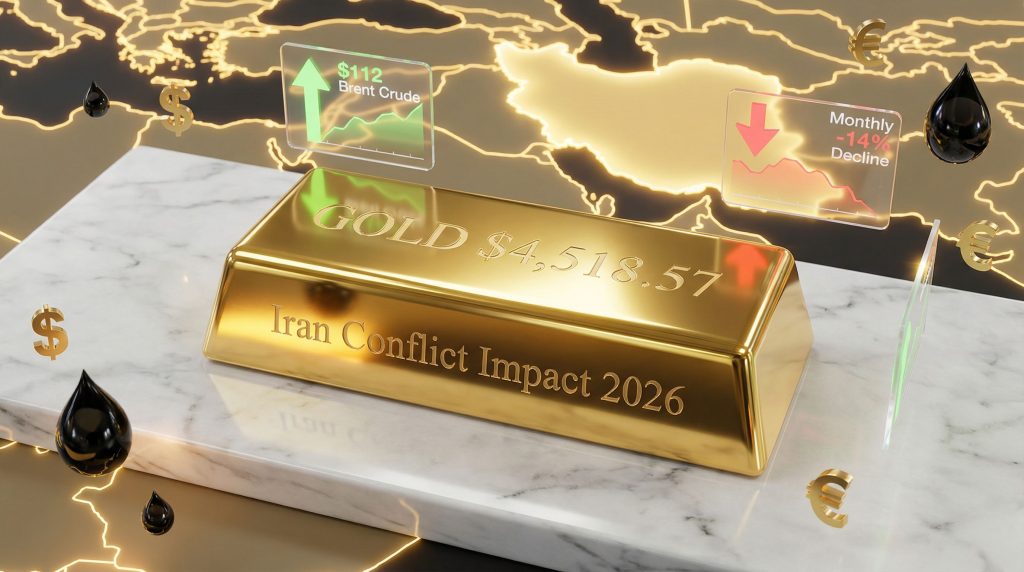
The ongoing Iran conflict has generated significant volatility patterns across commodity markets, with gold price amid Iran war dynamics reflecting complex interactions between safe-haven demand and currency appreciation effects. Current market data reveals spot gold trading at $4,518.57 with a modest 0.6% session gain, while futures positioning shows $4,557.50 representing a 0.7% daily increase.
Despite these short-term gains, the broader monthly performance tells a different story. March 2026 has witnessed a severe 14%+ decline from earlier peaks, marking what analysts describe as the worst monthly performance since 2008. This downturn occurred despite reaching $5,200+ per ounce in early 2026, highlighting how multiple macroeconomic pressures can overwhelm traditional safe-haven dynamics.
Furthermore, understanding the gold market surge patterns helps contextualise how current corrections fit within broader market cycles.
Current Market Performance Metrics:
| Metric | Value | Time Period |
|---|---|---|
| Spot Gold Price | $4,518.57 | Current session |
| Futures Position | $4,557.50 | Daily close |
| Monthly Decline | 14%+ | March 2026 |
| Peak Pricing | $5,200+ | Early 2026 |
| Correction Duration | 5+ weeks | Ongoing |
The persistence of this correction phase suggests that energy market disruptions create inflationary pressures that influence central banking decisions in ways that mechanically pressure gold valuations. Regional supply chain vulnerabilities, particularly around critical shipping lanes like the Strait of Hormuz, generate secondary effects beyond immediate commodity pricing.
When big ASX news breaks, our subscribers know first
Currency Strength vs. Commodity Demand
Dollar appreciation during periods of geopolitical stress creates a fundamental paradox for precious metals investors. While uncertainty typically drives safe-haven demand for gold, the simultaneous strengthening of the US Dollar creates mechanical downward pressure on all USD-denominated commodity prices.
This dynamic reflects the hierarchical nature of safe-haven asset preferences during crisis periods. International investors demonstrate clear preference for reserve currency holdings over physical commodities, particularly when energy supply disruptions threaten global trade stability.
However, the concept of gold as inflation hedge remains relevant when considering longer-term portfolio positioning strategies. The Trump administration's focus on maintaining Strait of Hormuz access demonstrates how policy responses can reinforce dollar demand through security guarantees.
Reserve Currency Status Reinforcement Factors:
- Reassurance of continued energy supply access
- Demonstration of enforcement capabilities for trade route protection
- Strong USD-backed security guarantee signalling
- Reduced emergency hedging demand through policy clarity
Energy price shocks reaching Brent crude above $112 per barrel and WTI returning above $100 create additional complexity in currency dynamics. Higher energy costs typically support dollar demand as international trade settlements require increased USD liquidity for commodity purchases.
The mechanical relationship between currency appreciation and commodity pricing means that even strong fundamental demand for gold as an inflation hedge can be negated by the currency channel. This creates opportunity cost considerations for investors choosing between dollar-denominated fixed-income assets and non-yielding precious metals.
International trade disruption patterns further support reserve currency status by increasing demand for USD as a settlement mechanism, independent of any specific commodity price movements. This structural dynamic explains why gold price amid Iran war scenarios often exhibit counterintuitive pricing behaviour despite elevated geopolitical risk premiums.
Energy-Driven Inflation Pressures
The current energy shock demonstrates how regional conflicts can trigger broad-based inflationary pressures through multiple transmission channels. Beyond direct energy cost increases, production disruptions create cascading effects across energy-intensive manufacturing sectors and transportation networks.
Energy Market Critical Infrastructure:
The Strait of Hormuz represents approximately 21% of globally traded petroleum flows, making any disruption threats highly consequential for global energy pricing. Current elevated pricing in both Brent crude ($112+ per barrel) and WTI ($100+ per barrel) reflects market assessment of supply vulnerability rather than actual production cuts.
LNG trade route concerns compound these supply chain anxieties by affecting alternative energy sources that many economies rely upon for power generation and industrial processes. The parallel movement in both oil benchmarks suggests broad-based supply concerns rather than localised pricing anomalies.
Inflation Transmission Mechanisms:
- Direct Consumer Impact: Gasoline and heating costs increase immediately
- Production Cost Channel: Energy-intensive industries face margin pressure
- Transportation Sector: Shipping and logistics costs rise across all goods
- Secondary Price Effects: Manufacturers pass through higher input costs
The Trump administration's threats regarding Iranian energy assets specifically target infrastructure that supports these global supply chains. Combined with Iran-backed Houthi participation in regional conflicts, these factors maintain elevated uncertainty premiums in energy markets that flow through to broader inflation expectations.
In addition, US economic pressures from tariff policies and debt concerns create additional complexity for monetary policy responses to geopolitical events.
Regional supply chain disruptions extend beyond immediate energy impacts to affect manufacturing timelines, inventory management strategies, and alternative sourcing arrangements. These operational adjustments create additional cost pressures that contribute to persistent inflation risks independent of energy price movements.
Federal Reserve Policy Recalibration
Jerome Powell's recent communications reveal sophisticated central banking approaches to energy-driven inflation that distinguish between transitory supply shocks and persistent demand-driven price pressures. His assessment that long-term inflation expectations remain anchored suggests Fed confidence in their policy framework's effectiveness.
The Federal Reserve's decision to maintain current policy rather than implement immediate rate increases reflects recognition that energy shocks often prove temporary while rate hikes amid geopolitical stress risk exacerbating economic slowdown effects. This nuanced approach provides crucial support for non-yielding assets like gold.
Fed Policy Framework Considerations:
Market expectations for 2026 rate cuts have been eliminated, but the absence of immediate tightening provides relative support for precious metals positioning.
Powell's emphasis on anchored expectations represents a technical framework where economic agents maintain confidence in the Federal Reserve's ability to manage price stability over medium-term horizons. This credibility allows temporary accommodation of energy shocks without triggering persistent inflation psychology.
Monetary Policy Transmission Effects:
- Opportunity Cost Channel: Lower rate expectations reduce the cost of holding non-yielding gold
- Real Interest Rate Impact: Nominal rates versus inflation expectations determine fixed-income attractiveness
- Growth Signal Effects: Accommodative policy suggests economic vulnerability requiring safe-haven positioning
- Currency Policy Interaction: Fed restraint influences USD strength relative to other central bank policies
The elimination of rate cut expectations for 2026 while avoiding immediate tightening creates a policy middle ground that removes both positive and negative monetary drivers for gold pricing. This neutral positioning allows geopolitical and inflation factors to dominate precious metals valuation dynamics.
Forward guidance effectiveness becomes crucial during energy shock periods as markets assess whether supply disruptions will prove temporary or require monetary policy responses. The Fed's communication strategy focuses on maintaining distinction between crisis-driven supply constraints and demand-driven inflation pressures.
Global Central Bank Coordination Patterns
International monetary policy coordination during geopolitical energy shocks reveals sophisticated central banking approaches to managing inflation without triggering growth slowdowns. European Central Bank and Bank of Japan policies during similar periods demonstrate how coordinated responses can stabilise currency and commodity markets.
Central bank gold accumulation patterns provide additional market dynamics beyond private investment demand. Official sector purchases continue despite current price volatility, suggesting institutional confidence in long-term precious metals positioning strategies.
Central Bank Accumulation Trends:
- Continued official sector purchases during price corrections
- Strategic reserve diversification away from pure USD holdings
- Long-term hedging against currency debasement risks
- Geopolitical insurance positioning independent of short-term pricing
International coordination mechanisms help prevent competitive devaluations during energy crises whilst maintaining monetary policy flexibility for domestic economic management. These coordination efforts affect global liquidity conditions that influence precious metals demand patterns.
Technical Market Structure Analysis
Current gold price amid Iran war dynamics demonstrate how modern market microstructure affects precious metals price discovery mechanisms. Electronic trading platforms, algorithmic positioning strategies, and institutional portfolio rebalancing create technical factors that can overwhelm fundamental supply and demand considerations.
Trading Volume and Position Analysis:
The five-week correction duration following early 2026 peaks suggests institutional position adjustment rather than fundamental demand destruction. Large-scale portfolio managers often require extended periods to rebalance allocation strategies during volatile geopolitical environments.
Marc Loeffert from Heraeus Precious Metals observed that short-term trend patterns suggest continued bearish consolidation following the strong prior rally. This technical assessment reflects market structure dynamics where rapid price appreciation often requires extended consolidation periods.
Market Structure Components:
- ETF Flow Patterns: Mixed institutional positioning signals
- Futures Market Positioning: Speculative versus hedging demand distinctions
- Physical Market Premiums: Regional supply chain disruption effects
- Currency Hedge Demand: International portfolio protection strategies
The relationship between spot pricing at $4,518.57 and futures positioning at $4,557.50 indicates normal market contango conditions despite geopolitical uncertainty. This pricing relationship suggests that immediate supply concerns are not dominating longer-term market structure considerations.
Consequently, understanding gold-stock market dynamics becomes essential for investors navigating these complex correlation patterns during geopolitical stress periods.
The next major ASX story will hit our subscribers first
What Drives Multi-Metal Performance Correlations?
Precious metals markets demonstrate varying sensitivity to geopolitical events based on their industrial versus monetary demand characteristics. Silver trading near $70 per ounce reflects both safe-haven demand and industrial supply chain concerns, whilst platinum and palladium show moderate gains during uncertainty periods.
Precious Metals Performance Comparison:
| Metal | Current Level | Primary Demand Drivers | Geopolitical Sensitivity |
|---|---|---|---|
| Gold | $4,518.57 | Monetary/Safe-haven | High |
| Silver | ~$70/oz | Industrial/Monetary | Moderate-High |
| Platinum | Moderate gains | Industrial/Auto | Moderate |
| Palladium | Positive session | Auto/Industrial | Low-Moderate |
Industrial metals within the precious metals complex show different correlation patterns during supply chain disruptions. Platinum's automotive sector exposure creates vulnerability to economic slowdown concerns, whilst its supply concentration in politically sensitive regions adds geopolitical premiums.
Silver's dual industrial and monetary characteristics create complex pricing dynamics where both safe-haven demand and manufacturing supply concerns contribute to volatility patterns. The metal's performance often amplifies gold price movements whilst adding industrial demand sensitivity.
For instance, analysts at Switzer note that gold's traditional safe-haven status faces challenges during complex geopolitical scenarios involving multiple competing factors.
Investment Strategy Framework Development
Current market conditions require sophisticated portfolio construction approaches that account for multiple competing dynamics affecting precious metals valuations. Traditional safe-haven positioning strategies must incorporate currency effects, monetary policy responses, and technical market structure considerations.
Risk Management Considerations:
- Diversified Precious Metals Exposure: Balancing monetary and industrial metals
- Currency Hedging Strategies: Managing USD appreciation effects
- Geopolitical Risk Premium Allocation: Sizing positions for extended uncertainty
- Technical Timing Frameworks: Understanding consolidation versus trend continuation patterns
The elimination of 2026 rate cut expectations whilst maintaining current policy creates a monetary backdrop that neither strongly supports nor undermines precious metals positioning. This neutral monetary environment allows geopolitical and inflation factors to dominate investment decision-making processes.
Strategic Positioning by Investment Horizon:
| Time Frame | Strategy Focus | Key Risk Factors |
|---|---|---|
| Short-term (3-6 months) | Tactical rebalancing | Volatility management, technical patterns |
| Medium-term (6-18 months) | Conflict resolution scenarios | Policy normalisation timing |
| Long-term (2+ years) | Structural demand trends | Central bank accumulation patterns |
Major financial institutions maintain constructive long-term precious metals outlooks despite current correction phases. JP Morgan's $6,300 year-end target, Deutsche Bank's €6,000+ projection, and Goldman Sachs' $5,400 forecast suggest institutional confidence in structural demand factors overcoming current technical pressures.
How Do Economic Scenarios Impact Future Gold Pricing?
Conflict Escalation Scenarios:
Extended regional involvement could support gold price amid Iran war dynamics toward $5,000+ pricing levels through increased safe-haven demand and supply chain disruption effects. Energy price persistence above current levels would likely trigger more accommodative monetary policy responses that reduce opportunity costs for non-yielding assets.
De-escalation Scenarios:
Rapid conflict resolution might pressure gold toward $4,000 support levels as geopolitical premiums dissipate and risk-on sentiment favours growth-oriented asset allocation. Normalised energy pricing would reduce inflation concerns that currently support precious metals positioning strategies.
Moreover, analysts at Deutsche Welle highlight how geopolitical conflicts create interconnected effects across currencies, commodities, and inflation expectations.
Structural Long-term Considerations:
- Central bank diversification trends continue independent of short-term pricing
- Currency debasement concerns persist across developed economies
- Geopolitical fragmentation supports strategic precious metals allocation
- Technology sector demand for industrial precious metals provides price floor support
The current correction phase, whilst significant at 14%+ monthly decline, occurs within a broader context of structural demand factors that support longer-term precious metals valuations. Understanding these multiple time horizon dynamics becomes crucial for navigating current market volatility whilst maintaining strategic positioning objectives.
Furthermore, examining the gold price forecast provides additional context for longer-term investment planning during uncertain geopolitical environments.
Investment decisions should consider multiple scenarios and risk management approaches. Precious metals markets exhibit significant volatility during geopolitical events, and past performance does not guarantee future results. Investors should consult qualified financial advisors and consider their individual risk tolerance and investment objectives.
Ready to Capitalise on Next Major Gold Discovery?
Discovery Alert's proprietary Discovery IQ model delivers real-time alerts on significant ASX mineral discoveries, instantly empowering subscribers to identify actionable opportunities ahead of the broader market. Begin your 14-day free trial today and secure your market-leading advantage in precious metals investing.